“The sea doesn't give up its secrets easily, especially not to those who don't know how to listen.”
— Spoken by a seasoned fisherman early in the story, foreshadowing the challenge of uncovering the truth about the Black Duck.

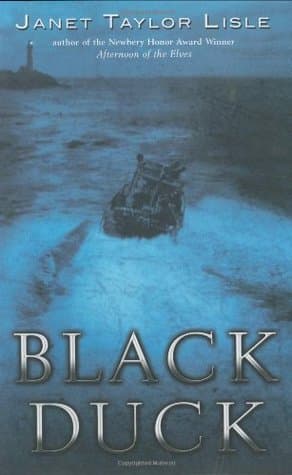
Janet Taylor Lisle (2006)
Genre
Children's / Historical Fiction / Mystery / Young Adult
Reading Time
240 min
Key Themes
See below
Sign in to track this book
In 1929 Rhode Island, two boys get caught in a deadly war between rival Prohibition gangs after finding a body and a mysterious package on the beach, leading one of them aboard the legendary smuggling ship, the Black Duck.
In the summer of 1929, thirteen-year-old Ruben and his friend Jed are exploring the Rhode Island shore near Jed's family's fishing shack. They find a man's body washed up on the beach. The man, a stranger, has a gunshot wound. In his pocket, they find a small, oilskin-wrapped package with a folded map and cash. Jed, impulsive and interested in local rum-running stories, takes the package, believing it is tied to the illegal liquor trade. Ruben, more careful, is unsure but goes along with Jed. This discovery immediately puts the boys into the hidden, dangerous world of Prohibition-era smuggling in their quiet coastal town.
The boys, especially Jed, become focused on the package and the dead man. They start listening more closely to the quiet talks among local fishermen and their families, many of whom are involved in or know about rum-running. They hear stories of the legendary Black Duck, a fast, black boat that is the most successful and feared rum-runner in the area. It is captained by Ruben's enigmatic uncle, Jim. They also learn about the rivalry between Jim and another smuggler, Mr. Slater, who runs his own fleet. The map in the package seems to be a coded chart, and the money suggests a payment or a share in a deal, making the mystery around the dead man and the package's meaning deeper.
Jed, excited by the secret, starts acting without caution. He tries to figure out the map, believing it shows a hidden liquor stash. He starts spending time at the docks and local speakeasies, trying to get information. This often puts him and Ruben in risky situations. Ruben, still curious, grows more uneasy with Jed's boldness. He worries about what will happen because of their discovery and the danger they are inviting. The boys' shared secret starts to divide them, as Jed's excitement clashes with Ruben's growing fear and sense of responsibility for the package and the dead man's fate.
Their amateur detective work eventually gets unwanted attention. One evening, as Jed is trying to investigate near the docks, he and Ruben are trapped by two of Mr. Slater's men, who are looking for the package. They demand to know what the boys found on the dead man. Under pressure, Jed says they have the package. However, the men are not interested in liquor; they say the package contains something far more valuable: a set of detailed, hand-drawn plans for a new, very fast boat engine. The dead man was an inventor, and the plans were stolen, making the boys' possession of them very dangerous and putting them directly in the path of rival gangs.
Ruben's Uncle Jim, a quiet but strong man, eventually learns about the boys' involvement and the stolen plans. Jim tells Ruben that the Black Duck is not just a rum-runner; it is a source of great pride and a symbol of his resistance against the law and rival gangs like Slater's. He confides that the dead man, an engineer named Mr. Davies, was supposed to deliver the engine plans to him. Jim intended to build an even faster boat using Davies's design. The plans give a big advantage in the competitive world of smuggling, and Jim is set on getting them back, not just for money, but for honor and survival.
With the package's true nature known, Ruben finds himself pulled deeper into his uncle's world. Jim, seeing the danger the boys are in and the importance of the plans, asks Ruben to help get them from Jed, who has hidden them. Jim makes a plan to lure Slater's men into a trap, hoping to get the plans and secure his position. Ruben, caught between fear and loyalty to his uncle, agrees to help. The risks increase as they realize Slater is also actively looking for the plans, leading to a tense game of cat-and-mouse across the dangerous coastal waters and hidden coves.
The story's peak happens on the water. Ruben, against his mother's wishes and his own fears, is on the Black Duck with Uncle Jim and his crew. They are trying to make a liquor run, knowing that Slater's men will be watching for them, hoping to get the plans. A thrilling and dangerous chase follows as the Black Duck, with its greater speed, tries to outmaneuver Slater's faster, more heavily armed boat. Shots are fired, and the boys see the brutality and high risks of the rum-running trade. Ruben faces the realities of his uncle's life and the violence of the Prohibition era.
During the intense chase, Jim outsmarts Slater's crew and gets the engine plans. However, the win comes with a cost. While no one dies in this fight, the experience leaves a deep mark on Ruben. He sees the violence, the desperation, and the moral compromises made by those involved in rum-running. The romantic idea of the Black Duck and the adventurous life of a smuggler is broken by the grim reality of the conflict. The plans are now safe with Jim, who plans to use them to build his faster boat, strengthening his reputation and control.
After the difficult events, Jed's initial excitement about the rum-running world starts to fade. The reality of the danger and violence is less exciting than he imagined. He becomes quieter, thinking about the close calls and the seriousness of their actions. Ruben, on the other hand, comes out of the ordeal more mature. He understands the complexities of his uncle's life, the economic desperation driving many to illegal activities, and the blurred lines between right and wrong in their community. He has seen a darker side of the world and gained a deeper understanding of the adults around him.
As summer ends, life in the coastal town seems normal again, though for Ruben and Jed, nothing is quite the same. The Black Duck continues its runs, and local rum-running goes on, but the boys' innocent curiosity has been replaced by a more serious understanding of the world. Ruben continues to watch his Uncle Jim with a new view, seeing both his strength and his weaknesses. Finding the body and getting involved in the smuggling world has been a powerful coming-of-age moment, shaping their understanding of right and wrong, loyalty, and the hidden parts of their community.
The Protagonist
Ruben transforms from an innocent, somewhat naive boy into a more mature and understanding individual, grappling with the complexities of adult morality.
The Supporting
Jed's initial romantic view of rum-running is replaced by a more sober and somewhat disillusioned understanding of its dangers.
The Supporting
His character remains largely consistent, representing the steadfast and resourceful figure navigating the dangerous world of smuggling.
The Antagonist
Slater remains a static character, serving as the persistent, dangerous force in opposition to Jim and a threat to the boys.
The Mentioned
His character arc is complete before the story begins, but his legacy drives the plot.
The Supporting
Her character remains consistent, embodying maternal concern and conventional morality.
The Supporting
His character remains static, serving as a representation of the broader community's involvement.
The Supporting
Their roles are purely functional, driving the plot's external conflict.
The novel mainly explores the theme of growing up as Ruben and Jed see the realities of the adult world. Their discovery of the dead body and involvement in the dangerous rum-running trade makes them face violence, moral questions, and human nature. Ruben, especially, matures a lot, moving from a romantic view of adventure to a more serious understanding of the consequences of illegal acts, as seen during the intense chase on the Black Duck.
“"He knew now that the men on the Black Duck were not just adventurers. They were desperate, dangerous, and sometimes, desperate to survive."”
The book looks at the unclear lines of morality during Prohibition. While rum-running is illegal, many characters, like Uncle Jim, are driven by financial need or a sense of defying what they see as an unfair law. The community often ignores or even participates, showing how hard it is to judge right from wrong when people's livelihoods are at risk. Ruben struggles with this, seeing his uncle not as a villain but as a complex person trying to survive, which contrasts with Slater's clear bad intentions.
“"It wasn't just about the liquor. It was about making a living, about not letting the government tell you what you could and couldn't do."”
The mystery around the dead body and the package first draws Ruben and Jed in. This represents the appeal of the unknown and the excitement of forbidden adventure. Jed is especially taken by the romantic idea of rum-running and the Black Duck. However, as they look deeper, the unknown quickly turns dangerous, showing the violent and unforgiving consequences of their curiosity. The boys learn that some secrets are best left alone, as their lives are threatened by the very world they wanted to explore.
“"It was like a game, at first. A dangerous game, but a game nonetheless. Until it wasn't."”
Loyalty is important, especially Ruben's loyalty to his Uncle Jim. Despite the dangers and his mother's disapproval, Ruben feels a strong bond with his uncle and, to some extent, becomes involved in his activities. This theme explores the complexities of family ties when faced with illegal acts and personal risk. Ruben's inner conflict often comes from his wish to protect his uncle while also fearing the results of his actions, showing the strength and difficulty of these relationships.
“"He couldn't just stand by. Not when it was Uncle Jim."”
The central MacGuffin that drives the initial mystery and conflict.
The oilskin-wrapped package found on the dead man's body serves as the primary MacGuffin of the story. Initially believed to contain clues about liquor smuggling, its true contents—valuable engine plans—become the object of desire for both Uncle Jim and Mr. Slater. This device fuels the plot, creating suspense, drawing the boys into danger, and ultimately revealing the deeper, more serious stakes of the rum-running world beyond just alcohol.
A symbolic and literal vessel representing freedom, defiance, and danger.
The Black Duck is more than just Uncle Jim's boat; it's a powerful symbol. It represents speed, defiance against authority, and the romanticized adventure of rum-running. For the boys, it initially embodies excitement and legend. However, as the story progresses, it also symbolizes the inherent danger and violence of the trade. It is the setting for the climactic chase, where Ruben directly experiences the harsh realities his uncle faces, transforming its symbolic meaning for him from pure adventure to a more complex understanding of survival and risk.
Provides an intimate, coming-of-age perspective on the events.
The story is told from Ruben's first-person perspective, allowing the reader to experience the events through the eyes of an innocent, maturing boy. This narrative choice enhances the coming-of-age theme, as the reader directly witnesses Ruben's internal struggles, fears, and evolving understanding of the complex adult world he stumbles into. It creates a sense of immediacy and personal connection to the danger and moral dilemmas faced by the protagonist, making his journey of discovery more impactful.
Provides a backdrop of lawlessness and economic struggle that fuels the plot.
The Prohibition era of the 1920s and early 1930s serves as a crucial historical backdrop. This period of widespread illegal alcohol production and distribution creates the context for the rum-running trade, the existence of characters like Uncle Jim and Mr. Slater, and the moral ambiguities explored in the novel. The economic hardship of the time also explains why many legitimate citizens were drawn into illegal activities, adding depth and realism to the motivations of the characters and the community's acceptance of the illicit trade.
“The sea doesn't give up its secrets easily, especially not to those who don't know how to listen.”
— Spoken by a seasoned fisherman early in the story, foreshadowing the challenge of uncovering the truth about the Black Duck.
“Sometimes, the biggest treasures aren't gold or jewels, but the stories people carry inside them.”
— An observation made by the young protagonist, Ruben, as he begins to understand the value of oral history and personal narratives.
“A lie, like a ripple in water, spreads out and touches things you never intended.”
— A warning given by Miss Maggie about the long-term consequences of deceit within a small community.
“Fear can make people do strange things, and even stranger things can happen when they try to hide it.”
— Reflecting on the motivations behind some of the characters' secretive behavior related to the Black Duck.
“The past isn't just something that happened; it's still happening in the way we remember it, and the way we choose to tell it.”
— A key theme explored as Ruben gathers different perspectives on the Black Duck incident, highlighting the subjectivity of history.
“There's a difference between what people say is true and what they know in their hearts is true.”
— Ruben's internal struggle to discern truth from rumor and public perception while investigating the mystery.
“Even the smallest island holds more stories than you could ever imagine, if you just know where to look and who to ask.”
— Emphasizing the richness of local history and the importance of engaging with community elders.
“Sometimes, doing the right thing means stirring up a lot of trouble.”
— A realization by Ruben as he pushes for answers that some in the community would prefer to remain buried.
“The sea can take everything, but it can also give back, in its own time and in its own way.”
— A poignant reflection on loss and discovery, particularly in relation to the shipwreck and its aftermath.
“It's not enough to just hear a story; you have to feel it, too, to understand its real weight.”
— Ruben's growing empathy for the characters involved in the Black Duck's history.
“Every secret has its own shadow, and the longer it's kept, the darker that shadow grows.”
— A metaphorical description of the burden of long-held secrets within the community.
“Children see things adults often miss, because they haven't learned yet what not to look for.”
— Highlighting the unique perspective and inquisitiveness of the young protagonist in uncovering clues.
“The past isn't always neat and tidy, and neither are the people who lived it.”
— A reflection on the complexities and moral ambiguities encountered in the historical investigation.
Ready to see how well you understood this book? Take our interactive quiz with 10 questions.

Dan Gemeinhart
4.5
Kate O'Hearn
4.4

Jeanne Birdsall
4.4

Jen Wang
4.4
Wendelin Van Draanen
4.3

John Marsden
4.3

Chris Van Allsburg
4.3
Jennifer A. Nielsen
4.2