“The wind was a living thing, tearing at the sails, whipping the spray into their faces, a relentless, roaring beast.”
— Describing a violent storm at sea during a voyage.

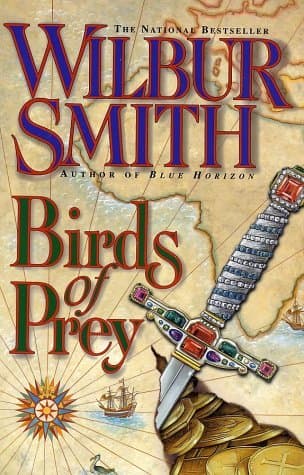
Wilbur Smith (1997)
Genre
Thriller / Historical Fiction
Reading Time
140 min
Key Themes
See below
Sign in to track this book
In 1667, a father and son aboard their fighting caravel hunt treasure-laden Dutch galleons off the dangerous Agulhas Cape, starting a brutal quest for riches and power that builds their legend across the high seas from Good Hope to the Horn of Africa.
In 1667, Sir Francis Courtney, an experienced privateer, and his young son, Hal, command the fighting caravel 'Lady Edwina' off the dangerous Agulhas Cape. They are hunting the treasure-laden galleons of the Dutch East India Company. Their target, the 'Oosterland', a large Dutch merchantman, appears. After a tense chase and a brutal boarding, the Courtneys and their crew overpower the Dutch, capturing the ship and its valuable cargo. During the fight, Hal shows his skill in combat and earns his father's respect, though he also sees the harshness of naval warfare, including the death of a close friend. This first win shows their ability and sets the stage for future fights.
Sir Francis and Hal bring the captured 'Oosterland' to the British settlement at the Cape of Good Hope. Their success is met with praise, but also with the rivalry of the Dutch Governor, Van der Decken, who sees their privateering as an act of war. Sir Francis is then approached by Lord Albemarle, the British commander, with a new, secret mission: to sail north to the Red Sea and disrupt French and Dutch trade routes, specifically targeting a rumored French treasure fleet. This mission is risky, involving unknown waters and powerful European rivals, but the promise of riches and strategic advantage for England is too great to refuse.
The 'Lady Edwina' begins the long journey around the Horn of Africa, facing violent storms and the constant threat of scurvy and disease. They eventually reach the Red Sea, a region controlled by various local powers and contested by European fleets. Here, they meet the Ethiopian Queen, Zenobia, and her navy. Initially, there is tension, but Sir Francis, through diplomacy and a show of strength, forms an alliance with Zenobia against their common European enemies. Hal also begins to navigate complex political situations and becomes interested in Ethiopia's culture.
Following information from Zenobia, the Courtneys find the French naval base at Massawa, a harbor known as 'The Serpent's Lair'. They observe a large French fleet, including warships and the rumored treasure galleons. However, their reconnaissance mission goes wrong. Captain Dubois, the French commander, expecting an attack, sets a trap. Hal and a small landing party are ambushed during a scouting mission, and Hal is captured. This setback is a major blow to Sir Francis, who is now torn between his mission and the need to rescue his son.
Hal is imprisoned within the French fortress at Massawa, subjected to brutal conditions and interrogation by Captain Dubois. Despite the torture, Hal refuses to betray his father's plans. During his captivity, he befriends Seraphina, who is also held captive by Dubois. Seraphina, a skilled infiltrator and survivor, reveals her own reasons for escape. Together, they plan an escape, using their knowledge of the fortress and help from locals. Their attempt is dangerous, leading to a fight for freedom within the fortress walls.
Sir Francis, unwilling to abandon his son, plans an assault on Massawa, despite being outnumbered. He coordinates with Queen Zenobia, who provides forces and knowledge of the local terrain. The attack is launched under cover of darkness, a chaotic land and sea battle. The 'Lady Edwina' engages the French warships, while Sir Francis leads a landing party to breach the fortress and rescue Hal. The battle rages with heavy casualties on both sides, ending in a confrontation between Sir Francis and Captain Dubois, and the flight of Hal and Seraphina.
Having rescued Hal and damaged the French base, the Courtneys now focus on the main objective: the French treasure fleet. Captain Dubois, having expected their goal, tries to slip away with the remaining galleons, laden with riches. A chase begins across the Red Sea, a test of seamanship, endurance, and strategy. The 'Lady Edwina', despite battle damage, is pushed to its limits, constantly harassing the larger, slower French ships, seeking an opportunity to strike and claim the wealth.
The chase ends in a final confrontation in a narrow strait. Sir Francis corners the French treasure fleet, forcing them into a battle. The 'Lady Edwina', with help from Zenobia's ships, engages the remaining French warships and the armed treasure galleons. The battle is fierce, a close-quarters fight involving cannon fire, boarding, and hand-to-hand combat. Hal again shows his bravery and leadership, fighting alongside his father. The Courtneys are victorious, capturing the treasure fleet and securing a large prize for England, but not without losses.
After the battle, the Courtneys count their spoils and mourn their dead. Sir Francis, though victorious, is tired from the conflict and the weight of command. Hal, having grown through the trials, looks towards his own future as a privateer and leader. Seraphina, having played a role, must decide her path forward, her connection with Hal deepening. The treasure is secured, but the cost of its acquisition is clear. The novel ends with the Courtneys looking towards new horizons, their legacy as seafarers established, and the promise of further adventures.
The victorious Courtneys, with their captured treasure, return to the Cape of Good Hope. Their arrival creates a stir, further increasing tensions with the Dutch Governor, Van der Decken, who resents their success. Sir Francis delivers his prize to the British authorities, solidifying his reputation and influence. Hal, now a proven leader, deals with his growing feelings for Seraphina, whose mysterious past continues to intrigue him. The Courtneys, though celebrating their victory, know that their exploits have made them powerful enemies, and the struggle for maritime power in the region is far from over, hinting at future conflicts and adventures.
The Protagonist
Sir Francis begins as a driven privateer seeking fortune and ends as a national hero, solidifying his legacy while grappling with the personal costs of his ambition.
The Protagonist
Hal transforms from an eager but naive youth into a seasoned warrior and leader, finding his own identity amidst the chaos of war and adventure.
The Supporting
Seraphina moves from a life of captivity and secretiveness to one of freedom and a potential future with Hal, gradually revealing her true nature and past.
The Antagonist
Dubois remains a steadfast and formidable antagonist throughout, his strategic brilliance ultimately outmatched by the Courtneys' combined strength and determination.
The Supporting
Zenobia forms a crucial, though temporary, alliance with the Courtneys, asserting her power and influence on the international stage.
The Supporting
Albemarle serves as the initial catalyst for the Courtneys' grand adventure, representing the larger political forces at play.
The Antagonist
Van der Decken remains a consistent, though often indirect, antagonist, representing the political obstacles and rivalries faced by the Courtneys.
The Supporting
Mansur remains a steadfast and loyal member of the crew, providing crucial support and expertise throughout the journey.
The novel looks at the blurred lines between legal warfare and piracy in the 17th century. Sir Francis Courtney operates under a letter of marque, making his actions legal under British law, yet his methods—raiding, plundering, and killing—are like those of pirates. The story shows how national interests justified acts that would otherwise be criminal, showing the hypocrisy and brutality in this system. This theme is clear from the opening scene with the capture of the 'Oosterland', where the violence is sanctioned by the British flag, yet is savage.
“What is piracy to the Dutchman is patriotism to the Englishman, and a fortune to the man who seizes it.”
A main theme is the relationship between Sir Francis and Hal Courtney, and Hal's journey to create his own identity while living in his father's shadow. Hal wants to prove his worth and earn his father's respect, often taking risks. Sir Francis, in turn, struggles with protecting his son while also letting him grow into a capable leader. Their bond is tested by the dangers they face, from shared combat to Hal's capture and rescue, ultimately strengthening their connection as Hal becomes a seafarer.
“He saw the fire in his son's eyes, the same fire that had driven him through a lifetime of storm and battle. Hal was truly his own.”
The story is set against the rivalry between England, the Netherlands, and France for control of trade routes and colonial territories. The Courtneys' actions are not just for personal gain but serve the strategic interests of the British Empire. This is clear in the constant fights with Dutch ships off the Cape and the mission to disrupt French trade in the Red Sea. The novel shows the global scale of these conflicts, from the tip of Africa to the Horn of Africa, as European powers fought for power.
“The sea was a chessboard, and every ship a pawn in the great game of empires.”
The characters, especially the Courtneys and Seraphina, face extreme challenges—brutal combat, imprisonment, harsh weather, and the constant threat of death. Their ability to endure, adapt, and fight back against odds shows human resilience. Hal's survival in French captivity and Seraphina's resourcefulness in dire situations show this theme. The crew of the 'Lady Edwina' also shows fortitude, pushing their ship and bodies to the limit across vast, dangerous oceans, showing the will needed to survive in such an era.
“To survive the sea, you must become as unforgiving as the sea itself.”
A legal document authorizing privateering.
The Letter of Marque is a crucial plot device that legitimizes the Courtneys' actions, distinguishing them from common pirates. It grants them official permission from the English Crown to attack and seize enemy vessels, allowing them to operate within a legal framework despite engaging in acts of violence and plunder. This device highlights the political complexities of the era, where state-sanctioned piracy was a tool of foreign policy, allowing the protagonists to act with official backing while pursuing their own fortunes and serving national interests.
The ultimate prize and driving force of the main mission.
The rumored French treasure fleet serves as the primary MacGuffin and the central objective for the Courtneys' perilous journey to the Red Sea. Its immense value provides a powerful motivation for both the protagonists and the antagonist, Captain Dubois, driving much of the plot's action. The pursuit, discovery, and eventual battle for this fleet generate high stakes and propels the narrative forward, culminating in the climactic confrontation. The treasure represents not only wealth but also strategic power for whichever nation secures it.
An unexpected and powerful non-European ally.
Queen Zenobia functions as an enigmatic ally, introducing a non-European perspective and power dynamic into the story. Her presence allows for the exploration of local politics and cultures, and her strategic alliance with the Courtneys provides crucial intelligence and military support against the French. This device expands the geographical and political scope of the narrative beyond the traditional European rivalries, offering the protagonists new resources and challenges, and adding an element of exoticism and cultural exchange to their adventure.
The dangerous maritime environment as a constant antagonist.
The treacherous seas, particularly the notorious Agulhas Cape and the challenging Red Sea, act as a constant, non-human antagonist. They present formidable obstacles through storms, hidden reefs, and vast distances, testing the seamanship and endurance of the characters and their vessels. This device heightens the stakes of the journey, making every voyage a battle for survival against nature itself. It emphasizes the skill and bravery required to navigate these waters, adding realism and tension to the maritime adventures.
“The wind was a living thing, tearing at the sails, whipping the spray into their faces, a relentless, roaring beast.”
— Describing a violent storm at sea during a voyage.
“There was a certain exhilaration in facing death, a sharpening of the senses, a clarity of thought that was rarely achieved in the mundane world.”
— Francis Courtney reflecting on a dangerous situation.
“Power was not given, it was taken. And once taken, it had to be defended with every fiber of one's being.”
— A character's cynical view on the acquisition and maintenance of power.
“The sea was a fickle mistress, offering bounty with one hand and snatching life with the other.”
— A sailor's perspective on the unpredictable nature of the ocean.
“Revenge was a cold dish, but it tasted sweet when finally served.”
— A character's internal monologue contemplating retribution.
“He carried the scent of powder and salt, the indelible marks of a man who had lived by the sword and the sea.”
— Describing the hardened nature of a seasoned warrior/sailor.
“To be truly free, one had to be willing to lose everything.”
— A philosophical reflection on the cost of ultimate freedom.
“The roar of cannons was the music of their world, a brutal symphony of destruction and glory.”
— During a naval battle, depicting the intensity of the conflict.
“History was written by the victors, but the truth often lay buried with the vanquished.”
— A character's observation on the subjective nature of historical accounts.
“Love, like gold, was a treasure to be guarded fiercely, for it could be stolen as easily as it was given.”
— A character's thoughts on the fragility and value of love.
“The line between courage and madness was often blurred in the heat of battle.”
— Reflecting on the extreme psychological states experienced during combat.
“He knew the smell of fear, a bitter, metallic tang that clung to men like a shroud.”
— A character's keen perception of fear in others.
“The world was a dangerous place, and only the strong, the cunning, and the utterly ruthless survived.”
— A cynical worldview expressed by a character hardened by experience.
“Every man carried his own private hell, and some wore it openly for all to see.”
— A reflection on internal suffering and how it manifests.
Ready to see how well you understood this book? Take our interactive quiz with 10 questions.

Biography coming soon.







