“Home is a place on Earth. It is a place in my heart. It is a place in my spirit.”
— Binti reflects on the meaning of home and her identity.

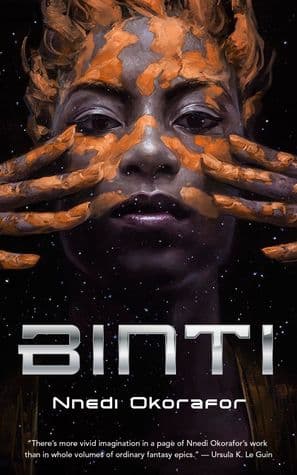
Nnedi Okorafor (2015)
Genre
Fantasy / Science Fiction / Young Adult
Reading Time
90 min
Key Themes
See below
Sign in to track this book
A Himba woman leaves her desert home for an intergalactic university, only to be caught in an ancient alien war, making her bridge cultures to survive.
Binti, a seventeen-year-old Himba girl, struggles with the decision to accept admission to Oomza University, the galaxy's most respected academic institution. This choice means leaving her traditional Himba life, her family, and her role as a 'master harmonizer' of otjize, a sacred clay mixture. Her family, especially her father, is upset by her decision, seeing it as a betrayal of their heritage and a dangerous step. Despite her inner conflict and the pain of leaving, Binti wants knowledge and the chance to study mathematics and engineering at Oomza. She packs her edan (a spiritual communication device) and her otjize, symbols of her Himba identity.
Binti boards a local shuttle to the spaceport, immediately feeling like an outsider. Her Himba appearance—dark skin, braided hair covered in otjize, and traditional clothing—draws stares, whispers, and prejudice from the Khoush passengers, the main human ethnic group. She tries to blend in, but her distinctiveness makes her a target of curiosity and subtle hostility. The journey confirms her worries about leaving home and the challenges she will face in a world that does not understand or respect her culture. She finds comfort in mathematics, a universal language, and the feel of her otjize, which connects her to her roots in the alien environment.
Upon boarding the large interstellar ship for Oomza University, Binti goes to her assigned room. The ship's advanced technology, with shifting walls and an adaptable environment, is both amazing and overwhelming. She carefully applies her otjize, a daily ritual that provides comfort and a link to her heritage. She avoids common areas, sensing continued discomfort and judgment from other students, mostly Khoush. Her isolation is deep, yet she finds a strange peace in solitude, using the time to reflect and prepare for the intellectual challenges ahead. She begins to understand the true weight of being the first Himba at Oomza.
Suddenly, the ship is attacked by the Meduse, a jellyfish-like alien race with a long, violent history with humanity, especially the Khoush. Binti hides in her room, terrified. The Meduse kill everyone else on board, leaving only Binti alive. She is spared because she is Himba; her otjize, with a unique copper substance, creates a static charge that the Meduse's electrical sensors perceive differently. The horrific massacre leaves Binti traumatized, the sole survivor of unimaginable carnage. This event changes how she sees the universe and her place in it, forcing her to face the brutal reality of interspecies conflict.
After the attack, Binti carefully leaves her room and finds a surviving Meduse, whom she names Okwu. Okwu, a young, aggressive Meduse, is injured and hostile. Binti, using her Himba traditions of harmony and her innate gift for 'tree-rooting' (a deep intuition and connection), approaches Okwu with fear and empathy. She uses her edan, a spiritual device, to try to communicate. Surprisingly, Okwu responds, though with initial aggression. Through shared space, fear, and Binti's persistent, non-violent approach, a fragile connection begins to form, starting interspecies understanding.
Binti realizes she is not just a survivor but a 'hostage' in a unique position. Okwu reveals, through Binti's edan and shared experience, the deep reasons for the Meduse's attack: Oomza University stole a sacred Meduse artifact, a 'God-Herder'. The Meduse demand its return and reparations for centuries of conflict and cultural disrespect. Binti, horrified by the massacre but understanding the Meduse's pain, agrees to act as their emissary to Oomza University. She becomes the unlikely link between two warring species, responsible for preventing more bloodshed and seeking justice for the Meduse.
During her journey with Okwu, Binti undergoes a terrifying and painful physical change. She develops 'stinger' hair, a Meduse biological trait, causing intense pain and shame. This change isolates her further, making her even more alien to humans. She fears how the university, and humanity, will react to her new appearance. This change is not just physical; it symbolizes her growing connection to the Meduse and her role as a 'between-person', no longer fully Himba or human, but also not Meduse. It is a visible sign of her journey of cultural and personal synthesis.
Binti and Okwu arrive at Oomza University aboard the Meduse ship. The university is a sprawling, living entity, filled with countless alien species. Binti, now visibly changed with her Meduse-like hair, faces shock, fear, and hostility from university authorities and students. She is a paradox: a human survivor of a Meduse attack, now seemingly allied with the enemy. The weight of her mission is immense; she must convince the university to return the stolen artifact and negotiate peace, all while dealing with her own trauma and identity crisis. Her unique appearance makes her an immediate spectacle and a symbol of the conflict.
Binti, with Okwu beside her, confronts the Dean of Oomza University and the Council of Elders. She delivers the Meduse's demands, explaining their history of grievances and the sacred importance of the stolen 'God-Herder.' The university officials are initially resistant and disbelieving, seeing the Meduse as savage aggressors. However, Binti's unique position as a survivor and her ability to communicate with Okwu give her credibility. She reveals the God-Herder, a complex, ancient Meduse device, which the university had been studying without understanding its true meaning or sacred value. Tension is high as Binti tries to bridge the vast cultural gap.
Through Binti's persistent and emotional mediation, the university finally agrees to return the God-Herder to the Meduse and negotiate real peace. The Meduse, in turn, agree to stop fighting. Binti's Himba gift of harmonization, her ability to bridge divides and find common ground, helps achieve this historic resolution. With peace established, Binti can finally begin her studies at Oomza University. She finds a unique place for herself, not fully Himba, not fully human, but a new kind of being—a harmonizer of cultures and a symbol of interspecies understanding. Her journey of self-discovery and acceptance has only just begun.
The Protagonist
Binti transforms from an isolated, fearful Himba girl into a courageous harmonizer, bridging the gap between warring species and embracing her unique, hybrid identity.
The Supporting
Okwu evolves from a purely vengeful warrior to a more understanding being, learning to trust and cooperate with a human through their bond with Binti.
The Mentioned/Cultural Influence
Their cultural values and traditions are challenged by Binti's departure, but ultimately their principles of harmony prove vital to galactic peace.
The Supporting/Antagonistic
Their entrenched prejudice and historical actions are exposed and challenged by Binti's intervention, forcing them to confront their past.
The Supporting
Represents the traditional Himba resistance to change, whose wisdom Binti ultimately applies in a galactic context.
The Supporting
Moves from an entrenched, academic perspective to a more open and diplomatic stance, acknowledging the university's role in the conflict.
Binti's journey is about finding her identity as a Himba woman in a galaxy that often does not understand or accept her. She struggles with leaving her culture, the prejudice she faces on the shuttle, and her physical change into a 'stinger'. Her otjize and edan become symbols of her Himba heritage, grounding her when she feels most alone. By the end, she creates a new, hybrid identity, embracing her role as a 'between-person' who belongs to multiple worlds, showing that identity can change and be a source of strength. This is clear when she uses her Himba 'harmonizing' skills to bridge the gap between species, proving her unique identity is her greatest asset.
“My Himba identity was a part of me, a part of my body. And that part of me was always in conflict with the rest of the world.”
The story clearly shows the dangers of prejudice, both between humans and between species. Binti faces prejudice from the Khoush for her Himba appearance, encountering stares and whispers on the shuttle. This mirrors the deeper, violent xenophobia between humans and the Meduse, caused by centuries of misunderstanding and conflict, leading to the massacre on the university ship. The Khoush's inability to see the Meduse as anything but monsters, and the Meduse's retaliatory violence, show how fear of what is 'other' leads to destruction. Binti's role is to break down these prejudices through empathy and understanding, offering a path beyond violence.
“They were scared of me. Not because I was Himba, but because I was alien to them. And that fear, it was old. Older than me.”
A main part of the story is the Himba idea of 'harmonizing' and 'tree-rooting'—Binti's natural ability to understand, connect, and bring balance to complex systems and beings. This skill, first seen as a traditional Himba practice, becomes the key to galactic peace. Her use of the edan to talk with Okwu, and her patient mediation between the Meduse and Oomza University, show that true understanding and resolution come from empathy and a willingness to bridge divides, not through force. Binti's ability to 'harmonize' the different parts of two warring cultures ultimately saves many lives and changes the galaxy's future.
“I was a harmonizer. Not just with numbers, but with people. With living things. It was a Himba thing.”
Binti's initial decision to leave her family and Himba traditions for the advanced, alien world of Oomza University immediately sets this theme. Her family sees her departure as betraying their heritage, while Binti seeks knowledge beyond their traditional limits. However, the story suggests that tradition and progress are not separate. Binti's Himba heritage—her otjize, her edan, and her harmonization skills—are exactly what help her survive the Meduse attack and make peace. She does not abandon her roots but combines them into her new, progressive life, proving that ancestral wisdom can be important in facing future challenges.
“My people always said that tradition was like a tree. It grew, it changed, but its roots stayed deep.”
A sacred Himba clay mixture that acts as a physical and spiritual shield.
Otjize is a red ochre mixture used by Himba women for skin and hair. In the story, it serves multiple functions: it's a powerful symbol of Binti's Himba identity and connection to her ancestors, a physical comfort, and a spiritual grounding. Crucially, the unique properties of the otjize (containing copper) create an electrical field that shields Binti from the Meduse's sensors, saving her life during the attack. It becomes a literal and metaphorical protective layer, allowing her to survive and eventually mediate between the warring factions.
A spiritual communication device that facilitates understanding across species.
The edan is a small, ancient, and highly spiritual Himba device that Binti carries. It functions as a communication tool, allowing her to 'tree-root' and connect with other beings, including the alien Meduse. It helps her to understand their language and intentions, and to convey her own. The edan is instrumental in Binti's ability to bridge the communication gap between humanity and the Meduse, transforming a violent encounter into an opportunity for dialogue and peace. It represents the Himba's unique spiritual technology and Binti's inherited gifts.
Binti's innate Himba ability to deeply connect with and harmonize complex systems.
Tree-rooting is Binti's extraordinary Himba gift, an intuitive ability to understand, connect with, and bring balance to complex systems, whether mathematical equations, living organisms, or even emotional states. It's a form of deep empathy and pattern recognition that allows her to harmonize disparate elements. This ability is initially seen in her mathematical prowess and her skill with otjize, but it becomes critical in her interactions with Okwu and her subsequent mediation between the Meduse and Oomza University. It's the core of her 'harmonizer' identity and her most powerful tool for diplomacy.
A sacred Meduse artifact whose theft incites the conflict.
The God-Herder is an ancient, sacred Meduse artifact, described as a complex, living machine with profound cultural and spiritual significance to the Meduse. Its theft by Oomza University is the direct cause of the Meduse's violent retaliation against humanity. For the Meduse, it is not merely a piece of technology but a vital part of their heritage and identity, a 'god' that connects them to their past. Its return is the central demand in the Meduse's negotiations, highlighting the theme of cultural disrespect and the importance of respecting other species' sacred objects.
“Home is a place on Earth. It is a place in my heart. It is a place in my spirit.”
— Binti reflects on the meaning of home and her identity.
“I was Binti. I was Himba. I was not just Himba. I was also something new. I was also what I was becoming.”
— Binti embraces her evolving identity as she travels to Oomza University.
“The universe was a big, scary place, but it was also a place of wonder and beauty.”
— Binti's initial apprehension and eventual awe of space and the university.
“My family had always told me that to be Himba was to be connected to the earth, to the stars, to everything.”
— Binti recalls her Himba upbringing and its connection to the natural world.
“Sometimes, the things that make us different are the very things that save us.”
— Binti realizes the strength in her unique Himba traditions and her mathematical abilities.
“I was a peacemaker, not a warrior. But sometimes, a peacemaker had to be a warrior too.”
— Binti confronts the Meduse and attempts to mediate peace.
“Math was my language. It was how I understood the world. It was how I spoke to the stars.”
— Binti's deep connection to mathematics and its significance to her.
“Tradition was important, but so was progress. And sometimes, progress meant breaking with tradition.”
— Binti grapples with balancing her Himba heritage with her desire for education and new experiences.
“Fear was a powerful thing, but hope was even more powerful.”
— Binti faces the terror of the Meduse attack but holds onto hope for resolution.
“There was a thin line between genius and madness, and sometimes, the most brilliant people danced right on it.”
— Binti observes the eccentricities of some of the students and faculty at Oomza University.
“To truly see someone, you had to look past their skin, past their culture, past everything that made them seem different.”
— Binti's evolving understanding and empathy for the Meduse.
“The universe was not just a collection of stars and planets; it was a living, breathing entity.”
— Binti's spiritual connection to the cosmos and the deeper life within it.
“Sometimes, the greatest journeys were not about going to a new place, but about discovering a new part of yourself.”
— Binti reflects on her personal growth and transformation during her travels.
“My otjize was my shield, my comfort, my connection to my people. And now, it was also a bridge.”
— Binti realizes her otjize, a symbol of her Himba identity, can also be a tool for communication and connection.
Ready to see how well you understood this book? Take our interactive quiz with 10 questions.
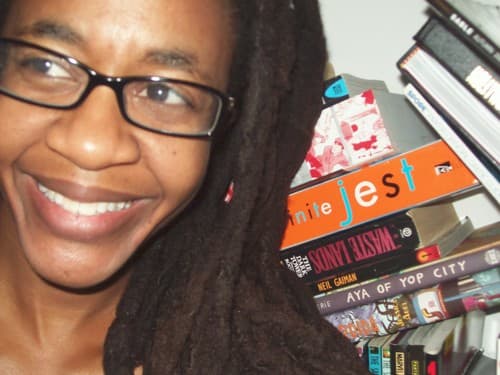
Biography coming soon.







