“It is a strange thing to be a soldier, to be a professional killer, to be a man whose most important skill is to end a life.”
— Billy reflecting on his role as a soldier.

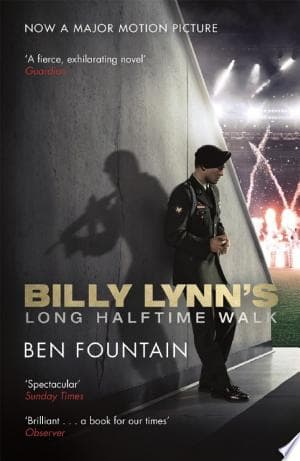
Ben Fountain (2012)
Genre
Literary Fiction
Reading Time
6-7 hours
Key Themes
See below
Sign in to track this book
A young Iraq War hero, thrust into a surreal halftime show at a Dallas Cowboys game, grapples with the fleeting nature of celebrity and the stark reality of his imminent return to combat.
Specialist Billy Lynn and the other members of Bravo Company arrive in Dallas, Texas, for a hero's welcome. They've been brought back from Iraq for a two-week 'Victory Tour' after a video of their intense firefight in Al-Ansakar Canal went viral on YouTube. The tour ends with them being honored guests at the Dallas Cowboys' Thanksgiving Day game. Billy, still dealing with the recent death of his squad leader, Sergeant Shroom, feels a deep disconnect between the public's view of their heroism and the brutal reality of combat. The media attention is overwhelming, and the soldiers are paraded as symbols, not individuals.
The Bravo Company soldiers are escorted by the Cowboys' owner, Norman Oglesby, and his associates, including a Hollywood producer named Albert Ratner. Ratner wants a movie deal to tell their heroic story, promising them good contracts. The soldiers, especially Billy, are skeptical and wary of being used. They get lavish meals and are surrounded by Dallas Cowboys cheerleaders, including Faison, with whom Billy quickly feels a strong attraction. The absurdity of their situation — being celebrated while facing an immediate return to war — starts to become clear.
During a rehearsal on the football field, Billy gets some time alone with Faison. Their conversation quickly becomes personal. Faison, a devout Christian, admires his bravery and believes he is a 'man of God.' Billy, despite his internal cynicism about the war and his role, is drawn to her sincerity and beauty. Their new connection is a brief escape from the manufactured heroism and the overwhelming noise of the stadium, offering him a glimpse of real human interaction amid the spectacle.
Billy's family, including his sister Kathryn, arrives at the stadium. Kathryn, who helped bring attention to Bravo Company's story, worries about Billy and urges him not to return to Iraq. She feels great guilt over a past incident where Billy took the blame for her actions, leading to his enlistment. Their reunion is full of unspoken tension and the weight of their shared history. Billy's father, meanwhile, is more interested in the potential money from the movie deal, showing the family's different views on Billy's situation.
Bravo Company participates in the elaborate halftime show rehearsal, which involves them standing on a huge stage alongside Destiny's Child and fireworks. The rehearsal is chaotic and demeaning, with the soldiers feeling like props rather than honored guests. Stagehands push and pull them, invade their personal space, and mock their military bearing. This experience makes Billy feel more like an object for public consumption, a sharp contrast to the respect he believes they earned on the battlefield. The sensory overload and the artificiality of it all are confusing.
During a pre-game dinner, the soldiers try to negotiate their share of the movie profits with Albert Ratner and Norman Oglesby. They are offered a small sum, much less than they believe their story is worth. Ratner's condescending attitude and Oglesby's dismissive nature show the power imbalance. The soldiers realize they are seen as expendable commodities, their bravery reduced to a marketable story. This interaction is a bitter pill, confirming their suspicions about being used by the very people who claim to honor them.
The actual halftime show is a loud mix of lights, sound, and pyrotechnics. Billy and his comrades are on stage amid the chaos, feeling the concussive blasts of fireworks and the roar of the crowd. The experience is deeply confusing, blurring the lines between the spectacle and the actual trauma of war. The intense sensory overload triggers flashbacks to the firefight in Iraq, making the artificiality of the performance even more jarring. Billy struggles to stay composed, feeling completely cut off from the cheering masses.
After the halftime show, a misunderstanding with a group of stadium workers leads to a heated argument and then a violent brawl. The workers, resentful of the soldiers' special treatment, provoke them. The fight quickly turns brutal, with the soldiers, conditioned by combat, reacting with trained aggression. Billy participates, feeling a raw, physical release of pent-up frustration. The fight is a shocking display of the soldiers' readiness for violence, contrasting sharply with their public image as heroes. It also shows their difficulty in returning to civilian life.
After the fight, Billy finds Faison again. He confesses his feelings of disillusionment about the war, the hero worship, and the phoniness of the entire event. He reveals his internal struggle and his doubts about returning to combat. Faison, initially sympathetic, cannot reconcile his raw honesty with her idealized image of him as a brave, God-fearing soldier. Their connection, so promising earlier, shatters under the weight of his truth, leaving Billy feeling even more isolated and misunderstood.
Before the game ends, Albert Ratner makes a final, slightly improved offer for the movie rights. However, the soldiers, having experienced the full extent of their commodification and the disrespect shown by the producers, unanimously reject the deal. They realize that no amount of money can make up for the exploitation of their experiences or the diminishment of their sacrifice. Their refusal is a small act of defiance, a reclaiming of their narrative and their dignity, even if it means returning to war without a financial safety net.
As the game concludes, Billy Lynn and the rest of Bravo Company prepare to board their bus, heading back to the airport and then back to Iraq. The brief break of the 'Victory Tour' has only deepened their cynicism and highlighted the vast gap between civilian understanding and military reality. Billy carries the weight of his experiences, the fleeting connection with Faison, the betrayal by the producers, and the grim certainty of his return to combat. He is leaving Dallas a different person, more hardened and disillusioned, but also with a clearer understanding of himself and the world.
The Protagonist
Billy transitions from a somewhat naive soldier to a deeply disillusioned observer, ultimately choosing integrity over exploitation as he accepts his inevitable return to war.
The Supporting
Faison moves from idealizing Billy to being unable to reconcile his true self with her expectations, highlighting the civilian-military divide.
The Supporting
Kathryn's arc is less about personal change and more about her steadfast, though often frustrated, effort to save her brother from the war.
The Antagonist
Ratner remains a static character, consistently embodying the exploitative nature of the entertainment industry.
The Supporting
Oglesby remains a static figure, a symbol of powerful, detached wealth and corporate patriotism.
The Mentioned
Shroom's influence on Billy's internal state is profound and lasting, shaping Billy's perspective throughout the novel.
The Supporting
Mango's character largely serves to reinforce the shared disillusionment and camaraderie of Bravo Company.
The Supporting
Dime remains a consistent figure of authority and protection for his men, unwavering in his commitment.
The novel shows the vast, often impossible gap between the brutal realities of combat and the idealized, sanitized version presented to the American public. Billy and his comrades feel deeply alienated as civilians celebrate them for a heroism they barely recognize, while also failing to understand the psychological cost of their experiences. The constant sensory overload of the stadium, contrasted with the raw memories of the firefight, highlights this disconnect, making the soldiers feel like props in a patriotic spectacle rather than individuals who have faced death. This theme is central to Billy's internal monologue, as he observes the ignorance and superficiality of those around him.
“It was for others to believe; it was for the soldier to do and to suffer.”
Ben Fountain critiques how modern society sells and exploits the sacrifices of soldiers for entertainment and profit. The 'Victory Tour' and the relentless pursuit of a movie deal by Albert Ratner show this. The soldiers are treated as marketable assets, their trauma reduced to a compelling story, and their valor used to sell tickets and boost corporate images. The meager financial offers and the condescending attitude of the producers show the cynical nature of this exploitation. This theme is especially clear during the negotiations for the movie rights, where the soldiers' dignity is continually undermined.
“The price of their story, what it was worth to the world, was a thing that could be negotiated, like any other commodity.”
Billy Lynn and his fellow soldiers are forced to act as 'heroes' for a public that demands a certain image of them. This performance clashes with their authentic selves and the trauma they carry. Billy constantly feels like he is acting, putting on a brave face while questioning the entire spectacle. The halftime show, with its elaborate choreography and artificiality, is a metaphor for this forced performance. This theme explores how external expectations can distort internal reality, forcing individuals to suppress their true feelings for public consumption, especially for soldiers returning from war.
“He just wanted to be himself, but himself was not what they wanted.”
The novel constantly questions the difference between perceived truth and actual truth. The viral video of Bravo Company's firefight creates a public story of heroism that differs significantly from the soldiers' lived experience. The media, the producers, and even Faison project their own ideals onto Billy, creating a 'truth' that he struggles to embody. Billy's internal monologues reveal the raw, unvarnished truth of war, which is often messy, terrifying, and without the clean narrative arcs that civilians desire. This theme highlights how stories are built and how easily they can hide complex realities.
“The truth of war was a thing that could not be transmitted.”
The novel explores the complex mix of traditional masculinity, as expected of soldiers, and the vulnerability that comes with experiencing combat trauma. Billy and his comrades are expected to be tough, stoic, and uncomplaining, yet they are deeply scarred by their experiences. The fight with the stadium workers shows their suppressed aggression and the difficulty of containing their combat-trained responses. Billy's brief, tender connection with Faison, and his subsequent confession of his disillusionment, highlight his struggle to reconcile his 'hero' persona with his genuine emotional fragility. The novel subtly critiques the societal pressures that prevent soldiers from expressing their pain.
“He understood that his manhood was a thing that had to be proved, repeatedly, and that it was a thing that could be taken from him.”
The story is primarily told through Billy Lynn's continuous, unfiltered thoughts.
The novel employs a stream of consciousness narrative style, allowing readers direct access to Billy Lynn's internal world. This technique immerses the reader in Billy's thoughts, observations, cynicism, and trauma as he experiences the surreal events of the day. It highlights the profound disconnect between his internal reality and the external spectacle, creating a sense of immediacy and intimacy. This device is crucial for conveying the psychological impact of war and the overwhelming sensory experience of the Thanksgiving game, often blurring the lines between memory, present observation, and philosophical reflection.
The narrative overwhelms the reader with intense sights, sounds, and smells.
Fountain frequently uses vivid, almost assaulting descriptions of sensory details – the roar of the crowd, the concussive blasts of fireworks, the glare of the lights, the smell of cheap perfume and stale beer. This technique mimics Billy's own experience of sensory overload, particularly during the halftime show, which triggers flashbacks to the chaos of combat. The constant barrage of stimuli disorients both Billy and the reader, effectively conveying the overwhelming and artificial nature of the 'Victory Tour' and blurring the lines between the battlefield and the stadium spectacle.
The Cowboys represent American excess, commercialism, and a simplified patriotism.
The Dallas Cowboys football team, their stadium, and their owner, Norman Oglesby, serve as potent symbols throughout the novel. They embody American excess, corporate wealth, and a brand of patriotism that is often superficial and commercialized. The Cowboys' star logo, their cheerleaders, and the elaborate halftime show all contribute to an image of idealized American greatness that stands in stark contrast to the gritty reality of war. The team becomes a microcosm of the very forces that exploit and misunderstand Billy and his comrades, highlighting the commodification of national pride.
The YouTube video of the firefight acts as a catalyst and a symbol of media distortion.
The viral YouTube video of Bravo Company's firefight in Al-Ansakar Canal is the inciting incident for the entire 'Victory Tour.' It functions as a powerful plot device, simultaneously elevating the soldiers to hero status and creating a simplified, often distorted, public narrative of their experience. The video represents the modern media's ability to instantly create celebrity and a 'truth' that may not align with reality. It is the genesis of their exploitation, forcing them to confront the gap between their lived trauma and the public's perception, and setting the stage for all subsequent events.
“It is a strange thing to be a soldier, to be a professional killer, to be a man whose most important skill is to end a life.”
— Billy reflecting on his role as a soldier.
“There's a lot of things you can't understand unless you've been there. And that's what war is, mostly. Being there.”
— Billy contemplating the disconnect between civilians and soldiers.
“The universe, it turns out, is a lot like a high school locker room. Full of loud, insecure, half-naked boys.”
— A humorous observation about the world.
“War is a drug. It's a powerful and dangerous addiction, I'm telling you. It's not the violence, exactly. It's the clarity.”
— Sgt. Dime explaining the allure of war.
“It was not a parade, it was a hallucination. It was not a game, it was a dream.”
— Describing the surreal experience of the halftime show.
“You can't go home again, not really. Because home is a place you carry inside you.”
— Billy's internal struggle with returning home.
“The greatest country in the world, and we're sending our kids to fight for oil in a desert.”
— A critical commentary on the war's motives.
“Every man has his own war, his own personal combat zone, his own private hell.”
— A broader reflection on individual struggles.
“The truth is a terrible thing, sometimes. It's like a grenade with the pin pulled.”
— Discussing the difficulty of confronting reality.
“He felt like a mascot, a symbol, a thing to be looked at and admired, but not understood.”
— Billy's feeling of being objectified during the show.
“It's a strange thing, to be celebrated for something you wish you'd never had to do.”
— Billy reflecting on the irony of his hero status.
“The world is full of people who want to tell you how to live, but very few who actually know how to live themselves.”
— A general observation about unsolicited advice.
“He had seen things that no man should ever see, and now he was seeing things that no man ever could.”
— Contrasting the horrors of war with the spectacle of the halftime show.
“There's a thin line between crazy and sane, and sometimes that line is just a uniform.”
— Sgt. Dime's cynical view on mental state and military life.
Ready to see how well you understood this book? Take our interactive quiz with 10 questions.

Ben Fountain is an American writer currently living in Dallas, Texas. He has won many awards including a PEN/Hemingway award for Brief Encounters with Che Guevara: Stories (2007) and the National Book Critics Circle Award for fiction for his debut novel Billy Lynn's Long Halftime Walk (2012).







