“A man's got to have a code. An animal—a beast, a fish—has a code, and so does a man. You live by it, or you don't.”
— Edward Bloom reflecting on his life philosophy.

Sign in to track this book
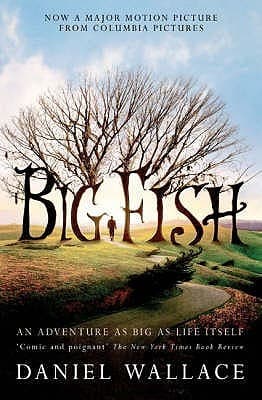
A dying father's incredible tales make his cynical son face the mythical man he thought he knew, blurring the line between exaggerated legend and the real truth of a life well lived.
The story begins with William Bloom thinking about his father, Edward Bloom, who is dying. Edward's life is shown through a series of fantastical stories, starting with his birth. He was born during a drought, and it rained right after he arrived. As a young boy, Edward was incredibly energetic and grew very fast. He was also known for his curiosity and his ability to charm people and animals. One of his early accomplishments includes outgrowing his clothes daily and learning to walk and talk quickly, setting the stage for a life full of big achievements and a lasting love for storytelling.
One of Edward's most famous tales involves a terrifying giant named Karl who was bothering the town of Ashland. The townspeople were afraid to face Karl, but young Edward, with his usual bravery, approached the giant. Instead of fighting, Edward offered Karl a job and a place in society, convincing him to leave Ashland for a bigger city where his size would be an advantage. This act of kindness and cleverness not only saved Ashland from Karl's destructive fits but also showed Edward's unique ability to see the good in everyone and his talent for turning perceived threats into allies, further cementing his legendary status in his son's eyes.
Edward tells of his journey into a mysterious, perfect town called Spectre, a place so ideal it seemed to exist outside of time. He finds it during his adventurous travels and is charmed by its simple, happy residents who walk barefoot and live in harmony. Edward eventually leaves Spectre, promising to return. Years later, he tries to save Spectre from financial ruin, attempting to modernize it. This episode highlights Edward's desire to help others, even when his actions might unintentionally change what he loves about a place. William, however, finds the tales of Spectre especially hard to believe, seeing it as another example of his father's elusive nature.
Edward describes his first meeting with Sandra Templeton, who would become his wife and William's mother. He was instantly smitten and began an extraordinary quest to win her heart. This involved many grand gestures, including working in a circus for three years without pay just to learn her favorite flower and serenading her from a tree. His persistence and elaborate romantic actions eventually won Sandra over, despite her initial engagement to another man. This story is a cornerstone of Edward's romantic legend, showing his boundless determination and his belief in love at first sight, a sharp contrast to William's more practical view of relationships.
While pursuing Sandra, Edward joins a circus where he meets a mysterious ringmaster who, in Edward's version, turns into a werewolf at night. This ringmaster has a magical glass eye that can show a person their future. Edward, always eager for adventure and knowledge, looks into the eye and sees his own death. This experience solidifies his fatalistic view on life and destiny, shaping his willingness to take risks and live life to the fullest. The circus also sets the scene for many of his romantic endeavors and shows his natural ability to adapt to any situation and connect with diverse characters, further enhancing his legendary persona.
Edward recounts his time as a soldier in various wars, portraying himself as an unmatched hero and secret agent. He claims to have won battles alone, infiltrated enemy lines, and even met famous historical figures. These stories, full of impossible feats and daring escapes, are told with Edward's usual embellishment, making it hard for William to tell fact from fiction. While William struggles with the truth of these claims, he acknowledges the underlying message of bravery and resilience that his father tries to convey through these war stories, highlighting Edward's unwavering patriotism and adventurous spirit.
A repeated idea in Edward's stories is his lifelong pursuit of an impossibly large, legendary fish. This fish, which he claims to have met many times but never quite caught, symbolizes Edward's grand ambitions and his relentless pursuit of the extraordinary. It represents the ultimate challenge, the one thing that remains just out of his grasp, yet constantly drives him forward. William sees this fish as a metaphor for his father's entire life — always reaching for something bigger, something beyond the ordinary, even if it means stretching the truth to make the story more captivating and memorable for his audience.
As Edward's health worsens, William grows more frustrated by his father's continued insistence on telling tall tales, even on his deathbed. William wants a genuine, unembellished account of his father's life, feeling that the stories have created a barrier between them. He tries to investigate some of his father's claims, seeking out people and places mentioned in the legends, hoping to uncover the underlying truth. This search for reality often leads to more confusion than clarity, as the few facts he finds are often mundane or contradict the fantastical stories, increasing William's inner conflict and his desire for real connection.
During his investigation, William starts to find bits of truth within his father's elaborate stories. He discovers that the giant Karl was a real person, a troubled individual whom Edward truly helped. The town of Spectre, though not a perfect utopia, was a real, struggling community that Edward tried to support. These discoveries allow William to see the human core beneath the myth, realizing that Edward's tales, while exaggerated, often came from real experiences, acts of kindness, and a desire to make his life, and the lives of those around him, more meaningful and exciting. This understanding marks a turning point in William's view of his father.
As Edward lies dying, he can no longer speak, so William helps him tell his final story. In this tale, Edward describes his death not as an end, but as a grand, heroic journey. He imagines himself escaping the hospital, meeting all the fantastical characters from his life's stories — the giant Karl, the mermaid, the werewolf ringmaster — who have gathered to say goodbye. Together, they walk to a river where Edward, in his final act, turns into the legendary big fish he had pursued his entire life, swimming away into the unknown. This final, shared story brings William a deep sense of peace and understanding.
After Edward's death, William fully embraces the power and beauty of his father's stories. He realizes that the legends were not meant to deceive, but to enrich life, to make the ordinary extraordinary, and to leave a lasting impression of a man who lived with endless imagination. William understands that by embodying these larger-than-life tales, Edward became a legend, not just in his own mind, but in the hearts of everyone he touched. William, once a skeptic, now finds himself retelling his father's stories to his own son, ensuring that Edward Bloom's spirit and his extraordinary life continue to inspire and entertain for generations to come.
The Protagonist
Edward remains consistent in his storytelling nature, but through William's perspective, his character evolves from an enigmatic figure to a deeply loving father whose tales are understood as a form of legacy and connection.
The Narrator/Protagonist
William transforms from a frustrated skeptic who resents his father's tall tales into a compassionate son who understands and embraces the power of his father's imagination and legacy.
The Supporting
Sandra's character remains largely consistent as the loving, supportive wife and mother, embodying stability amidst Edward's fantastical life.
The Supporting
Karl's arc is seen through Edward's eyes, transforming from a feared outcast to a valued friend, demonstrating Edward's positive impact on others.
The Supporting
The Ringmaster is a static character, serving as a symbolic figure who reveals Edward's destiny and reinforces the story's themes of fate and acceptance.
The Supporting
Josephine remains a consistent source of support and wisdom for William, her role primarily being to facilitate his understanding of Edward.
The Mentioned/Supporting
Jenny's arc reflects the changing nature of Spectre, from youthful innocence to a more complicated, faded reality, mirroring the balance between Edward's idealized past and the present.
This is the main theme of 'Big Fish.' Edward Bloom lives his life as if it were a grand story, using fantastical tales to make the ordinary extraordinary and to connect with others. His stories are not meant to deceive, but to enrich life, to provide meaning, and to leave a lasting legacy. William's journey is about understanding that the truth of his father's life is not in literal facts, but in the emotional impact and power of his imaginative stories. For instance, the story of Edward taming Karl the Giant is a greatly exaggerated retelling of an act of kindness and understanding.
“A man's stories are his way of becoming immortal.”
The novel explores the tension between William's desire for objective truth about his father's life and Edward's preference for living in a world of embellished myth. William initially struggles to match his father's fantastical stories with reality, feeling that the legends hide the 'real' man. However, as the story progresses, William comes to understand that Edward's stories *are* his truth, a reflection of his spirit and how he saw the world. The 'truth' is not a collection of facts, but the emotional impact and meaning in the tales, such as the underlying courage in Edward's war stories, even if the details are exaggerated.
“It was impossible to tell where the truth ended and the exaggeration began.”
The complex relationship between Edward and William is the emotional core of the book. William initially feels separated by his father's storytelling, wanting a more conventional, 'real' connection. As Edward faces death, William's quest to understand his father becomes an urgent search for reconciliation and acceptance. The novel shows how a son comes to terms with his father's unique identity and embraces the legacy he leaves behind, not just in genes, but in shared stories and perspectives. William's eventual retelling of Edward's final story signifies his acceptance and continuation of his father's imaginative legacy.
“In telling the story of my father's life, I have in some way told the story of my own.”
The certainty of death is always present, especially as Edward is dying. However, the novel presents death not as an end, but as a transformation, particularly through Edward's final, fantastical story where he becomes the 'big fish.' Through his stories, Edward achieves a form of immortality, living on in the memories and narratives shared by his family and friends. The idea is that while the body dies, the stories and the spirit they embody endure, making Edward's life, and his death, a continuous, grand adventure.
“A man's life is his story. And my father, Edward Bloom, had a story that was bigger than life itself.”
The story of Edward's life is framed by William's present-day narrative of his father's impending death.
The entire novel is framed by William Bloom's perspective as he recounts his father Edward's life on his deathbed. This framing device allows for a dual narrative: the fantastical past told through Edward's eyes (and William's retelling) and the present-day reality of William's struggle to understand his father. It highlights the contrast between the vibrant, mythical past and the somber, reflective present, ultimately bringing them together in a poignant resolution as William accepts and embraces his father's unique legacy.
The constant interplay between Edward's exaggerated tales and the underlying truths.
This device is central to the novel's structure and theme. Each of Edward's fantastical stories is presented alongside William's attempts to find the 'real' facts. The tension between the incredible, magical elements of Edward's narratives (e.g., meeting a werewolf, taming a giant) and the mundane, often less exciting reality that William uncovers (e.g., a troubled man Edward helped, a struggling town he tried to save) drives the plot. This interplay ultimately reveals that the 'truth' is more complex than simple facts, residing in the meaning and impact of the stories themselves.
The elusive giant fish symbolizes Edward's life, ambitions, and ultimate transformation.
The 'big fish' is a recurring symbol throughout Edward's stories, representing the grand, elusive goal he constantly pursues, the extraordinary life he strives to live. It embodies his larger-than-life persona, his adventurous spirit, and his desire to make his existence legendary. In the novel's climax, Edward's final transformation into the big fish symbolizes his complete embrace of his own myth, his transcendence of ordinary life and death, and his enduring legacy through storytelling, becoming the very legend he always pursued.
Early hints and Edward's own 'vision' of his death.
The novel begins with Edward on his deathbed, immediately establishing the somber context for the recounting of his life. Furthermore, Edward's recurring story about seeing his own death in the Werewolf Ringmaster's glass eye serves as direct foreshadowing. This device creates a sense of urgency and poignancy, as William races against time to understand his father before it's too late. It also allows Edward to frame his own death as a final, grand adventure, aligning with his lifelong narrative style.
“A man's got to have a code. An animal—a beast, a fish—has a code, and so does a man. You live by it, or you don't.”
— Edward Bloom reflecting on his life philosophy.
“My father was a man who knew a lot of jokes, and he told them well. But he never told the same joke twice.”
— William Bloom describing his father's unique humor.
“The thing about my father is that he was a man who loved a good story. And he wasn't afraid to be the hero of it.”
— William Bloom's perspective on his father's larger-than-life persona.
“Sometimes, the only way to catch an uncatchable fish is to think like a fish.”
— Edward Bloom's advice on problem-solving, often metaphorical.
“A man tells his stories so many times that he becomes the stories. They live on after him, and in that way, he becomes immortal.”
— William Bloom's realization about his father's legacy.
“It was a good life. It was a good life, and I'm glad I lived it.”
— Edward Bloom's final thoughts on his deathbed.
“The biggest fish in the river, they say, is the one that gets away.”
— A common refrain, representing elusive goals or dreams.
“You can't catch a fish that doesn't want to be caught. But you can make it want to be caught.”
— Edward Bloom's approach to persuasion and achieving the impossible.
“My father, Edward Bloom, was a man of many contradictions. He was a hero and a coward, a truth-teller and a liar, a saint and a sinner.”
— William Bloom grappling with the complexities of his father's character.
“Some things are just too big to be true. But that doesn't mean they didn't happen.”
— A reflection on the nature of truth and myth.
“A man's life is a series of choices, and each choice leads to another.”
— Edward Bloom's deterministic view of life's path.
“The world is a stage, and we are merely players. But some of us have better costumes than others.”
— Edward Bloom's theatrical view of life.
“He lived a life of such grandeur and imagination that it was hard to tell where the truth ended and the legend began.”
— William Bloom summarizing his father's extraordinary existence.
“The greatest gift a father can give his son is to show him how to live without fear.”
— A poignant realization about Edward Bloom's influence.
Ready to see how well you understood this book? Take our interactive quiz with 10 questions.

Daniel Wallace is the author of the acclaimed novel *Big Fish: A Novel of Mythic Proportions*, which was adapted into a major motion picture by Tim Burton. His work is celebrated for its imaginative storytelling and exploration of family, myth, and memory. Wallace holds an MFA from the University of South Carolina and has been recognized for his contributions to contemporary fiction.







