“I am Beorn, son of the sea, and I will not be broken by any man.”
— Beorn declares his identity and resolve when facing adversity.

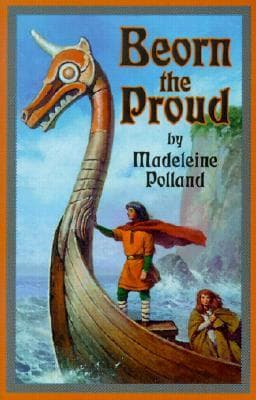
Madeleine A. Polland (1961)
Genre
Children's / Historical Fiction / Young Adult
Reading Time
150 min
Key Themes
See below
Sign in to track this book
In 9th-century Ireland, a young Norse warrior named Beorn discovers the power of Christian humility through his captive, an Irish chieftain's daughter.
The story begins with a Viking raid on an Irish village. Twelve-year-old Ness, daughter of Chieftain Cormac, is playing with her dog, Bran, when the longships arrive. The Vikings, led by young chieftain Beorn, burn the village, kill many inhabitants, and loot treasures. Ness tries to escape but is cornered by Beorn. Beorn, impressed by her spirit, takes her captive instead of killing her, deciding she would be a good thrall for his mother, Sigrid. Ness is dragged onto a longship, leaving her burning home and the life she knew, filled with fear and hatred for her captors, especially Beorn.
Ness's journey north introduces her to Viking life. She is kept in the longship's hold, enduring rough seas, little food, and constant fear. She observes the Vikings' skill as sailors and their devotion to their gods, Odin and Thor. Upon reaching Beorn's settlement, a remote fjord among towering cliffs, Ness is overwhelmed by the wild land and the stark longhouse architecture. She is presented to Beorn's mother, Sigrid, a stern but fair woman, who assigns Ness to work with other thralls in daily household chores.
Life as a thrall contrasts sharply with Ness's former life as a chieftain's daughter. She performs hard tasks: grinding grain, fetching water, mucking out animal pens, and tending the hearth. Despite the physical labor, Ness refuses to let her spirit break. She holds onto her Irish identity, speaking her native tongue when she can, and secretly practicing her Christian faith, making the sign of the cross and whispering prayers. She dislikes Beorn, blaming him for her capture, and often challenges him with her defiant gaze, earning his respect and irritation.
Beorn, used to obedience, is both frustrated and interested in Ness. Her defiance, quiet prayers, and belief in her God are new to him. He watches her, noticing her resilience and gentle nature with younger thralls. He starts to question the Viking way of life, especially their use of force and their gods of war. His initial dislike for Ness slowly changes into respect, and then a deeper curiosity about her faith, which seems to offer a different kind of strength than his own.
As winter arrives, the Viking community prepares for a feast and sacrifices to their gods, hoping for a mild winter and successful spring raids. Ness watches these pagan rituals with fear and pity. During the long, dark evenings, Beorn sometimes seeks her out, drawn by her quiet presence. Ness, seeing his openness, tells him stories from her Christian faith, not as a challenge, but as a way to share her hope. She speaks of a God of love and forgiveness, ideas foreign to Beorn's warrior culture, planting seeds of doubt and wonder in his mind.
Spring comes, and Beorn, wanting to prove himself and get more supplies, leads a raid on a distant coastal settlement. However, the raid goes wrong. They meet unexpected resistance, and Beorn is badly wounded with an axe to his leg. His men retreat, but the journey back is hard, and Beorn's condition worsens. Back in the longhouse, he is close to death, feverish and in pain. This time of weakness makes him face his mortality and the limits of his warrior code, allowing Ness's influence to grow.
During Beorn's long recovery, Ness, despite her past hatred, cares for him. She uses her knowledge of herbs and poultices, learned from her mother, to treat his wound. She sits by his side, speaking softly of her God's love and the peace it offers. Beorn, weak and humbled, listens. He sees the strength in her compassion and forgiveness, a strength greater than any he has known from battle. Through her actions and words, Beorn changes. He rejects his pagan gods and, quietly, accepts the Christian faith, choosing peace over violence.
Beorn's conversion causes disbelief, anger, and confusion among his people. His mother, Sigrid, worries for his soul and their clan's future. The warriors, who saw him as a fierce leader, struggle to understand his rejection of Odin and Thor. Some see it as weakness, others as a betrayal. Beorn, though still recovering, stands firm in his new faith, supported by Ness. He knows changing his people will be hard, but he is committed to the God of peace.
With his health restored and his faith strong, Beorn decides to return Ness to Ireland and seek reconciliation with her people. He gathers his loyal men, those who saw his change and are open to his new ideas. The journey back is uncertain, but Beorn is determined. In Ireland, he approaches Ness's village, not as a raider, but as someone seeking forgiveness. He finds Ness's father, Chieftain Cormac, to ask for forgiveness and to offer peace between their peoples. Ness, now free, stands by Beorn, bridging their two worlds.
The meeting between Beorn and Chieftain Cormac is tense, weighed by past violence. Cormac, initially angry, sees Beorn's genuine change, helped by Ness's testimony and her affection for him. Beorn offers payment for the damage he caused and promises to stop raiding, suggesting trade and peaceful coexistence. It is a hard negotiation, but their shared humanity and Ness's role as a mediator eventually succeed. A fragile truce is established. Lasting peace will take time, but Beorn and Ness have started a future where their cultures, once in conflict, might learn to live together, united by faith and understanding.
The Protagonist
From a fearful captive consumed by hatred, Ness transforms into a beacon of forgiveness and faith, ultimately becoming a catalyst for peace between two warring cultures.
The Protagonist/Antagonist
Beorn undergoes a radical transformation from a proud, pagan Viking raider to a humble Christian leader seeking reconciliation.
The Supporting
She struggles to accept her son's radical change of faith but ultimately demonstrates a mother's enduring love.
The Supporting
From a grieving and vengeful chieftain, he moves towards forgiveness and reconciliation for the sake of peace.
The Mentioned
N/A - serves as a symbol of loss.
The Supporting
He represents the resistance to change within the Viking community.
The Supporting
He shows a degree of adaptability and loyalty to Beorn, even through his conversion.
The Supporting
They serve as a backdrop for Ness's resilience and compassion.
The book's main theme is the conflict between two cultures and faiths – pagan Viking raiders and Christian Irish communities – and the possibility of reconciliation. This is shown in Beorn and Ness's relationship. At first, their interactions are violent and hateful, reflecting historical Viking raids. However, through Ness's faith and Beorn's experience, the story moves towards understanding, forgiveness, and seeking peace. The resolution with Cormac shows the effort needed for reconciliation after old conflicts.
“He had come to Ireland as a raider, but now he came as one seeking peace.”
The power of faith, especially Christian faith, to change individuals and connect cultures is a core theme. Ness's belief in a God of love and forgiveness gives her strength during captivity and helps change Beorn. Beorn's journey from worshipping Norse gods of war to following Christ shows the power of spiritual awakening. The contrast between violent pagan rituals and Ness's quiet prayers highlights the different values of the two faiths, with Christianity offering a path to peace.
“He had never known a God who asked for love, only for strength and sacrifice.”
Despite suffering, Ness shows forgiveness and compassion. Her decision to nurse Beorn, rather than letting him die, is a key moment. This selfless care for her captor breaks through Beorn's hardened exterior and opens him to new ideas. The theme suggests that true strength is in forgiveness and mercy, leading to healing and a new future.
“She hated him, but she could not let him die.”
Ness and Beorn both deal with identity and belonging. Ness holds onto her Irish identity and Christian heritage in a foreign land. Her struggle to keep her 'self' against Viking culture shows how important cultural roots are. Beorn, after his conversion, faces an identity crisis as he rejects the warrior values and pagan gods that defined him. He must create a new identity as a Christian leader. This alienates him from some of his people but also opens the door to a different kind of leadership rooted in peace.
“She was Irish, and she would not forget it, not even here.”
Highlighting the stark differences between Viking and Irish societies.
The novel effectively uses the stark contrast between 9th-century Viking and Irish cultures to drive the narrative and thematic exploration. The fierce, pagan, seafaring, and raiding lifestyle of the Vikings is juxtaposed with the settled, Christian, agricultural, and artistic traditions of the Irish. This contrast is evident in customs, beliefs, architecture, and daily life. It sets up the initial conflict and underscores the magnitude of Beorn's transformation and the challenge of reconciliation. The differing worldviews are central to Beorn's internal conflict as he grapples with Ness's faith.
The story of a protagonist held against their will, leading to personal growth and cultural exchange.
The entire plot is framed as a captivity narrative, with Ness's capture by Beorn serving as the inciting incident. This device allows the author to explore themes of resilience, cultural clash, and personal transformation from an intimate perspective. Ness's experience as a thrall provides a window into Viking life through the eyes of an outsider, forcing her to adapt while holding onto her identity. Crucially, it's her captivity that places her in a position to influence Beorn directly, making the personal relationship between captive and captor the engine of the larger cultural and spiritual conflict and resolution.
Beorn's physical injury acts as a catalyst for his spiritual healing.
Beorn's severe injury during the ill-fated raid serves as a crucial plot device, transforming him from a proud, invincible warrior into a vulnerable, dependent individual. This physical wound opens him up to Ness's care and teachings. His weakened state strips away his defenses, making him receptive to the Christian message of love and forgiveness that he previously dismissed. The healing of his body by Ness directly parallels the healing of his spirit through her faith, making the injury a catalyst for his profound conversion and the subsequent shift in his values.
Representing both Viking power and the journey of transformation.
The longship functions as a powerful symbol throughout the narrative. Initially, it embodies the terrifying power and predatory nature of the Vikings, bringing destruction and fear to the Irish coast. For Ness, it represents her abduction and the terrifying journey into the unknown. However, as the story progresses, the longship also symbolizes a journey of transformation. When Beorn decides to return Ness to Ireland in his longship, it transforms into a vessel of peace and reconciliation, carrying him and his changed intentions back to the land he once ravaged, signifying a new beginning.
“I am Beorn, son of the sea, and I will not be broken by any man.”
— Beorn declares his identity and resolve when facing adversity.
“The sea does not forgive, but it teaches us to endure.”
— Reflecting on lessons learned from his Viking heritage.
“Pride is not in the conquest, but in the strength to stand again.”
— Beorn learns humility after a defeat.
“A true leader listens to the wind as much as to his own heart.”
— Advice given to Beorn about leadership.
“In Ireland, even the stones have stories to tell.”
— Beorn observes the rich history of the land he encounters.
“Fear is a shadow; face it, and it vanishes.”
— Beorn encourages a companion during a perilous moment.
“We are all threads in the tapestry of time, woven by choices.”
— A reflective moment on destiny and free will.
“The greatest treasure is not gold, but the trust of those you lead.”
— Beorn realizes the value of loyalty over material wealth.
“To understand another, you must first walk in their footsteps.”
— Beorn learns empathy through his experiences with different cultures.
“A ship is only as strong as the crew that sails her.”
— Highlighting the importance of teamwork among Vikings.
“Sometimes, the quietest voice holds the deepest truth.”
— Beorn learns to value subtle wisdom over loud boasts.
“The past may shape us, but it does not define our future.”
— Beorn decides to forge his own path beyond his heritage.
“In the clash of swords, remember the peace you seek.”
— A reminder during conflict about ultimate goals.
Ready to see how well you understood this book? Take our interactive quiz with 10 questions.

Biography coming soon.

Dan Gemeinhart
4.5

Kate O'Hearn
4.4

Jeanne Birdsall
4.4

Jen Wang
4.4

Wendelin Van Draanen
4.3

John Marsden
4.3

Chris Van Allsburg
4.3
Jennifer A. Nielsen
4.2