“You are saved, Don Benito, saved!”
— Captain Delano's initial joyful declaration to Cereno.

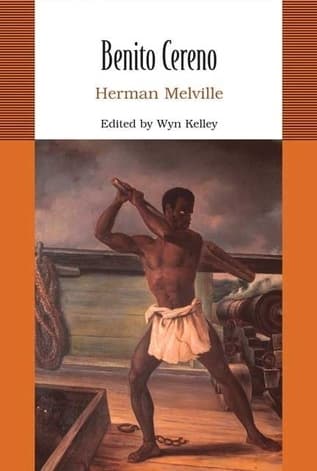
Herman Melville (1926)
Genre
Historical Fiction
Reading Time
160 min
Key Themes
See below
Sign in to track this book
A Spanish slave ship, seemingly in trouble, hides a dark secret, forcing an American captain to confront misleading appearances of power, race, and madness at sea.
Captain Amasa Delano, leading the American sealer 'President of the United States,' is anchored off Santa María island, near Chile. One morning, he sees a large, dark ship approaching, seemingly in trouble. Its sails are ripped, rigging tangled, and it appears to drift. Delano, a kind and trusting man, immediately prepares to help, thinking it a merchant ship in need. As the ship gets closer, he sees its poor condition and the odd, chaotic activity on its decks, which raises his concern and interest.
Delano boards the Spanish ship, the 'San Dominick.' He is immediately struck by the ship's mess and the unusual dynamic between the thin Spanish crew and the many enslaved Africans. The ship's captain, Don Benito Cereno, appears young, weak, and deeply troubled, always with his enslaved 'servant,' Babo. Cereno's answers to Delano's questions are vague and avoidant, broken by fits of sadness and physical weakness, which Babo seems to expect and handle with remarkable care. Delano blames Cereno's strange behavior on illness and the hardships at sea.
Don Benito, often prompted and supported by Babo, tells a confusing story of their trip. He claims they sailed from Buenos Aires with enslaved people for Lima, but scurvy and calm weather killed many of both the Spanish crew and some enslaved people. A later violent storm, he says, further damaged the ship and swept away many of the remaining white sailors, including officers and his friend, Alexandro Aranda. Delano finds some details inconsistent but mostly accepts this story, blaming its confusion on Cereno's illness and trauma.
During his time on the 'San Dominick,' Delano notices many odd things that bother him, though he quickly dismisses them. He sees the enslaved people using axes and other tools with unusual freedom and observes the Spanish sailors appearing quiet and scared. Babo's constant closeness to Don Benito, his apparent control over the captain's actions and words, and the unsettling, almost theatrical respect the enslaved show Babo, all seem strange but are explained by Delano as cultural differences or effects of the ship's distress. He even sees Babo shave Cereno in a disturbing scene, where the razor is held dangerously close to Cereno's throat.
Despite his initial trust, Delano starts to feel a deep unease. He briefly suspects a pirate plot, then a mutiny by the enslaved, or even a trick by Cereno to trap him. These brief suspicions, however, are always dismissed by Delano's natural optimism, his belief that enslaved people are naturally submissive, and his conviction that such wickedness is beyond human nature. He blames the strange atmosphere on his own imagination or the stress of the situation and continues to offer help and supplies, including water and provisions.
During a shared dinner, the ship's tension is clear. Delano, Cereno, and Babo are present, with Babo serving and seemingly directing Cereno's actions. At one point, Delano playfully tries to take a dagger from a young enslaved boy, but Babo quickly and sternly steps in, taking control. This incident further highlights Babo's unusual authority. Delano also sees a suspicious knot on a rope, which he tries to untie, but Babo's quick, almost threatening, intervention stops him. These small but important moments add up, yet Delano's mild view of events stays mostly the same.
After a full day on the 'San Dominick,' Delano decides to return to his ship. He offers to take Don Benito aboard the 'President' to recover, but Cereno refuses, saying he must stay with his ship. As Delano's boat pulls away from the 'San Dominick,' Don Benito suddenly jumps into Delano's boat, frantically seeking protection. Babo, who had been with Cereno, jumps in after him, trying to drag Cereno back, seemingly out of loyalty. At this moment, Captain Delano begins to grasp the full, horrifying truth.
As Babo tries to pull Cereno back, Delano's men intervene. During the struggle, Babo is found to be hiding a dagger. The truth is suddenly clear: the enslaved people, led by Babo, had mutinied, killed the Spanish officers, and taken control of the 'San Dominick.' Don Benito had been a prisoner, forced to keep up the act under constant threat. Babo's careful attention was a planned performance, meant to trick Delano and keep him from finding out about the mutiny. The 'San Dominick' was not a ship in trouble, but a ship controlled by its former captives.
Delano's crew, now understanding the danger, immediately secures Babo. With the deception revealed, Delano orders his men to chase the 'San Dominick,' which is trying to escape. A chase follows, ending in a fierce fight as Delano's armed sailors board the Spanish ship. The mutineers, though resisting at first, are eventually overpowered and captured. During the boarding, the gruesome sight of Alexandro Aranda's skeleton, Don Benito's friend, nailed to the masthead with the words 'FOLLOW YOUR LEADER,' is found, confirming the mutiny's brutality.
After the capture, an investigation and trial are held in Lima, Peru. Don Benito Cereno, now free but deeply traumatized, gives his official statement, detailing the mutiny. He recounts how Babo organized the revolt, murdered the ship's officers, and forced Cereno to maintain the elaborate deception under threat of death. He describes the constant psychological torture and the ever-present danger he faced, revealing the true meaning behind Babo's constant presence and the many unsettling details Delano had observed but misunderstood. Cereno's testimony provides the official account of the 'San Dominick's' terrifying voyage.
Despite being freed and Babo's conviction, Don Benito Cereno remains deeply scarred by the events on the 'San Dominick.' He tells Delano that Babo's 'shadow' still follows him. The psychological trauma he endured, the constant fear, and the horror of seeing his friends murdered and being forced to take part, are too much for him. He dies a few months after the trial, a broken man, unable to escape the memory of the mutiny and Babo.
Babo, the cunning leader of the mutiny, is convicted and sentenced to death. Throughout his trial and execution, he remains silent, refusing to speak or offer any defense. He dies without revealing his reasons or showing regret. His head is cut off and, as a grim warning, is placed on a pole in Lima's plaza, facing the monastery where Don Benito Cereno's body lies, a final, silent confrontation between victim and oppressor, even in death.
The Protagonist
Delano begins as an overly trusting and racially naive observer, and while he eventually comprehends the mutiny, his underlying worldview remains largely unchallenged, as he struggles to fully grasp the depths of human evil or the justified rage of the oppressed.
The Victim/Supporting
Cereno is introduced as a seemingly sick and ineffective captain, but is revealed to be a tortured victim of a brutal mutiny, his 'illness' a mask for terror. He is rescued but never recovers from the psychological scars.
The Antagonist
Babo maintains a consistent facade of subservience while secretly orchestrating control, revealed as a formidable and unyielding leader of rebellion who defies his captors even unto death.
The Mentioned/Symbolic
Aranda's story is complete before the novella begins, but his remains serve as a powerful, static symbol of the mutiny's brutality and a constant threat to Cereno.
The Supporting
They are introduced as a distressed crew, but are revealed to be helpless captives, their fear a silent testament to the mutiny's power.
The Supporting/Collective Antagonist
Initially appearing as passive cargo, they are revealed to be active, organized rebels, demonstrating their agency and collective will for freedom.
This theme is key to the novella, as Captain Delano often misreads the 'San Dominick's' reality based on his prior beliefs and what he expects to see. The whole situation is an elaborate, carefully staged act by Babo, meant to show a distressed slave ship while hiding a successful mutiny. Delano's inability to see past the surface, especially his racial biases that keep him from imagining enslaved people as capable of such cleverness, drives the story. The 'San Dominick' itself is a 'mask,' a representation that hides a horrifying truth, shown by Aranda's skeleton at the masthead, a grim piece of 'stagecraft' that highlights the deception. This theme shows how easily perception can be manipulated and how often people see what they want or expect, rather than what is real.
“Captain Delano's mind, ever alert to the least appearance of peril, though at the same time delighting in every sound that might betoken a friendly approach, was now, by turns, a prey to those opposite emotions, each of which produced its own peculiar illusion.”
Melville explores the widespread racism of the time through Captain Delano's view. Delano's failure to understand the mutiny is largely due to his deep-seated belief in the inferiority of Black people. He interprets Babo's intelligence and assertiveness as 'dog-like loyalty' or 'childlike devotion,' never as the cleverness of a leader. He dismisses the enslaved people's ability to act, assuming they cannot organize or carry out such a complex plan. This prejudice blinds him to clear clues, causing him to explain away every inconsistency. The story implicitly criticizes how such biases prevent understanding and strengthen oppressive systems, showing how racism can make one unable to see the humanity, let alone the rebellious spirit, of the oppressed.
“There is something in the Negro which, in a peculiar way, fits him for an office like that of Babo... a strange affectionate good-nature, of the canine species, in the Negro, which, in a peculiar way, fits him for the office of a body-servant.”
The novella looks into the dark side of human nature, showing a complex mix of cruelty and desperation. While Babo's actions respond to slavery's inherent evil, his methods are brutal, ending in the gruesome display of Aranda's skeleton. Cereno, though a victim, also takes part in the system of slavery, making his suffering a result of a larger evil. Delano struggles to fit the 'benevolent' world he believes in with the horrifying reality he eventually finds. The story questions where true evil lies – in the system of slavery, in the violent rebellion against it, or in the human capacity for deception and brutality, regardless of motive.
“The past is passed. Why moralize upon it? Forget it. See, yon bright sun has forgotten it all, and the blue sea, and the blue sky; but the heart of man never forgets.”
Don Benito Cereno's character arc clearly shows the deep and lasting impact of psychological trauma. Even after his rescue, he cannot recover from the ordeal. The constant fear, the forced involvement, and witnessing horrific violence leave him a broken man. His repeated statements about Babo's 'shadow' following him mean the experience has left a permanent mark on his mind. This theme highlights how extreme stress can permanently change a person, showing that freedom from physical capture does not always mean freedom from mental pain. Cereno's death is a tragic example of trauma's destructive power.
“'The negro,' said Don Benito, gravely, 'don't you see, has left a shadow, literally, too, a shadow, for you, and for me, and for all of us.'”
The story is primarily filtered through Captain Delano's flawed perception.
The narrative is almost entirely told from Captain Amasa Delano's point of view, making him an unreliable narrator. His inherent optimism, racial biases, and inability to conceive of certain forms of depravity lead him to consistently misinterpret the events unfolding around him. He rationalizes every strange occurrence, dismissing crucial clues and constructing a benign reality that is far from the truth. This device forces the reader to engage critically with the narrative, questioning what is presented and searching for the underlying reality that Delano himself cannot perceive until the very end. The reader's understanding evolves alongside (or often ahead of) Delano's, creating a sense of dramatic irony and suspense.
Objects and characters carry deeper, often contradictory, meanings.
Melville employs rich symbolism throughout the novella. The 'San Dominick' itself symbolizes the decaying system of slavery, outwardly distressed but inwardly a powder keg of rebellion. The skeleton of Alexandro Aranda nailed to the masthead with the inscription 'FOLLOW YOUR LEADER' is a powerful symbol of brutal rebellion, a constant threat to Cereno, and a grim message to white authority. Babo's razor during the shaving scene symbolizes the constant, life-threatening control he exerts over Cereno. Even the names, 'San Dominick' (Saint Dominic, associated with the Inquisition) and 'President of the United States' (representing American ideals), carry ironic or contrasting symbolic weight, highlighting themes of oppression, freedom, and national identity.
The reader is often aware of the truth before the protagonist.
Dramatic irony is a pervasive element, as the reader often grasps the true nature of the 'San Dominick's' situation and Babo's role long before Captain Delano. Clues such as the enslaved people's unusual freedom, the fear in the Spanish sailors' eyes, Babo's controlling gestures, and Cereno's evasiveness are presented in a way that allows a discerning reader to infer the mutiny. This creates tension and suspense, as the reader watches Delano repeatedly misinterpret events, often with a sense of dread, knowing the danger he is in while he remains blissfully unaware. The irony underscores Delano's naiveté and the effectiveness of Babo's deception.
Subtle hints and clues predict the eventual revelation of the mutiny.
Melville subtly weaves numerous instances of foreshadowing into the narrative. Examples include the initial observation of the ship's 'disorderly' appearance, the enslaved people's unusual access to tools, the Spanish sailors' furtive glances and fearful demeanor, Babo's constant proximity and seemingly dictatorial control over Cereno, and the incident with the dagger during dinner. Each of these details, though rationalized away by Delano, serves as a breadcrumb leading to the inevitable revelation of the mutiny. The cumulative effect builds a sense of unease and anticipation, preparing the reader for the shocking truth even as Delano remains oblivious.
“You are saved, Don Benito, saved!”
— Captain Delano's initial joyful declaration to Cereno.
“The Spaniard's long, lean, pale face, that at intervals of gloom would appear just above the white of his neck-cloth; and long, lean, pale hands, whose nervous flutterings were at intervals revealed by his loosely-hanging sleeves.”
— Delano's physical description of Don Benito Cereno.
“As for the black, certainly, since Benito Cereno's illness, no one had been more assiduous than Babo in attending him.”
— Delano's observation of Babo's attentiveness to Cereno.
“Who, in the name of all that is good, are you, sir?”
— Captain Delano's bewildered question during the climax.
“What has cast such a shadow upon you?”
— Captain Delano's question to Cereno after the rescue.
“The negro. There is no shadow, then, but the negro.”
— Don Benito Cereno's response to Delano's question about his gloom.
“He was a negro, and a slave; but with an air of a gentleman.”
— Delano's initial impression of Babo.
“Somehow, there was a certain indefinable discomfort, at times, in the presence of Don Benito.”
— Delano's developing unease with Cereno's behavior.
“The morning was one of those rare ones, when a tropical sea, not yet agitated by the Trades, is for a space like a great blue eye, that looks up into the equally blue, tranquil eye of the sky.”
— Opening description of the calm, deceptive setting.
“Not a soul knew of it but myself and the negro.”
— Cereno's revelation about Babo's role in the uprising.
“It was impossible for Captain Delano to read the full import of the melancholy of Cereno.”
— Delano's continued inability to grasp the depth of Cereno's suffering.
“And the Spaniard, what he thought was a dagger, was really a razor.”
— The revelation about the object Babo used on Cereno.
“Follow your leader!”
— The defiant cry of the enslaved people during the uprising.
“His body was then, by order of the Viceroy, gibbeted and burned.”
— The fate of Babo after the trial.
“And the shadow of the negro.”
— The final phrase of the narrative, summarizing Cereno's enduring trauma.
Ready to see how well you understood this book? Take our interactive quiz with 10 questions.
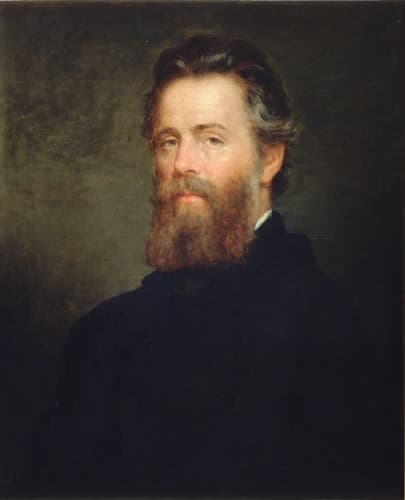
Herman Melville was an American novelist, short story writer, and poet of the American Renaissance period. Among his best-known works are Moby-Dick (1851); Typee (1846), a romanticized account of his experiences in Polynesia; and Billy Budd, Sailor, a posthumously published novella. Although his reputation was not high at the time of his death, the 1919 centennial of his birth was the starting point of a Melville revival, and Moby-Dick grew to be considered one of the great American novels.







