“Life was a funny thing. A moment ago she was alive, now she was dead. It was as simple and as complicated as that.”
— Ruby's reflection on a tragic event.

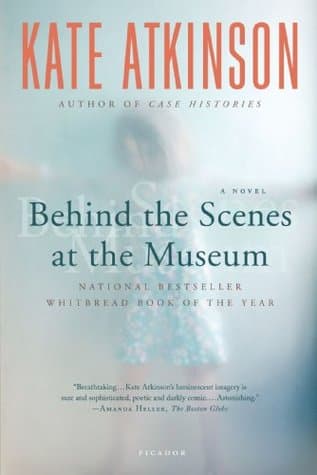
Kate Atkinson (1996)
Genre
Literary Fiction / Historical Fiction / Mystery
Reading Time
7 hours 30 minutes
Key Themes
See below
Sign in to track this book
From the surprising spark of conception, Ruby Lennox unspools a century of English life, untangling her family's knotted secrets with a wry wit and an insatiable curiosity.
Ruby Lennox begins her narrative from the moment of her conception in 1951, a rather unromantic affair between her mother, Bunty, and father, George, in a cinema. She immediately establishes her unique perspective, observing her family's history unfold. Ruby describes her early childhood in York, living above her father's pet shop, and the often-tense atmosphere within her family home. Her mother, Bunty, is frequently unhappy and withdrawn, while her father, George, is more jovial but often distant. Ruby's older sister, Patricia, is already present, and her younger sister, Gillian, will soon follow. Ruby's narrative voice is inquisitive and somewhat detached, as she begins to piece together the fragments of her family's past, always sensing unspoken secrets and a pervasive sadness.
Ruby continues to detail her childhood experiences in York, providing vivid descriptions of the pet shop and the cramped living quarters above it. She paints a picture of a largely isolated existence, where her primary interactions are with her immediate family. Her mother, Bunty, is often resentful and prone to fits of temper, particularly towards Patricia. George, her father, attempts to maintain a cheerful facade but struggles with his own disappointments. Ruby also introduces her grandmother, Alice, and her great-aunts, Nell and Lillian, whose visits and stories provide glimpses into earlier generations. The family dynamics are complex, marked by a lack of overt affection, unresolved tensions, and a pervasive sense of things left unsaid, which fuels Ruby's search for understanding.
The arrival of Ruby's youngest sister, Gillian, into the Lennox household does little to alleviate existing tensions; in fact, it seems to make them worse. Bunty's postpartum depression and general dissatisfaction deepen, making her even more withdrawn and irritable. Ruby observes the stark differences between her sisters: Patricia, the eldest, is often the target of Bunty's frustrations and develops a quiet resilience, while Gillian, the youngest, is more fragile and prone to illness. Ruby, caught in the middle, becomes an astute observer of these dynamics, trying to make sense of the emotional state of her home. She begins to realize that her family's present unhappiness is deeply rooted in their past, an idea that solidifies her determination to uncover their history.
Ruby starts to learn more about her family's past through fragmented conversations and overheard remarks, particularly from her grandmother, Alice. Alice, a stern but ultimately loving figure, occasionally reveals details about her own difficult upbringing and the lives of her sisters, Nell and Lillian. These snippets reveal a history marked by poverty, loss, and hardship in early 20th-century Yorkshire. Ruby learns about the various men who came and went in her grandmother's life and the struggles faced by her female ancestors. These stories, though often incomplete and disjointed, begin to form a mosaic in Ruby's mind, connecting her present reality to the historical misfortunes and resilience of her foremothers.
As Ruby transitions into adolescence, she becomes increasingly aware of the limitations and unhappiness within her family. She finds solace and escape in books, immersing herself in fictional worlds that offer a stark contrast to her own reality. Her relationship with her mother, Bunty, remains difficult, characterized by misunderstandings and unspoken resentments. Ruby witnesses Patricia's growing independence and Gillian's continued fragility, which sometimes manifests as illness. She starts to form her own identity, often feeling like an outsider even within her own home. This period marks her growing desire to break free from the cycle of unhappiness she perceives in her family and to forge her own path, distinct from the shadows of the past.
Ruby eventually leaves York to attend university, a significant step towards independence. This physical distance allows her a new perspective on her family, though she remains tethered to them by her ongoing search for understanding. She experiences freedom and intellectual stimulation, but questions about her family's secrets continue to haunt her. During her time away, she reflects on the lives of her parents and sisters, trying to reconcile their current unhappiness with the fragments of their history she has gathered. Despite her new environment, Ruby finds that her family's psychological legacy is not easily shed, and her narrative continues to weave between her present experiences and the historical threads she is uncovering.
Through a combination of fragmented memories, old photographs, and finally, direct conversations with her grandmother Alice, Ruby begins to piece together the full, tragic story of her great-aunt Nell. She learns that Nell, Alice's sister, was pregnant out of wedlock and, in a desperate act, abandoned her baby, who subsequently died. The family, particularly Alice, was complicit in covering up the scandal, leading to a lifetime of guilt and unspoken sorrow that permeated through generations. This revelation is an important moment for Ruby, explaining much of the underlying sadness and tension she observed in her mother and grandmother. The secret of Nell's baby is the central trauma that has cast a long shadow over the family.
With the discovery of Nell's story, Ruby begins to understand the impact this secret had on her grandmother, Alice, and consequently, on her mother, Bunty. Alice's guilt and grief over Nell's fate made her emotionally distant and unable to fully nurture Bunty. This lack of maternal affection created a deep resentment in Bunty, which she then unwittingly passed on to her own daughters, particularly Patricia. Ruby realizes that Bunty's unhappiness and her often-harsh treatment of her children were not simply arbitrary but were a direct consequence of her own unfulfilled need for love and her mother's emotional unavailability, a chain reaction of unresolved trauma across generations.
Ruby continues to observe the diverging paths of her sisters. Gillian, the youngest, remains fragile and somewhat sickly, seemingly bearing the weight of the family's unspoken sorrows in her physical being. Her dependency often draws Bunty's attention, albeit in a strained manner. Patricia, on the other hand, the eldest, eventually makes a decisive break from the family's emotional entanglement. She marries and moves away, creating her own life and seemingly escaping the direct influence of their mother's unhappiness. Ruby sees Patricia's departure as both an act of self-preservation and a confirmation of the difficulty of remaining within the suffocating family dynamic without succumbing to its historical burdens.
Towards the end of her narrative, Ruby, now an adult, starts to achieve a measure of reconciliation with her family's complicated past. While the secrets and tragedies cannot be undone, her understanding of them allows her to view her family members, particularly her mother Bunty and grandmother Alice, with more empathy and less judgment. She recognizes the chain of circumstances and historical pressures that shaped their lives and, by extension, her own. This newfound understanding brings a sense of release for Ruby, allowing her to accept her family for who they are and to begin to forge her own future, no longer solely defined by the shadows of the past, but enriched by the knowledge she has painstakingly uncovered.
The Protagonist
Ruby evolves from a bewildered child observing dysfunction to an adult who understands and ultimately accepts her family's history, finding peace in knowledge.
The Supporting
Bunty remains largely static in her unhappiness, but Ruby's narrative ultimately provides context for her suffering, even if Bunty herself never fully reconciles with it.
The Supporting
George remains a largely static character, unable to significantly alter the family's emotional landscape.
The Supporting
Alice's arc is largely in the past, her present-day stoicism slowly revealing the immense burden she has carried throughout her life.
The Supporting
Patricia moves from being a victim of her mother's resentment to achieving independence and escaping the family's direct influence.
The Supporting
Gillian remains largely a static character, her fragility serving as a poignant symbol of the family's unaddressed pain.
The Mentioned
Nell's arc is entirely in the past, her tragedy being the originating trauma for the family's generational pain.
The Supporting
Lillian's arc is primarily historical, her character serving to provide context and a contrasting emotional tone to Alice.
The novel shows how unresolved traumas and secrets from previous generations impact the lives of subsequent ones. The tragedy of Nell's abandoned baby and Alice's subsequent guilt creates a chain reaction of emotional repression and unhappiness, directly affecting Bunty's ability to parent and her daughters' emotional well-being. Ruby's entire narrative is driven by her subconscious awareness of this inherited burden, forcing her to actively uncover the historical events that explain her family's present dysfunction. The past is not just history; it is a living, breathing entity shaping every interaction.
“The past is not a foreign country, it is a room we are all in, a room that we keep re-entering.”
Ruby's journey is a quest for identity, both her own and that of her family. By meticulously piecing together the fragmented stories of her ancestors, she tries to understand where she comes from and why her family is the way it is. This understanding is crucial for her to forge her own identity, distinct from the cycle of unhappiness she observes. Her feeling of being an 'outsider' within her own family fuels her determination to uncover the truth, hoping that knowledge will bring a sense of belonging or, at least, a clear path to self-definition.
“I was always searching for the meaning of things, always looking for a pattern, a connection.”
The novel explores storytelling itself. Ruby, as the narrator, self-consciously constructs her family's history, acknowledging the subjective nature of memory and the gaps in her knowledge. She emphasizes that history is not a linear, objective account but a collection of personal narratives, often contradictory or incomplete. Her act of narration is an attempt to impose order and meaning on a chaotic past, highlighting how stories shape our understanding of ourselves and our families. The 'museum' in the title symbolizes this curated collection of memories and artifacts that make up a family's history.
“All families have their secret histories, I suppose. All families are museums in their own right.”
The book focuses on the lives of the women in Ruby's family, tracing a lineage of both suffering and resilience. From Alice's endurance of poverty and loss to Nell's tragic fate and Bunty's lifelong resentment, the female characters bear the brunt of societal expectations and personal misfortunes. However, they also show strength in survival, adaptation, and, in Ruby's case, the courage to confront and understand their inherited burdens. The narrative celebrates their ability to endure, even if their resilience often comes at a significant emotional cost.
“Women, I thought, were like rivers, always flowing, always changing, yet always the same.”
Ruby Lennox narrates her life from conception with an all-knowing perspective.
The novel employs an unusual narrative device where Ruby Lennox narrates her own life story from the moment of her conception. This gives her an omniscient, detached, yet deeply personal perspective, allowing her to comment on events she couldn't possibly have witnessed first-hand, such as her parents' first meeting or her grandmother's past. This unique point of view enables a comprehensive historical sweep, weaving together different timelines and character perspectives into a cohesive, yet self-aware, narrative tapestry. It also highlights the idea that a person's story begins long before their birth, shaped by the lives and histories of their ancestors.
The story jumps between different time periods and family members' pasts.
The narrative frequently shifts between Ruby's present childhood/adolescence and various points in her family's past, sometimes going back several generations. These temporal jumps are often triggered by a memory, an object, or a question in Ruby's mind. This non-linear structure mirrors Ruby's investigative process, as she pieces together fragments of history to understand the present. It emphasizes that the past is not a closed chapter but constantly intersects with and influences the present, creating a sense of historical density and inevitability in the family's fate.
Unspoken family secrets, particularly Nell's tragedy, drive the plot and characters' motivations.
The core of the novel's mystery and emotional depth lies in the intergenerational secrets, primarily the truth about Nell Wilson's abandoned baby and the subsequent cover-up. These unspoken traumas create a pervasive atmosphere of unease, guilt, and emotional distance that defines the family's dynamics for decades. The secrets act as a powerful engine for Ruby's quest, as she instinctively senses the hidden truths and meticulously works to uncover them. Their revelation explains the deep-seated unhappiness and resentment that has plagued her mother, Bunty, and grandmother, Alice, and allows Ruby to finally understand her family.
The 'museum' represents the curated collection of family memories and artifacts.
The title 'Behind the Scenes at the Museum' is a significant symbolic device. The museum represents the family itself – a repository of memories, artifacts (like photographs or heirlooms), and stories, both public and private. Ruby, in her role as narrator, is like a curator, arranging and interpreting these exhibits to make sense of her family's history. The 'behind the scenes' aspect refers to the hidden truths, the unspoken narratives, and the private lives that are not typically displayed to the public but are crucial to understanding the full picture. It underscores the idea that every family has its own complex, often hidden, history.
“Life was a funny thing. A moment ago she was alive, now she was dead. It was as simple and as complicated as that.”
— Ruby's reflection on a tragic event.
“History was a great shaper of lives, even if you weren't aware of it.”
— Ruby pondering the influence of the past.
“Every family has a secret, or two, or three. It's what makes them interesting.”
— Ruby's cynical observation about family dynamics.
“Sometimes you just had to make do with what you were given, even if what you were given was a bit rubbish.”
— Ruby's pragmatic approach to difficult circumstances.
“The past was like a foreign country; they did things differently there.”
— A common saying, applied by Ruby to her family's history.
“What was the point of remembering if you couldn't change anything?”
— Ruby's frustration with the unalterable nature of the past.
“You can never truly know someone until you've walked a mile in their shoes, and even then, you'll only know the state of their shoes.”
— Ruby reflecting on the limits of understanding others.
“The truth was a slippery thing, always changing its shape depending on who was holding it.”
— Ruby musing on the subjective nature of truth.
“It wasn't that she didn't care, it was just that she cared about different things.”
— Ruby explaining her emotional detachment.
“Life carried on, whether you wanted it to or not. It had a momentum all its own.”
— Ruby observing the relentless march of time and events.
“Sometimes the things you didn't say were more important than the things you did.”
— Ruby's insight into unspoken communication and secrets.
“A museum was a repository of forgotten things, and sometimes, forgotten people too.”
— Ruby reflecting on the purpose of the museum and its contents.
“The past was not a foreign country, it was us, only younger.”
— A reinterpretation of a common idiom, emphasizing personal connection to history.
“Perhaps all families were like that, a collection of stories, some true, some embellished, some outright lies.”
— Ruby's generalization about the narratives within families.
Ready to see how well you understood this book? Take our interactive quiz with 10 questions.

Biography coming soon.







