“There are two kinds of people in this world. The ones who walk into a room and say, 'Here I am,' and the ones who walk in and say, 'Ah, there you are.'”
— Jack Angel describing his view on social interactions and his own charm.

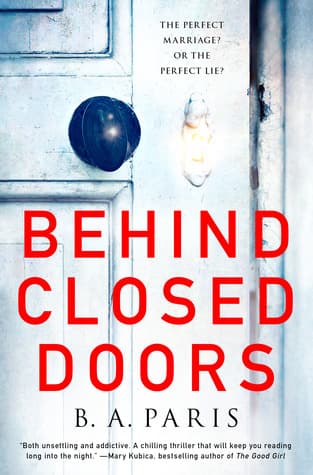
B.A. Paris (2016)
Genre
Thriller / Mystery / Romance
Reading Time
5-6 hours
Key Themes
See below
Sign in to track this book
Beneath their perfect marriage, a chilling story of control unfolds as Grace's every move is dictated by her charming, yet menacing, husband, Jack.
Grace and Jack Angel are introduced as a perfect couple. Jack is a successful, charming lawyer, and Grace is beautiful and elegant, known for her cooking. They live in a stunning house and host grand dinner parties, impressing everyone. But early observations show troubling details: Grace never answers her phone, is always with Jack, and seems very thin despite her cooking. The story moves between the present, where Grace seems happy, and flashbacks that slowly reveal the truth behind their polished image. These early scenes set up the outward perfection and the underlying tension.
Jack proposes to Grace, and she hesitates because of her strong bond with her younger sister, Millie, who has Down syndrome. Millie lives in a special needs home, and Grace is her main caregiver. Jack, however, uses Millie to his advantage, promising to build a beautiful, accessible garden for her at their future home. He describes himself as a loving, supportive husband who will welcome Millie. This promise, along with Grace's wish for a stable future for Millie, convinces her to accept Jack's proposal, unknowingly stepping into his trap. The garden becomes a symbol of her hope and, later, her confinement.
The wedding is a grand event, and Grace, despite some doubts, believes she is marrying a good man. The honeymoon in Thailand quickly shatters this idea. On their wedding night, Jack shows his true, terrifying nature. He locks Grace in their hotel room, taking her phone and passport. He admits his plan to imprison her, explaining that he enjoys the power of breaking women's spirits. Grace realizes with horror that the perfect life he promised was a lie, meant to isolate and trap her. Her shock turns into a desperate fight for survival and escape.
Back in their luxurious England home, Grace is immediately confined to a small, windowless room in the basement, which Jack calls her 'red room.' This room, with a bed and toilet, becomes her prison. Jack controls everything: her food, communication, and outside access. He dictates when she can be seen and how she must act during social events, threatening Millie's safety if Grace disobeys. Grace's only comfort is the faint light from the garden and her memories, as she endures psychological torture and complete isolation, her spirit slowly breaking.
Jack often hosts elaborate dinner parties, forcing Grace to act as the devoted, elegant wife. Before each event, he dresses her, applies her makeup, and coaches her on her behavior, threatening severe harm to Millie if Grace reveals anything. Grace becomes skilled at faking happiness, smiling and talking while her mind races with terror and escape plans. These public appearances are a harrowing performance, a sharp contrast to her imprisonment. The guests, unaware, praise their perfect marriage, further showing the deception and Grace's deep isolation.
The accessible garden Jack promised for Millie is built, but it becomes a cruel symbol of Grace's captivity. Jack allows Millie to visit the garden during the day, believing she is staying with her sister. Grace can only watch from her basement window, her heart aching. She knows Millie is unaware of her suffering, and Jack uses Millie's presence in the garden to torment Grace, knowing how much she loves her sister. The garden, initially a source of hope, becomes a stark reminder of Jack's manipulation and the devastating effect on her bond with Millie.
For Millie's birthday, Jack allows Grace to paint a picture for her. Grace uses this chance, hoping to show her situation. She paints a garden scene but includes subtle, disturbing details: a figure trapped behind bars, a distorted expression, and a hidden message. She hopes Millie, with her unique perception, might understand, or that the painting might cause suspicion. However, Jack intercepts the painting, recognizing her attempt to communicate. He punishes her severely, showing his complete control and crushing her hopes of outside help, deepening her despair.
As months pass, Grace's desperation grows. She tries various escape attempts, but Jack's careful planning and constant watch stop every effort. Her physical health worsens from malnutrition and stress, and her mental state is pushed to its limits by the psychological torture. She lives in constant fear for Millie's safety, which Jack uses against her. The story emphasizes her deep loneliness and the crushing weight of her situation, as she tries to stay sane and find a way out, knowing time is running out.
A new neighbor, Esther, moves in next door and, unlike others, starts to notice odd things about Jack and Grace's relationship. She observes Grace's strange behavior, the bars on the bedroom window, and their constant togetherness. Esther's growing unease offers a glimmer of hope for Grace, suggesting an outside view might finally break through Jack's carefully built facade. However, Jack is good at turning away suspicion, and Grace is too scared to risk drawing attention to Esther, knowing it could put Millie in greater danger. Esther's quiet observations put external pressure on Jack's control.
Grace, pushed to her breaking point, realizes she must take a drastic step. She carefully plans her escape, using every detail she has observed about Jack's routines and weaknesses. Her plan involves faking a severe illness to make Jack drop his guard, then giving him a sedative, and finally, causing his death. This is a high-stakes, all-or-nothing effort, as failure means certain death for her and potential harm to Millie. The story builds intense suspense as Grace prepares for her final, desperate gamble, knowing this is her one chance at freedom.
Grace puts her plan into action during one of Jack's elaborate dinner parties. She pretends to be very ill, forcing Jack to bring her water and medicine. While he is distracted, she slips a powerful sedative into his drink. As the evening goes on, Jack becomes increasingly drowsy. After the guests leave, Grace makes sure he is fully incapacitated. She then carefully stages the scene, making it look as though Jack, drunk, accidentally fell down the stairs, suffering a fatal injury. This is the critical moment of her escape, requiring immense courage and precision.
With Jack dead, Grace carefully covers her tracks, ensuring no evidence points to foul play. She then leaves the house, taking only what she needs. Her first priority is Millie. She arranges for Millie to be moved to a new, safe home where she can thrive. Grace then disappears, taking on a new identity and starting a new life, free from Jack's terror. She reflects on her ordeal, the strength she found, and the unbreakable bond with Millie that motivated her survival. The ending shows Grace finally regaining her freedom, with the scars of her past, but with new hope and purpose.
The Protagonist
Grace transforms from a hopeful bride into a terrified captive, and finally into a determined survivor who reclaims her freedom and ensures her sister's safety.
The Antagonist
Jack remains a consistently evil and manipulative character, his true nature fully revealed and ultimately leading to his downfall.
The Supporting
Millie remains a constant, innocent presence, her well-being secured by Grace's ultimate sacrifice and triumph.
The Supporting
Esther's suspicions grow, but she remains an outside observer, her curiosity adding to the tension without directly intervening until the end.
The Mentioned
Diane remains unaware of Grace's true situation, her presence highlighting Grace's isolation.
The main theme of the novel is the sharp contrast between the perfect image Jack and Grace show the world and the horrific reality of Grace's imprisonment. Their luxurious home, grand dinner parties, and Jack's charm all create the illusion of an ideal marriage. This theme appears in scenes where Grace must act as the 'happy wife' during social events, smiling and talking while secretly terrified for Millie's safety. The unsuspecting guests, like Esther's initial observations, are completely fooled, showing how easily evil can hide behind a perfect appearance.
“Everyone knows a couple like Jack and Grace. He has looks and wealth, she has charm and elegance. You might not want to like them, but you do.”
Jack's main goal is an overwhelming desire for absolute control and power over another person. He carefully plans Grace's captivity, taking away her identity, freedom, and independence. This theme is clear in his constant watch, the locked doors, the confiscation of her phone and passport, and his control over her food and communication. He enjoys breaking Grace's spirit, using threats against Millie to ensure her obedience. Grace's struggle is a fight to regain her freedom and resist his complete power, ending with her ultimate act of taking control of her own life.
“I want to watch you break, Grace. I want to see the light go out of your eyes.”
Grace's strong love for her sister, Millie, drives her survival and eventual escape. She initially marries Jack, swayed by his promise to care for Millie, and endures great suffering mainly to protect her. This theme is shown powerfully when Grace tries to send a coded message through a painting for Millie's birthday, risking severe punishment. Her final plan to escape and ensure Millie's long-term safety, even if it meant sacrificing her own life, shows the deepness of her family love and the sacrifices she will make for those she cares about.
“Millie was my anchor, the one thing that kept me tethered to life, to hope.”
Despite severe psychological and physical torture, Grace shows remarkable resilience and a strong will to survive. This theme appears in her inner resistance, her refusal to be completely broken, and her careful planning for escape. Even when her hope fades, she holds onto the thought of Millie, which fuels her determination. Her ability to maintain a normal appearance during dinner parties while secretly planning shows her strength and strategic thinking under extreme pressure. Her final success is proof of the human spirit's ability to endure and overcome great hardship.
“He thought he could break me. But he didn't know how strong I was, how much I had to live for.”
Alternating timelines slowly reveal the sinister truth behind the perfect marriage.
The novel employs a dual narrative structure, shifting between Grace's present life with Jack and flashbacks to their courtship and early marriage. The present-day scenes depict the chilling reality of her captivity, while the flashbacks gradually reveal Jack's manipulative nature and the subtle signs Grace missed. This device creates suspense, allowing the reader to piece together the puzzle of how Grace became trapped, simultaneously building empathy for her current plight and highlighting the insidious nature of Jack's deception.
A windowless basement room that symbolizes Grace's physical and psychological imprisonment.
The 'red room' is the windowless, locked basement room where Jack confines Grace. This specific setting serves as a powerful symbol of her complete lack of freedom and her psychological torture. It is a physical manifestation of Jack's control, a place where Grace is stripped of her identity and autonomy. The claustrophobic nature of the room emphasizes her isolation and despair, making her brief ventures upstairs for dinner parties even more jarring and highlighting the stark contrast between her public and private existence.
A symbol of hope twisted into a tool of psychological torment.
Jack's promise to build an accessible garden for Millie is what initially convinces Grace to marry him. The garden, therefore, represents hope, love, and a future for Millie. However, once Grace is imprisoned, the garden becomes a cruel tool of psychological torment. Grace can see Millie in the garden from her basement window, but cannot reach her. This turns a symbol of love into a constant reminder of her captivity and the danger Millie is in, deepening Grace's despair and fueling her ultimate desire for revenge and freedom.
The meticulously maintained public image of a perfect couple, masking a horrifying reality.
The 'perfect facade' is the elaborate illusion Jack and Grace maintain for the outside world. This device is crucial to the plot, as it explains why no one suspects Grace's plight. Jack is charming and wealthy, and Grace is forced to play the role of the doting wife during dinner parties. This outward perfection prevents any intervention, making Grace's escape incredibly difficult. It also highlights the theme of appearances versus reality and the insidious nature of domestic abuse that can hide in plain sight.
“There are two kinds of people in this world. The ones who walk into a room and say, 'Here I am,' and the ones who walk in and say, 'Ah, there you are.'”
— Jack Angel describing his view on social interactions and his own charm.
“Every marriage has its secrets. But theirs is a secret that could destroy them both.”
— A general narrative statement hinting at the core mystery of Jack and Grace's relationship.
“He doesn't need to lock me in a room. He's locked me in his life.”
— Grace reflecting on the psychological prison Jack has created for her.
“People always want to believe the best in others, especially when they're charming.”
— Grace's internal thought about why others are easily fooled by Jack.
“He loved the idea of me, not the real me.”
— Grace realizing Jack's affection was for an idealized version of her, not her true self.
“The perfect couple. Everyone said so. And that was the problem.”
— Narrator's observation on the facade Jack and Grace present to the world.
“Sometimes the most beautiful things hide the darkest secrets.”
— A general thematic statement about the contrast between outward beauty and inner darkness.
“He had taken everything from me. My freedom, my voice, my hope.”
— Grace listing the things Jack has stripped away from her.
“Fear can be a powerful motivator, but so can hope.”
— Grace considering her options and motivations for survival and escape.
“The silence was his weapon, and I was his prisoner.”
— Grace describing Jack's method of control and her trapped situation.
“You never truly know what goes on behind closed doors.”
— A meta-commentary on the central theme of the novel.
“He was a master of manipulation, and I was his masterpiece.”
— Grace acknowledging Jack's skill in controlling her and her role in his twisted game.
“I had to become someone else to survive. Someone he wouldn't expect.”
— Grace planning her eventual escape and transformation.
“The most dangerous lies are the ones we tell ourselves.”
— Grace reflecting on her initial denial and the self-deception that kept her trapped.
Ready to see how well you understood this book? Take our interactive quiz with 10 questions.

B.A. Paris is a British author known for her gripping psychological thrillers. Her debut novel, 'Behind Closed Doors,' became an international bestseller, lauded for its suspenseful plot and exploration of dark relationships. She continues to captivate readers with novels like 'Bring Me Back,' solidifying her reputation in the domestic noir genre.







