“Don't try to remember. Just try to understand.”
— Dr. Nash's advice to Christine, highlighting the futility of forcing memories.

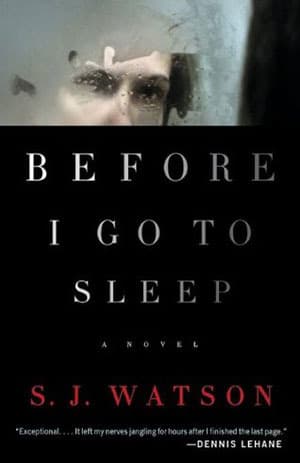
S.J. Watson (2015)
Genre
Thriller / Mystery
Reading Time
7-8 hours
Key Themes
See below
Sign in to track this book
Amnesia-stricken Christine pieces together her past each day, only to uncover a chilling truth that makes her question everything her husband has told her.
Every morning, Christine Lucas awakens in an unfamiliar bedroom next to a stranger. This man, Ben, patiently explains that he is her husband, and she is Christine, a 47-year-old woman with anterograde amnesia due to a traumatic accident twenty years prior. She has no memory of her life after her early twenties, and each day is a complete reset. Ben shows her a photo album, reminding her of their life together, their marriage, and the accident that stole her memory. Christine struggles with the difference between the presented reality and her internal sense of self, which feels much younger and unburdened by two decades of shared history.
One morning, Christine receives a phone call from Dr. Nash, a neuropsychologist, who reveals they have been working together for weeks without Ben's knowledge. He instructs her to find a hidden journal she keeps, a process she repeats daily. This journal becomes her lifeline, a concrete record of her thoughts and experiences that bypasses her memory deficit. Dr. Nash encourages her to write everything down, promising to call her each morning to remind her of their sessions. This secret therapy introduces suspicion into Christine's already disorienting existence, making her question Ben's motivations and the full truth of her condition.
As Christine reads her journal entries each day, she starts to find inconsistencies between her written recollections and Ben's daily explanations. She learns about past arguments with Ben, her discomfort with their life, and the growing sense of unease she feels about her situation. The journal also hints at a son, Adam, whom Ben initially claimed they did not have, or that he had died. This difference deeply disturbs Christine, making her question Ben's honesty and his reasons for withholding information. The journal is a silent, evolving witness to her struggle for truth.
Christine finds proof in her journal that she had a son named Adam. When she confronts Ben, he initially tries to change the subject, then admits that Adam is alive but distant, having resented Christine's condition. Ben claims he withheld this information to protect her from further pain, as Adam rarely visits. This revelation shatters Christine's trust in Ben, confirming her growing suspicion that he has been manipulating her for years. The existence of Adam becomes a central mystery, driving Christine's desire to understand her past beyond Ben's controlled story. She feels a deep grief for the lost years with her son.
Through her journal, Christine pieces together fragments that contradict Ben's story of a car accident causing her amnesia. She finds references to a brutal assault, a beating that left her severely injured. This new information deeply affects her, changing her view of herself from an accident victim to a survivor of violence. The journal entries detail her trauma and the gradual realization that the official story is a lie. This discovery increases her fear and distrust, as she begins to suspect that the truth of her past might be far more sinister and that Ben might be more involved than he lets on.
With Dr. Nash's encouragement and against Ben's wishes, Christine arranges to meet Adam. The reunion is emotionally charged and confusing for Christine, who has no memory of him as an adult. Adam, now a young man, confirms some of Ben's stories about his difficult relationship with his mother's condition but also reveals details that further challenge Ben's story. He shares memories of their family life before the accident, offering Christine glimpses of her past through someone else's eyes. This meeting provides Christine with an independent source of information, validating her suspicions about Ben's selective storytelling.
One day, while searching for clues, Christine finds an old photograph of herself with a man she does not recognize. The man in the picture is clearly not Ben. This discovery triggers a terrifying realization: the man she has been living with, the man she believes to be her husband, is an impostor. The true Ben Lucas is nowhere to be found. This revelation is the climax of her journey, overturning her entire perceived reality and plunging her into deep terror and confusion. She realizes the full extent of the deception she has been living under for twenty years.
Through a series of agonizing recollections and further journal entries, Christine realizes that the man she knows as Ben is actually Mike, the man who brutally assaulted her twenty years ago, causing her amnesia. He had been a former lover of hers. Mike, obsessed with her, took advantage of her condition to kidnap her and live out a twisted fantasy of their life together. The 'accident' was his doing, and he has been her captor, not her husband, all along. This horrifying truth explains all the inconsistencies and Ben's manipulative behavior.
Armed with the full, terrifying truth, Christine confronts Mike. The confrontation is dangerous, as Mike attempts to gaslight her, denying her accusations and trying to reinforce his fabricated reality. Christine, however, holds onto her fragmented memories and the evidence from her journal. A struggle ensues, fueled by Christine's desperation to escape and Mike's determination to maintain his control. She manages to fight him off, her survival instincts kicking in with a ferocity born of twenty years of stolen life.
During their struggle, Mike is accidentally killed. Christine is found by the authorities, who have been alerted by Dr. Nash's growing concerns. The police investigate, confirming Mike's true identity and the horrific nature of Christine's captivity. Despite the resolution of the physical threat, Christine's amnesia remains. She is reunited with the real Ben Lucas, who has been searching for her for years, and Adam. While the immediate danger is over, Christine still faces the daily challenge of her memory loss, but now she is surrounded by the true people from her past, beginning a new, if still difficult, path towards recovery.
The Protagonist
From a confused, helpless victim, Christine transforms into a determined detective, uncovering the horrific truth of her past and reclaiming a semblance of agency.
The Antagonist
Initially appearing as a supportive, long-suffering husband, he is gradually exposed as a deceptive, controlling, and ultimately violent abuser.
The Supporting
A consistent pillar of support and ethical guidance, his role is primarily to enable Christine's discovery and ensure her safety.
The Supporting
From an unknown and emotionally distant figure, he becomes a tangible link to Christine's true past and a source of independent information.
The Antagonist
His true, villainous nature is gradually exposed, culminating in his confrontation and death.
The Mentioned
His presence is felt through his absence and the impact of his loss, and he is ultimately reunited with Christine.
The novel deeply explores how identity is built, particularly when memory is absent. Christine struggles daily with who she is, relying on external stories from 'Ben' and later her journal. Her sense of self is constantly challenged by conflicting information, forcing her to question if she is the person described by others or the person she feels she is internally. This theme is central to her journey as she tries to reconcile her youthful internal self with the older, amnesiac woman she sees in the mirror, and ultimately with the survivor she discovers herself to be. The discovery of her true history fundamentally changes her self-perception from a victim of an accident to a victim of a crime.
“I open my eyes, and instantly I know that something is wrong. I don't know who I am. I don't know where I am.”
The core of the mystery revolves around the widespread deception Christine lives under. 'Ben' carefully creates a false reality, controlling every piece of information she receives. The journal becomes a critical tool for Christine to uncover the truth, piece by piece, as she finds inconsistencies and outright lies. The novel highlights the subtle nature of gaslighting and how difficult it is to find truth when one's own memory is compromised. The gradual unraveling of 'Ben's' lies, from the existence of her son to the nature of her accident, drives the entire plot and exposes the dangers of manipulation.
“My journal. My truth. My memories. This is the only way I can keep track of what's real.”
Christine's amnesia is not just a plot device but a deep exploration of memory's role in human experience and its connection to trauma. Her inability to form new memories makes her perpetually vulnerable and trapped in a cycle of rediscovery. The novel looks into how trauma can show up, not just in physical injury, but in the psychological breaking of memory. While her anterograde amnesia prevents new memories, the slow, agonizing return of fragmented retrograde memories about her assault is important to her understanding. It suggests that even deeply buried traumatic memories can resurface, though painfully and incompletely.
“My mind is a blank page, but the past is written there somewhere, waiting to be found.”
Christine's life is defined by a lack of control; her memory dictates her daily existence, and 'Ben' dictates her perceived reality. Her journey is one of slowly reclaiming agency. By secretly working with Dr. Nash and maintaining her journal, she takes control of her narrative and her investigation. Each discovery, no matter how terrifying, gives her a small piece of autonomy. The climax, where she confronts her captor, is her ultimate act of reclaiming agency and fighting for her freedom, even if her memory remains impaired. The novel emphasizes the human need for self-determination against overwhelming odds.
“I am not just a collection of symptoms. I am a person, and I deserve to know my own story.”
The central neurological condition preventing Christine from forming new memories.
This is the primary plot device, creating Christine's daily reset and her vulnerability. It establishes the initial mystery and the high stakes. It necessitates the use of the journal, as Christine cannot rely on her own internal memory. This condition makes her entirely dependent on her environment and the people around her for information, setting the stage for the deception orchestrated by 'Ben'. It also highlights the profound psychological impact of losing one's ability to retain experiences, making every interaction and revelation feel fresh and terrifying each day.
Christine's secret diary, acting as her external memory and a source of truth.
The journal is a crucial plot device, serving as Christine's only consistent link to her accumulating experiences and discoveries. It allows the narrative to progress despite her amnesia, as she reads her previous entries daily. It functions as a confessional, a detective's notebook, and a direct line to her evolving suspicions. The journal's contents gradually contradict 'Ben's' narrative, providing the evidence Christine needs to piece together the true story and offering the reader insight into her daily struggle and fragmented revelations.
Christine's internal monologue and perceptions are constantly shifting due to her amnesia.
While Christine is the protagonist, her memory impairment makes her an inherently unreliable narrator in the traditional sense. Her understanding of events changes daily, and her initial trust in 'Ben' is based on his repeated explanations, not her own recollection. This device creates suspense and forces the reader to experience Christine's confusion and doubt. It also highlights the psychological impact of her condition, where her internal reality is perpetually unstable, adding to the tension as she tries to discern truth from deception.
Psychological manipulation by 'Ben' to make Christine doubt her perceptions and sanity.
Gaslighting is a pervasive plot device used by 'Ben' to control Christine. He consistently denies her emerging suspicions, dismisses her journal entries as confused ramblings, and reinforces his false narrative. This manipulation is particularly effective due to Christine's amnesia, as she has no internal memories to counter his claims. This device creates immense psychological tension and makes Christine question her own sanity, heightening her vulnerability and making her eventual discoveries all the more impactful and terrifying.
“Don't try to remember. Just try to understand.”
— Dr. Nash's advice to Christine, highlighting the futility of forcing memories.
“Every day, I start again. Every day, I am born.”
— Christine's internal monologue reflecting her daily struggle with amnesia.
“My past is a foreign country. I don't know who I am.”
— Christine's feeling of alienation from her own history due to memory loss.
“The truth is not always what you want it to be.”
— A realization Christine makes as she uncovers disturbing facts about her past.
“How can you trust someone when you don't even know yourself?”
— Christine's dilemma regarding her husband, Ben, given her memory condition.
“We are all defined by our memories. But what if you don't have any?”
— Christine's existential crisis about her identity.
“He says I chose him. I don't remember choosing anyone.”
— Christine's doubt about her marriage to Ben, lacking any memory of their relationship.
“The diary is my only friend. It tells me who I am.”
— Christine's reliance on her hidden journal to piece together her life.
“Fear is a powerful motivator. Especially when you don't know what you're afraid of.”
— Christine's constant state of unease and suspicion.
“Sometimes it's better not to know. Sometimes the truth just hurts.”
— A reflection on the painful revelations Christine uncovers.
“I live in a constant state of déjà vu, but without the 'vu' part.”
— Christine's unique experience of life, lacking memory of previous events.
“You can forget a lot of things, but you never forget how someone made you feel.”
— A poignant thought from Christine, even with her amnesia.
“He looks like a stranger. He sounds like a stranger. But he says he's my husband.”
— Christine's daily struggle to reconcile her husband's claims with her own perceptions.
“My life is a blank page, written over every night.”
— A poetic description of Christine's condition, where her memories are erased daily.
Ready to see how well you understood this book? Take our interactive quiz with 10 questions.







