“The State is me. I am the State. I can do what I like with you, and with the whole of England.”
— Henry II speaking to Becket, asserting his absolute power.

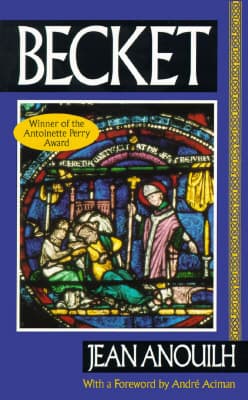
Jean Anouilh (1959)
Genre
Historical Fiction
Reading Time
144 min
Key Themes
See below
Sign in to track this book
Anouilh's 'Becket' explores the souls of men caught between earthly power and divine conviction during the Norman conquest, from a king's prayer to a saint's sacrifice.
The play opens with King Henry II, stripped and whipped, kneeling in penance at Thomas Becket's tomb in Canterbury Cathedral. Monks administer the lashes. This scene immediately sets up the main conflict and Becket's tragic end, creating a somber tone. Henry's actions are a public show of regret and an attempt to reconcile with the Church and his conscience after his former Chancellor and Archbishop's murder. The scene frames the story, hinting at the deep relationship that led to this moment of humility for the King.
The story flashes back to Henry II, a young, loud Norman king, struggling to control the Saxon people and the Church. He is frustrated by his Norman barons' inefficiency and the constant need to please the Archbishop of Canterbury. During a hunt, he meets Thomas Becket, a young, sophisticated, and seemingly amoral Saxon. Impressed by Becket's intelligence, wit, and lack of typical ambition, Henry likes him. Despite Becket being a Saxon, a group generally disliked by Normans, Henry sees him as a potential confidant and a way to consolidate his power, especially against the Church.
Becket quickly rises, becoming Henry's Chancellor and closest friend. He fully adopts the lavish lifestyle of a Norman lord, sharing Henry's love for hunting, women, and entertainment. Becket proves to be a very effective Chancellor, ruthlessly carrying out Henry's will and centralizing power. He helps Henry bring order to the kingdom, often at the expense of the Church's traditional rights. Their bond is deep, marked by mutual affection, shared interests, and understanding. Becket, despite his Saxon roots, becomes more Norman than the Normans, enjoying his new status and power.
The old Archbishop of Canterbury dies, creating a vacancy. Henry, wanting to control the Church and ensure its obedience, sees an opportunity. He decides to appoint Becket as the new Archbishop, believing his loyal Chancellor will continue to serve the King's interests and help limit the Church's power. Despite warnings from his mother and others about a possible spiritual change in Becket, Henry trusts his friend's loyalty and perceived lack of religious belief. Becket initially resists, sensing the profound shift this appointment would bring.
Despite his initial reluctance and warnings to Henry, Becket accepts the Archbishopric. The moment he puts on the Church's robes, a deep and unexpected change begins. He gives up his flamboyant lifestyle, renounces his worldly possessions, and dedicates himself entirely to God and the Church. His former love for luxury and power is replaced by asceticism, piety, and an unwavering commitment to his new spiritual role. This sudden change shocks Henry, who expected his loyal Chancellor to remain compliant. Becket's transformation begins the irreconcilable conflict between the two men.
As Archbishop, Becket immediately champions the Church's rights and privileges, often directly opposing Henry's policies. He challenges Henry on issues like the jurisdiction of church courts and the Church's right to property. What Henry saw as a way to control the Church, Becket now sees as a divine calling to protect it. Their intimate friendship quickly turns into a power struggle. Henry is angry at what he sees as Becket's betrayal, while Becket views his actions as fulfilling his sacred duty. Their personal bond is now overshadowed by their conflicting institutional roles.
The conflict grows, with Henry trying to strip Becket of his lands and authority. Becket, refusing to compromise, flees to France, seeking protection from King Louis VII and Pope Alexander III. During his exile, Becket lives a life of austerity, strengthening his spiritual commitment. Henry, meanwhile, faces pressure from the Pope and other European monarchs who threaten excommunication if he does not reconcile with Becket. The political consequences of their feud grow, involving the entire European Christian world and showing the Church's immense power.
Several attempts to make peace occur, including a meeting between Henry and Becket in France. While there are moments of warmth and hope for their old friendship to rekindle, their fundamental differences remain. Henry demands Becket's submission to royal authority over the Church, while Becket insists on the supremacy of God's law and the Church's independence. Neither man will yield on their core principles. The meeting fails, with both men realizing the gap between them is too wide, sealing their tragic fate.
Under pressure from the Pope and tired of exile, Becket eventually agrees to return to England, having secured a fragile peace with Henry, though without full resolution. He knows, however, that his return is dangerous. Before leaving France, he makes arrangements for his burial, showing he foresees martyrdom. His arrival in England is met with popular acclaim and the resentment of Henry's loyalists and certain bishops he had excommunicated. Becket's return is an act of faith, knowing it could lead to his ultimate sacrifice.
Back in England, Becket continues to assert the Church's authority, excommunicating bishops who supported Henry. This angers Henry, who, hearing the news at Christmas, shouts in rage, "Will no one rid me of this turbulent priest?" Though Henry later claims he did not mean it as a direct command for murder, four of his knights interpret his words as such. This moment is the turning point, leading directly to the tragic climax and showing Henry's impulsiveness and the dangerous power of a king's anger.
The four knights travel to Canterbury Cathedral, confronting Becket. They demand he revoke the excommunications and submit to the King. Becket steadfastly refuses, declaring his loyalty to God and the Church. Despite warnings from his monks to flee, Becket calmly awaits his fate. The knights kill him on the altar steps. His death is a shocking and sacred event, solidifying his image as a martyr and transforming him into a saint. This violence deeply affects Henry and the kingdom, leading to widespread condemnation and Becket's veneration.
The play returns to Henry's penance at Canterbury. Henry is haunted by Becket's death and the loss of his friend. He acknowledges his role in the tragedy, even if unintended. He reflects on Becket's change and his own ongoing struggle with spiritual and temporal matters. Becket, though dead, achieves an eternal victory, becoming a saint and a symbol of spiritual defiance against temporal power. Henry, despite his power, is left with the burden of his actions and the deep void left by the man who was once his closest companion and then his greatest enemy. The ending shows the lasting impact of their conflict.
The Protagonist
Becket transforms from a hedonistic, politically savvy Chancellor into a devout, self-sacrificing Archbishop who finds his true identity and purpose in serving God, ultimately becoming a martyr.
The Antagonist/Co-Protagonist
Henry begins as a powerful, confident king who believes he can control all aspects of his kingdom, only to be humbled by Becket's spiritual resistance and the profound guilt of his friend's murder.
The Supporting
Gwendolen serves as a catalyst for revealing Henry's possessiveness and Becket's early attachment to worldly pleasures, before being discarded by both men.
The Supporting
Eleanor remains a consistent, pragmatic voice, highlighting the political implications of Henry's emotional decisions.
The Supporting
The Pope's decisions and influence serve to escalate the conflict and ultimately facilitate Becket's return to England, knowing the risks.
The Supporting
Louis serves as a temporary haven and political chess player, highlighting the broader European context of the conflict.
The Mentioned
His death sets the entire plot in motion.
The Supporting
They serve as the physical agents of the tragic climax, embodying the king's unchecked power and the danger of literal interpretation.
The play explores identity, especially through Thomas Becket's radical change. Becket begins as a Saxon who adopts Norman culture and a worldly life, seemingly without a fixed moral center. His acceptance of the Archbishopric, however, forces him to shed his old identity for one rooted in spiritual duty. This change is sudden and complete, leading him to find 'God's honor' that goes beyond earthly loyalty. Henry also struggles with his identity as a king versus his feelings for Becket. The play suggests true identity can be found in selfless devotion to a higher cause, even if it brings conflict and martyrdom.
“I was a man without honor. I was a man who served his King. Now I am a man who serves God. And in that, I have found my honor.”
This is the play's central conflict. Henry demands absolute loyalty to the crown, seeing Becket's change as a betrayal of their friendship and his king. Becket, however, shifts his loyalty from the king's temporal power to God and the Church's spiritual principles. The play asks where ultimate loyalty should lie: with a personal bond, a political entity, or a divine calling. Becket's unwavering commitment to his principles, even to death, highlights how these two forms of loyalty clash irreconcilably.
“You are my friend, Becket! My creature! You owe me everything!”
Anouilh examines various forms of power: the king's absolute temporal power, the Church's spiritual power, and the personal power of conviction. Henry wields political and military power, believing he can control all aspects of his kingdom, including the Church. Becket, once a master of political power as Chancellor, finds a different, more lasting power in spiritual authority and martyrdom. The play shows that while temporal power can enforce obedience, spiritual power can inspire faith and ultimately last beyond death, leaving a legacy even kings must face.
“The King's power is only for a lifetime. God's power is eternal.”
The deep, complex friendship between Henry and Becket forms the play's emotional core. They share a unique bond, a love for life, and mutual understanding. Henry feels a deep sense of personal betrayal when Becket, as Archbishop, turns against him. Becket, in turn, feels he has betrayed his old self, but not his true calling. The play explores how political and spiritual obligations can tragically destroy even the strongest personal bonds, leaving both individuals deeply scarred. Henry's penance is as much for the loss of his friend as for the murder of an archbishop.
“I loved him, you see. I loved him. And he betrayed me.”
The play begins and ends with Henry's penance at Becket's tomb.
The play opens with King Henry II performing public penance at Becket's tomb, then flashes back to the beginning of their relationship, and finally returns to the present-day penance. This device immediately establishes the tragic outcome and the profound weight of the past events. It creates a sense of foreboding and allows the audience to view the unfolding events through the lens of their inevitable conclusion, emphasizing the themes of guilt, fate, and the lasting impact of the conflict.
The audience is aware of Becket's future martyrdom from the outset.
From the very first scene, the audience knows that Becket will die and that Henry will be implicated in his death, leading to his penance. This creates dramatic irony as the audience watches Henry's initial delight in Becket and his confident appointment of him as Archbishop. The audience understands the tragic consequences of Henry's actions and Becket's transformation long before the characters do, heightening the tension and the sense of inevitability in their escalating conflict.
A symbolic prop representing a character's role and transformation.
The robes that Becket wears, first as Chancellor (luxurious, worldly) and then as Archbishop (austere, spiritual), are powerful symbols. The act of Becket donning the Archbishop's vestments marks his immediate and profound spiritual transformation. The robes represent not just a change in office, but a complete shift in identity, loyalty, and purpose. They visually signify the moment Becket sheds his worldly self and fully embraces his divine calling, setting him on an irreversible path towards martyrdom.
A rash statement leading to unforeseen, tragic consequences.
Henry's infamous cry, "Will no one rid me of this turbulent priest?" is a classic example of a king's words having unintended, yet devastating, consequences. It serves as the direct catalyst for Becket's murder. This device highlights the immense power of a monarch's words, even when spoken in a moment of unbridled rage, and the dangerous loyalty of those who interpret them literally. It underscores Henry's impulsiveness and his ultimate responsibility for the tragic climax, despite his later claims of not intending murder.
“The State is me. I am the State. I can do what I like with you, and with the whole of England.”
— Henry II speaking to Becket, asserting his absolute power.
“I was a Saxon. That's a great deal to be, for me. For a long time, I didn't know what I was. Now I know.”
— Becket reflecting on his Saxon heritage and newfound identity as Archbishop.
“When one has to govern a country, one must have a certain amount of cynicism. And a certain amount of indifference.”
— Henry II explaining the necessities of rulership to Becket.
“God's honour, my Lord. It is not mine, but His.”
— Becket defending the rights of the Church against the King, now as Archbishop.
“You are my friend, Thomas. My only friend. Don't go and become God's friend, too, it's too much.”
— Henry II pleading with Becket not to prioritize his religious duties over their friendship.
“One does not choose God, one is chosen.”
— Becket accepting his fate and the burden of his new role as Archbishop.
“I had a Saxon for a friend. Now I have a saint for an enemy.”
— Henry II lamenting the transformation of Becket from his companion to a spiritual adversary.
“There are times when one must choose between one's king and one's conscience.”
— Becket explaining his dilemma to the Pope's Legate.
“It is a terrible thing to have to choose between God and Caesar.”
— Becket expressing the profound difficulty of his position.
“A man must be true to what he is, even if it kills him.”
— Becket's internal monologue about remaining steadfast to his new identity.
“When you are a king, you are never alone. But you are always lonely.”
— Henry II reflecting on the isolation of his royal position.
“I am not God. I am only a man. But I am a man who has chosen his path.”
— Becket asserting his human will and determination.
“There is no more dangerous animal than a priest who believes in God.”
— Henry II's cynical observation about Becket's fervent faith.
“I have loved him, and I have hated him. And I shall never forget him.”
— Henry II's final reflection on his complex relationship with Becket.
Ready to see how well you understood this book? Take our interactive quiz with 10 questions.

Biography coming soon.







