“You can't always judge people by the things they done. You got to judge them by what they are doing now.”
— Opal's father, the preacher, advises her about forgiveness and understanding others.

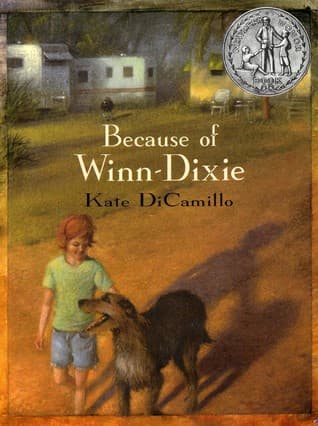
Kate DiCamillo (2000)
Genre
Children's / Young Adult
Reading Time
180 min
Key Themes
See below
Sign in to track this book
A lonely girl in a new town finds unexpected friendships and learns to mend her heart, all thanks to a scruffy, smiling dog named Winn-Dixie.
Ten-year-old India Opal Buloni, recently moved to Naomi, Florida, with her preacher father, feels lonely and misses her absent mother. At the Winn-Dixie supermarket, she finds a large, scruffy, and smelly dog causing trouble. Instead of letting him go to the pound, Opal claims the dog, naming him Winn-Dixie after the store. She convinces her father to let her keep him, promising to take full responsibility. Winn-Dixie quickly proves to be an unusual but loving companion, with a fear of thunderstorms and a talent for making friends, instantly easing Opal's solitude in their new town.
Because of Winn-Dixie, Opal feels brave enough to ask her reserved father, the Preacher, about her mother, who left when Opal was three. The Preacher, usually quiet about the topic, agrees to tell Opal one thing about her mother for each of Opal's ten years. He reveals details like her red hair, her love for stories, her laughter, her green thumb, her kindness to stray animals, her inability to cook, her sensitivity, her dislike of wearing shoes, and her love of whiskey. These revelations begin to paint a picture of the mother Opal barely remembers, helping her understand her own roots.
Opal and Winn-Dixie visit the Herman W. Block Memorial Library, where they meet the elderly librarian, Miss Franny Block. Miss Franny is startled by Winn-Dixie at first, but the dog's charming nature quickly wins her over. Miss Franny, a kind but somewhat lonely woman, tells Opal a captivating story: how, as a young girl, she once fought off a bear that wandered into her library using a copy of Leo Tolstoy's *War and Peace*. This story starts a unique friendship between Opal, Winn-Dixie, and Miss Franny, who becomes a source of wisdom and tales for Opal.
While on an errand, Winn-Dixie runs off into a neglected yard, leading Opal to a small, cluttered house belonging to Gloria Dump. Gloria is an elderly, nearly blind woman with a kind manner and a unique outlook on life. Her backyard has a 'mistake tree' covered with empty alcohol bottles, a reminder of her past struggles with drinking. Gloria offers Opal peanut butter sandwiches and encourages her to tell stories. Despite her failing eyesight, Gloria understands people and life deeply, and she quickly becomes a cherished friend and mentor to Opal, offering comfort and unusual wisdom.
To earn money for a collar and leash for Winn-Dixie, Opal asks for a job at Gertrude's Pets. She meets Otis, a shy, soft-spoken man who works there. Otis is an ex-convict who went to jail for disturbing the peace after playing music on the street. Despite his quiet nature, Otis has an extraordinary talent with animals; he can play his guitar and mesmerize all the pets in the shop, even letting them out of their cages to dance around him. Opal begins working for Otis, sweeping floors and helping with the animals, and through him, learns about looking beyond appearances and judging people by their hearts.
Opal meets two brothers, Dunlap and Stevie Dewberry, who live next door to Gloria Dump. They are unwelcoming and tease Opal, calling Gloria a witch. However, Opal also meets Sweetie Pie Thomas, a small, lonely girl who likes Winn-Dixie and dreams of having a party. Sweetie Pie often sits on her porch, sucking her thumb, and becomes another person Opal shows growing kindness and friendship to. These interactions show Opal's developing confidence and her ability to connect with different people in Naomi.
One day, a strong thunderstorm starts, showing Winn-Dixie's deep fear of loud noises. He panics, running wildly through the house, knocking things over, and eventually hiding under the Preacher's bed, shaking uncontrollably. Opal, at first frustrated and worried, realizes how scared Winn-Dixie is. This event brings Opal closer to her dog, as she comforts him and understands that even beloved companions have vulnerabilities and fears. It also makes her think about her own fears and how important it is to comfort and understand others.
Inspired by Sweetie Pie Thomas's wish for a party and her desire to bring her new friends together, Opal decides to host a party at Gloria Dump's house. She gets Gloria's help in preparing food and decorations, and begins inviting everyone she has befriended: Miss Franny Block, Otis, the Dewberry boys (though they are hesitant), and of course, Sweetie Pie Thomas. The party becomes a main focus for Opal, a way to celebrate her friendships and create a sense of community among the diverse group of people Winn-Dixie has helped her meet.
The party at Gloria Dump's begins with a happy atmosphere, with Otis playing his guitar and Gloria's special punch. However, a sudden, fierce summer thunderstorm rolls in. True to his nature, Winn-Dixie is terrified and runs away in a panic. The partygoers, including Opal, the Preacher, Gloria, Miss Franny, Otis, and even the Dewberry boys, stop everything to search for the dog. Opal is devastated, fearing she has lost her best friend, and blames herself for not protecting him from the storm. The search is frantic and emotional, showing how much Winn-Dixie has come to mean to everyone.
After a long, tearful search, Winn-Dixie is found by Otis, hiding under Gloria Dump's bed, shaking but safe. His return brings great relief and joy to everyone. After the scare, Opal has an honest conversation with her father. She confronts him about her mother, expressing her grief and anger, and her father shares his own pain and regret, admitting he misses her too. This open talk helps them connect more deeply. The party resumes, and Opal realizes that even without her mother, she has found a loving family in her new friends and her father, all thanks to Winn-Dixie.
The Protagonist
Opal transforms from a solitary, somewhat resentful child into a confident, compassionate girl who embraces friendship and finds peace with her past and present.
The Supporting
Winn-Dixie remains consistently himself, his presence acting as the primary driver for Opal's emotional and social development.
The Supporting
He moves from a reserved, grief-stricken father to one who is more open, communicative, and emotionally present for his daughter.
The Supporting
Her character remains consistently wise and empathetic, acting as a stable source of guidance for Opal.
The Supporting
She finds renewed companionship and purpose through her friendship with Opal and Winn-Dixie.
The Supporting
He remains a gentle, consistent presence, finding a quiet connection with Opal and the community.
The Supporting
She gains a friend in Opal and experiences the joy of a party, fulfilling her simple wish.
The Supporting
They gradually soften from initial hostility to reluctant participation in the community.
The main theme is the strong impact of friendship and finding a chosen family. Winn-Dixie helps Opal, a lonely newcomer, connect with different people in Naomi: the wise Gloria Dump, the unique Miss Franny Block, the quiet Otis, and even the initially unfriendly Dewberry boys. The novel shows how these unlikely friendships grow, offering support, understanding, and a sense of belonging to each character, all leading to the inclusive party at Gloria Dump's house.
“It was because of Winn-Dixie that I met all these people. It was because of Winn-Dixie that I got to know the preacher better. And it was because of Winn-Dixie that I had my first real party.”
Opal deals with the deep sadness of losing her mother, whose absence has left a big hole in her life and created distance with her father. Through talks with the Preacher and her new friends, especially Gloria Dump, Opal starts to process her grief and accept that some questions may never be fully answered. The book explores the idea that while loss hurts, it doesn't mean the end of happiness or the inability to form new connections. Accepting the past helps Opal embrace her present and future.
“You can't hold on to anything too tight, or it will run away. You've got to hold it loose, like a bird in your hand. Let it go if it wants to go. Because if you squeeze too tight, you'll kill it.”
Many characters in the book are first judged or misunderstood based on how they look. Gloria Dump is seen as a 'witch' by the Dewberry boys, Otis is an ex-convict, and Winn-Dixie is a scruffy, smelly dog. Opal, however, learns to look past these outside traits and see the kindness, wisdom, and unique qualities within each person and animal. This theme emphasizes empathy and open-mindedness, suggesting that true understanding comes from looking with one's heart, like Gloria Dump, who is physically blind but sees deeply.
“The thing about Gloria Dump is, she may be nearly blind, but she sees a whole lot more than most people.”
Stories are important in shaping Opal's understanding of her world, her mother, and her new community. The Preacher's ten facts about Opal's mother, Miss Franny Block's historical stories (like the bear incident), and the personal stories shared by Gloria Dump and Otis all help Opal grow emotionally. Storytelling helps preserve memories, connect generations, process past events, and build bonds between people, allowing characters to share their vulnerabilities and triumphs.
“And I got to thinking about my mama, and how she was a good storyteller, and how I was a good listener, and how that's what we had in common.”
The dog acts as the primary driver for Opal's social and emotional growth.
Winn-Dixie is not just a pet; he is the central catalyst for almost every significant event and relationship in the story. His presence prompts Opal to talk to her father about her mother, to overcome her shyness and introduce herself to strangers like Miss Franny Block and Gloria Dump, and to get a job at Gertrude's Pets, where she meets Otis. His endearing, friendly nature breaks down barriers between people, creating a sense of community where none existed before. Without Winn-Dixie, Opal would likely remain a lonely, isolated child.
The Preacher's ten revelations about Opal's mother provide a structured way to reveal backstory and deepen character.
The Preacher's decision to tell Opal one thing about her mother for each year she's been alive provides a unique, episodic structure for revealing crucial backstory. This device slowly builds a portrait of Opal's absent mother, not as a perfect figure, but as a complex human being with both strengths and flaws. It allows Opal (and the reader) to piece together her mother's identity gradually, reflecting how a child might slowly come to understand a parent they barely remember. This structure also facilitates the emotional thawing between Opal and her father.
A powerful symbol of past mistakes, forgiveness, and growth.
Gloria Dump's 'mistake tree' in her backyard, adorned with empty alcohol bottles, serves as a potent symbol. It represents her past struggles with alcoholism and her journey of overcoming those mistakes. It's a physical manifestation of her past that she acknowledges but doesn't let define her present. For Opal, it becomes a lesson in forgiveness—both for others and for oneself—and the idea that even mistakes can be transformed into something meaningful or at least acknowledged as part of one's history without shame. It signifies growth and resilience.
A plot device that reveals vulnerability and deepens emotional bonds.
Winn-Dixie's intense, debilitating fear of thunderstorms is a recurring plot device that serves multiple functions. It highlights the dog's vulnerability, making him more endearing and relatable. More importantly, it provides moments of crisis that bring characters together, most notably during the party when he runs away, forcing everyone to unite in a frantic search. This fear also allows Opal to practice empathy and care, strengthening her bond with Winn-Dixie and prompting her to reflect on her own fears and the importance of comforting others in their moments of distress.
“You can't always judge people by the things they done. You got to judge them by what they are doing now.”
— Opal's father, the preacher, advises her about forgiveness and understanding others.
“It's hard not to immediately fall in love with a dog who has a good sense of humor.”
— Opal describes her first impressions of Winn-Dixie, the stray dog she adopts.
“I think sometimes it's easier to be mad at the people you love than to be sad about them.”
— Opal reflects on her feelings about her mother, who left when she was young.
“You know, my daddy is a preacher, and he says that the whole world is a church and every person in it is a preacher.”
— Opal shares her father's perspective on life and spirituality with her new friends.
“There ain't no way you can hold on to something that wants to go, you understand? You can only love what you got while you got it.”
— Gloria Dump, an elderly woman, talks to Opal about loss and acceptance.
“The world is full of interesting things. You just have to know where to look.”
— Opal learns to appreciate the small wonders around her in Naomi, Florida.
“He looked like a big piece of old brown carpet that had been left out in the rain.”
— Opal humorously describes Winn-Dixie's scruffy appearance when she first meets him.
“Sometimes, the best way to learn about someone is to listen to their stories.”
— Opal discovers the importance of listening as she befriends various townspeople.
“You can't make someone stay if they want to go. But you can make sure they know they're loved before they leave.”
— Opal comes to terms with her mother's absence and the importance of expressing love.
“A dog like Winn-Dixie can make you feel brave when you're scared.”
— Opal explains how Winn-Dixie helps her face challenges and make new friends.
“We're all a little bit lonely, but that don't mean we have to be alone.”
— Opal realizes that many people in Naomi share feelings of isolation.
“Memories are like ghosts. They can haunt you or they can comfort you, depending on how you look at them.”
— Gloria Dump discusses the power of memories with Opal.
“It's funny how you can be in a place for so long and still feel like a stranger until someone shows you the way in.”
— Opal reflects on how Winn-Dixie helped her connect with the community.
Ready to see how well you understood this book? Take our interactive quiz with 10 questions.

Biography coming soon.
Dan Gemeinhart
4.5

Kate O'Hearn
4.4

Jeanne Birdsall
4.4

Jen Wang
4.4

Wendelin Van Draanen
4.3

John Marsden
4.3

Chris Van Allsburg
4.3
Jennifer A. Nielsen
4.2