“We are all just a collection of stories, and the ones we tell ourselves are the most important.”
— Reflection on identity and memory by a character.

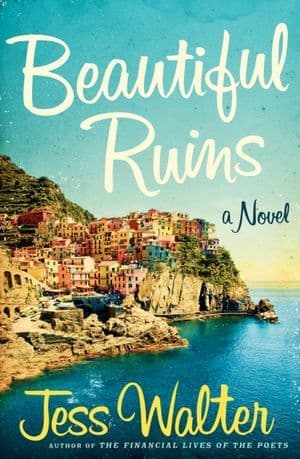
Jess Walter (2012)
Genre
Literary Fiction / Historical Fiction / Romance
Reading Time
450 min
Key Themes
See below
Sign in to track this book
A romance starts on the Italian coast in 1962 and affects fifty years of lives, Hollywood dreams, and 'Beautiful Ruins'.
In 1962, Pasquale Tursi runs the Hotel Adequate View in the small Italian village of Porto Vergogna. His life is quiet, following the rhythms of the sea and his family. This peace ends with the arrival of Dee Moray, an American actress. She says she is ill with a stomach ailment and has been sent to this remote place by the film studio to get better. Pasquale is immediately drawn to her beauty and vulnerability. He believes she is dying and sees her as a tragic figure. He becomes her devoted caretaker, making special meals and trying to make her comfortable, all while feeling an unspoken affection for her.
As Dee stays at the Hotel Adequate View, Pasquale learns more about her, or what he thinks he learns. She mentions a film she was working on, 'Cleopatra,' and a powerful actor, Richard Burton, with whom she had a brief, intense affair. It seems her 'illness' might be more emotional than physical, a result of heartbreak and the chaotic world of Hollywood. Burton, known for his drinking and relationship with Elizabeth Taylor, is a shadowy but strong presence in Dee's story, shaping her current situation. Pasquale, despite his growing jealousy and confusion, stays dedicated to her, caught in her glamour and sadness.
One day, Pasquale takes Dee to a secluded beach. While there, paparazzi, alerted by an unknown source, arrive, creating a chaotic scene. Pasquale tries to protect Dee from the cameras, leading to a struggle. In the confusion, Dee is taken away, seemingly by film studio representatives. Pasquale is left confused and heartbroken, with no explanation for her sudden departure. He has only questions and the memory of her. This event ends their brief connection and starts Pasquale's lifelong search for what happened to Dee Moray and why she left.
Fifty years later, in 2012, an older Pasquale Tursi, still thinking about Dee Moray's sudden disappearance, arrives in Hollywood. He has saved money his whole life to find her. He goes to the offices of Michael Deane, a powerful film producer who was involved in the original 'Cleopatra' production. Pasquale's arrival, with his broken English and serious quest, is an unexpected event in Deane's life. Deane's assistant, Claire Silver, at first thinks Pasquale is a deluded old man, but his persistence and the romantic sadness of his story start to interest her.
Michael Deane, who cares about his own legacy and a never-produced film script called 'Beautiful Ruins,' initially dismisses Pasquale. However, Claire Silver, his assistant, starts to connect Pasquale's story with Deane's past. She finds out that Deane was involved with 'Cleopatra' and had a history with Dee Moray. Claire begins to investigate, driven by her job and growing personal interest. Her research leads her to old film documents, interviews, and the possibility that Dee Moray's story is tied to Deane's artistic ambitions and regrets.
Claire's investigation leads her to Edinburgh, Scotland, specifically to the Fringe Festival, where she believes she can find more information about Dee Moray. There, she meets Shane O'Hare, a playwright and former college friend of Dee's son, Pat. Shane is trying to stage a play about a fictionalized version of Dee Moray's life, based on stories he heard from Pat. Claire, at first careful of Shane, slowly realizes that he might have important parts of the puzzle. Their talks reveal more about Dee's life after Porto Vergogna, her struggles, and her attempts to redefine herself outside of Hollywood.
Through her research and conversations, Claire discovers the truth about Dee Moray. Dee was not dying in Porto Vergogna; she was pregnant with Richard Burton's child. Michael Deane, fearing a scandal that would hurt the 'Cleopatra' production and his career, arranged for her removal from Italy and for her to have an abortion. He then paid her off and ensured her silence, ending her acting career and removing her from public memory. This shows Deane as a more cynical and manipulative figure than he first appeared, driven by self-preservation and the demands of the film industry.
Pasquale confronts Michael Deane, asking for answers about Dee. The language barrier and Deane's evasiveness make direct communication hard, but the emotional weight of Pasquale's lifelong quest is clear. Claire, now understanding Deane's deception, helps Pasquale understand what happened. She also uncovers the personal meaning of Deane's unfinished script, 'Beautiful Ruins.' It was his attempt to deal with his guilt and the consequences of his actions regarding Dee Moray.
With the truth revealed, the characters deal with the implications. Pasquale, though heartbroken by Dee's fate, finds some closure. Claire, disappointed by Hollywood's ruthlessness but also inspired by love, re-evaluates her career. Michael Deane, facing his mortality and choices, starts to acknowledge his past. The story connects their lives, exploring unrequited love, ambition, regret, and how the past shapes the present. The 'beautiful ruins' represent lives lived, dreams broken, and the human spirit.
Pasquale returns to Porto Vergogna, knowing the truth of Dee's life and death. He finds some peace, understanding that his lifelong quest, though ending sadly, was not wasted. The story suggests a connection between Claire and Shane, hinting at a new beginning and a possible collaboration on a project that might tell Dee's story fairly. The book ends with a mix of sadness and hope, acknowledging the bittersweet nature of life, the beauty in flawed human connections, and the power of stories to shape our understanding of the past and inspire our future.
The Protagonist
From an innocent, star-struck young man, Pasquale evolves into a determined elder who finally confronts the truth about his past love, finding a bittersweet closure.
The Central Figure/Catalyst
From a glamorous but troubled starlet, she becomes a woman forced to abandon her dreams and forge a new, anonymous life, her story ultimately being rediscovered and honored.
The Antagonist/Producer
From a calculating, self-preserving producer, he slowly comes to terms with his past actions, revealing a hidden layer of guilt and regret.
The Supporting/Protagonist
From a cynical but ambitious Hollywood assistant, she evolves into a truth-seeker, finding a new purpose in uncovering and honoring forgotten stories.
The Supporting/Mentioned
His character doesn't have a direct arc, but his actions in the past have profound, lasting consequences for Dee Moray and, by extension, Pasquale.
The Supporting
From a self-absorbed, struggling artist, he becomes a more empathetic and collaborative individual, recognizing the true weight of the story he's trying to tell.
The Supporting/Mentioned
His character's arc is not detailed, but his existence is a testament to Dee's life beyond Hollywood and the enduring impact of her choices.
The Supporting
Her arc involves a journey of self-discovery and an attempt to reconcile with, or at least understand, her complicated relationship with her father.
The book explores unrequited love, mainly through Pasquale Tursi's lifelong devotion to Dee Moray. His innocent affection in 1962 becomes a decades-long search for her fate. This theme shows in his saving money for fifty years to go to Hollywood, his memories of her, and his belief in her tragic beauty. It shows how one encounter can shape a whole life, even without reciprocation, and the bittersweet nature of holding onto a romantic ideal.
“He understood that he would spend the rest of his life thinking about her, wondering about her, and he would love her, in his own quiet way, until the day he died.”
Jess Walter contrasts Hollywood's glamorous image with its harsh realities. Dee Moray arrives in Porto Vergogna as a 'dying starlet,' a tragic figure, but the truth is she is a pregnant woman whose career is being sacrificed for studio interests. Michael Deane represents the ruthless side, willing to sacrifice people for profit and image. The book shows how fame can be fleeting, dreams can be broken, and the industry often puts spectacle over humanity, leaving 'beautiful ruins'.
“Hollywood was a cruel place. It took your dreams and made them into commodities, then sold them back to you at a vastly inflated price.”
Storytelling is a main part of 'Beautiful Ruins,' both as a plot device and a theme. The book itself is a complex story, combining many perspectives and timelines to build a complete narrative. Characters like Shane O'Hare try to tell Dee's story through theater, while Michael Deane deals with his past through his 'Beautiful Ruins' screenplay. Claire Silver's job is to uncover the true story, putting together pieces from different sources. The book shows how stories, true or embellished, shape our understanding of the past, keep memories, and offer a way to understanding and closure.
“Maybe that's what art was: a way to make sense of the beautiful ruins of our lives.”
Regret is clear, especially in Michael Deane's character. His actions in 1962, driven by ambition, lead to Dee Moray's tragic fate and affect him for decades. His unproduced script, 'Beautiful Ruins,' is an attempt at redemption or at least an acknowledgment of his past wrongs. Pasquale regrets that he could not protect Dee or understand her situation. The book explores if redemption is possible for past mistakes and how people carry their choices throughout their lives, often finding comfort or atonement in unexpected ways.
“Some mistakes, he thought, were too big to fix. Some wounds too deep to heal. But you kept trying, didn't you? You always kept trying.”
The book spans fifty years, moving between 1962 and 2012, showing how time changes and preserves. Pasquale's memory of Dee stays clear despite the decades, showing the power of personal memory and first love. Public memory of Dee has faded, manipulated by Hollywood. The dual timeline allows Walter to explore how past events affect generations, shaping present lives and showing that collective and individual recollections are often unreliable. The 'ruins' themselves show time's relentless march.
“Memory, Pasquale thought, was a beautiful, treacherous thing. It could keep you company, or it could keep you trapped.”
Alternates between 1962 and 2012 to reveal the full story.
The novel employs a dual timeline, primarily alternating between 1962 in Porto Vergogna and 2012 in Hollywood and Edinburgh. This non-linear structure is crucial for building suspense and gradually revealing the full truth about Dee Moray. The 1962 scenes establish the initial encounter and Pasquale's love, while the 2012 scenes show the consequences and the quest for answers. This device allows Jess Walter to contrast past ideals with present realities, explore the long-term impact of decisions, and create a sense of mystery that unravels piece by piece across decades and perspectives.
Narrated through various characters to offer a multifaceted view of events.
The story is told from the viewpoints of various characters, including Pasquale, Dee, Michael Deane, Claire Silver, and Shane O'Hare, and even includes excerpts from Richard Burton's fictionalized memoir. This technique provides a rich, mosaic-like understanding of the events and the characters' motivations. It highlights the subjective nature of truth and how different individuals interpret and remember the same events. By offering these diverse lenses, the author creates a more complex and nuanced portrait of the characters and the central mystery surrounding Dee Moray.
A script that serves as a symbolic and literal link to the past.
Michael Deane's decades-long, unfinished screenplay, titled 'Beautiful Ruins,' acts as a powerful symbolic and literal plot device. Initially presented as Deane's grand artistic endeavor, it is gradually revealed to be his subconscious attempt to grapple with his guilt over Dee Moray's fate. The script contains thinly veiled versions of the true events, offering clues to Claire Silver's investigation. It represents unfulfilled artistic ambition, the weight of regret, and the way creators sometimes process their personal demons through their art, even if the work remains incomplete.
A classic Hollywood trope used to misdirect and reveal deeper truths.
The initial premise of Dee Moray as a 'dying starlet' is a classic Hollywood trope, immediately invoking a sense of romantic tragedy and glamour. However, Jess Walter uses this device as a clever misdirection. The reality of Dee's situation—her pregnancy and the studio's cover-up—subverts this trope, exposing the harsh realities behind the cinematic illusion. This contrast between the romanticized image and the brutal truth highlights the novel's themes about the illusion versus reality of Hollywood and the human cost of fame and ambition.
A setting that symbolizes isolation, innocence, and a forgotten past.
Porto Vergogna, the isolated and picturesque Italian village where the story begins, functions as more than just a setting. Its remoteness symbolizes the innocence and simplicity of Pasquale's life before Dee's arrival, and also serves as a perfect place for the studio to hide Dee away from the prying eyes of the world. The village, whose name ironically means 'Port of Shame,' becomes a place where secrets are kept and where time seems to stand still for Pasquale, preserving his memories of Dee almost perfectly. It represents a contrast to the bustling, manipulative world of Hollywood.
“We are all just a collection of stories, and the ones we tell ourselves are the most important.”
— Reflection on identity and memory by a character.
“What is life but a series of inspired follies?”
— A character musing on the unpredictability of life.
“The world is a beautiful ruin, and we are all just trying to find our place in it.”
— Title-inspired reflection on human existence.
“Love is not a transaction. It is a gift, and sometimes it is given to the wrong person.”
— Discussion about romantic relationships.
“Memory is a funny thing. It chooses what to keep and what to discard, and we are left with the pieces.”
— Character reflecting on past events.
“In Hollywood, everyone is selling something, even if it's just a dream.”
— Commentary on the film industry.
“Sometimes the most beautiful things are the ones that are broken.”
— Observation about imperfection and beauty.
“We spend our lives chasing after ghosts, only to realize they were never there to begin with.”
— Philosophical thought on pursuit and illusion.
“Art is not about perfection. It's about capturing a moment, a feeling, a truth.”
— Discussion on the nature of art.
“The past is a foreign country; they do things differently there.”
— Reflection on historical changes and nostalgia.
“Hope is the thing with feathers that perches in the soul, and sings the tune without the words, and never stops at all.”
— Poetic description of hope's enduring nature.
“We are all actors in our own lives, playing parts we didn't choose.”
— Metaphor on fate and personal agency.
“Sometimes the only way to move forward is to look back.”
— Advice on dealing with the past to progress.
“In the end, all we have are the stories we leave behind.”
— Final thoughts on legacy and memory.
Ready to see how well you understood this book? Take our interactive quiz with 10 questions.

Biography coming soon.







