“In a cave in the woods, in his deep, dark lair, through the long, cold winter sleeps a great brown bear.”
— Opening lines describing the bear hibernating in his cave.

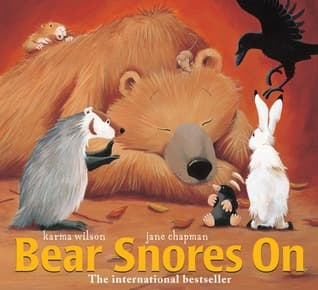
Karma Wilson (2001)
Genre
Fantasy / Children's
Reading Time
5 min
Key Themes
See below
Sign in to track this book
A hibernating bear unknowingly hosts a lively winter party for a parade of forest creatures, only to awaken to an unexpected, food-filled surprise.
In a big, dark cave, a great bear lies fast asleep, snoring loudly as winter rages outside. Snow swirls and wind howls, making the forest a very cold place. Bear snores on, oblivious to the world. His deep, rumbling snores echo through the cave, a constant rhythm against the sounds of the winter storm. He is completely unaware that his cozy den is about to become a refuge for a series of uninvited guests seeking warmth and shelter from the bitter cold.
A tiny, brown mouse, shivering from the biting wind, tiptoes into Bear's cave. He is small and timid, but the cold is too much to bear. He spots the enormous, sleeping bear, and is drawn to the relative warmth and shelter of the cave. Mouse quietly builds a small fire, seeking a bit of comfort. Bear continues to snore, completely undisturbed by the new arrival, his slumber unwavering even as the cave gains a new resident.
Soon after Mouse settles in, a long-eared hare, covered in snowflakes, hops into the cave. He shivers and sighs, distressed by the cold. Mouse, seeing the hare's plight, invites him to share the warmth of the small fire. Hare accepts. He pulls out some wild berries and nuts from his satchel, and the two small creatures begin to nibble quietly, careful not to disturb the still-snoring giant. Bear remains in a deep, peaceful sleep, oblivious to the gathering.
The next to arrive is a bustling badger, tracking snow into the cave. He carries a pail of honey nuts, a welcome contribution to the gathering. Badger greets Mouse and Hare, who are happy to share their warmth. They offer him a spot by the fire, and he joins them, adding his honey nuts to their meager feast. The cave, once silent except for Bear's snores, now has a soft hum of friendly chatter and rustling as the animals share their food. Bear, however, continues his deep, uninterrupted hibernation.
As the storm outside continues, a gopher and a mole, chattering and scurrying, dig their way into the cave. They are followed by a tiny wren, fluttering in with a twig in her beak. Each new arrival adds to the warmth and camaraderie. The gopher brings clover and the mole brings thyme, adding to the shared meal. The wren, too small to carry much, simply adds her cheerful presence. The cave is becoming quite crowded, filled with the sounds of happy munching and quiet conversation, all while the enormous Bear still snores on, unaware of the bustling party around him.
A raven, sleek and black, flies in, bringing a huckleberry pie, a treat for the cold guests. He joins the other animals, who are now quite a crowd. The wren, having found her courage, pipes up with a sweet song, adding music to the gathering. The animals share stories and laughter, making the cave a cozy haven from the winter storm. They brew nettle tea, pop corn over the fire, and toast marshmallows, creating a party. Bear, however, remains deeply asleep, snoring loudly through all the merriment, a large, furry centerpiece to the unexpected celebration.
The party reaches its peak with much laughter and conversation. Suddenly, a tiny mouse lets out a loud, unexpected sneeze! The sound, though small, is enough to jolt the enormous Bear from his deep slumber. His eyes blink open slowly, and he sits up, groggy and confused. He looks around his cave, now filled with a crowd of animals, a fire blazing, and food scattered everywhere. The sudden realization that his private den has become a bustling party without him begins to dawn on his sleepy mind.
Bear, now fully awake, surveys the scene. He sees the fire, the tea, the popped corn, the pie, and all his forest friends enjoying themselves. Sadness washes over him. He realizes they've had a party, a feast, and he was not a part of it. He feels left out and lonely, his big eyes welling up with tears. He lets out a soft moan, a sound of genuine disappointment, that silences the entire cave. The other animals, realizing their oversight, look at each other with guilt and concern.
Seeing Bear's distress, the animals quickly gather around him. Mouse, feeling responsible for the sneeze, offers him a piece of honey nut bread. Hare offers him a cup of nettle tea. Badger, Gopher, Mole, Wren, and Raven all offer words of comfort and share their food. They explain that they didn't want to wake him, but they also didn't want him to feel left out. They assure him that he is their friend and they are happy to share their warmth and food with him. Bear, touched by their kindness, begins to feel a little better.
With his friends' reassurance, Bear's sadness quickly dissipates. He smiles, a big, happy bear smile, and takes a bite of the honey nut bread. He sips the tea, feeling the warmth spread through his big body. Now that he's awake, he can truly join the fun. The animals all cheer, happy to have their big friend awake and participating. They continue to share their food and stories, and the cave fills with renewed laughter and warmth. The party continues, now with Bear as its joyful center, a celebration of friendship and warmth in the heart of winter.
The Protagonist
From deep sleep and unawareness to sadness, then to joy and participation in a shared celebration.
The Supporting
From timid seeker of shelter to an active participant and comforter.
The Supporting
From shivering and cold to warm and communal.
The Supporting
From cold traveler to warm, contributing party-goer.
The Supporting
Joins the growing party, contributing to the communal spirit.
The Supporting
Joins the growing party, contributing to the communal spirit.
The Supporting
Adds cheer and song to the communal gathering.
The Supporting
Contributes significantly to the feast and communal spirit.
The central theme is the importance of community and sharing resources, especially during harsh times. The animals, driven by the cold, gather in Bear's cave and instinctively share their meager provisions—berries, nuts, honey, clover, thyme, and even a huckleberry pie. This act of sharing transforms a simple refuge into a warm, joyful gathering, showing how collective effort and generosity create comfort and happiness for everyone. When Bear wakes up, the animals extend this spirit of sharing to him, ensuring he does not feel left out.
“They nibble, munch, and chew, a tiny tea is brewed. And Bear snores on.”
Bear's cave is an unintentional but vital refuge for the forest animals escaping the bitter winter. Despite Bear's deep sleep, his cave offers a safe, warm space. The animals, in turn, create a hospitable environment for each other, welcoming new arrivals without question. This theme shows how a shared space can become a haven, and how even an unconscious host can provide essential shelter. The animals' actions show an innate sense of welcome and care for others in need.
“A tiny mouse, Pitter-pat, tip-toe, creep-crawls in. He sniffs and sniffs, then tiptoes, too. This cave is warm and cozy, it's true!”
The story illustrates the bonds of friendship and the importance of empathy. The animals, though initially focused on their own survival and merriment, quickly recognize Bear's sadness upon his awakening. They show empathy by immediately comforting him, offering him food, and reassuring him of his place among them. This moment of collective care transforms Bear's disappointment into joy, reinforcing that true friendship involves understanding and addressing the feelings of others, ensuring no one feels alone or left out.
“Bear wakes up! What's this? He groans and he moans, and he whimpers and he weeps. 'You've had a party without me!'”
The harsh reality of winter is the primary reason for the entire plot. The biting cold, swirling snow, and howling wind force the animals out of their natural habitats and into Bear's cave. This theme describes the challenges of survival in nature and how animals adapt to find warmth and food. The shared resources and communal gathering are direct responses to the environmental pressures of winter, showing the instinct to seek shelter and support during difficult times.
“The wind howls outside, and the snow swirls and drifts. But Bear snores on.”
The audience and characters know more than the protagonist.
The entire premise of the story relies on dramatic irony: the reader and all the animal characters are aware of the bustling party taking place in Bear's cave, while Bear himself remains completely oblivious in his deep sleep. This creates a gentle humor and anticipation, as the reader wonders when and how Bear will finally awaken and discover his uninvited guests. This device builds the tension leading up to Bear's eventual surprise and disappointment.
The recurring line 'But Bear snores on' emphasizes his oblivious state.
The phrase 'But Bear snores on' is repeated throughout the first half of the book after each new animal arrives and the party activities escalate. This repetition serves to emphasize Bear's deep hibernation and his complete unawareness of the events unfolding around him. It creates a rhythmic, lulling effect, mirroring Bear's sleep, while simultaneously building the ironic contrast with the lively scene in his cave. It also acts as a narrative anchor, constantly reminding the reader of the central premise.
Adding elements one by one to build the narrative.
The story employs a cumulative plot structure, where each new animal arrives and adds to the growing gathering in Bear's cave. Mouse comes, then Hare, then Badger, and so on, each bringing a small contribution or adding to the atmosphere. This 'stacking' of characters and events builds momentum and visual complexity within the cave, gradually transforming it from a solitary den into a crowded, festive space, preparing the reader for the eventual climax of Bear's awakening.
Attributing human characteristics and emotions to animals.
The animals in 'Bear Snores On' are anthropomorphized, meaning they are given human-like qualities and behaviors. They brew tea, pop corn, share food, converse, sing, and express complex emotions like joy, guilt, sadness, and empathy. This device allows young readers to connect with the characters and understand the themes of friendship, sharing, and community through relatable actions and feelings, despite the characters being wild animals.
“In a cave in the woods, in his deep, dark lair, through the long, cold winter sleeps a great brown bear.”
— Opening lines describing the bear hibernating in his cave.
“But the bear snores on.”
— Repeated refrain as animals gather in the cave while the bear sleeps.
“One by one, cold creatures creep into the cave, out of the storm, to eat and sleep.”
— Animals seek shelter in the bear's cave during a snowstorm.
“Mouse squeaks, "Too damp, too dank, too dark."”
— Mouse's complaint about the cave's conditions.
“So they light a wee fire, merry and bright.”
— The animals start a small fire to warm up the cave.
“And the bear snores on.”
— Refrain emphasizing the bear's deep sleep despite the growing party.
“They munch and they crunch and they nibble and they nosh.”
— Description of the animals eating popcorn and other snacks.
“The bear wakes up with a great big roar!”
— The bear finally wakes up and reacts to the party in his cave.
“"You didn't ask!" the bear bellows and roars. "You didn't ask!" the great bear roars.”
— Bear expresses anger that the animals used his cave without permission.
“But the bear's great anger soon melts away.”
— The bear calms down after the animals explain and include him.
“"You're all invited," the bear says with a grin.”
— Bear invites the animals to stay and enjoy the party with him.
“And they chat and they chit and they chirp and they cheer.”
— Description of the animals and bear happily socializing together.
“But the bear... he stays awake.”
— Ending line showing the bear remains awake with his new friends.
“And the bear does not snore on.”
— Final line contrasting with the earlier refrains, indicating the bear's wakefulness.
Ready to see how well you understood this book? Take our interactive quiz with 10 questions.







