“Life is a game. So fight for survival and find out if you're worth it.”
— The Program's philosophy as explained by the government.

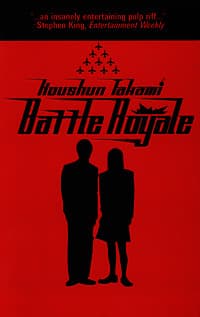
Koushun Takami (1999)
Genre
Thriller / Fantasy / Science Fiction / Young Adult
Reading Time
1200 min
Key Themes
See below
Sign in to track this book
In a dystopian twist on adolescence, a class of junior high students is thrust onto a deserted island, armed, forced into a brutal deathmatch where friendship and morality clash against the urge to be the last one standing.
Shuya Nanahara, a third-year student at Shiroiwa Junior High, is on a bus with his Class 3-B classmates, including his friend Yoshitoki Kuninobu and Noriko Nakagawa. They are supposedly on a field trip, but the mood is tense. Suddenly, the bus is gassed, and the students fall unconscious. They wake up in a classroom on a deserted island, each wearing a metallic collar. A man named Kinpatsu Sakamochi, a government official, explains the 'Program': a class is chosen each year to kill each other until only one survivor remains. He shows how the collars work by detonating Yoshitoki's when he defies him, making the students terrified.
Sakamochi explains the rules: students receive random 'weapons' (some useful, some not), a map, and a small amount of food and water. Certain island areas become 'forbidden zones' at specific times, and any student there will have their collar detonated. The collars also track their location and vital signs. He says only one can survive. The students then leave the classroom one by one, each getting their 'kit'. The first group of students, still reeling from Yoshitoki's death, panics. Some try to escape, others immediately attack, and several are killed in the initial chaos outside the school, including Tatsumichi Oki and Kaori Minami.
After the initial killings, Shuya, armed with a pot lid, finds Noriko, who has a severe migraine and is traumatized. They are both targets, and Shuya, remembering his promise to Yoshitoki to protect Noriko, decides they must stay together. They narrowly escape a fight with Tatsumichi Oki (before he dies) and later flee from Mitsuko Souma. They find temporary shelter in a cave, trying to understand the horrifying situation. Despite their fear and Noriko's weak state, they promise to try and find a way off the island without killing anyone, holding onto humanity amid the violence.
The game quickly becomes a brutal free-for-all. Kazuo Kiriyama, a quiet and smart transfer student, becomes a relentless, emotionless killer, hunting down other students. Shogo Kawada, another transfer student who has survived a previous 'Program', is smart and resourceful, initially staying away from others. Hiroki Sugimura, a skilled martial artist, searches for his childhood friend Takako Chigusa, refusing to kill unless he has to. Different strategies appear: some students form alliances, some become lone wolves, and others, like the girls of the lighthouse, try to keep peace.
Seven girls – Yuko Sakaki, Yukie Utsumi, Haruka Tanizawa, Satomi Noda, Chisato Matsui, Noriko Nakagawa, and Shuya Nanahara (whom Noriko brings) – gather at a lighthouse, hoping to survive by sharing resources and avoiding conflict. However, Yuko, traumatized and paranoid after seeing Shuya accidentally kill one of her friends (Tatsumichi), tries to poison Shuya's food. When Noriko eats it instead and becomes very ill, Yuko confesses. This betrayal breaks the group's trust, leading to an argument that becomes a violent shootout. Most of the girls are killed, including Yukie and Yuko, leaving only Shuya and Noriko to escape.
Wounded and despairing after the lighthouse incident, Shuya and Noriko are found by Shogo Kawada. Kawada, at first cautious, sees Shuya's wish to protect Noriko without killing. He says he survived a previous Battle Royale and offers to help them escape the island. He explains that the game is unfair and that the only true victory is to escape the system. Kawada's experience and strategic thinking give Shuya and Noriko, who are both hurt, a bit of hope. He starts to guide them, sharing information about the island and the Program's workings.
Kazuo Kiriyama, seemingly unbeatable, continues his killing, eliminating students including Hiroki Sugimura and Takako Chigusa. Meanwhile, Shinji Mimura, a brilliant hacker and Shuya's friend, works with Yutaka Seto and Motobu Iijima to disable the collars and blow up the school building, hoping to create a diversion for escape. He makes a small bomb and plans to use it at night. His plan offers an alternative to fighting, focusing on outsmarting the system instead of giving in to its violence.
Shinji Mimura's plan to detonate a bomb at the school happens. He successfully sets off the explosion, creating chaos and a temporary distraction. However, Kiriyama, expecting such a move, ambushes Mimura and his allies. A brutal gunfight follows. Despite Mimura's cleverness, Kiriyama's better combat skills and ruthlessness are too much. Mimura, Yutaka, and Motobu are all killed by Kiriyama, ending the hope of a mass escape and making Kiriyama the main threat on the island.
As fewer survivors remain, Shuya, Noriko, and Kawada know they must confront Kiriyama. They plan to ambush him, using their combined skills and Kawada's knowledge. The final fight is intense and bloody, taking place in a damaged building. Kiriyama, despite his injuries, fights with chilling effectiveness. Shuya and Kawada are both badly wounded, but with luck, strategy, and determination, they manage to hurt Kiriyama a lot. Kawada lands the fatal blow, finally stopping the relentless killer.
With Kiriyama dead, only Shuya, Noriko, and Kawada remain. Kawada reveals the final surprise: the administrator, Sakamochi, expects only one survivor and will try to kill the last two if there are more than one. He has a plan to use this. They fake Noriko's death, then surprise Sakamochi when he comes to congratulate the 'winner.' Kawada, badly wounded from the fight with Kiriyama, kills Sakamochi. Using a small boat and Kawada's escape route, Shuya and Noriko flee the island, leaving the dead behind. Kawada dies from his wounds shortly after their escape, having helped them.
Shuya and Noriko escape the island, but their trouble is not over. They are now wanted fugitives, pursued by the totalitarian Republic. With no official identity or safe place, they must constantly avoid capture, living on the run. Despite the trauma and loss they have faced, their bond has grown strong. They are survivors, marked by the Battle Royale, but determined to live and fight against the oppressive government that tried to destroy them. Their future is uncertain, but they face it together, showing hope against great odds.
The Protagonist
Shuya transforms from a passive, compassionate boy into a hardened survivor who still clings to his humanity, determined to escape the system.
The Protagonist
Noriko evolves from a helpless victim into a resilient survivor, her bond with Shuya becoming her greatest strength.
The Supporting
Kawada, initially a lone wolf burdened by his past, finds purpose in protecting Shuya and Noriko, ultimately sacrificing himself for their escape.
The Antagonist
Kiriyama remains a static, terrifying force of nature throughout, a symbol of pure, unfeeling destruction until his eventual demise.
The Antagonist
Sakamochi remains a consistently cruel and mocking figure, ultimately killed by Kawada.
The Supporting
Mimura strives to outsmart the system through intelligence and sabotage, ultimately dying in his attempt to fight back.
The Supporting
Sugimura maintains his moral compass throughout the game, his quest for Takako defining his actions until his tragic death at Kiriyama's hands.
The Supporting
Mitsuko descends into depravity, becoming a predatory killer until her own violent end.
The Supporting
Yukie attempts to foster peace and cooperation but is ultimately overwhelmed by the game's brutal reality, dying in the lighthouse massacre.
The Mentioned
Yoshitoki's death serves as a catalyst for the plot and a lasting motivation for Shuya.
The totalitarian Republic and its 'Program' show how absolute power corrupts. The government forces children to murder each other, saying it is needed for social control and national strength. Sakamochi, the administrator, shows this corruption, enjoying his authority and the students' suffering. The collars, forbidden zones, and constant surveillance are tools of this oppressive power, meant to remove people's control and humanity.
““Do you get it now? You’re all going to kill each other. Only one can survive. That’s the rule.””
The novel shows how ordinary junior high students must lose their innocence and face the darkest parts of human nature. Friendship, love, and compassion are tested against survival instincts. Some, like Kiriyama and Mitsuko, quickly become brutal, while others, like Shuya and Sugimura, try to keep their humanity, showing the range of human responses to extreme stress. The quick descent into violence shows how easily social structures can fall apart.
““There were no more classmates. Only enemies. Only targets.””
The Battle Royale setting is made to create paranoia, turning friends into possible enemies. The lighthouse massacre is an example, where a fragile alliance breaks due to a single betrayal and the distrust that follows. Students constantly question each other's reasons, leading to early attacks and sad misunderstandings. The novel shows how quickly trust can disappear under extreme pressure, making real cooperation almost impossible.
““Even if you trusted someone, could you really trust them with your life in a situation like this?””
Despite the brutality, characters like Shuya, Noriko, Kawada, and Mimura show resistance and hope. Shuya's refusal to kill, Mimura's attempt to hack the system, and Kawada's determination to help Shuya and Noriko escape are acts of defiance against the Program. Their survival and escape, though dangerous, represent a rejection of the system's nihilism and a belief in a future beyond its control. It shows the human spirit's fight for life and freedom.
““We’re not going to kill anyone. We’re going to survive without killing.””
The novel explores violence in different forms: government violence, planned murder, self-defense, and accidental death. It questions why such extreme measures are used, showing the 'Program' as a horrifying, senseless act of cruelty rather than a helpful social experiment. The graphic descriptions make readers see the reality of violence and its psychological effect on both those who do it and those who suffer from it, instead of making it seem good. It examines if violence is natural or caused by situations.
““This wasn't war. This was just senseless slaughter.””
A technological device enforcing participation and control in the Program.
The metallic collars placed around each student's neck are the central mechanism of the Battle Royale. They serve multiple functions: tracking student locations, monitoring vital signs, and, most crucially, acting as a deterrent against non-compliance or escaping forbidden zones through detonation. The collars are a constant, tangible reminder of the government's absolute power and the students' inescapable predicament. Their physical presence and deadly capability instill pervasive fear, forcing students to participate and comply with the brutal rules. They symbolize the students' literal enslavement to the Program.
Geographical restrictions that force students into conflict and prevent evasion.
The island is divided into a grid, with certain areas designated as 'forbidden zones' that shift and expand over time. Any student remaining in a forbidden zone when activated has their collar detonated. This device serves to constantly shrink the playable area, forcing the remaining students into closer proximity and inevitable confrontation. It prevents students from hiding indefinitely or simply waiting out the game, accelerating the killing process and ensuring that a single survivor will eventually emerge. They are a relentless, impersonal antagonist, pushing the narrative forward.
The arbitrary assignment of items that dictates initial survival chances.
At the start of the Program, each student is given a random 'weapon' from a bag. These range from highly effective firearms and knives to seemingly useless items like a pot lid, a fork, or a paper fan. This element introduces an immediate unfairness and randomness to the game, highlighting the arbitrary nature of fate and the government's disregard for fair play. It forces students to adapt to their given circumstances and often dictates their initial survival strategies, emphasizing that survival can hinge on luck as much as skill.
Characters who bring external knowledge or an unpredicatable element to the class.
Shogo Kawada and Kazuo Kiriyama, both transfer students, serve as crucial plot devices. Kawada, having survived a previous Battle Royale, provides vital information and strategic guidance to Shuya and Noriko, acting as a mentor figure. His past experience is a narrative shortcut to explain complex survival tactics and the Program's nuances. Kiriyama, on the other hand, is an unknown, emotionless variable, an ultimate antagonist who embodies the game's pure, unadulterated violence. Both characters, by being 'outsiders' to Class 3-B, disrupt the existing social dynamics and accelerate the plot in distinct ways.
“Life is a game. So fight for survival and find out if you're worth it.”
— The Program's philosophy as explained by the government.
“I'm not going to kill anyone. I'm going to get out of here alive, and I'm going to take you with me.”
— Shuya Nanahara's declaration to Noriko Nakagawa.
“The strong live and the weak die. That's the way of the world.”
— Kazuo Kiriyama's cold assessment of the game.
“I don't want to die. I want to live. I want to go home.”
— A student's desperate plea during the chaos.
“Trust no one. That's the first rule of the Program.”
— Advice given to students before the game begins.
“We're not animals. We're human beings.”
— Shogo Kawada arguing against the dehumanization of the game.
“The only way to win is to play the game better than anyone else.”
— Mitsuko Souma's ruthless strategy.
“I'll protect you, no matter what.”
— Shuya's promise to Noriko in the midst of danger.
“This isn't a game. It's murder.”
— A student's realization of the Program's true nature.
“Sometimes, the only way to survive is to become a monster.”
— Reflection on the psychological toll of the game.
“We were friends once. Remember that.”
— A poignant moment between former classmates turned adversaries.
“The government doesn't care about us. We're just pawns.”
— Shogo Kawada's critique of the authoritarian regime.
“I won't let them break me. I'll keep my humanity till the end.”
— Noriko Nakagawa's resolve to stay true to herself.
“In this world, you either kill or get killed. There's no middle ground.”
— A stark reminder of the game's brutal logic.
Ready to see how well you understood this book? Take our interactive quiz with 10 questions.







