“All it takes is one bad day to reduce the sanest man alive to lunacy.”
— The Joker explains his philosophy to Batman, arguing that anyone can be driven mad by a single traumatic event.

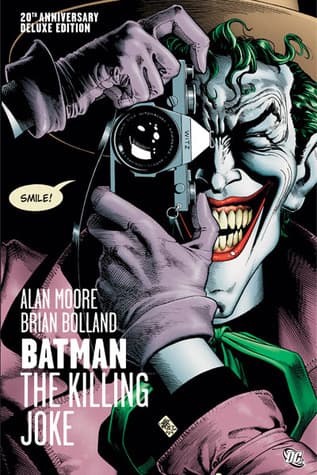
Alan Moore (1988)
Genre
Fantasy
Reading Time
30 min
Key Themes
See below
Sign in to track this book
The Joker's twisted origin unfolds as he brutalizes Commissioner Gordon and Batgirl, aiming to prove that one bad day is all it takes to shatter a man's sanity, even as Batman races against the clock to save his ally from the brink of madness.
Batman visits Arkham Asylum, hoping to speak with the Joker to establish a truce or, failing that, to understand his madness before their conflict escalates to a fatal conclusion. He believes that one of them will eventually kill the other, and he wants to prevent it. However, the guards inform him that the Joker has escaped. This immediately puts Batman on high alert, knowing that the Joker's freedom always means disaster and chaos for Gotham City, setting the stage for his next horrifying scheme.
The Joker, after his escape, targets Commissioner James Gordon. He arrives at Gordon's home and shoots Barbara Gordon, who answers the door, through the spine, permanently paralyzing her. He then strips her naked, photographs her injured and traumatized body, and kidnaps Commissioner Gordon. This act is not merely an attack on the Gordons but a calculated move by the Joker to prove a twisted point about the fragility of human sanity. Batman arrives at the scene to find Barbara alive but gravely wounded, intensifying his personal vendetta against the Joker.
The story flashes back to the Joker's past. He is a failed, nameless stand-up comedian struggling to make ends meet and support his pregnant wife, Jeannie. Desperate for money, he agrees to help two criminals with a heist at the chemical plant where he used to work. Despite his moral reservations, his love for Jeannie and the impending birth of their child push him to accept the dangerous proposition, hoping this one job will secure their future.
On the day of the planned heist, the comedian receives devastating news: his wife, Jeannie, and their unborn child have died in a household accident. Devastated, he tries to back out of the robbery, but the criminals force him to go through with it, putting him in a red hood disguise. During the botched heist at Ace Chemical Processing Plant, Batman appears. Frightened, the comedian falls into a vat of chemicals, emerging with bleached skin, green hair, and a permanent rictus grin. This traumatic event, combined with his earlier grief, shatters his mind, giving birth to the Joker.
The Joker takes Commissioner Gordon to an abandoned amusement park, where he tortures him psychologically. He forces Gordon to view disturbing photographs of his injured daughter, Barbara, and parades him around the derelict park, forcing him to witness freak show exhibits and listen to the Joker's deranged monologues about madness. The Joker's goal is to break Gordon's sanity, to prove that even the most righteous man can be driven insane by 'one bad day,' mirroring his own perceived transformation.
Upon discovering Barbara's attack and Gordon's abduction, Batman immediately begins his investigation. He uses his detective skills, interrogating informants like the mentally unstable 'Carl' and analyzing clues left behind by the Joker. His main objective is to locate Commissioner Gordon and rescue him from the Joker's clutches before the villain can succeed in his plan to drive the commissioner mad. The urgency of the situation is heightened by the personal nature of the attack, pushing Batman's resolve to its limits.
Despite the Joker's horrific psychological assault, Commissioner Gordon maintains his sanity. He endures the grotesque displays, the taunts, and the forced viewing of Barbara's photographs, clinging to his moral compass and his belief in order. He silently resists the Joker's attempts to push him over the edge, showing incredible strength of will. His internal monologue reveals his determination to prove the Joker wrong and to maintain his own humanity, even when facing unspeakable evil.
Batman tracks the Joker to the abandoned amusement park and confronts him. A brutal fight ensues between the two arch-nemeses amidst the decaying rides and macabre attractions. During the fight, Batman manages to free Commissioner Gordon, who, despite his ordeal, urges Batman to capture the Joker 'by the book' to show him that their way of justice is the correct one, even after everything he has endured. This request shows Gordon's unwavering commitment to his principles.
Batman defeats the Joker, who, even in defeat, offers a final, dark joke about two inmates escaping an asylum. One jumps a roof successfully, while the other is too scared to try and asks for a flashlight to see the way. The first inmate offers to shine it, but the second says, 'What do you think I am? Crazy? You'd turn it off when I was halfway across!' This joke, a metaphor for their own relationship and the Joker's view of sanity, causes Batman to laugh. The two share a moment of understanding, a shared laughter in the face of their eternal, grim dance.
As their laughter subsides, the panel focuses on Batman's hand reaching out and possibly grabbing the Joker's shoulder, or perhaps even his neck. The siren of a police car approaches, growing louder until it abruptly cuts off, leaving the final outcome ambiguous. It is left to the reader to interpret whether Batman finally breaks his one rule and kills the Joker, or if he merely subdues him to hand him over to the authorities. The abrupt silence of the siren makes the conclusion unsettling and uncertain.
The Protagonist
Batman's arc reinforces his unwavering moral code in the face of the Joker's attempt to prove 'one bad day' can break anyone, solidifying his role as a symbol of resilience.
The Antagonist
The Joker's 'arc' is less about development and more about a desperate attempt to validate his own madness by corrupting others, ultimately failing to break Gordon but succeeding in disturbing Batman.
The Supporting
Gordon's character arc emphasizes his unyielding moral fortitude and resilience, demonstrating that even 'one bad day' cannot always break a truly good man.
The Supporting
Barbara's arc is one of tragic victimization, as her paralysis marks a permanent change in her life, forcing her to adapt to a new reality.
The Mentioned
Jeannie's character arc is tragic and brief, serving primarily as a catalyst for the Joker's transformation.
The Supporting
Their arc is limited to their role in the Joker's origin, serving as catalysts for his transformation.
The central theme is the nature of madness and how easily one can descend into it. The Joker's entire plan is based on proving that 'one bad day' is all it takes to break a man, referencing his own origin. He tries to push Commissioner Gordon over the edge by torturing him with images of his paralyzed daughter, Barbara. The book questions whether sanity is merely a thin veil over chaos, and if the Joker's philosophy holds any truth. Despite the Joker's efforts, Gordon's resilience ultimately challenges this nihilistic view, suggesting that some individuals possess an unwavering moral compass.
“All it takes is one bad day to reduce the sanest man alive to lunacy. That's how far the world is from where I am. Just one bad day.”
The conflict between Batman and the Joker is a self-perpetuating cycle of violence and mutual obsession. Batman visits Arkham at the beginning, hoping to break this cycle, acknowledging that one of them will eventually kill the other. The Joker's actions against the Gordons are a direct provocation, designed to get a violent response from Batman. Their final confrontation, ending in a shared, dark laugh, symbolizes their intertwined destinies and the difficulty of escaping their roles. The ambiguity of the ending further emphasizes the unending nature of their struggle.
“I mean, what do you think would happen if I ever *stopped* laughing?”
The story tests the moral boundaries of its characters, particularly Batman and Commissioner Gordon. Batman adheres strictly to his code of not killing, even when facing the Joker's most heinous acts. Commissioner Gordon, despite enduring unimaginable personal suffering, insists that Batman capture the Joker 'by the book,' showing his unwavering commitment to justice and law. Their resistance to succumbing to the Joker's nihilism highlights the importance of maintaining one's moral code when facing profound evil. This contrasts sharply with the Joker's complete lack of such boundaries.
“I want him brought in by the book, Batman! Do you hear me? BY THE BOOK!”
The narrative explores the concept of origin and how trauma can shape an individual. The Joker's fragmented and potentially unreliable origin story suggests that a series of tragic events — the death of his pregnant wife, his failure as a comedian, and his chemical accident — led to his transformation. While the story offers a possible explanation for his madness, it also questions the definitive nature of any single origin. Barbara Gordon's paralysis is another trauma that forever alters her life, mirroring the transformative power of 'one bad day' but without succumbing to madness. This offers a counterpoint to the Joker's philosophy.
“If I'm going to have a past, I prefer it to be multiple choice!”
The Joker's backstory is presented as ambiguous and possibly fabricated.
The Joker's origin story is deliberately ambiguous, with the Joker himself stating, 'If I'm going to have a past, I prefer it to be multiple choice!' This device makes the reader question the veracity of the flashbacks, suggesting that the Joker's memories might be distorted or entirely made up. It reinforces his chaotic nature and the idea that his madness is so profound that even his own history is fluid, preventing any definitive understanding of his transformation. This challenges the reader to grapple with the mystery of his insanity rather than providing a simple explanation.
Interweaving the present-day conflict with flashbacks to the Joker's past.
The story employs parallel narratives, intercutting the Joker's present-day torment of Commissioner Gordon with flashbacks detailing his possible origin as a struggling comedian. This juxtaposition serves to provide context for the Joker's philosophy and actions, showing the reader the 'one bad day' that he believes transformed him. It creates a powerful contrast between his past humanity and his present monstrosity, while also building suspense and allowing the thematic exploration of sanity's fragility to resonate more deeply by showing its potential genesis.
The setting reflects the Joker's twisted worldview and the fragility of joy.
The abandoned amusement park where the Joker tortures Gordon is highly symbolic. Carnivals and amusement parks are typically places of joy and escapism, but in their derelict state, they represent the Joker's perversion of these concepts. The decaying rides, freak show exhibits, and distorted funhouse mirrors reflect his twisted sense of humor and his belief that life itself is a 'bad joke.' It's a setting where the veneer of happiness has rotted away, exposing the underlying chaos and despair that the Joker embodies and seeks to impose on others.
An ambiguous shared moment of dark humor between Batman and the Joker.
The story culminates in Batman and the Joker sharing a laugh after the Joker tells a joke about two asylum inmates. This 'final laugh' is a powerful and ambiguous device. It suggests a moment of profound, albeit dark, understanding between the two, highlighting their unique and symbiotic relationship. It can be interpreted as Batman's acknowledgement of the Joker's twisted point, or perhaps his own descent into a shared madness. The laughter, followed by the abrupt silence, leaves the ultimate fate of the Joker, and the nature of their relationship, unsettlingly unresolved and open to multiple interpretations.
“All it takes is one bad day to reduce the sanest man alive to lunacy.”
— The Joker explains his philosophy to Batman, arguing that anyone can be driven mad by a single traumatic event.
“I'm not exactly sure what it was. Sometimes I remember it one way, sometimes another... If I'm going to have a past, I prefer it to be multiple choice!”
— The Joker recounts his origin story, emphasizing its unreliability and his embrace of chaos.
“Why aren't you laughing?”
— The Joker asks Batman this after revealing his horrific actions, highlighting their twisted dynamic.
“I've been thinking lately. About you and me. About what's going to happen to us, in the end.”
— Batman reflects on his inevitable confrontation with the Joker, suggesting a shared fate.
“Maybe it's just that I'm not as particular as you are.”
— The Joker dismisses Batman's moral code, implying his own embrace of amorality.
“I don't want to hurt you. I don't want either of us to end up killing the other.”
— Batman pleads with the Joker to end their cycle of violence, showing a rare moment of vulnerability.
“It's all a joke! Everything anybody ever valued or struggled for... it's all a monstrous, demented gag!”
— The Joker expresses his nihilistic worldview, seeing life as meaningless and absurd.
“You had a bad day once, am I right? I know I am. I can tell. You had a bad day and everything changed.”
— The Joker taunts Batman, drawing parallels between their origins through trauma.
“I'm not talking about killing you. I'm talking about letting you live.”
— The Joker hints at his plan to psychologically break Commissioner Gordon rather than kill him.
“We could try to understand one another.”
— Batman offers the Joker a chance at reconciliation, emphasizing their potential connection.
“I'm not a monster. I'm just ahead of the curve.”
— The Joker justifies his actions by portraying himself as a visionary of chaos.
“What do you get when you cross a mentally ill loner with a society that abandons him and treats him like trash?”
— A rhetorical question posed by the Joker, critiquing societal neglect and its consequences.
“Sometimes I remember it one way, sometimes another. If I'm going to have a past, I prefer it to be multiple choice!”
— The Joker's repeated line about his origin, underscoring his fluid and chaotic identity.
“You see, I'm not a monster... I'm just ahead of the curve.”
— The Joker's justification for his actions, framing chaos as a form of enlightenment.
Ready to see how well you understood this book? Take our interactive quiz with 10 questions.
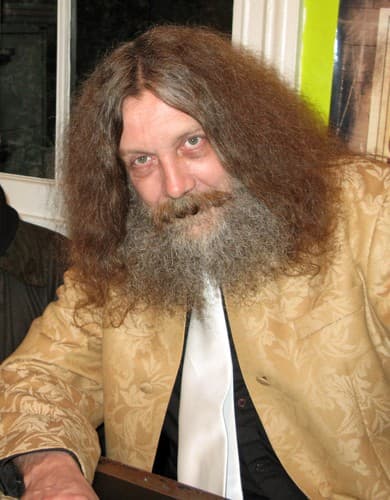
Alan Moore is an English author known primarily for his work in comic books including Watchmen, V for Vendetta, The Ballad of Halo Jones, Swamp Thing, Batman: The Killing Joke, and From Hell. He is widely recognised among his peers and critics as one of the best comic book writers in the English language. Moore has occasionally used such pseudonyms as Curt Vile, Jill de Ray, Brilburn Logue, and Translucia Baboon; also, reprints of some of his work have been credited to The Original Writer when Moore requested that his name be removed.







