“This... this isn't a hospital... this is a tomb.”
— Batman's internal monologue upon seeing the state of Arkham Asylum.

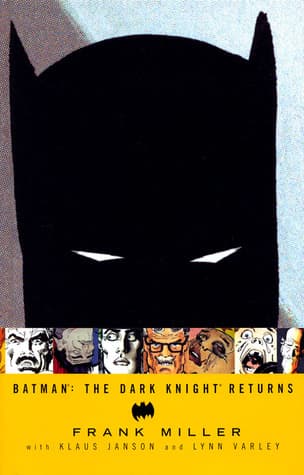
Frank Miller (1986)
Genre
Fantasy
Reading Time
120 min
Key Themes
See below
Sign in to track this book
An aging, embittered Bruce Wayne emerges from a decade of retirement to don the cowl once more, battling a new wave of savage criminals, a psychopathic Joker, and even Superman in a decaying, near-future Gotham.
Ten years after his retirement, Bruce Wayne, now 55, lives a life of forced normalcy, haunted by his past as Batman. Gotham City is a cesspool of crime, dominated by the violent street gang known as the Mutants. Wayne's internal struggle is clear; he exercises relentlessly, races cars, and tries to distract himself, but news reports of escalating violence and the memory of his parents' murder constantly bother him. Commissioner James Gordon, also nearing retirement, is powerless against the rising crime. Wayne observes the city's decay, feeling an urge to return to his vigilante life, a struggle personified by his recurring dream of falling into a bat-filled cave. This internal conflict ends in a moment of decision as he watches the news, finally succumbing to the call of the Bat.
Batman makes his brutal return, targeting street thugs and swiftly demonstrating his renewed ferocity. His initial appearance causes a media frenzy, with some hailing him as a savior and others condemning him as a dangerous vigilante. Meanwhile, 13-year-old Carrie Kelley, disillusioned with her negligent parents and inspired by the news of Batman's return, buys a Robin costume and seeks him out. She proves her worth by saving Batman from a near-fatal fall during a confrontation with the Mutant gang in 'Crime Alley.' Batman, initially hesitant, accepts her as his new Robin, recognizing her courage and resourcefulness. Together, they begin to systematically dismantle the Mutant gang's operations, leading to a direct confrontation with their leader.
Batman orchestrates a public challenge to the Mutant Leader in the toxic waste dump known as the 'Mudhole.' After a brutal, drawn-out fight where Batman initially takes a severe beating, he triumphs by exploiting the Leader's overconfidence and the muddy terrain. He breaks the Mutant Leader's back, effectively decapitating the gang. This victory, however, doesn't bring immediate peace. The Mutants splinter into smaller, less organized but still dangerous factions, some rebranding themselves as the 'Sons of Batman,' idolizing his extreme methods. The mayor is killed, and Commissioner Gordon retires, replaced by the younger, less sympathetic Ellen Yindel, who immediately declares Batman a fugitive.
News of Batman's reappearance has a disturbing effect on the Joker, who has been catatonic for the past decade in Arkham Asylum. His psychiatrist, Dr. Bartholomew Wolper, believes the Joker is reformed and uses Batman's return to justify his 'recovery,' convincing the public and authorities that the Joker is a victim of Batman's psychological influence. Wolper arranges for the Joker to appear on a talk show, 'David Endochrine,' to prove his rehabilitation. Batman, sensing danger, begins to track the Joker, knowing his nemesis's 'recovery' is a sinister prelude to a new wave of terror. The stage is set for their final, inevitable confrontation.
During his appearance on the 'David Endochrine' show, the Joker brutally murders everyone in the studio audience and on stage, including Dr. Wolper, with a deadly nerve toxin. He then escapes, leading Batman and Robin on a chase through Gotham. The Joker takes refuge at a carnival, where he continues his killing spree, targeting children. Batman confronts the Joker in the Tunnel of Love, engaging in a savage, desperate battle. Batman, pushed to his limit, breaks the Joker's neck, but not enough to kill him outright. The Joker, with his last ounce of strength, twists his own neck further, completing his suicide and framing Batman for his murder, solidifying Commissioner Yindel's resolve to capture the Dark Knight.
With the Cold War escalating and a nuclear winter threatening, the United States government, under President Ronald Reagan, views Batman's vigilante activities as a dangerous anomaly that could destabilize an already fragile world order. Superman, now a government operative, is reluctantly dispatched to Gotham City with the directive to stop Batman. Superman, who has been largely absent from public life, maintaining global peace discreetly, struggles with this assignment, as he and Batman were once allies. He attempts to reason with Bruce, appealing to their past friendship, but Batman refuses to cease his operations, viewing Superman as a pawn of a corrupt system. This sets the stage for their clash.
A Soviet nuclear missile, launched by a rogue general, detonates in the atmosphere over the United States, creating an electromagnetic pulse (EMP) that plunges the entire nation into darkness and chaos. Gotham City, like the rest of the country, is without power, communication, or law enforcement. This catastrophic event creates a power vacuum, leading to widespread looting and anarchy. Batman, with Robin and the reformed 'Sons of Batman' (former Mutants), steps into this void, using the chaos as an opportunity to restore order and establish a new kind of vigilante rule. He empowers his followers to protect the innocent and rebuild the city, creating a beacon of stability amidst the nationwide collapse.
Superman arrives in Gotham, ordered to stop Batman at any cost, especially after Batman's actions during the blackout are perceived as establishing a rogue state. Batman, anticipating this confrontation, has prepared for years. He uses Gotham's power grid (briefly restored with a generator), a powerful armored suit, and a synthetic kryptonite arrow crafted with the help of Oliver Queen (Green Arrow). The battle is fierce and destructive, with Batman strategically weakening Superman. He defeats Superman by exposing him to the kryptonite, causing him to collapse. As Superman lies defeated, Batman seemingly suffers a heart attack and dies, witnessed by Robin and the 'Sons of Batman.'
Following his apparent death, Bruce Wayne is given a public funeral. However, it is revealed that his 'death' was a planned deception. He used a drug to simulate a heart attack, and the 'Sons of Batman' helped him disappear. Superman, having recovered, attends the funeral and hears a faint heartbeat from Wayne's coffin, realizing Batman is alive. In the final scenes, Bruce Wayne, along with Carrie Kelley and a dedicated team of former 'Sons of Batman,' retreats to the Batcave, now a fully operational underground command center. He declares that they will continue their fight against crime, not from the shadows of Gotham's rooftops, but from beneath the city, orchestrating a new era of justice.
The Protagonist
From a restless, retired recluse, he embraces his identity as Batman, pushing the boundaries of his vigilante justice, and ultimately fakes his death to continue his fight from the shadows.
The Supporting
From an ordinary, neglected teenager, she transforms into a vital, capable partner for Batman, demonstrating immense courage and loyalty.
The Supporting
From a semi-retired global peacekeeper, he is forced into a confrontation with his former ally, ultimately realizing the depth of Batman's commitment despite their differing methods.
The Antagonist
Awakens from catatonia to commit a final, horrific spree, culminating in his death by suicide, framing Batman.
The Supporting
Retires from the GCPD, having witnessed Batman's return and the city's descent, maintaining his quiet support for the Dark Knight.
The Antagonist
Dominates Gotham's criminal underworld before being decisively defeated by Batman, leading to the collapse of his gang.
The Supporting
From a staunch opponent of Batman, she is forced to confront the complexities of justice in a chaotic city, her stance ultimately softening slightly.
The Mentioned
Aids Batman in his final confrontation with Superman, demonstrating his unwavering loyalty.
The Mentioned
Oversees the government's response to the escalating Cold War and the perceived threat of Batman.
The book explores the blurred lines between justice and vigilantism, particularly through Batman's increasingly brutal methods. As Gotham descends into anarchy, Batman's return questions whether traditional law enforcement can truly address systemic decay. His actions are often violent, pushing the boundaries of what is considered heroic, forcing the reader to confront whether his extreme measures are necessary or simply a reflection of the society he fights. Characters like Commissioner Yindel represent the legalistic opposition, while Gordon embodies the pragmatic acceptance of Batman's 'necessary evil.'
“This is the one. The one who makes me whole.”
Bruce Wayne's age (55) is central to the narrative. He is physically diminished but mentally driven by an unyielding obsession with his mission. His return is not graceful but a struggle against his own failing body and the weight of his past. The theme of legacy is explored through Carrie Kelley, who takes up the mantle of Robin, ensuring Batman's fight continues. The book questions whether a hero can ever truly retire and what it means to pass on a torch, even if the methods are controversial. Batman's defiance of aging and his relentless pursuit of justice define his character.
“I'm the last one, Alfred. The last one. And they're not making any more.”
The omnipresent media plays a role, shaping public opinion and influencing events. Television news anchors, talk show hosts, and commentators constantly debate Batman's actions, portraying him as both a hero and a menace. The media's sensationalism and its ability to manipulate narratives (e.g., Dr. Wolper's portrayal of the Joker as a victim) show how truth can be distorted. This constant public scrutiny and judgment contribute to the chaotic atmosphere and directly impact how Batman operates and how the government responds to him.
“Some call him a hero. Others, a menace. But no one denies he is back.”
The book has ideological conflicts, most notably between Batman and Superman. Batman represents individual liberty, self-reliance, and a distrust of authority, while Superman embodies state power, order, and a willingness to operate within established systems. Their final battle is not just physical but a clash of philosophies about how justice should be served and who should wield ultimate power. The Cold War backdrop further emphasizes the fragility of global order and the dangers of unchecked power, whether from governments or individuals.
“I'm going to want you to remember that, Clark. In all the years to come. In your most private moments. I want you to remember the one man who beat you.”
Gotham City itself is a character, depicted as a decaying metropolis consumed by crime, poverty, and social unrest. The rise of the Mutants and the widespread anarchy during the blackout are symptoms of a society on the verge of collapse. The theme explores how a city can rot from within, and how traditional institutions fail to stem the tide of violence. Batman's return is a desperate attempt to salvage what's left, transforming him from a crime-fighter into a symbol of resistance against total societal breakdown.
“This city is a sewer. It's time to flush it.”
Provides direct access to characters' thoughts and motivations.
Frank Miller extensively uses internal monologues, primarily from Bruce Wayne/Batman, and occasional voiceover narration from other characters (like Gordon or news anchors). This allows the reader direct access to Batman's cynical worldview, his relentless self-doubt, his strategic thinking, and his deep-seated psychological motivations. It's crucial for understanding his character arc and the moral ambiguity of his actions, as well as providing context for the chaotic state of Gotham and the broader political landscape.
Fragments the narrative through various news and talk show segments.
The story is frequently interrupted and framed by segments from various media outlets – television news, talk shows, and expert commentary. This device serves multiple purposes: it reflects public opinion and the media's role in shaping it, provides exposition from different viewpoints, and creates a sense of a chaotic, information-saturated world. It also highlights the fragmented perception of Batman himself, who is simultaneously hailed as a savior and condemned as a menace, depending on the commentator.
Represents fear, rebirth, and the primal force of justice.
The bat symbol is more than just a costume; it's a potent symbol of fear and a primal force within Bruce Wayne. It represents his rebirth from retirement, his embracing of his darker, more brutal self. The imagery of bats is pervasive, from his dreams to his methods of striking fear into criminals. It underscores the idea that Batman is not just a man but an almost mythic, elemental force of nature responding to the city's decay, striking from the shadows and embodying the very fear he seeks to instill.
Illustrates the unintended consequences of Batman's extreme methods.
After Batman defeats the Mutant Leader, a faction of the gang rebrands themselves as the 'Sons of Batman.' This plot device highlights the unintended and often morally ambiguous consequences of Batman's violent return. While they initially provide a chaotic, if effective, form of order during the blackout, their existence forces Batman to confront the idea that his methods can be misinterpreted or even perverted by those who idolize him. It also demonstrates his ability to adapt and even co-opt elements of the criminal underworld for his own ends.
Symbolizes Batman's physical limitations and his strategic genius.
The bulky, armored Bat-suit Batman wears for his final confrontation with Superman is a crucial plot device. It physically represents his aging body and his inability to match Superman's raw power without technological assistance. However, it also symbolizes his strategic genius and meticulous preparation, demonstrating that his greatest strength lies not in brute force but in his intellect and foresight. The suit, combined with the kryptonite arrow, allows a mere mortal to stand against a god, underscoring the theme of human ingenuity triumphing over overwhelming power.
“This... this isn't a hospital... this is a tomb.”
— Batman's internal monologue upon seeing the state of Arkham Asylum.
“I'm old. Not dead.”
— Batman's defiant internal thought as he struggles against his age.
“The rain on my chest is a baptism. I'm born again.”
— Batman's internal monologue after his first night back as Batman.
“You don't get it, son. This isn't a mudhole. It's an operating table. And I'm the surgeon.”
— Batman's declaration to the leader of the Mutants during their final fight.
“Crime is an illness. I'm the cure.”
— Batman's internal thought as he reflects on his mission.
“All the people I've saved... and I can't save him.”
— Batman's lament about Harvey Dent's failed rehabilitation.
“I've spent a lifetime perfecting the art of being a ghost. Now I need to learn to be a man.”
— Batman's reflection on his choice to return.
“Clark... I think we're gonna have to have a talk.”
— Batman's internal thought after a news report about Superman.
“We've had a good run, haven't we? Some guys, they never get to go out on top.”
— Batman's internal monologue during his final confrontation with the Joker.
“You sold us out, Clark. You gave them the power. You gave them the right.”
— Batman's accusation towards Superman during their final battle.
“Every time I think I'm out, they pull me back in.”
— Batman's internal thought as he is drawn back into his vigilante life.
“I want you to remember, Clark. In all the years to come. In your most private moments. I want you to remember my hand at your throat. I want you to remember the one man who beat you.”
— Batman's famous declaration to Superman during their climactic fight.
“This is a good death. But not for me.”
— Batman's internal thought as he fakes his death.
“The future is a nightmare. I'm not afraid. I'm angry.”
— Batman's internal monologue reflecting on the state of Gotham.
Ready to see how well you understood this book? Take our interactive quiz with 10 questions.
Biography coming soon.







