“I’m not crazy. I’m just in a bad mood.”
— Jane Charlotte's repeated assertion to her psychiatrist, Dr. Chen, about her mental state.

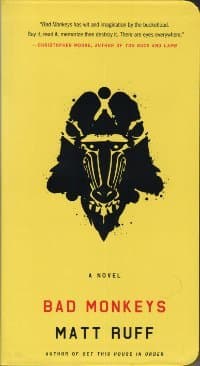
Matt Ruff (2007)
Genre
Thriller / Fantasy / Mystery / Science Fiction
Reading Time
240 min
Key Themes
See below
Sign in to track this book
A woman arrested for murder claims she belongs to the 'Bad Monkeys,' a secret group fighting evil; her sanity, and reality itself, break down under a psychiatrist's questioning.
Jane Charlotte is arrested in Reno for Paul's murder. She claims Paul was a serial killer. She does not deny the murder but says she works for the Department for the Final Disposition of Irredeemable Persons, or 'Bad Monkeys.' This group, she explains, finds and eliminates people destined to commit evil in parallel universes. Her strange story lands her in the psychiatric ward, where Dr. Vale must determine if she is a dangerous liar, delusional, or something else.
Under Dr. Vale's questions, Jane talks about her past. She describes Mrs. Rodriguez, an enigmatic figure, recruiting her into Bad Monkeys. Her first job, she claims, was to watch and then 'dispose of' Phil, an ordinary man who would become a brutal serial killer in her original timeline. Jane details the emotional toll of this mission, watching Phil's decline before following orders, all while dealing with the moral issues of pre-emptive justice. This story tries to make her current actions seem legitimate to Dr. Vale.
Jane describes Bad Monkeys' complex and strange bureaucracy, with departments for different parts of multi-dimensional policing. She explains how agents like her are assigned to timelines and 'loops' to stop future evils. She talks about the 'Orientation Unit,' the 'Department of Historical Correction,' and the 'Department of Temporal Integrity.' This detailed, almost ordinary description of a fantastical group makes Dr. Vale wonder if Jane is carefully creating a delusion or if her claims have a strange logic, even as he looks for inconsistencies.
Jane tells of the events leading to her arrest and Paul's murder. She claims Paul was a 'bad monkey' who had done terrible things in other timelines and was about to do so in her current reality. Her mission was to eliminate him. She describes tracking him, watching him, and confronting him in a hotel room. The murder details are vague, but Jane insists it was a necessary act of pre-emptive justice, a standard operation for her department. This account addresses the crime she is accused of, placing it within her fantastical story.
As Jane continues her elaborate story, Dr. Vale notices subtle differences and shifts. He questions her on details, dates, and locations, finding some elements do not quite match. He first thinks this is delusion or a made-up story, but a growing unease suggests something more complex. He wonders if she is a pathological liar, a master manipulator, or genuinely suffers from a complex psychological disorder that creates this intricate fantasy. His professional skepticism slowly fades due to Jane's detail and conviction, even as he seeks a logical explanation.
In a surprising turn, Jane reveals she was once a 'Bad Monkey.' She explains that because of a past mistake or a possible future deviation, she was marked for elimination. Instead, she was given a chance to join the group and work off her 'debt' by eliminating others. This complicates her character, suggesting a deeper, more morally ambiguous role in the Department. It makes Dr. Vale reconsider her motives and involvement, adding another layer to her already complex tale.
Driven by a perceived threat or a new mission, Jane tries to escape the psychiatric ward. Her methods are resourceful, showing a level of planning and physical ability that surprises the staff and Dr. Vale. Though caught, the incident reinforces that she is not a typical patient. Her actions raise questions about whether her 'training' as an agent gave her skills beyond a normal prisoner, or if her desperation fuels extraordinary measures. The escape attempt further blurs the line between reality and her fantastical claims.
Frustrated by Jane's shifting stories and lack of concrete evidence, Dr. Vale investigates her background. He finds records that paint a different picture of Jane Charlotte: a history of petty crimes, unstable jobs, and deception. This 'real' history contradicts much of what Jane told him about her life before Bad Monkeys. Dr. Vale confronts her with these findings, hoping to break her story. But Jane has an explanation for every inconsistency, weaving the new information into her narrative, claiming it is all part of the Department's cover-up.
As Jane's story progresses, she introduces the idea of multiple parallel timelines and alternate versions of herself. She claims her memories and experiences combine various 'Janets' (her name for her alternate selves) and that Dr. Vale's discrepancies are because he tries to fit a multi-dimensional truth into a single timeline. This explanation accounts for inconsistencies and makes her story harder to disprove, challenging Dr. Vale's understanding of reality and sanity. It is a clever narrative device that keeps him off balance.
The story reaches its peak as the true nature of Bad Monkeys is revealed. The 'Department' is not a physical group but a mental construct, a sophisticated form of psychological conditioning and identity manipulation. Agents like Jane do not travel through parallel universes but are given false memories and personas, designed to believe they are part of this grand scheme. Their 'missions' are carefully planned events, and the 'Bad Monkeys' they eliminate are often people similarly manipulated or targets for other, less noble reasons. Jane's entire reality has been a constructed illusion.
It is revealed that the mastermind behind the 'Bad Monkeys' program is a highly intelligent and manipulative person, possibly Mrs. Rodriguez or someone similar, who uses advanced psychological techniques and perhaps technology to create these elaborate alternate realities in their subjects' minds. The purpose is not to fight evil across universes but to control and use individuals for their own ends, whether for social engineering, political gain, or elaborate psychological experiments. The 'Department' is a tool for manipulation, with its agents as the main victims.
Faced with overwhelming evidence of her manipulation, Jane must make a profound choice. She can continue to believe in the comforting, false reality of being a Bad Monkey agent, with her sense of purpose and heroism. Or she can accept the painful truth that her life has been a lie, her memories fabricated, and her actions driven by external manipulation. This choice is her final act of agency as she grapples with her identity and the nature of reality. Her decision will define her future, whether within the illusion or outside it.
The Protagonist
Jane transforms from a seemingly confident operative to a woman grappling with the dissolution of her perceived reality, ultimately facing a choice between delusion and a harsh truth.
The Supporting
Dr. Vale's journey shifts from objective medical evaluation to a personal quest for truth, ultimately leading him to question the nature of reality and his own judgments.
The Antagonist/Supporting
Mrs. Rodriguez remains largely static as a character, serving as a catalyst for Jane's perceived journey and the embodiment of the organization's manipulative power.
The Mentioned
Paul's character arc is entirely retrospective, his identity shifting from a victim to a 'Bad Monkey' and back again, depending on the narrative's revelations.
The Mentioned
Phil's role is primarily to illustrate the 'Bad Monkeys' protocol and Jane's early experiences within the organization.
The novel constantly blurs the lines between real and perceived, manipulated, or imagined. Jane's elaborate story challenges Dr. Vale's, and the reader's, understanding of truth. As her narrative shifts and inconsistencies appear, the book explores how easily reality can be built, taken apart, and rebuilt, especially through psychological conditioning and memory manipulation. The revelation that Bad Monkeys is a mental construct, not a physical one, highlights this theme, showing that perception can be stronger than objective truth, as seen in Jane's firm belief in her missions.
““Reality is a crutch for people who can't cope with drugs.””
Jane Charlotte's identity is fluid and always in question. She is not just Jane Charlotte; she is 'Janet' from many timelines, an agent, a 'Bad Monkey' herself, and a woman with a fake past. The novel explores how identity can be imposed, adopted, and strongly defended, even if based on lies. Jane's struggle to match her 'Bad Monkey' persona with parts of her 'real' self shows how much outside forces affect a person's sense of who they are. Her journey involves constantly shedding and rebuilding her self-concept.
““You are who you pretend to be. If you pretend to be a hero, you are a hero. If you pretend to be a villain, you are a villain. And if you pretend to be an operative of the Department for the Final Disposition of Irredeemable Persons, you are one.””
The idea of Bad Monkeys—finding and eliminating 'irredeemable persons' destined to commit evil—directly addresses the debate of free will versus determinism. Is evil an innate quality that can be predicted and prevented, or do people always have the ability to choose? The organization's methods suggest a deterministic view, but Jane's own status as a former 'Bad Monkey' who was 'redeemed' complicates this. The final reveal that the 'Department' is a manipulative construct further questions whether anyone truly has free will when their reality and choices can be so thoroughly engineered.
““We don’t stop evil. We just dispose of it before it happens.””
The novel explores the subjective and often unclear nature of good and evil. The 'Bad Monkeys' organization claims to fight evil, but their methods involve pre-emptive murder, raising questions about whether their 'good' actions are ethical. The revelation that the organization itself is manipulative further blurs these lines, suggesting that what one group calls evil, another might exploit or even create. The story makes the reader consider if the ends justify the means and if true heroism can exist within a system built on deception and control.
““Evil is not a thing. It is a choice.””
The entire story is told through the perspective of a character whose trustworthiness is constantly in doubt.
Jane Charlotte is the quintessential unreliable narrator. Her elaborate and fantastical story, filled with parallel universes, secret organizations, and shifting identities, immediately casts doubt on the veracity of her claims. The reader, like Dr. Vale, is forced to constantly question whether Jane is telling the truth, fabricating a delusion, or meticulously crafting a lie. This device keeps the reader engaged in a constant state of suspicion and analysis, making the eventual twists and revelations more impactful as previous assumptions are shattered. It's the primary engine of the novel's mystery.
A story within a story, where Jane's narrative is framed by her interrogation.
The novel employs a frame story structure, where Jane Charlotte's detailed account of her life as a 'Bad Monkey' operative is embedded within the ongoing interrogation by Dr. Vale. The present-day interrogation in the psychiatric ward serves as the outer frame, constantly pulling the reader back to the immediate reality of Jane's arrest and psychological evaluation. This structure allows for a constant interplay between Jane's fantastical claims and Dr. Vale's skeptical, scientific questioning, creating tension and grounding the more outlandish elements of her story in a tangible setting. It also provides a clear mechanism for revealing information gradually.
Misleading clues or information designed to distract the reader from the truth.
The novel is replete with red herrings, particularly in Jane's shifting and contradictory narratives. Every time Dr. Vale uncovers an inconsistency or a piece of 'real' information about Jane's past, she has an ingenious explanation that re-integrates it into her Bad Monkeys story, leading the reader down another speculative path. These misdirections serve to build the mystery and prevent the reader from guessing the true nature of the 'Department' too early, creating a complex web of possibilities that keeps the central twist hidden until the opportune moment. The 'parallel universes' explanation is a major red herring.
The use of mental conditioning and deception to control characters' beliefs and actions.
At its core, the novel utilizes psychological manipulation as a central plot device. The 'Bad Monkeys' program itself is revealed to be a highly sophisticated system of mental conditioning, memory implantation, and identity construction, designed to make operatives believe they are part of a grand multi-dimensional mission. This manipulation affects not only Jane but potentially other characters within the story. It serves to explain the inconsistencies in Jane's narrative and ultimately reveals the true, chilling nature of the 'Department' as a means of control rather than interdimensional policing, making the characters victims of a deeper conspiracy.
“I’m not crazy. I’m just in a bad mood.”
— Jane Charlotte's repeated assertion to her psychiatrist, Dr. Chen, about her mental state.
“There are no coincidences, only the illusion of coincidence.”
— A recurring theme and philosophical statement regarding the interconnectedness of events.
“We're not here to make the world a better place. We're here to keep it from getting worse.”
— A pragmatic view of the Bad Monkeys' mission, highlighting their role as maintainers rather than saviors.
“The truth is a moving target.”
— Reflecting the shifting realities and unreliable narrators throughout the story.
“Every choice you make creates a new reality.”
— Exploring the multiverse theory and the impact of individual decisions.
“Sometimes you have to break a few rules to save the world.”
— Justifying morally ambiguous actions taken by characters in pursuit of their objectives.
“Memory is a funny thing. It can play tricks on you.”
— Jane Charlotte's own unreliable memory and the manipulation of memories within the narrative.
“You can never truly escape your past. It always finds a way to catch up.”
— The lingering consequences of past actions and decisions for various characters.
“The greatest trick the devil ever pulled was convincing the world he didn't exist.”
— A classic quote used to illustrate the hidden forces and conspiracies at play.
“There's a difference between being crazy and being right about crazy things.”
— Jane Charlotte's distinction between her sanity and the bizarre reality she claims to inhabit.
“You don't get to choose your reality. You just get to live in it.”
— A statement on the lack of control individuals have over the fundamental nature of their existence.
“Every villain is the hero of their own story.”
— Exploring the complex motivations and self-justifications of antagonists.
“We're all just trying to make sense of a world that doesn't make any.”
— A broader commentary on the human condition amidst the chaotic and inexplicable events.
“The line between good and evil is a lot blurrier than most people think.”
— Highlighting the moral ambiguities faced by the 'Bad Monkeys' and other characters.
Ready to see how well you understood this book? Take our interactive quiz with 10 questions.

Biography coming soon.







