“BATH TIME! Oh, no! Not bath time! Anything but bath time!”
— Kitty's initial reaction to the impending bath.

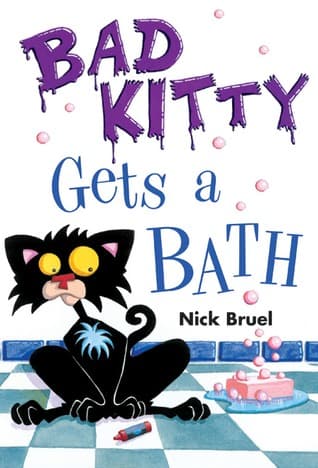
Nick Bruel (2008)
Genre
Children's
Reading Time
15 min
Key Themes
See below
Sign in to track this book
Bad Kitty, known for her sass and dislike of baths, faces her biggest challenge: the bathtub.
The book starts with Kitty's owner, a young boy, noticing a terrible smell from his cat. He tries to ignore it, but the smell fills the house, making plants wilt and paint peel. The owner realizes that Kitty needs a bath. This thought causes immediate worry, as both the owner and narrator know how hard this will be, given Kitty's bad temper and dislike of water.
Before even trying to give a bath, the narrator lists all the needed supplies. These start with practical items like a bathtub, water, and dry towels, but quickly become silly: armor, a letter to loved ones, clean underwear, an ambulance, and paramedics. The long list shows the extreme danger of bathing Kitty, humorously suggesting one should prepare for a dangerous event. The last, and hardest, item on the list is Kitty herself.
The first problem is finding Kitty, who has hidden herself, perhaps sensing danger. The owner searches the house, calling her name, but Kitty stays hidden. To get her out, the narrator suggests using anchovies. The smell of the anchovies brings Kitty out, and she eats the fish, distracted from the owner's real plan. This short moment of calm ends when the owner sees Kitty and can start the next step.
With Kitty distracted by the anchovies, the owner moves quickly and grabs her. Kitty immediately realizes what is happening and fights hard. She scratches, bites, and thrashes, escaping the owner's grip. This starts a chaotic chase through the house. Kitty is surprisingly agile and determined to avoid the bath. The owner, bruised, must rethink his plan, seeing that a direct approach will not work.
After the first failed attempt, the owner, with the narrator's help, makes a new plan. They decide to lure Kitty into the bathroom without her knowing. This involves making a trail of treats, like tuna and catnip, leading into the bathroom and toward the bathtub. Kitty, always ready for food, carefully follows the trail, her suspicions temporarily forgotten by her hunger. The tension grows as she gets closer to the water-filled tub, unaware of the trap.
Kitty reaches the end of the treat trail and, to her shock, finds herself in the bathtub. The moment she realizes she is in water, her reaction is immediate and violent. She screams and thrashes wildly, claws out, trying to escape. The owner, despite his preparations, is overwhelmed by Kitty's fury, struggling to hold her. The bathroom becomes a scene of chaos, with water splashing everywhere and Kitty's desperate tries to escape.
What follows is a full battle in the bathtub. The owner, now wearing armor (as the narrator suggested), tries to apply soap and scrub Kitty. Kitty fights back with all her might, becoming a furry, wet, and very angry whirlwind. She scratches, bites, and sprays water, making it almost impossible for the owner to clean her. The narrator gives humorous warnings and survival tips, showing how hard and dangerous the task is, reinforcing that bathing Kitty is an epic struggle.
Despite the owner's best efforts, Kitty, covered in soap and very slippery, gets free. She leaps out of the tub and runs from the bathroom, leaving wet paw prints and suds. The owner, tired and defeated, watches Kitty disappear, the bathroom left messy. Her escape shows Kitty's strong will and her complete dislike of baths, making the owner wonder if the task is even possible.
After the chaos, the owner finds Kitty hiding under a bed. To his surprise, even though the bath was not fully done, Kitty is quite clean. Her frantic thrashing, the soap, and her escape through the house have cleaned her fur. She is still wet and very angry, but the bad smell is gone. The owner realizes that while the bath was a disaster, Kitty is clean, in a roundabout way.
Kitty, now clean but upset, glares at her owner, promising future revenge. She is wrapped in a towel, still damp, and refuses comfort. The owner, relieved the smell is gone, is bruised and tired. The narrator ends by saying that while Kitty is clean for now, the experience was so difficult that the thought of bathing her again fills everyone with dread. The book finishes with Kitty still angry, and the owner left to think about the next time Kitty gets stinky.
The Protagonist/Antagonist
Kitty remains largely unchanged in her personality; her 'arc' is more about her physical transformation from stinky to clean, and the hilarious, chaotic journey to get there.
The Protagonist/Supporting
He begins with a daunting task and, despite numerous setbacks and injuries, ultimately succeeds in cleaning Kitty, albeit unconventionally. He learns the extreme difficulty of bathing his cat.
The Supporting
The Narrator's role is consistent throughout, providing a humorous, instructional, and cautionary voice without undergoing personal development.
The Mentioned
N/A
The Supporting
N/A
The book humorously exaggerates the common difficulties of owning a pet, focusing on the dreaded task of bathing a cat. It shows the conflict between an owner's duty to keep a pet clean and a pet's natural instincts, like a cat's dislike of water. The owner's struggles and planning reflect real pet owner efforts, made funnier for comedy. The book suggests that loving a pet means dealing with difficult and messy situations.
“The following are some items you will need for Kitty's bath: one bathtub, plenty of water, dry towels, a suit of armor, a letter to your loved ones, clean underwear (because stressful situations can cause 'accidents'), an ambulance in your driveway with the engine running, and, oh, yeah, you'll also need Kitty…but good luck with that!”
A main theme is using extreme exaggeration and absurdity for humor. The simple task of bathing a cat becomes a dangerous mission needing emergency services and protective gear. The narrator's over-the-top advice, Kitty's strong resistance, and the owner's battered look all create comedy by taking a normal situation to its most ridiculous extreme. This theme makes the book relatable yet very funny for young readers.
“First, you will need to find Kitty. This may be difficult. Kitty is very good at hiding. When she doesn't want to be found, she cannot be found.”
The book explores the conflict between Kitty's animal instincts (her deep dislike of water and strong independence) and the human need for cleanliness. Kitty's strong resistance is her natural instinct, while the owner's persistence comes from the need for a clean home. This struggle drives the plot, showing how hard it can be to put human rules on an animal driven by its own nature.
“Kitty, however, has other plans. She does not like water. She does not like baths. She does not like YOU, if you try to give her a bath.”
The narrative is structured as an instructional manual for bathing a cat.
The entire book is framed as a 'how-to' guide, directly addressing the reader with instructions and advice. This format immediately engages the audience, making them feel like participants in the daunting task. The humor arises from the contrast between the seemingly simple premise of a 'how-to' and the increasingly absurd and dangerous steps involved. It also allows the narrator to offer comedic warnings and exaggerated precautions, enhancing the overall tone of the book.
The narrator and reader are aware of the impending chaos, while Kitty remains oblivious.
Dramatic irony is heavily used, particularly in the scenes leading up to Kitty entering the bathroom. The narrator constantly warns the reader about Kitty's impending fury, and the reader knows the owner's true intentions when he lures Kitty with treats. Kitty, however, is completely unaware of the trap until she is in the bathtub. This creates suspense and heightens the humor as the reader anticipates Kitty's explosive reaction, making her eventual outburst even funnier.
Over-the-top descriptions and scenarios for comedic effect.
Exaggeration is the primary comedic device. From Kitty's unbearable stench causing plants to wilt, to the necessity of a suit of armor and an ambulance for her bath, every aspect of the situation is blown out of proportion. This hyperbole turns a mundane household task into an epic, dangerous adventure, making the challenges of pet ownership relatable yet hilariously extreme. It's key to the book's lighthearted, humorous tone.
Attributing human-like emotions and motivations to Kitty.
While Kitty doesn't speak, she is consistently portrayed with human-like emotions and motivations, such as 'realizing' she's been tricked, having 'other plans,' or giving a 'vengeful' glare. This anthropomorphism allows readers to connect with Kitty's 'bad' personality and understand her actions in a more relatable way, even as she acts on animal instinct. It makes her a more complex and engaging character, despite her animal nature, and fuels much of the story's humor.
“BATH TIME! Oh, no! Not bath time! Anything but bath time!”
— Kitty's initial reaction to the impending bath.
“The cat was a mess. A very, very dirty mess. A very, very, very dirty mess.”
— The narrator describing Kitty's state before the bath.
“You're going to love it! It'll be fun! A nice warm bath!”
— The owner trying to convince Kitty about the bath.
“But Kitty did not love it. Kitty did not think it was fun. Kitty did not think it was a nice warm bath.”
— Kitty's internal thoughts contrasting with the owner's assurances.
“It was a cold, wet, soapy, bubbly, splashy, scary, awful, horrible, terrible, no-good, very bad bath!”
— Kitty's extensive description of how terrible the bath is.
“No, no, no! Not the water! The water is evil! It will melt me!”
— Kitty's dramatic reaction to the water.
“A-C-H-O-O! Kitty sneezed. A big, wet, bubbly sneeze.”
— Kitty's reaction to getting wet.
“This is ridiculous! I am a cat! Cats do not take baths!”
— Kitty's protest, emphasizing feline nature.
“But sometimes... just sometimes... cats get so dirty that they have to take a bath.”
— The narrator's explanation of why the bath is necessary.
“And then... it was over. The bath was done.”
— The abrupt end of the bath.
“Kitty was clean. Very, very clean. Sparkly clean. Fluffy clean. But... still a little mad.”
— Kitty's state after the bath, clean but still annoyed.
“And the owner was wet. Very, very wet. Soapy wet. Messy wet. But... happy.”
— The owner's state after the bath, contrasting with Kitty's.
“Because even a very bad kitty can be a very clean kitty.”
— The concluding thought about the outcome of the bath.
“Next time... maybe a shower?”
— A humorous, slightly ominous thought about future bathing attempts.
Ready to see how well you understood this book? Take our interactive quiz with 10 questions.

Biography coming soon.

Dan Gemeinhart
4.5

Kate O'Hearn
4.4

Jeanne Birdsall
4.4

Jen Wang
4.4
Wendelin Van Draanen
4.3

John Marsden
4.3

Chris Van Allsburg
4.3
Jennifer A. Nielsen
4.2