“The wind was blowing a gale, and the rain was coming down in sheets, but Megan didn't care. She was free.”
— Megan's initial escape from her difficult home life to live with her aunt.

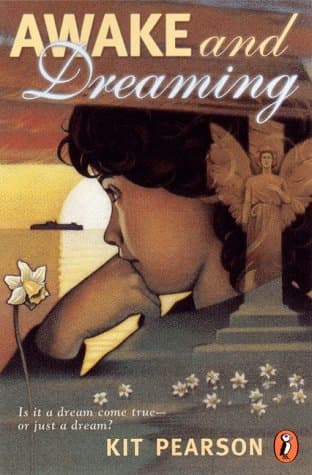
Kit Pearson (1996)
Genre
Fantasy / Children's / Young Adult
Reading Time
244 min
Key Themes
See below
Sign in to track this book
A young girl trapped in poverty dreams of a perfect family, only to find herself questioning the line between reality and illusion when her magical new life with the warm Kaldors mysteriously unravels.
Ten-year-old Theo lives a nomadic and impoverished life with her mother, Gwen. Gwen is artistic and free-spirited but deeply irresponsible. She often forgets to feed Theo or pay rent. They move frequently, staying in rundown apartments. Theo constantly feels the weight of her mother's neglect and the instability of their existence. Theo often retreats into her imagination, dreaming of a stable home and a 'real' family with a father and siblings, and the simple comforts she lacks. She longs for a sense of belonging and permanence, a sharp contrast to her current reality where she is often left alone.
One day, after Gwen has left Theo alone for a long time, Theo is drawn to a beautiful old house. A woman, Mrs. Kaldor, appears at the door and, without explanation, invites Theo to stay. Theo is quickly absorbed into the large, loving Kaldor family. It consists of Mr. and Mrs. Kaldor and their many children: Hilary, a kind teenager; twins Laura and Lucy; and the younger boys, Ben and Peter. The Kaldors provide Theo with everything she has ever dreamed of: a warm bed, regular meals, new clothes, and, most importantly, a sense of belonging and affection. She feels safe and cherished for the first time in her life.
Life with the Kaldors is everything Theo imagined. She attends school regularly, makes friends, and enjoys family meals and outings. She forms a special bond with Hilary, who acts as an older sister, and enjoys the chaos and affection of the younger children. The Kaldor house is full of laughter, books, and art, a sharp contrast to the sterile, temporary rooms she shared with Gwen. Theo thrives in this environment. Her confidence grows, and she begins to forget the harsh realities of her past life. She feels completely integrated into the family, even though the circumstances of her arrival remain a mystery.
As time passes, subtle cracks appear in Theo's perfect new life. She occasionally glimpses a shadowy figure that makes her uneasy. The Kaldor children sometimes seem to forget things she has told them about her past, or their memories of events differ from hers. Objects in the house occasionally shift or disappear. Theo also notices that the Kaldors never mention her mother, Gwen, and she herself finds it increasingly difficult to recall specific details about her old life. These inconsistencies make Theo question her new reality.
One day, Gwen suddenly reappears at the Kaldor house, seemingly unaware of the time that has passed or where Theo has been. She takes Theo away without much explanation. Theo is thrust back into her old life of instability and neglect. The transition is jarring; the warmth and comfort of the Kaldor home are replaced by the familiar coldness and uncertainty. Theo is heartbroken and confused, unable to reconcile the two vastly different realities. She struggles to understand what happened and why she was taken from a place where she finally felt she belonged.
Back with Gwen, Theo tries to make sense of her experience with the Kaldors. She clings to memories, but they begin to feel hazy and dreamlike. Gwen dismisses Theo's stories as fantasies, further confusing Theo. Theo desperately searches for any tangible proof of the Kaldors' existence: a drawing, a school paper, anything. She revisits the location of the Kaldor house, only to find an empty lot or a different building, adding to her despair and leading her to question her own sanity. The shadowy figure from her time with the Kaldors also reappears in her thoughts, deepening the mystery.
Gwen, in her typical fashion, decides they need a fresh start and moves them to a new town. Here, they settle into a slightly more stable, though still modest, apartment. Theo meets Matthew, a kind and curious boy her age. Matthew is empathetic and a good listener, and Theo cautiously begins to confide in him about her past, including her experiences with the Kaldors. Matthew, unlike Gwen, takes Theo's stories seriously and believes she might have experienced something extraordinary, offering her much-needed validation and companionship. Their friendship provides a new anchor for Theo.
As Theo and Matthew spend more time together, Theo continues to be haunted by the shadowy figure. Through conversations with Matthew and her own introspection, Theo realizes that the figure is not menacing. Instead, it represents her own suppressed memories and grief. She begins to understand that the figure is connected to the loss of her father, who died when she was very young. This realization is painful but also brings clarity, allowing her to process a grief she hadn't consciously acknowledged before. The shadow symbolizes the unresolved sadness within her.
With Matthew's help and her own growing maturity, Theo begins to see Gwen not just as an irresponsible parent, but as a flawed individual struggling with her own demons and grief. She understands that Gwen's artistic nature and flightiness are coping mechanisms. While Gwen loves her, she is incapable of providing the stability Theo craves. This understanding does not excuse Gwen's behavior, but it allows Theo to approach their relationship with more empathy and less resentment, recognizing her mother's limitations without taking them as a personal failing.
Theo eventually accepts that her time with the Kaldors was a magical, dream-like experience. It was a manifestation of her deepest desires for a stable family and a safe home. It was not a hallucination, but a profound emotional and psychological journey that allowed her to heal and grow. The Kaldors represented the ideal family, a space where she could process her grief and longing. She understands that while they may not have been 'real' in a conventional sense, the love and lessons she learned from them were real and have shaped her into a stronger, more resilient person.
Armed with a new understanding of herself, her mother, and her experiences, Theo begins to take more control over her own life. She actively seeks out positive influences, like Matthew and a kind librarian. She starts to build her own support system and finds ways to create moments of stability and joy for herself, even within the unpredictable framework of her life with Gwen. Theo realizes that while she may not have the perfect family she once dreamed of, she has the inner strength and resilience to navigate her reality and find happiness.
Towards the end of the story, there are small but significant improvements in Theo and Gwen's relationship. While Gwen does not completely transform, she shows glimmers of more attentiveness and responsibility, partly due to Theo's growing independence and maturity. Theo, having processed her grief and understood her mother better, is less reliant on Gwen for her emotional well-being. She is no longer just a passive recipient of her mother's whims but an active participant in shaping her own life. The ending suggests a future where Theo, though still living with Gwen, is better equipped to thrive.
The Protagonist
Theo transforms from a passive, longing child into a self-aware and resilient girl who understands her past and takes control of her future.
The Supporting
Gwen remains largely static in her core personality, but Theo's understanding of her evolves, leading to a subtle shift in their dynamic.
The Supporting
As a figure in Theo's 'dream' world, Mrs. Kaldor's character remains consistent, serving as an anchor of warmth and ideal motherhood.
The Supporting
Hilary serves as a consistent beacon of support and sisterly love within Theo's transformative experience.
The Supporting
Matthew's character is consistent, serving as a catalyst for Theo's self-discovery and emotional healing.
The Mentioned
The shadowy figure transforms from an undefined fear into a symbol of Theo's past grief, which she eventually confronts and integrates.
Theo's imagination is both a refuge and a tool for processing her reality. Her 'dream' of the Kaldor family provides her with the emotional nourishment and stability she lacks in her real life with Gwen. This theme explores how imagination can be a coping mechanism for trauma and neglect, and how it can also be a pathway to self-discovery. The vividness of the Kaldor experience highlights the impact of Theo's inner world, suggesting that emotional truths can manifest in deeply personal, non-literal ways. The story emphasizes that even if an experience is not 'real' in the conventional sense, its emotional and psychological impact can be true and transformative.
“Maybe it was a dream, but it was the most real dream I ever had.”
Central to Theo's journey is her longing for a stable home and a sense of belonging. Her life with Gwen is characterized by constant movement, neglect, and a lack of permanence. The Kaldor family represents the ideal of this desire, a large, loving, and stable household where Theo feels cherished and secure. This theme explores the human need for connection and a safe haven, especially for a child. Theo's search for belonging drives her story, and her eventual understanding is that true belonging comes not just from outside circumstances but from within herself and the connections she builds.
“She wanted a house where the furniture stayed in the same place, where there was a father, and a mother who remembered to feed you.”
The novel sharply contrasts two forms of maternal figures: Gwen, Theo's biological mother, who is loving but deeply neglectful and irresponsible, and Mrs. Kaldor, the idealized, nurturing surrogate mother. This theme examines the complexities of motherhood, showing that love alone is not enough to provide for a child's needs. Gwen's inability to care for Theo highlights the impact of parental neglect on a child's development and emotional well-being. Conversely, Mrs. Kaldor represents the transformative power of consistent, unconditional care. The theme ultimately encourages understanding Gwen's flaws while affirming Theo's right to proper care and her eventual ability to seek it out for herself.
“Gwen loved her, Theo knew that, but it was a slippery, unreliable kind of love.”
Beneath Theo's longing for a stable family is an unacknowledged grief for her deceased father. The shadowy figure that haunts her thoughts is eventually revealed to be a manifestation of this suppressed loss. This theme explores how unresolved grief can impact a child's emotional state and behavior, and how it can subtly shape their desires and fears. Theo's journey involves confronting this grief, understanding its origins, and integrating it into her sense of self. Her ability to finally name and process this loss is a step in her healing and maturity, allowing her to move forward with greater emotional clarity.
“The shadow wasn't a monster, she realized. It was just sadness, waiting to be seen.”
The blurring of reality and fantasy, making Theo's experience with the Kaldors ambiguous.
The novel employs magical realism or dream logic to present Theo's time with the Kaldor family. It is never explicitly stated whether the Kaldors were 'real' or a product of Theo's imagination. The narrative maintains this ambiguity, presenting the Kaldor experience with vivid detail and emotional truth, while simultaneously introducing subtle inconsistencies and a dreamlike quality that hints at its fantastical nature. This device allows the author to explore Theo's psychological journey and her deepest desires without needing a literal explanation, emphasizing the emotional reality over objective facts.
The house represents the ideal home and family Theo craves.
The Kaldor house serves as a powerful symbol throughout the novel. It is described as warm, welcoming, full of books, art, and laughter – everything Theo's real-life homes are not. It represents the stability, comfort, and unconditional love of the 'real' family Theo longs for. When Theo returns to her old life and finds the house gone or changed, it underscores the ephemeral nature of her dream, yet the memory of the house continues to symbolize the ideal she strives for and the emotional nourishment she received there.
A recurring motif that symbolizes Theo's repressed grief.
The shadowy figure is a significant symbolic device. Initially, it appears as an unsettling, indistinct presence, causing Theo vague unease. As the story progresses and Theo matures, she comes to understand that this figure is not an external threat but an internal manifestation of her suppressed grief for her deceased father. Its gradual unveiling and Theo's eventual confrontation with its meaning represent her journey of emotional processing and healing from unacknowledged loss. The shadow is a concrete representation of an abstract internal state.
“The wind was blowing a gale, and the rain was coming down in sheets, but Megan didn't care. She was free.”
— Megan's initial escape from her difficult home life to live with her aunt.
“There were other worlds, she thought, and sometimes, if you were lucky, you could slip into them.”
— Megan's growing awareness of the magical aspects of her new home and the past.
“It was like looking through a window into another time, another life.”
— Megan's experience with the antique mirror, a portal to the past.
“Sometimes the past wasn't really past at all. Sometimes it was just waiting for you to find it.”
— Megan's realization about the lingering presence of the past in the house.
“She felt a strange pull, a sense of belonging that she hadn't felt anywhere else.”
— Megan's connection to the old house and the spirits within it.
“The house was alive, whispering secrets she was only just beginning to understand.”
— Megan's growing sensitivity to the house's history and its ghostly inhabitants.
“Grief was a funny thing. It could make you do things you never thought you would.”
— Reflecting on the motivations behind the actions of the past inhabitants.
“It wasn't just about seeing the past; it was about feeling it, living it.”
— Megan's deep immersion into the lives of the children from the past.
“Children, she thought, were often braver than anyone gave them credit for.”
— Megan's admiration for the courage of the children from the past and her own.
“The hardest part wasn't letting go, but realizing you had to.”
— Megan's struggle with accepting the need to move on from the past and the spirits.
“Even ghosts needed someone to remember them, to tell their story.”
— Megan's role in bringing peace to the spirits by acknowledging their existence.
“Sometimes the magic wasn't in the big, grand gestures, but in the quiet, everyday moments.”
— Megan's appreciation for the subtle wonders of her new life.
“She was no longer just dreaming; she was awake, and she was living.”
— Megan's transformation from a passive observer to an active participant in her own life.
“The world was full of wonders, if you only knew where to look.”
— Megan's broadened perspective after her magical experiences.
Ready to see how well you understood this book? Take our interactive quiz with 10 questions.







