“He was a boy who could make things, but he was not a boy who could make things happen.”
— Describing Geryon's nature and passivity.

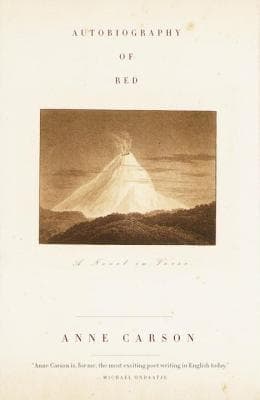
Anne Carson (1999)
Genre
Fantasy
Reading Time
120 min
Key Themes
See below
Sign in to track this book
A winged red monster named Geryon navigates love, loss, and artistic awakening through his camera and the presence of Herakles, in a lyrical retelling of myth.
Geryon, a small, winged red monster, begins writing his autobiography at five. He lives with his distant, often violent older brother and his well-meaning but ineffective mother. His early writings detail both the ordinary and unusual parts of his life, including his struggles with his body and his brother's constant teasing. He finds comfort in observing and thinking, often feeling like an outsider in his family and the world. His mother tries to understand him, but her efforts are often clumsy against his brother's cruelty.
As Geryon grows up, he develops a love for photography, using his camera as a shield and a way to see the world from his unique view. One day, while taking pictures, he meets Herakles, a charming, older boy with a wild spirit. Herakles is immediately drawn to Geryon's unusual looks and quiet intensity. Their first meetings are full of a growing attraction, and Geryon, despite his shyness, is deeply interested in Herakles's strong personality and easy confidence. This meeting marks a turning point, bringing romance and vulnerability into Geryon's solitary life.
Geryon and Herakles start a passionate, if unusual, relationship. Herakles shows Geryon new experiences and a sense of belonging Geryon has never known. Their time together is intense and joyful, filled with desire and companionship. Geryon falls deeply in love, believing he has found his soulmate. But Herakles, being a drifter, suddenly leaves Geryon one day without a word. This sudden departure breaks Geryon's heart and leaves him confused, dealing with the pain of being left and the strength of his unreturned love.
After Herakles leaves, Geryon puts his pain and longing into his photography, developing his artistic voice. He travels to different places, including Argentina, trying to understand himself and the world through his camera. These years involve much thought and creative growth. He learns to live with his unique identity, becoming more comfortable with himself, even as Herakles's memory stays with him. His photography becomes more complex, showing his changing emotions and his search for meaning.
Years later, Geryon, now an accomplished photographer, is in Buenos Aires for an exhibition. To his surprise, he sees Herakles, who is now with a woman named Ancash. The reunion is awkward and full of unspoken feelings. Geryon is overcome with old hurt, renewed longing, and the shock of seeing Herakles again. Herakles, for his part, seems to acknowledge the past but is reserved. This chance meeting disrupts Geryon's carefully built peace and forces him to face the lasting effect of their past relationship.
Geryon spends time watching Herakles and Ancash, noticing how they interact. He sees Herakles dancing the tango with Ancash, a dance that shows passion and connection, further highlighting Geryon's feeling of being left out and his longing. Despite the years, Geryon's feelings for Herakles are still strong and complex. He struggles to match the Herakles he loved with the man in front of him, who seems both familiar and changed. The unspoken history between them creates an intense tension for Geryon.
During their time in Buenos Aires, Geryon and Herakles share a moment of understanding, perhaps a touch or a look, that hints at their unresolved connection. This moment leads Herakles to invite Geryon and Ancash on a trip to a volcano. Geryon accepts, hoping for some kind of closure or explanation, despite the pain of being with Herakles and his new partner. The journey to the volcano shows a descent into the strong emotions under their surface interactions.
The three travel to the volcano, a place of stark beauty that reflects Geryon's inner turmoil. Here, raw emotions surface. Geryon confronts Herakles, not necessarily with words, but through his art and his presence. The setting allows for a deeper look at their shared history and Herakles's effect on Geryon's life. The volcano, a place of creation and destruction, becomes a symbol for Geryon's passionate heart and his own emotional landscape.
Ancash, sensing the complex history between Geryon and Herakles, offers Geryon a different view of Herakles's character and reasons. She reveals parts of Herakles Geryon hadn't considered, helping him see Herakles not just as a lover who left him, but as a complex, perhaps flawed, person. This insight, combined with the release at the volcano, helps Geryon start to let go of his idealized image of Herakles and find a way to a more mature understanding of love and loss. Ancash eventually leaves, leaving Geryon and Herakles alone for a final, unspoken goodbye.
After the encounter at the volcano, Geryon experiences an artistic breakthrough. His experiences—his early suffering, his intense love for Herakles, the pain of being left, and the complexities of their reunion—power his creative mind. He no longer just records but turns his life into art. He finds a way to show his unique perspective, his unusual beauty, and his deep capacity for love and sorrow through his photography, moving past his personal pain to create something universal and powerful.
Throughout the story, Geryon's life is linked with hints of the ancient Greek myth of Geryon, a three-bodied monster killed by Herakles. Geryon, the character, deals with this mythic weight, seeing himself as a modern version. By the end, Geryon fully accepts his identity as a winged red monster, seeing it not as a curse but as a part of his artistic vision. He combines his personal story with the myth, finding strength and purpose in his unusualness and his artistic calling, creating his own mythic journey of self-discovery and creation.
The Protagonist
Geryon transforms from a tormented, isolated child into a mature artist who reconciles his monstrous identity with his profound human experiences of love and loss, ultimately finding his unique voice.
The Supporting/Antagonist (initially)
Herakles remains largely unchanged in his fundamental nature, serving as a catalyst for Geryon's growth rather than undergoing significant personal transformation.
The Supporting
Her character remains static, serving to illustrate Geryon's early home environment and his initial sense of being misunderstood.
The Mentioned/Antagonist
The brother's role is primarily confined to Geryon's childhood memories, shaping Geryon's initial psychological landscape without a developed arc himself.
The Supporting
Ancash serves as a temporary guide for Geryon, facilitating his emotional processing rather than undergoing a significant personal arc.
The book explores first love, the pain of being left, and the lasting impact of a deep connection. Geryon's strong feelings for Herakles are shown with raw honesty, making his later heartbreak clear. The reunion in Buenos Aires highlights how past loves continue to shape the present, making Geryon face unresolved emotions and the pain of unfulfilled desire. The story suggests that love, even lost love, can drive personal and artistic growth, turning sadness into creative energy.
“He fell in love. He was a monster. He was a boy. He was a boy in love with a monster. He was a monster in love with a boy. He was a boy in love with a boy.”
Geryon's identity as a winged red monster is central, symbolizing feeling different and alone. His physical difference reflects his internal struggles with self-acceptance and feeling like an outsider. The story follows his journey from being bothered by his difference to accepting it as a unique part of himself and a source of his art. His 'monstrousness' is not a flaw but an essential part of his identity, letting him see the world from a distinct view. This theme connects with anyone who has felt 'other.'
“He lived inside his own skin and the skin was red and had wings.”
Photography is Geryon's main way of expressing himself and a key tool for navigating his inner and outer worlds. His camera acts as both a shield and a lens, letting him observe life from a distance while capturing its essence. Through his art, Geryon processes his pain, explores his identity, and turns his suffering into something beautiful and meaningful. Creating becomes a way for him to understand himself, to say what words cannot, and to find purpose and belonging in a world that often alienates him. His autobiography itself is an act of artistic self-creation.
“He wanted to take a picture of the inside of his soul.”
Carson retells the ancient Greek myth of Geryon and Herakles, changing it from a tale of heroic conquest into a modern love story. The original myth's violence and clear hero/villain dynamic are reversed, with Geryon as a sensitive character and Herakles as a complex, unclear figure. This new interpretation lets the novel explore vulnerability, desire, and the human condition through a mythic lens, showing how old stories can still be meaningful today. The 'monstrous' Geryon is made human, and the 'heroic' Herakles is shown to be flawed.
“A monster is not a human being. A monster is a type of dream.”
The story often looks into Geryon's memories, especially of his childhood and his first love with Herakles. The past is not fixed but a living thing that keeps influencing Geryon's current experiences and emotions. The reunion with Herakles forces Geryon to confront these persistent memories and the unresolved feelings they carry. The autobiography format itself stresses remembering and reinterpreting the past, showing how personal history shapes identity and how one's story can change over time. The pain of being left, though years old, is felt again with full force.
“Memory is a kind of monster.”
The story is presented as Geryon's personal memoir, written from childhood to adulthood.
This device offers an intimate, first-person perspective into Geryon's thoughts, feelings, and experiences. It allows readers direct access to his unique voice and worldview, emphasizing his introspection and artistic sensibility. The fragmented, sometimes poetic nature of the 'autobiography' reflects Geryon's developing consciousness and his struggle to articulate his identity. It also provides a chronological framework while allowing for lyrical digressions and philosophical musings, blurring the lines between prose and poetry.
The story explicitly references and reworks the ancient Greek myth as an underlying framework.
This device adds layers of intertextuality and symbolic meaning. By casting the protagonist as the 'monster' Geryon and his lover as 'Herakles,' the novel subverts traditional heroic narratives and explores the complexities of power dynamics, desire, and vulnerability. The myth acts as both a parallel and a counterpoint to the modern story, allowing for a commentary on how ancient stories continue to inform and shape human experience, and how they can be reinterpreted to explore contemporary themes like queer love and identity.
Geryon's passion for photography is a central element, serving as both a narrative tool and a symbolic lens.
Photography functions as Geryon's primary means of engaging with and understanding the world. It symbolizes his desire to capture and preserve moments, to see beauty in the mundane, and to create meaning from his experiences. The camera acts as a barrier, allowing him to observe from a distance, but also as a bridge, connecting him to his subjects and his own emotions. It represents the artistic process of transforming raw experience into a crafted image, mirroring Geryon's own journey of self-creation.
A recurring symbol representing raw emotion, creation, and destruction.
The volcano appears both literally as a destination for Geryon, Herakles, and Ancash, and metaphorically throughout the narrative. It symbolizes the volatile, powerful, and often destructive nature of Geryon's emotions, particularly his love and pain. It represents a place of intense internal pressure and potential eruption, mirroring the 'volcanic terrain' of Geryon's soul. The journey to the volcano acts as a cathartic climax, allowing for emotional release and a confrontation with deep-seated feelings, leading to Geryon's artistic breakthrough.
“He was a boy who could make things, but he was not a boy who could make things happen.”
— Describing Geryon's nature and passivity.
“To be a monster is to be a mutation in the order of the world. I am a monster. I am a mutation.”
— Geryon's internal reflection on his identity as a winged red creature.
“You remember too much, my mother said to me. But how can you forget enough?”
— Geryon reflecting on his mother's words about memory and forgetting.
“Love, like a carefully chosen lie, gets you through the day.”
— A cynical observation about the nature of love.
“Desire is a kind of house. It has walls, it has windows. It has a roof, it has a door. It has a bed. It has a body.”
— A poetic description of desire as a physical space.
“What is the sound of one heart breaking? It is the sound of a thousand hearts breaking.”
— Geryon's experience of heartbreak, universalizing the pain.
“Every time he put on his wings, he felt a strange sadness. They were a part of him, but they were also a burden.”
— Geryon's mixed feelings about his wings, his defining physical trait.
“He lived in a world where things happened, but he did not feel that he was part of them.”
— Geryon's sense of detachment and observation rather than participation.
“The past is a foreign country; they do things differently there.”
— A common saying quoted, highlighting the difference between past and present, particularly in relationships.
“He knew that the world was full of terrible beauty, and that he was one of its creatures.”
— Geryon's acceptance of his place within a complex and often harsh world.
“To be seen is to be loved, he thought. But to be understood, that is another thing.”
— Geryon's longing for understanding beyond mere visibility or superficial affection.
“He saw himself as a book whose pages had been torn out and scattered by the wind.”
— A metaphor for Geryon's fragmented sense of self after a significant loss or change.
“There are some things you can't undo. And some things you can't outrun.”
— A reflection on the inevitability of certain consequences or past events.
“He had a hunger for knowledge, a hunger for experience, a hunger for all the things that made up a life.”
— Describing Geryon's deep curiosity and desire for a full existence.
Ready to see how well you understood this book? Take our interactive quiz with 10 questions.

Anne Patricia Carson is a Canadian poet, essayist, translator, classicist, and professor.







