“But at the same time, I also understood that the things we do in life, no matter how small, leave a trace, a memory that can be reactivated at any time.”
— Austerlitz reflecting on the traces of history and personal memory.

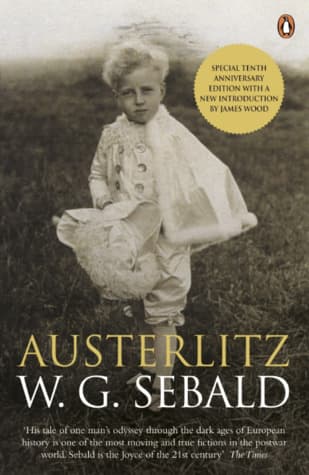
W.G. Sebald (2001)
Genre
Historical Fiction
Reading Time
900 min
Key Themes
See below
Sign in to track this book
A lonely architect, haunted by childhood memories, travels across Europe to find the truth of his Kindertransport past and rebuild his identity.
The story begins with the narrator describing his architectural trips across Europe. In the summer of 1967, at Antwerp Central Station, he meets Jacques Austerlitz. Austerlitz, a seemingly unusual and solitary man, talks with the narrator for a long time about the station's history and architecture. He discusses its role in human movement and memory. This first meeting shows Austerlitz's intellectual curiosity and his deep, though then unstated, connection to themes of displacement and time, which will later be central to his own life story.
Years pass, and the narrator occasionally sees Austerlitz in London, often at places like Liverpool Street Station or the London Library. During these meetings, Austerlitz, now an art history professor, starts to reveal more about himself. He shares his interest in photography, especially pictures of old buildings and empty landscapes, which he sees as holding historical memory. In these talks, Austerlitz first mentions a deep personal emptiness and a strange feeling of being an outsider, hinting at a past he cannot fully recall but which strongly affects him.
Austerlitz has a major breakthrough during a visit to Liverpool Street Station. He is suddenly overwhelmed by a memory: a large, busy station and the feeling of being a small child among many others. This makes him realize he arrived in England in 1939 as part of the Kindertransport, a rescue effort for Jewish children fleeing Nazi persecution. He had been raised by a Welsh Methodist minister and his wife, Emyr and Gwenllian Elias, in a remote parsonage, unaware of his true identity or background. This discovery starts his conscious search for his past.
After his discovery, Austerlitz travels to the remote Welsh village where he grew up with the Eliases. He visits the parsonage and the surrounding area, trying to recall parts of his early childhood. He remembers the strict, emotionally distant upbringing, the unfamiliar language, and the constant feeling of being an outsider, despite the Eliases' care. This journey is marked by a deep sadness, as he looks at his past life from a distance, understanding now why he always felt disconnected from his adoptive parents and the life they gave him.
Back in London, Austerlitz dedicates himself to finding his origins. He spends many hours in archives, libraries, and government offices, looking through Kindertransport records and other refugee organizations. He searches for any mention of his birth parents, their names, and their fate. This period involves careful, often frustrating, detective work, as he deals with bureaucracy and the many lost histories from that time. His research becomes an obsession, driven by a desperate need to fill the emptiness of his unknown past.
A significant discovery happens when Austerlitz meets Vera, an elderly woman who knew his mother. Vera reveals that his mother was Agáta, a well-known actress from Prague, and his father was Maximilián Aychenwald, a communist intellectual. Vera recounts Agáta's last days, her efforts to get Austerlitz to safety, and her eventual deportation to Theresienstadt concentration camp. This meeting gives Austerlitz specific details about his parents' identities and their tragic end, bringing painful clarity to the previously abstract void of his past.
With knowledge of his mother's fate, Austerlitz travels to Theresienstadt (Terezín), the former ghetto-concentration camp in Czechoslovakia. He explores the fortress-like architecture, the barracks, and the crematorium, trying to imagine his mother's experiences there. This visit is intensely emotional and difficult, as he confronts the physical remains of the Holocaust and the suffering it caused. He walks through the silent spaces, feeling the weight of history and the personal tragedy of his mother's death, trying to connect with a past he was spared but which shaped him.
From Theresienstadt, Austerlitz goes to Prague, his birthplace. He visits the apartment building where he lived as a small child with his parents, trying to recall images of their life before the war. He walks the streets, visits the Jewish Quarter, and observes the architecture, looking for any echoes of his family. While he finds no direct physical evidence of his parents, the city's atmosphere, full of history and memory, allows him to feel a deeper connection to his heritage and to imagine the lively, intellectual world his parents lived in before its destruction.
Through more research and conversations, Austerlitz learns more about his father, Maximilián Aychenwald. Maximilián, a committed communist, was arrested shortly after the German occupation and died in a concentration camp, likely in France. This discovery completes the tragic picture of his parents' lives, showing that both were victims of the totalitarian regimes that devastated Europe. Knowing his father's political beliefs and his persecution adds another layer of understanding to Austerlitz's own feeling of being rootless and his deep engagement with history and memory.
The story returns to Antwerp, where Austerlitz and the narrator meet again. Austerlitz, having finished his difficult journey of discovery, tells the narrator the full story of his origins and his parents' fate. He thinks about memory, the burden of history, and how the past deeply affects the present. While he has found answers, the process has left him with a deep sadness and a lasting awareness of how fragile life is and how vast human suffering can be. His quest, though finished, leaves him with a permanent sense of the 'void' at the center of his identity.
The Protagonist
Austerlitz transforms from a man unknowingly haunted by his past into one who actively confronts and uncovers the traumatic events of his origins, finding painful clarity but no true peace.
The Supporting
The narrator's understanding of history and human suffering deepens through his encounters with Austerlitz.
The Mentioned
Her story, though tragic, is revealed posthumously, providing Austerlitz with crucial pieces of his identity.
The Mentioned
His fate is uncovered posthumously, completing the tragic narrative of Austerlitz's family.
The Supporting
They remain static figures in Austerlitz's past, their impact understood only in retrospect.
The Supporting
She provides a crucial piece of Austerlitz's puzzle, enabling him to connect with his mother's memory.
The novel explores the connection between personal memory and collective history, especially regarding the Holocaust. Austerlitz's fragmented memories and anxieties are tied to the traumatic events of the 20th century. His search tries to bridge his personal amnesia with the historical truth. Sebald suggests that history is not distant but an ever-present force that shapes lives, often appearing as haunting echoes in buildings, photographs, and landscapes. Remembering, even painful memories, is shown as essential for understanding identity and confronting the 'void' left by past horrors, as seen in Austerlitz's difficult but necessary visit to Theresienstadt.
“But the past is not dead, it is not even past; we carry it with us, it is in our present.”
A central theme is the deep loss and displacement experienced by people uprooted by historical events. Austerlitz's journey begins with his arrival in England as a child refugee, separating him from his family, language, and culture. This early trauma causes a lifelong feeling of being an outsider, a 'blank slate' without a true past. The novel examines the psychological impact of such displacement, showing how it can lead to sadness and a constant search for belonging. The loss extends beyond personal identity to the wider loss of a civilization and the destruction of a rich cultural life, especially in Central Europe, symbolized by the vanished lives of Austerlitz's parents.
“I felt that I was a living anachronism, a ghost of myself.”
Architecture serves as a key motif and a holder of memory in the novel. Sebald carefully describes grand railway stations, fortresses, libraries, and old buildings, presenting them not just as structures but as physical signs of history, bearing the marks of human lives and suffering. Austerlitz, as an architectural historian, is drawn to these places, sensing their historical weight. The buildings become silent witnesses to past events, and by examining their details, Austerlitz tries to read the stories embedded within them, connecting the physical environment to his personal search for truth. The decaying grandeur often reflects the decay of memory and the passage of time.
“The greater the darkness, the more the past is illuminated.”
The novel explores the harm caused by silence and unspoken truths, particularly about traumatic pasts. Austerlitz's adoptive parents' choice to hide his origins leaves him with a deep inner emptiness and a feeling of not being authentic. This silence, though possibly well-meaning, prevents him from forming a complete identity and leaves him haunted by an unknown past. The narrative emphasizes the human need to face and speak about traumatic histories, both personal and collective, even when they are painful. Only by breaking the silence and piecing together his family's story can Austerlitz begin to understand himself, even if that understanding brings more sorrow than comfort.
“I was always trying to find a way back to the point where I had been taken from myself.”
A silent, observant chronicler who frames Austerlitz's story.
The unnamed narrator functions as an attentive listener and a recorder of Austerlitz's fragmented recollections. He provides a detached, almost scholarly, lens through which Austerlitz's deeply personal and emotional journey is presented. His presence allows for a multi-layered narrative, where Austerlitz's story is filtered through another consciousness, emphasizing the subjective nature of memory and storytelling. The narrator's own architectural interests and melancholic tone resonate with Austerlitz's, creating a sympathetic but largely passive container for the protagonist's profound introspection.
Extensive descriptions of images and buildings as repositories of memory.
Sebald employs vivid and lengthy descriptions of photographs, architectural details, and historical sites. These descriptions are not merely ornamental; they are integral to the narrative, serving as catalysts for Austerlitz's memories and as physical manifestations of the past. The photographs, often of desolate or forgotten places, act as a visual language for the themes of loss and the passage of time. Similarly, the meticulous detailing of stations, fortresses, and libraries grounds the abstract concepts of history and memory in tangible, observable reality, inviting the reader to 'read' the past embedded in these physical traces.
A fragmented, episodic structure mirroring the nature of memory.
The novel's plot unfolds in a highly non-linear fashion, mirroring Austerlitz's own fragmented memories and his circuitous quest for his past. The story moves back and forth in time, often through lengthy digressions and associative leaps, rather than a straightforward chronological progression. These digressions, which often delve into historical details, architectural theories, or the lives of minor figures, create a dense, layered texture that mimics the way memory and history are experienced – not as a clear line, but as a complex web of interconnected events, thoughts, and feelings. This structure emphasizes the difficulty and the subjective nature of reconstructing a lost past.
An overarching mood of sadness and longing for a lost past.
The entire novel is imbued with a deep sense of melancholy and a pervasive nostalgia for a lost world. This tone is established through the narrator's reflective voice, Austerlitz's profound sadness, and the recurrent imagery of decay, ruins, and forgotten histories. It reflects not just Austerlitz's personal grief but also a broader lament for the destruction of European Jewish culture and the trauma of the 20th century. The melancholic mood underscores the idea that certain losses are irreparable and that even understanding them brings a form of sorrow, rather than resolution.
“But at the same time, I also understood that the things we do in life, no matter how small, leave a trace, a memory that can be reactivated at any time.”
— Austerlitz reflecting on the traces of history and personal memory.
“For the most part, we are unaware of the continuity of the past, and it is only when we are confronted with its traces that we begin to understand how deeply it has shaped us.”
— The narrator's thoughts on the pervasive influence of the past.
“It seems to me that we can never really know what is going on in the minds of others, and that all our attempts to communicate are doomed to failure.”
— Austerlitz's sense of isolation and the difficulty of true connection.
“The past, it seems, is not dead; it is not even past. We cut ourselves off from it at our peril.”
— A general reflection on the inescapable presence of history.
“The greater the destruction, the more it seems to me, the more the past is present in the ruins.”
— Observing the ruins of a building and the weight of its history.
“And I gradually came to the conclusion that the world is a gigantic memory, which conserves everything, and which we ourselves are part of.”
— Austerlitz's evolving understanding of the world as a vast repository of memory.
“Perhaps it is only when we are no longer able to understand the world that we begin to see it as it really is.”
— Austerlitz's perception of reality shifting as his understanding of the world becomes more fragmented.
“The feeling of having been robbed of my past, of having been cut off from my own life, was something I never entirely overcame.”
— Austerlitz's lingering trauma from his childhood displacement and loss of identity.
“Time, it seems, does not heal all wounds. Some wounds remain open, bleeding for a lifetime.”
— Austerlitz's personal experience of enduring pain and the limitations of time.
“The railway stations, the waiting rooms, the corridors, the platforms, the tracks, all of them seem to me to be imbued with a particular melancholy.”
— Austerlitz's observations of railway stations as places of transit and unspoken sadness.
“We live in a world that is constantly forgetting, and yet everything that has ever happened is still there, somewhere, waiting to be remembered.”
— A reflection on the paradox of societal forgetting versus the persistence of memory.
“And the longer I looked at it, the more I felt as if the photograph were a kind of membrane, separating me from a reality that was both intensely present and irrevocably lost.”
— Austerlitz examining an old photograph and its power to evoke both presence and absence.
“It is always the children who pay for the mistakes of their parents, and for the blindness of society.”
— A general observation on the generational impact of historical injustices, particularly for children.
“How many times, in the course of our lives, do we pass by something without noticing it, only to discover its significance much later?”
— A thought on the delayed recognition of important details or experiences.
Ready to see how well you understood this book? Take our interactive quiz with 10 questions.

Biography coming soon.







