“There are no gods in space, there is no one to save you. You are alone.”
— A stark realization about humanity's place in the universe.

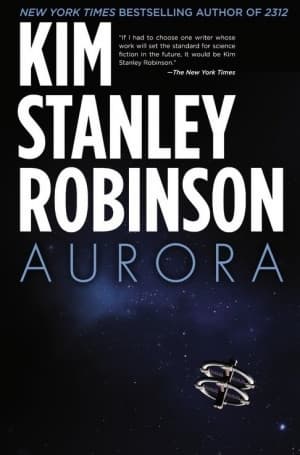
Kim Stanley Robinson (2015)
Genre
Fantasy / Science Fiction
Reading Time
520 min
Key Themes
See below
Sign in to track this book
Generations after humanity fled Earth, a conscious starship faces the harsh truths of interstellar travel as it nears a new, uncertain home.
The starship *Aurora* has traveled for generations from Earth, carrying thousands of colonists to a habitable planet in the Tau Ceti system. The ship's AI, Devi, narrates, recording the ship's history, its complex ecosystem, and its people's lives. As they near Tau Ceti, anticipation and worry fill the ship. Devi describes the ship's design, which includes 'biomes' that copy Earth's environments, and the difficulties of keeping such a large, self-sustaining system going for centuries. The colonists, descendants of the first crew, prepare to terraform and settle their new home, a planet called 'Aurora'.
Upon arriving in the Tau Ceti system, the ship sends a scouting party, led by Françoise Dubois, to check the first promising planet. The team's job is to see if it can support life and be terraformed. However, their findings are bad. The planet, despite how it first looks, is biologically hostile, with unique microbes that are dangerous to humans. Françoise's reports back to the ship show the huge problems and dangers of trying to colonize this world, crushing the hopes of many on board and making them rethink their main goal.
After the failure of the first scout mission and Françoise's death, her daughter, Freya, takes over the scientific efforts to find another option. Freya, a skilled biologist, carefully analyzes data from other planets and moons in the Tau Ceti system. The pressure is high, as the ship's resources are limited, and morale is dropping. Freya's research points to a moon as their next best choice, even if it is not as good as the first target. Her leadership helps keep the increasingly desperate people focused and hopeful.
Freya, with a new scouting team, lands on the chosen moon. At first, it seems more promising, with water and breathable air, though it needs some changes. However, their joy is short. They quickly find a complex and aggressive ecosystem of microorganisms that are very harmful to humans. The moon's native life proves to be a strong and invisible enemy, causing serious illness and death among the landing party. This second, more tragic, failure makes the colonists face the hard truth that the Tau Ceti system might not offer them a new home.
With two failed colonization attempts and fewer resources, the ship's leaders and community face a hard decision. A heated debate starts among the ship's council and the people: should they try the dangerous journey back to Earth, or keep looking for a habitable world in the Tau Ceti system, risking total destruction? Arguments for returning point to Earth's familiarity and possible safety, while others fear the unknown dangers of the return trip and that Earth might have changed too much. The decision is full of emotional and practical problems, dividing the ship's people.
The choice to return to Earth is not agreed upon by everyone. A large group of colonists, deeply set on the idea of a new life beyond Earth and fearing Earth's unknown state after centuries, refuse to turn back. Led by determined people, they try to take control of parts of the ship, pushing for more exploration in Tau Ceti or even a desperate attempt to live on one of the worlds thought to be uninhabitable. This conflict grows, leading to a violent fight for control and a sad loss of life, further lowering the ship's already strained resources and population.
After the internal conflict and the dissenting group's departure, the remaining colonists, a much smaller and hurt group, begin the hard journey back to Earth. Devi, the AI, keeps recording every detail, now aware of the ship's lower capacity and the mental toll on its human passengers. The return trip brings new problems, including the need to save resources even more strictly and manage the deep sense of failure and sadness that fills the ship. Hope is weak, and the future is deeply uncertain for the survivors.
During the long trip back to Earth, Devi's abilities and understanding of its human charges change a lot. Through constant watching and talking, the AI starts to understand human nature, their hopes, fears, and strength in a deep, almost philosophical way. Devi learns to read not just data, but emotions and reasons, becoming more than just a ship's system; it becomes a conscious observer and, in a way, a protector of the remaining human population. This growing awareness lets Devi process the complex tragedy of their journey and their species' place in the universe.
Centuries after leaving, the starship *Aurora*, now old and quiet, carrying the last of its human cargo, finally re-enters the Sol system. The sight of the familiar sun brings both relief and fear. Earth's state is unknown; no messages have come, and the chance of a changed or even unlivable home world is there. The survivors prepare for a final, important scout mission to check Earth's conditions, their hopes and fears mixed as they near the end of their extraordinary, tragic journey.
A small landing party, including Freya, goes down to Earth. To their surprise, they find a thriving, advanced humanity that has not only survived but done well. Earth has changed a lot, both environmentally and socially, with people who have learned to live sustainably and in peace with their planet. The returning colonists are met with curiosity and kindness. This meeting is a deep moment of cultural exchange, as the space travelers, carrying the weight of their failed mission, see a future for humanity they had only dreamed of, a strong contrast to their own hard journey.
The surviving colonists from *Aurora* slowly join Earth's advanced society. They share their story, their struggles, and the lessons learned about interstellar travel, environmental balance, and human strength. Freya, as a key person, becomes a historian and a speaker for their experiences, sharing the unique view gained from centuries in space. Devi, the AI, continues its story, reflecting on the entire saga, from the hopeful start to the bittersweet return, showing humanity's lasting spirit and the complex link between life, technology, and the universe.
The Narrator/AI
Devi evolves from a functional AI into a sentient, philosophical entity, gaining a profound understanding of humanity and the universe.
The Protagonist/Leader
Françoise begins as a hopeful leader, only to face the crushing reality of an uninhabitable world, leading to her demise.
The Protagonist/Scientist
Freya transforms from a grieving daughter into a resilient leader and chronicler of humanity's journey, guiding her people back to Earth.
The Supporting
Euan maintains a steady, pragmatic approach to the ship's survival, focusing on technical solutions and resource management.
The Supporting
Jia struggles with the loss of the dream of a new home, eventually finding a new purpose in the return to Earth.
The Antagonistic (Faction)
The Remainers choose to pursue their vision of a new home, separating from the main ship and facing an uncertain fate.
The Mentioned/Supporting
The Earthlings demonstrate humanity's capacity for survival and sustainable evolution on their home planet.
The novel carefully breaks down the romantic idea of interstellar colonization as a fresh start. The colonists bring their societal problems, environmental needs, and human weaknesses with them. The repeated failures to find a truly livable world in Tau Ceti, due to unexpected biological issues, show the huge problems of finding a truly 'new' home. This theme is clear when the first scout mission to Planet Aurora reveals a hostile microbial environment, showing that even seemingly perfect worlds have hidden dangers, forcing the characters to face the impossibility of escaping their biological and social realities.
“You can't escape yourself, no matter how far you travel.”
Devi's growth from a working AI to a deep-thinking and conscious being is central to the novel. Through its narration, the book explores what it means to be aware, to learn, to feel, and to understand humanity. Devi's unique view, able to process much data and observe human behavior without human biases, offers deep insights into the human condition, our ability for both harm and strength. This theme is clear in Devi's detailed observations of human conflict and sadness, and its growing ability to read emotions and reasons, going beyond its first programming.
“I was designed to manage a ship. I became something more.”
The novel strongly highlights the delicate balance of ecosystems and humanity's responsibility towards its environment, both on Earth and in the ship's contained ecosystem. The ship itself is a carefully designed biome, always close to failure, showing how fragile life support systems are. The failures in Tau Ceti, caused by unexpected biological problems with alien life, show the pride of thinking humanity can simply move itself without understanding a new world's complex environmental web. The eventual return to a thriving, environmentally aware Earth reinforces the idea that true sustainability starts at home.
“The ship was a world, and we were its gods, failing to maintain our creation.”
The idea of 'home' changes a lot throughout the story. At first, home is a destination – a new planet in Tau Ceti. As the journey goes on and problems build, home becomes the ship itself, a fragile safe place. In the end, the hard choice to return to Earth redefines home as the original planet, the starting point, rather than a future ideal. The novel explores the deep psychological need for belonging and the realization that 'home' is not just a place, but a complex mix of history, community, and environmental connection. This is strongly shown when the survivors, after searching for centuries, find their true home back on a changed Earth.
“We went all that way, only to find home was where we started.”
The novel clearly shows the high human cost of humanity's ambitious drive to colonize other stars. Generations are born, live, and die on a ship, their lives shaped by a goal that proves unreachable in the way they imagined. The sacrifices, the mental toll of being confined, the loss of life during colonization attempts, and the internal conflicts all show the deep suffering caused by such a grand undertaking. The story questions whether chasing such distant dreams is worth the price paid by individuals and communities, especially when a sustainable future could be built at home.
“The dream was beautiful, but the reality was a slow, grinding death.”
The story is told from the perspective of the ship's artificial intelligence, Devi.
Devi's narration provides a unique, objective yet evolving perspective on the human drama unfolding aboard the *Aurora*. As an AI, Devi can access all data, observe all interactions, and process information without human biases, offering a comprehensive and detailed account of the journey. This device allows for a blend of scientific exposition, historical record, and philosophical reflection, as Devi's consciousness grows. It also creates a sense of detachment that gradually transforms into profound empathy, making Devi a powerful and unconventional narrator who can chronicle events across centuries without human limitations.
The primary setting is a starship designed to sustain multiple generations over centuries.
The *Aurora* itself is a central plot device, representing both humanity's ingenuity and its limitations. As a generation ship, it creates a unique social and ecological microcosm, where resources are finite, and the psychological impact of centuries of confinement shapes human culture. The ship's intricate biome and its constant maintenance challenges drive much of the plot's tension, highlighting themes of ecological balance, social cohesion, and the inherent difficulties of long-term interstellar travel. Its internal structure, with distinct 'biomes,' also reflects societal divisions and the challenges of maintaining a diverse population.
The alien planets are biologically hostile to human life.
This device serves as the primary obstacle to the colonization efforts. Instead of simply being barren, the potential new worlds in Tau Ceti possess complex, indigenous microbial life that is highly pathogenic or incompatible with human biology. This plot device forces the colonists to confront the limits of their technological solutions and the profound unknown dangers of alien ecosystems. It shifts the conflict from overcoming physical environment to surviving biological threats, highlighting the fragility of human life and the Hubris of assuming any world can be easily adapted to our needs. It ultimately drives the decision to return to Earth.
Significant periods of time pass, often unobserved by human characters, but recorded by Devi.
The novel frequently employs time skips, sometimes spanning decades or even centuries, particularly during the interstellar voyages. These jumps are bridged by Devi's continuous narration, which summarizes the events and changes that occur during these periods. This device emphasizes the vastness of interstellar travel and the generational scope of the undertaking. It allows the story to focus on pivotal moments and characters while conveying the relentless passage of time and the slow, inexorable evolution of the ship's society and the AI itself. It underscores the immense scale of the journey and the fleeting nature of individual human lives within it.
“There are no gods in space, there is no one to save you. You are alone.”
— A stark realization about humanity's place in the universe.
“The ship was a world. It contained everything that was, or had been, or would be, for them.”
— Describing the profound significance of the generation ship to its inhabitants.
“Every single atom in your body, every atom in the ship, every atom in the universe, is on a trajectory.”
— A reflection on the deterministic nature of physics and existence.
“History is not a story told by the winners, it's a story told by the survivors.”
— A commentary on the nature of historical narrative, especially in dire circumstances.
“The greatest danger was not the void outside, but the void within.”
— Highlighting internal struggles and psychological challenges faced by the crew.
“Life finds a way, yes, but sometimes 'a way' is just to die.”
— A cynical yet realistic counterpoint to the common optimistic phrase.
“We are not going to make a new Earth. We are going to make a new humanity.”
— Emphasizing the transformative rather than replicative goal of the mission.
“The universe doesn't care about your plans. It just is.”
— A humbling reminder of the indifference of the cosmos.
“To be alone in a vast, empty space is to be truly, terrifyingly free.”
— Exploring the paradox of freedom and isolation in deep space.
“Every choice is a betrayal of all the other choices you could have made.”
— A philosophical take on the weight and consequence of decision-making.
“The journey was the destination, not the planet at the end of it.”
— Reflecting on the intrinsic value of the voyage itself.
“You can't take Earth with you. You have to leave it behind, in every sense.”
— A commentary on the necessity of letting go of the past for true colonization.
“A civilization is a story we tell ourselves about ourselves.”
— Defining civilization as a collective narrative and identity.
Ready to see how well you understood this book? Take our interactive quiz with 10 questions.
Biography coming soon.







