“I got them for you, Ma. I got them for you.”
— Darl Bundren's internal monologue about Addie's death and Cash's coffin.


William Faulkner (2013)
Genre
Literary Fiction
Reading Time
360 min
Key Themes
See below
Sign in to track this book
The Bundren family's difficult, often absurd journey to bury their matriarch Addie unravels their raw desires, ancient fears, and bitter rivalries, all while her coffin slowly decomposes.
The novel opens with Addie Bundren on her deathbed, watched by her family. Her eldest son, Cash, a carpenter, is outside her window, building her coffin. His precise work, despite the heat and grief, is a source of both admiration and irritation to his siblings. Darl, the most thoughtful of the children, narrates much of this section, noting Cash's dedication and the coming death. Vardaman, the youngest, struggles to understand his mother's death, connecting her with a fish he has just caught, leading to his declaration, 'My mother is a fish.'
After Addie's death, Vardaman's distress causes him to drill two holes into the lid of her coffin. He believes this will allow his mother to breathe, a literal interpretation of life and death from his child-like understanding. This act complicates the family's difficult task of preparing for the journey. Darl observes this with a detached understanding of Vardaman's grief. The family then struggles to get Addie's body into the coffin, facing the challenge of her being placed in it upside down due to Cash's earlier measurements, meant to fit her wedding dress.
The Bundren family, with Addie's coffin loaded onto their wagon, begins the journey to Jefferson, forty miles away, to fulfill Addie's wish to be buried with her own people. Their path is immediately blocked by a flooded river, swollen by recent rains. Jewel, Addie's illegitimate son, struggles with his horse, a symbol of his independence, as they attempt the crossing. The family's determination to honor Addie's wish is tested from the outset, showing their stubborn resolve and the harsh realities of their lives.
During the first attempt to cross the flooded river, tragedy occurs. The wagon overturns, sending the coffin and the family into the current. Vardaman nearly drowns, and several of their mules are lost. Cash breaks his leg, which is then set crudely and painfully by Darl and Jewel. Despite the setbacks — the loss of their animals, Cash's injury, and the near-loss of Addie's coffin — the Bundrens retrieve the coffin and remain determined to continue their journey to Jefferson, showing their commitment to their matriarch's last request.
As the journey continues under the summer sun, Addie's body decays faster, and the stench from the coffin becomes unbearable, attracting buzzards. The family must endure the smell, driving away potential helpers and drawing stares and complaints from townsfolk. Meanwhile, Dewey Dell, pregnant and wanting an abortion, is repeatedly misled and exploited by men. In Mottson, a drug store clerk named MacGowan seduces and deceives her, promising a remedy but using her vulnerability for his own gratification, further showing her isolation and desperation.
After the river crossing, the Bundrens face another challenge when their camp catches fire, started by Darl. Jewel, despite his usual distance, rushes into the burning barn to rescue Addie's coffin, proving his deep devotion to his mother. This act solidifies his unique position within the family. Darl's behavior, however, becomes more erratic and philosophical, his narrative sections growing more abstract and unsettling, foreshadowing his mental breakdown. His actions, including the fire, suggest a growing detachment from reality and a desire to end the grotesque journey.
Vardaman, in one of his fragmented narratives, recounts seeing Darl set fire to Gillespie's barn, where Addie's coffin is stored for the night. This confirms Darl's deliberate attempt to cremate his mother's body and end the agonizing journey. Jewel again bravely rescues the coffin from the blaze. Darl's motives are complex: a mix of compassion for his mother's decaying body, a desire to end the family's suffering, and a manifestation of his worsening mental state. The family, though, remains committed to the original plan, despite Darl's drastic intervention.
After days of travel, enduring the stench and physical hardships, the Bundrens finally arrive in Jefferson. The first order of business is to get proper medical attention for Cash's severely broken leg, which has been crudely splinted and is now infected. He is taken to a doctor, who tells them that the leg must be re-broken and properly set, a painful procedure that Cash endures with his characteristic stoicism. The long-awaited arrival in Jefferson brings some relief, but also new challenges and opportunities for the family members to pursue their individual desires.
Addie Bundren is finally buried in the Jefferson cemetery, fulfilling her dying wish. The burial is a somber affair, concluding the central quest of the novel. Immediately after the burial, Dewey Dell, still pregnant and desperate, tries again to find an abortionist. She meets a man who again exploits her vulnerability, leading to another failed and humiliating attempt to rid herself of the child. Her continued plight highlights the novel's themes of individual struggle and the limited agency of women in their society.
Following the discovery of his role in setting Gillespie's barn on fire, Darl is declared insane by the family, particularly by Jewel and Vardaman, and is sent to the state mental asylum in Jackson. His articulate, yet increasingly detached, narratives stop, replaced by the stark reality of his confinement. This act, while perhaps necessary for the family, also highlights the harsh treatment of mental illness and the family's desire to maintain a semblance of normalcy and order, even if it means sacrificing one of their own.
After the burial and Darl's departure, Anse, the patriarch, quickly attends to his own desires. He gets a new set of false teeth, a long-held ambition he had postponed due to his perceived bad luck. More strikingly, he returns to the family wagon with a new wife, who has a set of false teeth of her own. This new 'Ms. Bundren' is a jarring and almost comical conclusion to the family's arduous journey, showing Anse's self-serving nature and the quick replacement of Addie, despite the family's recent ordeal.
The Deceased Matriarch
Her arc is revealed posthumously, showing her life of quiet rebellion against her role and her desire for true connection.
The Patriarch
Anse remains largely unchanged, demonstrating his self-serving nature by fulfilling Addie's wish only to pursue his own desires immediately after.
The Eldest Son
Cash endures immense physical suffering but maintains his stoic resolve, embodying duty and sacrifice.
The Second Son
Darl's arc is a tragic descent from profound perceptiveness to madness, unable to reconcile the world's absurdity.
The Illegitimate Son
Jewel's arc reveals his deep, unspoken love for Addie through his actions, particularly his heroic efforts to save her coffin.
The Daughter
Dewey Dell's arc is one of increasing desperation and exploitation as she seeks to resolve her pregnancy.
The Youngest Son
Vardaman's arc shows his struggle to process grief and reality through a child's fragmented understanding.
The Supporting Character
Tull remains a steadfast, compassionate neighbor, offering aid and a moral compass amidst the Bundrens' chaos.
The Supporting Character
Cora remains consistent in her religious convictions and judgmental observations of the Bundrens.
The novel explores grief, not as a single emotion but as a personal and often isolating experience. Each Bundren child processes Addie’s death uniquely: Vardaman literally equates her with a fish, Darl intellectualizes and eventually tries to destroy the body to end the suffering, Jewel expresses it through protective actions, and Dewey Dell is largely preoccupied with her own pregnancy. The physical decay of Addie's body throughout the journey is a constant, visceral reminder of loss, forcing the family to confront death in its raw form. The varied responses show how grief can lead to both self-discovery and destruction.
“My mother is a fish.”
A central tension in the novel is the conflict between the family's duty to bury Addie and the individual desires of each Bundren member. While the goal is to fulfill Addie's wish, each character has other motives: Anse wants new teeth and a new wife, Dewey Dell seeks an abortion, and Jewel wants his horse. Even Cash, the most dutiful, has specific reasons for his actions. The difficult journey shows how family bonds, while strong enough to keep them together, are constantly tested by personal aspirations and the often selfish nature of human beings. The resolution of the journey, where Anse immediately fulfills his desires, emphasizes this theme.
“I got them teeth. I got my teeth.”
Faulkner uses the stream-of-consciousness narrative to reveal the isolation within the Bundren family, despite their physical closeness. Each character's internal monologue is distinct, often revealing thoughts and feelings that are never spoken to others. Darl's perceptiveness, for instance, isolates him, as he sees too much. Vardaman's struggle to communicate his grief leads to symbolic actions. The lack of direct, honest communication among the family members worsens their individual struggles and often leads to misunderstandings and resentment. Their journey is a communal act, but experienced by each as a solitary ordeal.
“How often have I lain beneath rain on a strange roof, thinking of home.”
The novel's multiple perspectives challenge the idea of a single, objective reality. Each character's narrative offers a subjective interpretation of events, colored by their individual biases, understanding, and mental states. What is real for Vardaman (his mother is a fish) is different from Darl's philosophical thoughts or Cash's practical observations. Faulkner forces the reader to piece together the truth from these fragmented and often contradictory accounts. This theme is clear in Darl's deteriorating mental state, where his perception of reality becomes increasingly distorted, and in Addie's own monologue, which redefines her life and relationships.
“I dont know what I am. I dont know if I am or not.”
The Bundrens' journey is shaped by their extreme poverty and the hardships of rural life in the Deep South. The lack of resources forces them to make difficult choices, such as using a crudely set leg for Cash or enduring the stench of a decomposing body for days. Their dependence on their mules, the loss of which is a major catastrophe, highlights their vulnerability. The family's struggles are not merely emotional but are constantly underscored by the harsh physical realities of their lives, including the flooded river and the need for their meager possessions. This theme grounds the fantastical elements of the journey in a stark, believable reality.
“I reckon I am one of the most unlucky men in the world.”
The story is told through the internal monologues of 15 different characters.
Faulkner employs a revolutionary narrative technique, presenting the story through the stream-of-consciousness monologues of 15 different characters, including the deceased Addie. Each chapter is a distinct voice, offering a subjective and often fragmented perspective on the same events. This device allows for a deep psychological exploration of each character, revealing their individual thoughts, motivations, and perceptions, often in stark contrast to their spoken words or outward actions. It creates a complex, multi-faceted reality where no single truth prevails, compelling the reader to synthesize meaning from disparate viewpoints. This technique is crucial for understanding the themes of communication, perception, and isolation.
The coffin represents duty, suffering, and the physical manifestation of Addie's presence.
Cash's meticulously crafted coffin serves as a powerful symbol throughout the novel. Initially, it represents Cash's dutiful love and skill. However, as the journey progresses, it transforms into a grotesque burden, a source of unbearable stench, and a tangible representation of the family's suffering and stubborn commitment. Its journey through flood and fire, and its repeated retrieval, underscore the family's relentless pursuit of their duty. The coffin also symbolizes Addie's enduring, albeit decaying, presence, which continues to shape and torment her family even after her death. Its placement, and the holes drilled by Vardaman, further emphasize its symbolic weight.
The physical journey to Jefferson serves as an extended metaphor for life, grief, and the human condition.
The arduous forty-mile journey from the Bundren farm to Jefferson is more than just a plot device; it functions as an extended metaphor for the human condition, grief, and the family's collective and individual struggles. The physical obstacles—the flooded river, the fire, Cash's broken leg, the stench—mirror the emotional and psychological burdens carried by each character. The journey forces the characters to confront their deepest fears, desires, and relationships, stripping away pretenses. It is a purgatorial passage that tests their resolve, reveals their true natures, and ultimately leads to profound changes (or lack thereof) for each family member.
Animals are used to symbolize primal instincts, individual identity, and the decay of life.
Faulkner employs various animals as powerful symbols. Vardaman's 'My mother is a fish' links Addie's death to the primal act of dismemberment and his inability to comprehend abstract loss, representing his raw, child-like grief. Jewel's horse is a potent symbol of his fierce independence, his untamed nature, and his unique, almost possessive, love for Addie. He works tirelessly to acquire it and fiercely protects it, reflecting his own wild spirit. The ever-present buzzards circling the coffin symbolize the inescapable decay of life, the grotesque reality of death, and the family's increasing isolation due to the putrid smell, serving as a constant, ominous reminder of their burden.
“I got them for you, Ma. I got them for you.”
— Darl Bundren's internal monologue about Addie's death and Cash's coffin.
“My mother is a fish.”
— Vardaman Bundren's iconic and surreal statement after his mother's death.
“I can remember how my father used to say that the reason for living was to get ready to stay dead a long time.”
— Cash Bundren reflecting on his father's philosophy.
“How often have I lain beneath rain on a strange roof, thinking of home.”
— Darl Bundren's poetic rumination on displacement and longing.
“It's not your horse. It's not your wagon. And it's not your team.”
— Anse Bundren's self-serving justification for taking other people's property.
“I made it on the bevel. There is more surface for the nails to grip.”
— Cash Bundren explaining the construction of Addie's coffin.
“I would think of the words that my father had put into my mouth, and if I could just stay awake until the day came, I would say them.”
— Jewel Bundren's internal struggle and resentment.
“That's what they mean by the love of a mother. That's what they mean by the love of a mother.”
— Darl Bundren observing Jewel's devotion to his horse, linking it to maternal love.
“And so when the high water came, I said, 'It is God's will.'”
— Anse Bundren attributing misfortunes to divine will to avoid responsibility.
“I could just remember how my mother used to say that the reason for living was to get ready to stay dead a long time.”
— Cash Bundren's repetition of his father's quote, showing its impact.
“It's not your horse. It's not your wagon. And it's not your team. And it's not your land.”
— Anse Bundren's further rationalizations for his actions.
“How often have I lain beneath rain on a strange roof, thinking of home.”
— Darl Bundren's recurring thought, emphasizing his detachment.
“I believe in God and the Bible. But it's just like I said: I wouldn't do it for nobody else.”
— Cora Tull expressing her limited charity and self-righteousness.
“I am not crying now. I am not crying now.”
— Vardaman Bundren's internal struggle to suppress his grief.
Ready to see how well you understood this book? Take our interactive quiz with 10 questions.
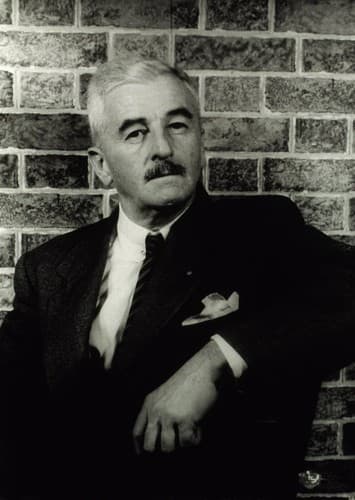
William Cuthbert Faulkner was an American writer known for his novels and short stories set in the fictional Yoknapatawpha County, based on Lafayette County, Mississippi, where Faulkner spent most of his life. A Nobel laureate, Faulkner is one of the most celebrated writers of American literature and often is considered the greatest writer of Southern literature.







