“It’s not what we’re given in this life that defines us, but what we do with it.”
— A recurring theme about resilience and agency.

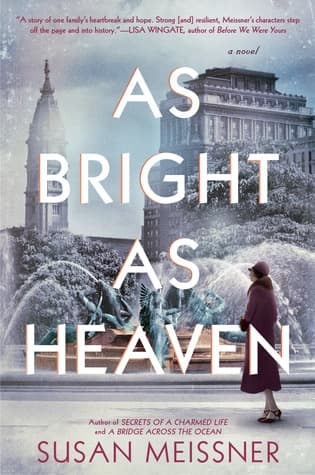
Susan Meissner (2018)
Genre
Historical Fiction
Reading Time
7-8 hours
Key Themes
See below
Sign in to track this book
During the 1918 Spanish Flu epidemic in Philadelphia, the Bright family, having lost so much, finds hope and purpose by caring for an orphaned baby, forming a strong bond born from tragedy.
In the spring of 1918, Pauline Bright, her husband Thomas, and their three daughters—Evelyn (17), Maggie (14), and Willa (8)—move from their farm in rural Pennsylvania to Philadelphia. Thomas, a former veterinarian, gets a job at a meatpacking plant, which gives the family a steady income after financial struggles on the farm. Pauline, a seamstress, finds work at a department store. The girls are excited about city life. Evelyn dreams of becoming a doctor, and Maggie likes the city's energy. Despite World War I, the Brights are hopeful, settling into their new home and enjoying Philadelphia's opportunities, unaware of the greater tragedy ahead.
By late summer, news of a new, deadly influenza spreads, first thought of as a common cold. But the illness, called the Spanish Flu, quickly becomes a pandemic. Philadelphia, after a large Liberty Loan parade, becomes a place where the disease spreads widely. Hospitals are full, doctors and nurses get sick, and the death count rises fast. The city stops as schools, churches, and businesses close. Pauline, Evelyn, and Maggie volunteer at a temporary hospital in a church basement, seeing the suffering and death. The Bright family takes careful steps, but fear fills their lives as thousands die daily.
The pandemic comes to the Bright family home. Thomas, tired from work and volunteering, gets the flu and dies quickly, leaving Pauline a widow and the girls without a father. The grief is huge, but the family has little time to mourn as Willa then dies. The loss breaks Pauline and her daughters, Evelyn and Maggie. Evelyn feels guilt, blaming herself for not saving them, while Maggie becomes quiet. The once lively family is now broken, living in a city changed by death and despair. Their hopes for a better life are replaced by loss and uncertainty.
While volunteering at the temporary hospital, Pauline finds an infant, abandoned and orphaned by the flu. Her parents died from the disease. Pauline feels a strong need to care for new life amid so much death, and perhaps to fill the space left by Willa. She brings the baby home and names her Rose. Rose's arrival first brings mixed feelings. Pauline sees her as a sign of hope and a chance for new starts. Evelyn struggles to connect, seeing Rose as a replacement for Willa. Maggie, however, finds comfort in the baby's presence, slowly coming out of her quiet state to care for her. Rose's cries and needs start to bring back purpose to the grieving household.
The Bright family works to adjust to their new life. Pauline, now the only provider, works hard as a seamstress, but money is tight. Evelyn puts aside her medical plans and takes on more household tasks, helping care for Rose. Maggie, still quiet, finds peace in caring for the baby, a task that helps her process her grief. The family faces criticism from neighbors and some relatives who question Pauline's choice to take in an orphaned child, especially after their own recent losses. Despite the problems and the ongoing pain, Rose's presence makes them look ahead, giving them a fragile but clear reason to continue.
As the pandemic lessens and life slowly gets back to normal, questions about Rose's identity appear. Pauline knows she cannot keep Rose forever without legal papers and feels a growing need to find the baby's original family. Evelyn, at first hesitant, becomes more involved in the search, wanting closure and feeling responsible. Their search leads them to the home of Rose's biological parents, a young couple who recently arrived in Philadelphia. They find that Rose's parents were immigrants, and her mother had a sister, Theresa, who might still be alive. This discovery makes Rose's story and the Brights' future more complicated.
Pauline and Evelyn find Theresa, Rose's maternal aunt, who lives and works in Philadelphia. Theresa is a young, unmarried woman struggling financially and is at first overwhelmed by the news that her sister's baby is alive. She is torn between her love for her deceased sister and the difficult task of raising an infant while barely supporting herself. The Brights understand her situation but also feel a strong bond with Rose. A tense meeting happens where Pauline explains how Rose was found and the care they provided. Theresa is unsure, recognizing her responsibility but also her inability to care for Rose well, creating a hard choice for both families.
Recognizing Theresa's love for Rose but also her financial limits, Pauline makes a hard and selfless choice. She suggests a plan: Theresa will take Rose, but Pauline will continue to give money and help with childcare, sharing the responsibility of raising the child. This choice is hard for Pauline, who has come to love Rose as her own, but she believes it is best for Rose to be with her biological family. Evelyn struggles with her mother's choice, feeling a renewed sense of loss. Maggie, understanding her mother's deep love, offers quiet support. The arrangement shows Pauline's kindness and her strong commitment to Rose's well-being, even if it means letting her go.
Years pass, and the Bright family slowly rebuilds their lives. Evelyn, inspired by the nurses she saw during the flu, becomes a doctor, dedicating her life to healing. Maggie, now a young woman, finds her voice through writing, telling her experiences and the family's story. Pauline continues her work as a seamstress, but her life is forever changed by the losses and hard choices she made. They keep a relationship with Theresa and Rose, who grows up knowing she has two families who love her deeply. The Spanish Flu leaves a lasting mark on each of them, shaping their lives and strengthening the bonds of love and strength that helped them through the darkest times.
The novel ends with the Bright women, older and wiser, looking back on their journey. The scars of the Spanish Flu remain, as does the love that sustained them. Evelyn is a respected doctor, Maggie a writer, and Pauline a quiet matriarch whose strength held her family together. Rose, now an adult, embodies the hope and strength born from tragedy, a living sign of the sacrifices made. The story shows that while loss can be devastating, it can also create strong bonds and lead to unexpected paths of purpose. The Brights' story is a narrative of survival, sacrifice, and the lasting power of family love in the face of great difficulty.
The Protagonist
From hopeful wife and mother, she transforms into a grieving widow and resilient matriarch, finding renewed purpose through sacrifice and shared love.
The Protagonist
She evolves from a hopeful, studious girl to a guilt-ridden survivor, eventually finding purpose and healing through her medical career and acceptance of her past.
The Protagonist
She transforms from a quiet observer to a deeply traumatized child, eventually finding her voice and purpose as a writer, processing grief through storytelling.
The Supporting
Her life is cut short by the flu, serving as a powerful symbol of the pandemic's devastating reach and the catalyst for significant emotional shifts in her surviving family.
The Supporting
His life is tragically cut short by the pandemic, leaving his family to grapple with immense grief and reshape their lives without him.
The Supporting
She is a symbol of hope and rebirth, her presence driving the Bright family's healing and challenging Pauline to make selfless choices for her future.
The Supporting
From a struggling, isolated survivor, she becomes a loving biological caregiver for her niece, forming an unconventional family bond with Pauline.
The Mentioned
A static character who represents the medical community's tireless efforts and inspires Evelyn's future career.
The novel explores grief during widespread death. The Bright family loses Thomas and Willa, forcing Pauline, Evelyn, and Maggie to deal with sorrow while also facing the pandemic. Each character handles grief differently: Pauline through action, Evelyn through guilt and a drive to control, and Maggie through silence. The book shows how grief is not simple, but a force that shapes identities and relationships, eventually leading to healing.
“Grief wasn't a river, she was learning. It was an ocean, and you could drown in it if you weren't careful.”
Amid the Spanish Flu, the theme of strength shows in the Bright family's story. Despite losing their father and youngest daughter, Pauline, Evelyn, and Maggie find ways to survive, physically and emotionally. Pauline's decision to take in Rose, Evelyn's medical career, and Maggie's writing are all acts of strength. The novel shows the human ability to endure hardship, adapt to new situations, and find strength in oneself and with others, even when the world is falling apart. Their survival is about finding meaning and purpose after trauma.
“Sometimes, the only way to get through was to just keep putting one foot in front of the other, even if you didn't know where you were going.”
Family, both by blood and by choice, is a main theme. The move to Philadelphia is for a better life for the Bright family. The pandemic breaks their immediate family but also strengthens the bonds between the surviving women. Pauline's decision to bring Rose into their home expands their idea of family. The co-parenting with Theresa shows the power of kindness and shared responsibility. The community, though affected by illness, also shows solidarity, as neighbors help each other and volunteers like the Brights step up. This shows the role of human connection during crisis.
“Love wasn't just about blood. It was about who showed up, who stayed, who carried you when you couldn't carry yourself.”
Despite the pandemic's darkness, the novel has hope and the chance for new beginnings. Baby Rose's arrival, after the deaths of Thomas and Willa, is the strongest symbol of this. Rose stands for life, innocence, and the future. Evelyn's choice to become a doctor and Maggie's writing are also acts of hope, showing belief in healing and storytelling. The Brights' ability to rebuild their lives, form new relationships, and find purpose after such loss shows the human ability to look forward and embrace joy, even after deep sorrow.
“Even in the darkest of times, there was always a flicker, a tiny spark, that promised a new day.”
The Spanish Flu forces each Bright woman to change their identities. Pauline, without her husband and youngest child, redefines herself as a widow and sole provider, finding inner strength and selfless love. Evelyn, an aspiring doctor, deals with guilt and responsibility before committing to her medical path with new purpose. Maggie, quiet at first, finds her voice and a new identity as a writer, processing her trauma through stories. The pandemic acts as a test, creating stronger, more self-aware individuals from hardship, shaping who they become.
“The flu took so much, but it also showed us who we truly were, beneath all the layers we thought defined us.”
The story is told through the alternating first-person perspectives of Pauline, Evelyn, and Maggie.
The novel utilizes a rotating first-person narrative, with chapters told from the distinct viewpoints of Pauline, Evelyn, and Maggie. This device allows readers to experience the Spanish Flu pandemic and its aftermath through the eyes of each Bright woman, providing intimate access to their individual grief, struggles, and growth. Each voice offers a unique emotional and psychological lens on the same events: Pauline's resilience and maternal love, Evelyn's intellectual and guilt-ridden perspective, and Maggie's sensitive and observant nature. This approach deepens characterization and provides a comprehensive, multi-layered understanding of the family's collective trauma and healing process, highlighting how each individual experiences and processes profound loss differently.
The historical backdrop of the 1918 Spanish Flu pandemic serves as the central catalyst and antagonist.
The meticulously researched historical setting of Philadelphia during the 1918 Spanish Flu pandemic is not merely a backdrop but a driving force of the plot and a powerful antagonist. The specific details of the pandemic—its rapid spread, the overwhelmed hospitals, the public health measures, and the sheer scale of death—create an immediate sense of dread and urgency. This historical context shapes every character's decision, inflicts the central tragedies, and dictates the societal and personal challenges the Bright family faces. The pandemic acts as a crucible, forcing the characters to confront their deepest fears and re-evaluate their lives, making the historical event integral to the narrative's emotional core and thematic exploration of loss and resilience.
The orphaned infant, Rose, symbolizes hope, new beginnings, and the enduring power of life amidst death.
Baby Rose serves as a powerful symbol throughout the novel. Discovered amidst the devastation of the flu, orphaned and vulnerable, she represents life's persistence in the face of overwhelming death. For Pauline, Rose embodies a fragile hope and a chance to nurture life after the loss of Willa. For Maggie, caring for Rose helps her to slowly emerge from her grief-induced silence, finding purpose in nurturing. While Evelyn initially struggles to accept her, Rose ultimately becomes a symbol of the future, a tangible reason for the family to keep going. Her presence signifies that even after immense tragedy, life continues, and new love and beginnings are possible, embodying the novel's central theme of finding light in darkness.
Maggie's act of writing serves as a narrative device for reflection, processing trauma, and preserving family history.
Maggie's eventual turn to writing, implied to be the source of the narrative itself or at least a significant part of it, functions as a crucial plot device. Her introspective nature and keen observation skills make her a natural chronicler of the family's experiences. Her writing allows for reflection on the events years later, providing a retrospective understanding of the trauma and the journey of healing. It also serves as a means for Maggie to process her own grief and to ensure that the family's story, particularly the losses and the resilience, is remembered. This device implicitly suggests that the act of storytelling itself is a form of survival and a way to create meaning from suffering.
“It’s not what we’re given in this life that defines us, but what we do with it.”
— A recurring theme about resilience and agency.
“Sometimes the greatest love story isn’t between a man and a woman, but between a mother and her child.”
— Reflecting on the profound bond of maternal love.
“The past is never truly gone. It’s always there, a shadow, a whisper, a reminder.”
— Characters grappling with the lingering effects of past events.
“Hope is a fragile thing, easily broken, but essential for survival.”
— During times of hardship and uncertainty.
“We all carry secrets, some heavier than others, some that shape us more than we know.”
— Exploring the hidden lives and burdens of the characters.
“Faith isn’t about seeing, it’s about believing even when you can’t.”
— A character's struggle with and affirmation of faith.
“The most beautiful things can sometimes grow from the most painful soil.”
— Finding beauty and meaning in difficult circumstances.
“Forgiveness isn’t for the other person; it’s for yourself.”
— A character's journey towards healing and letting go.
“War changes everything. It strips away what you thought you knew and leaves you with raw truth.”
— The impact of war on individuals and society.
“Sometimes, the strongest love is the one that allows for letting go.”
— A difficult decision made out of profound love.
“Home isn’t just a place; it’s a feeling, a memory, a collection of hearts.”
— Characters longing for or redefining the concept of home.
“Life has a way of leading you down paths you never expected, to places you never imagined.”
— Reflecting on the unpredictable nature of life's journey.
“Even in the darkest times, there is always a flicker of light, if you know where to look.”
— Finding solace and hope amidst despair.
“The stories we tell ourselves about our lives become the truth we live by.”
— Exploring self-perception and personal narratives.
Ready to see how well you understood this book? Take our interactive quiz with 10 questions.







