“The mind is its own place, and in itself can make a heaven of hell, a hell of heaven.”
— Elisha ben Abuyah's internal struggle with faith and reason.

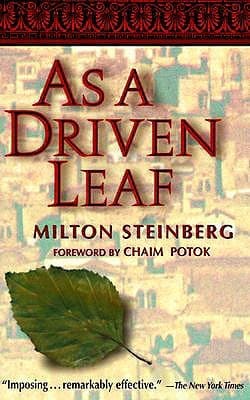
Milton Steinberg (2000)
Genre
Historical Fiction / Spirituality / Philosophy
Reading Time
10-12 hours
Key Themes
See below
Sign in to track this book
In Roman Palestine, a brilliant Talmudic sage grapples with the seductive pull of Hellenistic thought, risking excommunication and spiritual exile as he navigates the clash between ancient tradition and a challenging new world.
The novel introduces Elisha ben Abuyah, a brilliant and devout young student in Tiberias, already recognized for his exceptional intellect and piety. He studies under Rabbi Joshua ben Hananiah and Rabbi Akiba, two of the greatest sages of his time. Elisha, however, finds himself restless within the confines of traditional Jewish law and interpretation. He is drawn to the logic and beauty of Greek philosophy, which he secretly studies. This intellectual curiosity, initially a supplement to his Torah studies, begins to challenge the foundations of his faith. He questions the anthropomorphic descriptions of God, the literal interpretation of miracles, and the perceived irrationality of certain mitzvot (commandments), setting him apart from his peers.
Elisha's reputation as a scholar grows, and he is appointed to the Sanhedrin, the supreme Jewish judicial and legislative body. Here, he engages in debates with other sages, often subtly introducing Hellenistic philosophical concepts or questioning traditional interpretations from a rationalist perspective. While his brilliance is undeniable, his colleagues, particularly Rabbi Akiba, sense a growing divergence in his thinking. Elisha struggles, torn between his deep love for his people and their traditions, and his quest for logical truth. He tries to reconcile these two worlds, believing that reason can enhance, rather than undermine, faith, but finds the gap widening.
The political climate in Roman Palestine deteriorates, leading to harsh persecutions of the Jews under Emperor Hadrian. The Romans forbid the study of Torah, observance of the Sabbath, and performance of circumcisions, leading to widespread suffering and martyrdom. These events, culminating in the disastrous Bar Kochba Revolt, impact Elisha. He witnesses the brutal suppression of his people and the deaths of many righteous individuals, including Rabbi Akiba. For Elisha, this suffering, seemingly unredeemed by divine intervention, further fuels his doubts about God's justice and providence, pushing him closer to a complete rejection of traditional faith.
Unable to reconcile the suffering of his people with the God of traditional Judaism, Elisha makes a decisive break. He openly embraces Hellenistic culture, shedding his rabbinic garb and adopting the lifestyle of a Greek philosopher. He frequents gymnasiums, engages in philosophical discussions with Gentiles, and reads forbidden texts. His former colleagues are shocked and saddened by his apostasy. He is no longer referred to as 'Rabbi Elisha' but as 'Acher,' meaning 'the Other,' a symbol of his alienation. He believes he has found intellectual freedom and truth outside the confines of Jewish law, but also experiences loneliness and loss.
As Acher, Elisha explores various Greek philosophical schools, including Stoicism and Epicureanism. He seeks a universal ethical framework based purely on reason, independent of divine command. However, he finds that these philosophies, while intellectually stimulating, often lack the moral imperative and communal solidarity he had known in Judaism. He grapples with the implications of a world without a transcendent God, where moral values might be relative or purely human constructs. This intellectual journey, while liberating in some respects, also leaves him with a sense of moral ambiguity and a longing for absolute truth that seems perpetually out of reach.
Elisha's reputation as a philosopher reaches the Roman authorities. He is consulted by the Roman governor, Tinneius Rufus, who seeks his counsel on various matters, including the nature of Jewish resistance. This collaboration further alienates him from his former community, who view him as a traitor. Elisha, however, sees it as an opportunity to influence policy and perhaps alleviate some suffering, even as he knows he is walking a dangerous line. He finds himself caught between the world of his ancestors and the powerful, alluring world of Roman-Hellenistic culture, unable to fully belong to either.
Despite Elisha's apostasy, his most brilliant student, Rabbi Meir, remains devoted to him. Rabbi Meir continues to seek out Elisha, engaging him in philosophical and halakhic discussions, hoping to draw him back to Judaism. He believes that Elisha's knowledge of Torah, even if currently rejected, still holds the key to his redemption. These encounters are poignant, showing the deep bond between teacher and student, and Rabbi Meir's unwavering loyalty and love. Elisha, though touched by Meir's persistence, remains steadfast in his new path, yet the dialogues stir old memories and internal conflicts.
Despite his outward rejection of Judaism, Elisha finds that the traditions and teachings of his youth are deeply ingrained. He often quotes Torah verses and rabbinic sayings in his philosophical arguments, sometimes unconsciously. Moments of doubt about his chosen path arise, particularly when he witnesses the unwavering faith and resilience of the Jewish people, even under persecution. He recognizes the ethical framework and communal strength that Judaism provides, something he struggles to find in the detached intellectualism of Hellenism. This internal struggle reveals that his apostasy is not a simple abandonment, but a complex, agonizing search for truth.
In a powerful scene, Rabbi Judah ben Baba, one of the last surviving sages of the old generation, confronts Elisha, now Acher, about his choices. Rabbi Judah, a symbol of unwavering tradition and martyrdom, expresses his sorrow and condemnation. He reminds Elisha of his sacred past and the suffering he has brought upon his people. This encounter is a stark reminder of the social and spiritual cost of Elisha's rebellion, and the pain it has caused his community. Elisha, though outwardly defiant, is visibly shaken by the encounter, confronting the judgment of his former world.
As Elisha ages, he becomes increasingly isolated. The intellectual freedom he sought does not bring him the ultimate peace or truth he craved. He reflects on his life, his choices, and the paths not taken. While he never formally repents or returns to Judaism, there are hints that his intellectual quest, while leading him away from tradition, also deepened his understanding of the human condition and the complexities of faith. His death is marked by ambiguity, a sign of the unresolved tension between his reason and the spiritual heritage he abandoned, leaving his ultimate fate in the hands of divine mercy and rabbinic lore.
The Protagonist
Elisha transforms from a revered sage into 'Acher,' a symbol of apostasy, driven by intellectual doubt and disillusionment with divine justice in the face of suffering, ultimately finding neither complete peace nor resolution.
The Supporting
Rabbi Akiba remains steadfast in his faith and teachings, ultimately dying a martyr's death, solidifying his role as a pillar of Jewish tradition against external and internal challenges.
The Supporting
Rabbi Meir develops from a loyal student into a sage who deeply respects his former master's intellect while firmly upholding Jewish tradition, ultimately becoming a bridge between worlds.
The Supporting
Rabbi Joshua serves as an early guide for Elisha, witnessing his intellectual descent with sorrow and attempting to steer him back, embodying the elder wisdom that foresaw the dangers of unchecked reason.
The Mentioned
As a static character, Tinneius Rufus remains the embodiment of Roman power and a catalyst for Elisha's disillusionment with divine justice.
The Supporting
Rabbi Judah ben Baba remains a steadfast symbol of traditional Jewish faith and martyrdom, serving as a moral arbiter for Elisha's choices.
This is the central conflict of the novel, explored through Elisha's agonizing journey. He initially believes reason can enhance faith, but his relentless pursuit of logical truth ultimately leads him to reject traditional Jewish beliefs, which he perceives as irrational or anthropomorphic. The novel shows how the pursuit of pure reason can lead to a loss of spiritual meaning and communal belonging. Elisha's struggle highlights the tension between intellectual integrity and the comfort and conviction of inherited belief, a tension that remains unresolved for him. For example, his questioning of God's justice during the Roman persecutions directly pits his rational observations against the tenets of divine providence.
““There are two roads, Elisha, two roads and no more. Either a man bows to the Torah and the Sages and accepts, or he sets out on his own and questions and doubts and searches. There is no middle way.””
The novel portrays the seductive power of Hellenistic culture and the dangers it poses to Jewish identity. Elisha is drawn to Greek philosophy, art, and lifestyle, seeing in it a universal truth and beauty that transcends the particularism of Judaism. His embrace of Hellenism is not merely intellectual; it leads to a complete severance from his people and their traditions, marking him as 'Acher.' This theme is poignant in the context of Roman rule, where assimilation offers a path to social acceptance and intellectual freedom, but at the cost of spiritual and communal alienation. Elisha's interactions with Roman officials and his adoption of Greek customs exemplify this.
““I have chosen to walk in the light of reason, not in the shadows of ancient tales.””
Elisha's entire quest is a search for truth, but the novel presents different forms of truth. For Elisha, truth is primarily logical, demonstrable, and universal, found in philosophical inquiry. For the rabbis, truth is revealed, transcendent, and found in Torah and tradition, often requiring faith beyond pure reason. The novel explores whether truth can be singular or multifaceted, and whether a purely rational truth can provide meaning and moral guidance. Elisha's ultimate dissatisfaction, despite his intellectual freedom, suggests that a purely intellectual truth may be insufficient for the human spirit, especially when divorced from community and shared heritage.
““Is truth only in what the eye sees and the mind proves? Or is there a truth that the heart knows, though the mind may stumble?””
The brutal Roman persecutions and the devastating Bar Kochba Revolt are a crucible for Elisha's faith. He struggles to reconcile the immense suffering of his righteous people, including the martyrdom of Rabbi Akiba, with the concept of a just and benevolent God. This problem of evil is a major catalyst for his apostasy. The novel explores how individual and collective suffering can challenge deeply held religious beliefs, especially when divine intervention seems absent. Elisha's inability to find a rational explanation for the suffering ultimately drives him away from a God who permits such injustice.
““Where was God when His children were butchered? Where was His justice when the righteous were consumed by fire?””
A symbolic renaming that signifies Elisha's complete alienation from his community.
The transformation of 'Rabbi Elisha' into 'Acher' (meaning 'the Other' or 'another one') is a powerful symbolic device. It represents not only his excommunication from the rabbinic community but also his profound spiritual and intellectual alienation. This epithet marks him as an outsider, highlighting the irreversible nature of his choices and the deep sorrow and judgment of his former colleagues. It underscores the theme of assimilation's cost and the communal identity lost when one deviates from tradition, becoming a label of both condemnation and poignant separation.
Extended discussions between characters that serve to expound and debate the novel's central themes.
The novel heavily utilizes philosophical dialogues, particularly between Elisha and his teachers (Rabbi Akiba, Rabbi Joshua) and later with his student (Rabbi Meir). These dialogues are not merely conversations but structured debates where the characters articulate and challenge different perspectives on faith, reason, truth, and morality. They allow Steinberg to explore complex theological and philosophical ideas in depth, showcasing the intellectual rigor of both rabbinic Judaism and Hellenistic thought. These exchanges are crucial for understanding Elisha's internal struggles and the intellectual landscape of the era.
Historical events that serve as a catalyst for Elisha's disillusionment and a backdrop for communal suffering.
These historical events are not just background but crucial plot devices that directly impact Elisha's character arc. The brutal Roman persecutions and the devastating failure of the Bar Kochba Revolt challenge Elisha's faith in divine justice and providence. Witnessing the suffering and martyrdom of righteous individuals, including his beloved teacher Rabbi Akiba, provides a concrete, visceral reason for his intellectual doubts to solidify into apostasy. These events externalize Elisha's internal struggle, showing how real-world tragedies can shake the foundations of even the most devout faith.
References to Jewish texts and stories that enrich the narrative and highlight Elisha's internal conflict.
The novel is rich with allusions to biblical narratives, Talmudic discussions, and midrashic interpretations. These references serve multiple purposes: they ground the story in its historical and religious context, demonstrate Elisha's profound knowledge of Jewish tradition even as he questions it, and often foreshadow or parallel his own experiences. For instance, the story of the 'four who entered Pardes' (mystical study) is frequently referenced, directly linking Elisha's intellectual journey to a foundational narrative about the dangers of excessive inquiry, ultimately framing his personal tragedy within a larger Jewish mystical tradition.
“The mind is its own place, and in itself can make a heaven of hell, a hell of heaven.”
— Elisha ben Abuyah's internal struggle with faith and reason.
“There are times when a man must choose between his God and his conscience.”
— Elisha contemplating the conflict between religious law and his personal moral convictions.
“To be a Jew is to know the ache of eternity.”
— A reflection on the enduring nature and burdens of Jewish identity.
“Better to be a human being and a heretic than a stone and a saint.”
— Elisha's preference for intellectual honesty and human fallibility over rigid, unthinking piety.
“The greatest good is the pursuit of truth, wherever it may lead.”
— Elisha's driving motivation behind his philosophical inquiries and challenges to tradition.
“Man is a driven leaf, blown by the winds of circumstance and passion.”
— The central metaphor of the book, describing the human condition and lack of control.
“Doubt is not the enemy of faith, but its crucible.”
— Elisha's belief that questioning and skepticism can strengthen, rather than destroy, genuine faith.
“The world is full of wonders, but the greatest wonder is man himself.”
— A celebration of human potential, intellect, and complexity.
“There is no peace for the seeker of truth, only an endless journey.”
— The demanding and often unrewarding nature of a life dedicated to intellectual pursuit.
“To know God is to know the limits of human knowledge.”
— A statement on the ultimate unknowability of the divine, even for the most learned.
“Love is the only law that transcends all others.”
— A profound statement on the ultimate moral imperative, often contrasting with rigid legalism.
“The past is never dead; it is not even past.”
— Reflecting on the enduring influence of history and tradition on the present.
“A man's worth is measured not by his beliefs, but by his actions.”
— Emphasizing the importance of ethical conduct over mere dogmatic adherence.
“The greatest tragedy is not to die, but to live without ever truly living.”
— A call to embrace life fully, with all its challenges and questions, rather than settling for a passive existence.
Ready to see how well you understood this book? Take our interactive quiz with 10 questions.

Biography coming soon.







