“Aru Shah was fairly certain she was going to fail at life, or at least at middle school.”
— Aru's opening thought, setting her insecure tone.

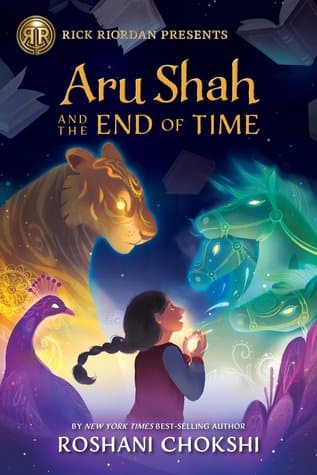
Roshani Chokshi (2018)
Genre
Fantasy / Children's / Young Adult
Reading Time
240 min
Key Themes
See below
Sign in to track this book
A mischievous twelve-year-old, prone to exaggeration, accidentally unleashes an ancient demon by lighting a cursed lamp, forcing her to embark on a perilous quest through the Kingdom of Death to find reincarnated Hindu demigods and save her frozen loved ones, all while still in her Spider-Man pajamas.
Twelve-year-old Aru Shah lives in the Museum of Ancient Indian Art and Culture with her mother, who is often away on archaeological digs. Aru struggles to fit in at her prestigious Atlanta school and often exaggerates stories about her life, claiming to be royalty and traveling the world. During autumn break, three popular classmates, Poppy, Arielle, and Burton, show up at the museum to catch her in a lie. They challenge her claim that the museum's Lamp of Bharata is cursed. To prove her story, Aru lights the lamp, thinking it's harmless. Instead, she unwittingly frees the Sleeper, an ancient demon, and freezes her classmates and mother in time, turning them into stone-like figures. Aru is the only one unaffected, left alone in the silent, frozen museum.
After the museum is frozen, a talking pigeon named Subala appears, revealing himself to be a messenger from the gods. He informs a bewildered Aru that she is a reincarnation of one of the Pandava brothers, specifically the son of Indra, and that she has accidentally unleashed the Sleeper, whose mission is to awaken the God of Destruction, Shiva. Subala explains that Aru must venture into the Kingdom of Death to find the other reincarnated Pandavas and collect three magical items — the celestial dice, the bow of Kama, and the arrow of Wrath — to stop the Sleeper before the End of Time. He gives her a magical pendant, the Om, which allows her to communicate with him and provides limited protection.
Subala guides Aru to the home of Mini, another twelve-year-old girl who lives in a different city. Mini is a meticulous, anxious girl who is also a reincarnation of a Pandava, the son of Dharma. Initially, Mini is hesitant and scared, but Aru convinces her of the urgency of their quest. The two girls, using their newfound celestial abilities and Subala's guidance, travel to the Kingdom of Death, also known as the Underworld, to retrieve the celestial dice. Their journey has challenges, including navigating treacherous paths and avoiding dangers in the land of the dead. They learn to rely on each other's strengths, with Aru's impulsiveness balanced by Mini's caution.
Upon reaching the Underworld, Aru and Mini discover that the celestial dice are held by Yama, the Lord of Death. To obtain them, they must challenge Yama to a game of dice. The stakes are high: if they lose, they will be trapped in the Underworld forever. Aru, known for her quick wit and impulsiveness, takes the lead in the game, while Mini uses her knowledge and observation skills to advise her. They face moral dilemmas and difficult choices during the game, testing their courage and integrity. With luck, strategy, and a bit of trickery, they manage to win the celestial dice from Yama, earning his grudging respect.
With the celestial dice secured, Aru and Mini set off to find the second item: Kama's bow. Subala directs them to the City of Love, an illusory realm where desires and emotions run rampant. The city presents them with various temptations and challenges designed to test their focus and resolve. They encounter mischievous spirits and illusions that play on their deepest wishes and insecurities. Aru struggles with her desire for acceptance and a normal life, while Mini grapples with her fears. They learn to see through the illusions and overcome these emotional obstacles, showing their growing maturity and understanding of their powers. This journey further strengthens their bond as companions.
As Aru and Mini continue their quest, they confront the Sleeper. During this encounter, the Sleeper reveals a devastating truth: Aru's father is not merely absent, but he is also the Sleeper himself, or at least connected to him. This revelation shatters Aru's understanding of her family and her identity, causing her immense emotional turmoil and doubt about her mission. She questions everything she has been told and struggles with the idea that she might be fighting against her own father. Mini tries to support her, but Aru is deeply shaken, making her vulnerable to the Sleeper's manipulations.
The final item they need is the Arrow of Wrath. Subala leads them to a sacred, ancient location where the arrow is guarded. To claim it, Aru must undergo a trial that requires a personal sacrifice. The trial tests her willingness to give up something she deeply values for the greater good. This moment forces Aru to confront her self-centered tendencies and make a selfless choice, proving her worthiness to wield such a powerful weapon. The experience is challenging, but Aru emerges with the arrow, understanding the heavy responsibility that comes with such power and the true meaning of heroism.
Armed with the celestial dice, Kama's bow, and the Arrow of Wrath, Aru and Mini confront the Sleeper in a climactic battle. The Sleeper reveals his full plan to awaken Shiva, the God of Destruction, which would lead to the End of Time. The girls use their combined powers and the artifacts they collected, fighting alongside celestial beings who join their cause. The battle is fierce and challenging, pushing Aru and Mini to their limits. Aru uses her ingenuity and newfound courage, while Mini provides strategic support and her protective abilities. They realize that defeating the Sleeper is not just about physical combat but also about understanding his motivations and disrupting his ritual.
During the battle, Aru finally uncovers the full truth about her father. It is revealed that her father is not the Sleeper, but rather a powerful being who sacrificed himself to imprison the Sleeper within the Lamp of Bharata, becoming intertwined with the demon's existence. The Sleeper had been manipulating Aru with partial truths. Aru realizes her father's love and sacrifice, which gives her renewed strength and resolve. Using the combined power of the artifacts and her own growing celestial abilities, Aru manages to defeat the Sleeper, preventing him from fully awakening Shiva and averting the End of Time.
With the Sleeper defeated, time is restored. Aru's mother and classmates are unfrozen, unaware of the cosmic battle that just transpired. Aru is back in the museum, but she is forever changed. She now understands her true identity as a Pandava and the daughter of Indra. While her everyday life resumes, she carries the secret of her adventures and the responsibility of her celestial heritage. Subala and other celestial beings remain in contact, indicating that her journey as a Pandava has just begun. Aru has learned the importance of honesty, courage, and self-belief, ready for future challenges.
The Protagonist
From a lying, insecure girl seeking external validation, Aru transforms into a brave and responsible hero who accepts her true identity and the weight of her celestial destiny.
The Supporting
Mini learns to overcome her anxieties and embrace her inner strength, becoming a brave and indispensable companion to Aru.
The Supporting
Subala's arc is less about personal change and more about fulfilling his divine duty to guide the Pandavas, subtly revealing his deeper understanding of cosmic balance.
The Antagonist
The Sleeper's arc is one of gradual revelation, from a mysterious antagonist to a figure with deep, personal ties to Aru and her family's past.
The Supporting
Her physical presence is frozen, but her role as a symbol of Aru's longing for family and a normal life drives Aru's initial quest.
The Supporting
Yama serves as a test-giver, observing the girls' growth rather than undergoing significant personal change.
The Mentioned
They remain frozen for most of the story, serving as a symbol of Aru's past life and the consequences of her actions.
The Mentioned
Kama's presence is thematic, representing the tests of desire and illusion the heroines must overcome.
The central theme is Aru's journey to understand who she truly is, beyond the lies she tells. She discovers her celestial heritage as a Pandava, the daughter of Indra, and learns to embrace her unique qualities rather than hide them. This theme is explored through her struggles with insecurity, her longing for a father figure, and her ultimate acceptance of her destiny. Her physical quest for artifacts mirrors her internal quest for self-knowledge.
“Maybe being a hero meant being yourself, even when you were afraid. Maybe it meant that you didn't have to be perfect, just good enough to try.”
Aru's initial character flaw is her tendency to lie and exaggerate to fit in. The entire plot begins because of her lie about the cursed lamp. Throughout her adventure, Aru learns the consequences of deception and the importance of honesty, both with others and with herself. The Sleeper also uses deception and half-truths to manipulate Aru, showing the dangers of misleading information. The theme ends with Aru's realization of her father's true sacrifice, which the Sleeper's lies had hidden.
“A lie was like a seed. Once planted, it grew roots and branches until it became a forest you couldn't escape.”
The bond between Aru and Mini is a foundation of the story. Despite their contrasting personalities, their friendship grows stronger through shared peril and mutual support. Mini's loyalty and analytical mind balance Aru's impulsiveness, and Aru's courage inspires Mini. Their ability to work together, trust each other, and rely on each other's strengths is important for their success in overcoming obstacles and defeating the Sleeper, showing the power of companionship.
“Sometimes the bravest thing you could do was admit you were scared and then do it anyway, especially if you had a friend to do it with.”
Aru's understanding of family is challenged and redefined. She grapples with her mother's frequent absence and the mystery surrounding her father. The revelation of her celestial parentage and her connection to the Pandavas forces her to confront a much larger, ancient family lineage. The theme explores how family ties, both biological and mythological, shape one's destiny and provide a sense of belonging and purpose, even when those ties are complicated or painful.
“You are not just Aru Shah. You are a Pandava. And that means you are part of something ancient, something greater than yourself.”
Aru is initially a reluctant hero, driven by guilt and fear. Her journey tests her courage, from facing mythical creatures to confronting her own deepest insecurities. She learns that true courage is not the absence of fear, but acting despite it. Along with courage, she must embrace the responsibility that comes with being a Pandava and having the power to save the world, understanding that her choices have cosmic implications.
“Being a hero wasn't about being fearless. It was about being afraid, and doing it anyway.”
The magical artifact that triggers the main conflict.
The Lamp of Bharata is the central plot device that sets the entire story in motion. It is an ancient, cursed lamp housed in Aru's museum. When Aru lights it, she accidentally frees the Sleeper, freezes time, and reveals her true identity as a Pandava. The lamp acts as a portal or a prison, connecting the mortal world to the celestial realm and serving as the origin point of the conflict. Its significance is tied to Aru's father's past actions, making it a powerful symbol of hidden truths and consequences.
The core mythological premise for the protagonists' identities.
The concept of Aru and Mini (and future characters) being reincarnations of the Pandava brothers from the Mahabharata is a fundamental plot device. It provides their inherent magical abilities, their celestial parentage, and their destined role in preventing the End of Time. This device immediately elevates them beyond ordinary children, giving them a rich mythological backstory and a preordained quest. It also allows for the introduction of other Pandava reincarnations, expanding the narrative scope for future books.
The MacGuffins that drive the quest narrative.
The three celestial artifacts – the celestial dice of Yama, Kama's bow, and the Arrow of Wrath – function as key MacGuffins. Their retrieval forms the primary objective of Aru and Mini's quest, propelling the plot forward through various mythological realms and challenges. Each artifact is guarded by a powerful entity or requires a specific trial to obtain, allowing the characters to demonstrate their growing skills and overcome personal flaws. Their combined power is essential to defeating the Sleeper.
The immediate consequence of Aru's actions and her primary motivation.
The freezing of time, which affects Aru's mother and classmates, is a critical plot device. It immediately establishes the stakes of the quest and provides Aru with a powerful, personal motivation to succeed. The frozen state of her loved ones creates a sense of urgency and isolation, forcing Aru to take responsibility. It also visually represents the disruption of the natural order caused by the Sleeper's release, emphasizing the cosmic implications of Aru's mistake.
A magical mentor figure who provides exposition and guidance.
Subala, the talking pigeon, serves as a classic literary device: the magical mentor or guide. He provides crucial exposition about the Hindu pantheon, Aru's heritage, the Sleeper, and the quest's objectives. His ability to appear and disappear, along with his cryptic advice, pushes Aru and Mini to think for themselves while still offering necessary support and direction. He bridges the gap between the mortal world and the celestial realm, making the mythological elements accessible to the protagonists.
“Aru Shah was fairly certain she was going to fail at life, or at least at middle school.”
— Aru's opening thought, setting her insecure tone.
“Sometimes the most ordinary-seeming people hide the most extraordinary secrets.”
— Narrator reflecting on Aru's hidden identity.
“The end of time is not a place. It's a person.”
— Mysterious line about the prophecy.
“You don't get to choose when you're needed. You just have to be ready.”
— Advice given to Aru about her role.
“Magic is just science we don't understand yet.”
— Aru's musing on the nature of her world.
“A lie is a story, and every story needs a hero.”
— Aru justifying her tall tales.
“The Pandavas' greatest weapon was not their strength, but their bond.”
— Reference to the mythological heroes Aru descends from.
“Time doesn't heal all wounds. It just teaches you how to live with them.”
— Wisdom shared during a reflective moment.
“Being different isn't a curse. It's what makes you powerful.”
— Encouragement to embrace uniqueness.
“The universe has a funny way of giving you exactly what you need, even if it's not what you want.”
— Observation on Aru's unexpected journey.
“Fear is a story you tell yourself, and you can choose to change the ending.”
— Motivational insight during a challenge.
“Home isn't a place. It's the people who make you feel like you belong.”
— Aru realizing where she finds comfort.
“Every ending is just a new beginning in disguise.”
— Hopeful note about the cycle of events.
Ready to see how well you understood this book? Take our interactive quiz with 10 questions.

Biography coming soon.







