“The greatest glory in living lies not in never falling, but in rising every time we fall.”
— A philosophical reflection on perseverance, often attributed to Arthur's wisdom.

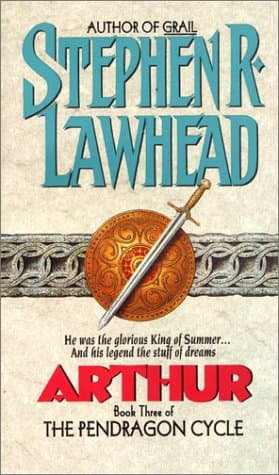
Stephen R. Lawhead (1989)
Genre
Fantasy / Historical Fiction
Reading Time
12-15 hours
Key Themes
See below
Sign in to track this book
Born from war-torn Britain, the illegitimate son Arthur, guided by Merlin and foretold by Taliesin, becomes the Pendragon, forging a legendary reign of peace, only to have his noble heart broken by the very treachery he sought to end.
The story begins with Arthur's difficult birth. Uther Pendragon, King of Britain, wants Igraine, wife of Gorlois, Duke of Cornwall. With Merlin's magical help, Uther takes on Gorlois's appearance and conceives a child with Igraine. Gorlois dies in battle that same night. Merlin, foreseeing the child's destiny and need for protection, takes infant Arthur soon after his birth. Arthur is then raised by Sir Ector and his wife, growing up with their son, Kay, on a rural estate, unaware of his true parents or the powerful destiny waiting for him as Britain struggles with internal conflict and Saxon attacks.
Years later, after Uther Pendragon's death, Britain falls into chaos as warlords compete for power. Merlin arranges a grand tournament in London, where a miraculous sword appears, plunged into an anvil on a stone, inscribed that whoever pulls it out is Britain's rightful king. Many powerful knights try and fail. Young Arthur, having forgotten Kay's sword for a joust, innocently pulls the sword from the stone to give it to his foster brother. Many witness this, including Merlin. Though met with initial doubt and resistance from the nobility, it slowly strengthens his claim to the throne, marking him as the chosen leader.
Arthur's rise is not easy. Many powerful kings and warlords, like Lot of Lothian and Urien of Gore, refuse to accept a low-born youth as their ruler. Merlin advises Arthur, guiding him in diplomacy and war. Arthur, with loyal knights like Sir Kay and Merlin's strategic skill, fights several key battles against the rebellious kings. Through military prowess, tactical cleverness, and a growing belief in his divine right, Arthur gradually defeats or wins over his opponents, beginning the hard process of uniting Britain's different kingdoms and tribes under his rule, often against difficult odds.
As Arthur's reign stabilizes, he establishes his capital at Camelot, a growing symbol of peace and order. He marries Guinevere, a princess from Cameliard, solidifying an important alliance. Merlin remains a key advisor, helping Arthur envision a new kind of kingship, one based on justice and chivalry. This vision leads to the creation of the Round Table, where knights sit as equals, symbolizing their shared commitment to righteousness, honor, and Britain's defense. This fellowship becomes the heart of Arthur's court, attracting the bravest and most noble warriors from across the land, including Lancelot, Gawain, and Percival.
With Britain somewhat united, Arthur focuses on the constant threat of Saxon invaders on the eastern coasts. He organizes his forces, using the combined strength of his British allies and the disciplined knights of the Round Table. Arthur proves himself a brilliant military commander, leading his armies in a series of important battles, most notably the Battle of Badon Hill. His strategic genius and his knights' unwavering loyalty result in a decisive victory against the Saxons, pushing them back and securing a period of relative peace and prosperity for Britain, marking the peak of his military achievements.
A mystical vision of the Holy Grail appears at Camelot, inspiring many Round Table knights to seek it. This quest, though noble, inadvertently causes a split within the fellowship. Knights like Lancelot, despite their strength, are deemed unworthy due to moral failings. Pure-hearted knights such as Percival and Galahad are more successful in their spiritual journey. The quest draws away many of Arthur's best warriors, weakening the court and leaving it vulnerable, as the focus shifts from earthly rule to spiritual salvation, challenging the very foundations of Arthur's kingdom.
The deep, unspoken love between Sir Lancelot, Arthur's most trusted knight, and Queen Guinevere, Arthur's wife, grows into a secret affair. This forbidden relationship, a betrayal of Arthur's trust and the chivalric code, begins to cast a dark shadow over Camelot. Though initially kept secret, rumors and suspicions grow, fueled by jealous forces within the court, particularly Sir Mordred. The affair represents a corruption at the heart of Arthur's ideal kingdom, leading to a breakdown of loyalty and honor among the Round Table knights, ultimately threatening to tear apart his reign.
Merlin, having guided Arthur for decades, senses the changing times and approaching doom. He foresees the ultimate collapse of Arthur's kingdom, partly due to growing moral decay and inevitable betrayal. Despite his deep love and loyalty to Arthur, Merlin leaves the court, either by choice or by being ensnared by the Lady of the Lake, leaving Arthur without his most powerful magical and strategic advisor. In Merlin's absence, Arthur's illegitimate son and nephew, Mordred, a figure consumed by ambition and resentment, begins to openly plot against his father, using the growing unrest and rumors of Guinevere and Lancelot's affair to cause discord and undermine Arthur's authority.
Mordred, with his allies, finally exposes the affair between Lancelot and Guinevere. Lancelot is forced to flee, and Guinevere is condemned to be burned at the stake for treason. Lancelot, loyal to his love, dramatically rescues Guinevere from her execution, killing several loyal Round Table knights in the process, including Gawain's brothers. This act ignites a devastating civil war in Britain. Arthur, torn between his love for Guinevere, his duty as king, and his friendship with Lancelot, must pursue Lancelot to France, weakening his hold on Britain and leaving the kingdom vulnerable to Mordred's ultimate betrayal.
While Arthur is abroad fighting Lancelot in France, Mordred seizes his chance. He spreads false rumors of Arthur's death and crowns himself king of Britain, gaining support from unhappy lords and those who never fully accepted Arthur's rule. Mordred's takeover plunges the kingdom into deeper chaos and despair. Arthur, hearing of Mordred's treachery, must abandon his pursuit of Lancelot and return to Britain to reclaim his throne, setting the stage for the final, tragic confrontation that will decide his kingdom's fate and his legacy.
Arthur returns to Britain and confronts Mordred in the devastating Battle of Camlann. It is a brutal and bloody conflict, a civil war that pits former comrades against each other. The battle results in immense loss of life on both sides, and the ideals of the Round Table are shattered. Arthur and Mordred engage in a final, fatal duel. Arthur manages to strike a mortal blow to Mordred, but not before Mordred delivers a fatal wound to Arthur. The battle marks the end of Arthur's dream, his unified kingdom's destruction, and the collapse of the golden age he had worked to create.
Mortally wounded, Arthur is carried from the battlefield by his last loyal knight, Sir Bedivere. He commands Bedivere to return Excalibur, his magical sword, to the Lady of the Lake. After much hesitation, Bedivere fulfills this final request. Arthur is then taken by mysterious veiled women, possibly queens or enchantresses, to the mystical isle of Avalon, where he is said to rest, awaiting a time when Britain might need him again. His death marks the end of an era, but his legend, the hope of a once and future king, begins, ensuring his ideals and Camelot's memory will endure through time.
The Protagonist
From an unknown youth, Arthur rises to become the legendary King of Britain, uniting a warring land, only to witness his kingdom crumble due to internal betrayals and human failings.
The Supporting
Merlin guides Arthur from infancy to kingship, serving as his most crucial advisor, only to foresee and ultimately withdraw from the tragic downfall of Camelot.
The Supporting
Guinevere ascends to Queen of Britain, but her affair with Lancelot leads to the unraveling of Arthur's kingdom and her own tragic fate.
The Supporting
Lancelot rises as Arthur's most esteemed knight, but his illicit love for Guinevere leads to his betrayal, banishment, and the downfall of Camelot.
The Antagonist
Mordred grows from a resentful figure to the ultimate betrayer of Arthur, orchestrating the downfall of Camelot and meeting his end in a final confrontation with his father.
The Supporting
Kay matures from a somewhat arrogant foster brother into a loyal and dedicated knight, serving Arthur faithfully throughout his reign.
The Supporting
Gawain serves as a loyal and strong knight, but his desire for vengeance against Lancelot after his brothers' deaths directly fuels the civil war.
The Mentioned
Uther's reign ends in chaos, leaving a power vacuum that his illegitimate son, Arthur, is destined to fill.
The Mentioned
Igraine's life is marked by the tragic circumstances of her marriage to Uther, leading to the birth of Arthur, whose true parentage remains hidden from her.
This theme explores the tension between Arthur's noble vision of a unified, just kingdom (Camelot and the Round Table) and the harsh realities of human nature, betrayal, and political conflict. Arthur tries to create a perfect society, but it is ultimately undone by the human flaws of its members—Lancelot and Guinevere's affair, Mordred's ambition, and the knights' arguments. The story consistently contrasts Arthur's idealism with the corrosive effects of lust, envy, and pride, showing that even the noblest intentions can fall to the world's imperfections, as seen in the ultimate collapse of the Round Table and Camlann's desolation.
“For the Round Table was not merely a table, but a symbol, a promise that all men were equal in the eyes of justice, and that the strong would protect the weak. Yet, even the noblest of promises can be broken by the frailties of the heart.”
Betrayal is a central and devastating theme, appearing on many levels. The most prominent is the affair between Lancelot and Guinevere, a deep betrayal of Arthur's trust, friendship, and marriage. This personal betrayal turns political when Mordred, Arthur's son/nephew, takes the throne in his absence. These acts of perfidy unravel Camelot, leading to civil war, the Round Table's destruction, and Arthur's death. The theme shows how broken trust can lead to irreversible consequences, destroying not just individuals but entire kingdoms, as Arthur's reign was built on loyalty and honor, which were ultimately shattered by those closest to him.
“And the wound that finally slew him was not dealt by a Saxon blade, but by the hands of those he loved and trusted most.”
The story constantly moves between periods of brutal warfare and brief moments of peace, showing conflict's cyclical nature. Arthur's reign begins by uniting a land ravaged by Saxon invasions and internal feuds. He achieves a golden age of peace through military victories and establishing justice. However, this peace is fragile and eventually gives way to internal strife and civil war, returning Britain to chaos. The narrative suggests that while peace can be forged through strong leadership and noble ideals, the human capacity for greed, ambition, and revenge often makes periods of tranquility temporary, leading back to renewed violence, as shown by Camlann's ultimate tragedy.
“He built a kingdom on peace, but it was forged in fire, and to fire it returned.”
This theme explores how much Arthur's life and Camelot's fate are predetermined by prophecy and magic, versus the role of individual choices. Merlin, with his foresight, guides Arthur's path from birth, knowing the general outline of his destiny. However, Camelot's tragic downfall is ultimately driven by the free-willed choices and moral failings of its key figures—Lancelot, Guinevere, and Mordred. While Arthur is destined to be king, his kingdom's success and eventual collapse are influenced by the decisions of those around him, suggesting that even a prophesied destiny can be altered or tragically fulfilled by human action. The story grapples with whether characters are mere puppets of fate or architects of their own doom.
“The threads of fate are spun long before a man takes his first breath, but it is his own hand that weaves the pattern of his life, for good or ill.”
The novel deeply examines the qualities and burdens of true leadership through Arthur's character. Arthur shows that effective leadership requires not only strength in battle but also wisdom, justice, compassion, and the ability to inspire loyalty and a shared vision. He strives to be a king who serves his people rather than merely ruling them. However, the theme also reveals leadership's isolation and immense personal cost, as Arthur must make difficult decisions, bear his kingdom's fate, and ultimately suffer the betrayals of those closest to him. His leadership is both his greatest strength and his greatest vulnerability, showing the sacrifices inherent in holding power.
“To be king is not to command, but to serve. To bear the crown is to carry the weight of all your people's hopes, and their failings.”
A magical sword that signifies Arthur's divine right to rule and his power.
The Sword in the Stone serves as the undeniable proof of Arthur's legitimate claim to the throne, a magical artifact that bypasses traditional lineage and establishes his destiny. Excalibur, later given by the Lady of the Lake, symbolizes Arthur's kingship and the divine favor bestowed upon him. It is not merely a weapon but a symbol of his authority, his connection to the mystical forces of Britain, and the justice of his cause. Its eventual return to the lake signifies the end of Arthur's reign and the passing of the golden age, reinforcing the cyclical nature of power and magic.
Foresight and magical intervention that guide and shape Arthur's destiny.
Merlin's prophecies and magical abilities serve as a crucial guiding force throughout Arthur's life and reign. His foresight allows him to orchestrate Arthur's birth, protect him in infancy, and strategically advise him in consolidating power. Merlin's magic is often used to establish legitimacy (like the Sword in the Stone) or to provide tactical advantages in battle. However, his prophecies also foreshadow the tragic downfall of Camelot, creating a sense of impending doom and highlighting the limitations of even powerful magic against human weakness and free will. He is a divine hand in a human story.
A symbol of equality, unity, and chivalric ideals among Arthur's knights.
The Round Table is a powerful symbolic device representing Arthur's vision of a just and egalitarian society, where all knights, regardless of their status, are equal in their commitment to chivalry, honor, and the defense of the realm. It fosters a sense of brotherhood and shared purpose, becoming the heart of Camelot's ideals. Its eventual splintering due to internal feuds, the Grail Quest, and the Lancelot-Guinevere affair visually represents the moral decay and fragmentation of Arthur's kingdom, demonstrating how the breakdown of shared values leads to destruction.
A mystical artifact representing spiritual purity and the ultimate quest for salvation.
The Holy Grail serves as a catalyst for spiritual introspection and division within the Round Table. Its appearance diverts the knights' focus from earthly governance to a more esoteric, spiritual quest. It exposes the moral failings of many knights (like Lancelot) and elevates others (like Galahad and Percival) who possess true purity. The Grail Quest, while noble, inadvertently weakens Camelot by drawing away its strongest warriors and highlighting the imperfections of the court, contributing to its eventual vulnerability and decline, as the pursuit of the divine clashes with the demands of the temporal.
“The greatest glory in living lies not in never falling, but in rising every time we fall.”
— A philosophical reflection on perseverance, often attributed to Arthur's wisdom.
“It is not the sword that makes the king, but the king that makes the sword.”
— Emphasizing that true leadership comes from character, not just power or symbols.
“A man's worth is not measured by the size of his purse, but by the size of his heart.”
— A common sentiment throughout the book, promoting inner virtue over material wealth.
“The past is a stubborn thing, and often it reaches out to shape the future in ways we cannot foresee.”
— Reflecting on the enduring influence of history and lineage on current events.
“Hope is a fragile thing, easily broken, but without it, we are truly lost.”
— A poignant observation on the importance of maintaining hope in dark times.
“Even the mightiest oak began as a tiny acorn. Greatness is not born, but grown.”
— Encouraging patience and recognizing the gradual development of strength and leadership.
“To forget one's own history is to be a leaf blown aimlessly by the wind.”
— Highlighting the importance of understanding one's heritage and past for direction.
“The true battle is not fought with swords and shields, but within the hearts of men.”
— A commentary on the internal struggles of morality, loyalty, and ambition.
“There are some wounds that time cannot heal, only hide.”
— A somber reflection on lingering pain and trauma from past events.
“Loyalty is a rare jewel, and betrayal a common stone.”
— A direct observation on the value of faithfulness and the prevalence of deceit.
“The world is full of wonders, if only we have the eyes to see them.”
— Encouraging a sense of awe and appreciation for the natural and mystical world.
“A king must be a shepherd to his people, not a wolf among them.”
— Defining the ideal role of a benevolent ruler who protects and guides his subjects.
“Sometimes, the greatest strength lies in knowing when to yield, not when to fight.”
— A nuanced perspective on strategy and the wisdom of choosing peace over conflict.
“The threads of destiny are woven by many hands, not just one.”
— Emphasizing that fate is a collective effort, influenced by many individuals.
Ready to see how well you understood this book? Take our interactive quiz with 10 questions.







