“The irregular is only the regular seen from far away.”
— Valentine talking about fractals and chaos theory.

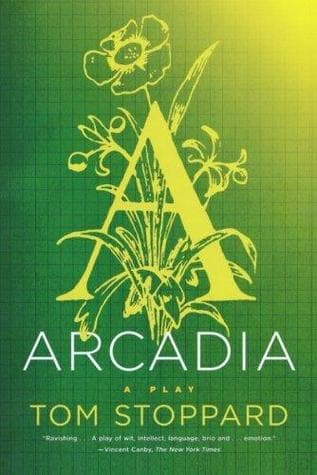
Tom Stoppard (1993)
Genre
Fantasy / Historical Fiction / Mystery / Science Fiction
Reading Time
97 min
Key Themes
See below
Sign in to track this book
In a grand English country house, a young woman in 1809 and modern academics unravel mysteries of mathematics, poetry, and passion, showing how chaos and order affect two centuries.
The play opens in Sidley Park, September 1809. Thirteen-year-old Thomasina Coverly is receiving a Latin lesson from her tutor, Septimus Hodge. Their conversation quickly moves to mathematics and physics. Thomasina has observed that the simple iteration of an equation never precisely returns to its starting point, leading to a concept she calls 'carnal embrace' of numbers. She is grappling with irreversible processes and the arrow of time, anticipating the second law of thermodynamics. Septimus, meanwhile, is trying to deflect her inquiries while also dealing with an affair with Mrs. Chater, the wife of a minor poet. He is also tasked with reviewing Mr. Chater's poetry for publication, a task he finds boring.
In the present day, April 1993, Hannah Jarvis, a landscape historian, is researching the history of Sidley Park's garden, particularly its change from classical formal design to the romantic, picturesque style. She is staying at the estate, working in the same room where Thomasina and Septimus once talked. Bernard Nightingale, a literary academic, also arrives at Sidley Park, convinced that Lord Byron, a contemporary of Septimus Hodge, was involved in a duel on the estate and murdered an obscure poet. Bernard wants to find evidence to support his theory, hoping to elevate the poet Chater and himself. Their research often clashes, creating tension.
Back in 1809, Thomasina continues her mathematical ideas, drawing patterns and developing an iterative algorithm to model natural forms, like artichoke leaves. She is close to discovering fractal geometry. Septimus, though initially dismissive, becomes intrigued by her insights. In 1993, Hannah's research focuses on the mysterious hermit who lived on the estate in the early 19th century. She finds evidence that suggests the hermit was a mathematician who burned his papers, possibly due to disillusionment or a tragic event. She believes the hermit may have been Septimus Hodge, driven to reclusion after Thomasina's death.
Bernard, in 1993, finds a letter he believes confirms Byron's presence at Sidley Park and his involvement in a fatal duel. He presents his findings with drama, much to Hannah's skepticism. Meanwhile, Valentine Coverly, a descendant of Thomasina and a chaotician, becomes interested in Thomasina's old notebooks. He recognizes the mathematical skill in her drawings and calculations, realizing she was exploring chaos theory and iteration long before they were understood. He tries to use her incomplete equations to model the population dynamics of grouse on the estate, finding a correlation between her ideas and the unpredictable behavior of natural systems.
In 1812, Thomasina, now a young woman, further refines her understanding of irreversible processes. She uses the example of stirring jam into rice pudding, noting that it's impossible to perfectly separate them again. She extends this concept to the universe, predicting its eventual 'heat death' – a state of uniform temperature where all energy is evenly distributed and nothing more can happen. Septimus, though still struggling to grasp the full meaning, recognizes the nature of her discovery. He tries to comfort her, but Thomasina remains focused on the bleak implications of her mathematical prophecy, envisioning a cold, dark end to all things.
A dinner party at Sidley Park in 1809 brings together the key characters of that era: Septimus, Thomasina, Lady Croom, Mr. Chater, and Captain Brice. The conversation touches on landscape design, poetry, and scientific ideas. Septimus's past indiscretions with Mrs. Chater are alluded to, and Mr. Chater's jealousy is clear. This scene provides context for Bernard's later theories about Byron and a duel. The social dynamics and discussions of this evening become material for future interpretations by the present-day characters, showing the subjective nature of historical truth.
In 1812, a fire breaks out at Sidley Park, tragically claiming Thomasina's life on the eve of her seventeenth birthday. Her mathematical papers are believed to have been lost in the blaze. This event becomes a central mystery for Hannah in 1993. Meanwhile, Hannah, examining historical records, finds inconsistencies in Bernard's theory about Byron's duel. She uncovers evidence that suggests the duel, if it happened, involved a different person and that Byron was likely not present at Sidley Park when Bernard claims. Her skepticism challenges Bernard's increasingly dramatic academic claims.
As the play progresses, Hannah and Valentine piece together the puzzle of the hermit. They discover that the hermit was Septimus Hodge, who, after Thomasina's death, retreated to the hermitage on the estate. He spent the rest of his life trying to understand and complete Thomasina's mathematical work, burning his papers in frustration or as a symbolic act of mourning for the lost genius. This revelation affects Hannah, confirming her suspicions about the hermit's intellectual depth and his connection to Thomasina's mathematical genius. It also shows the tragedy of lost knowledge.
In the final act, the timelines of 1812 and 1993 begin to overlap more clearly. Characters from both periods occupy the stage simultaneously, sometimes interacting indirectly or observing events from the other era. Septimus is seen working in the hermitage, while in the present, Hannah and Valentine discuss his fate. This staging emphasizes the play's themes of time, memory, and the enduring presence of the past. The audience witnesses Thomasina's last night and the present-day investigations in a unified, yet temporally distinct, dramatic space. The past influences the present, and the present tries to reconstruct the past.
On the night of her seventeenth birthday in 1812, Thomasina dances a waltz with Septimus. This moment has tender affection and a sense of impending loss. As the characters from 1993 observe, the truth about Thomasina's death is revealed: she was not murdered, but died in the fire that consumed her room, likely an accident. Her mathematical genius, though lost to history for nearly two centuries, is finally appreciated by Valentine. The play concludes with Septimus, now the hermit, trying to reconstruct Thomasina's equations, a poignant and futile attempt to preserve her legacy against the irreversible flow of time and entropy.
The Protagonist
She begins as a curious student, developing groundbreaking mathematical theories, and tragically dies young, leaving her genius largely unrecognized until the present day.
The Protagonist/Supporting
He evolves from a cynical, womanizing tutor to a devoted, reclusive scholar mourning the loss of his brilliant student and attempting to preserve her legacy.
The Protagonist
She begins by researching the garden and the hermit, gradually uncovering the profound intellectual legacy of Thomasina and Septimus, and ultimately challenging the romanticized view of history.
The Antagonist/Supporting
He pursues a sensational but ultimately flawed theory, experiencing a public downfall when his claims are debunked.
The Supporting Protagonist
He begins as a focused scientist, then discovers and champions his ancestor's lost genius, finding a connection with Hannah in the process.
The Supporting
Remains largely static, serving as a representative of the classical temperament and a comedic voice of her era.
The Supporting
She serves as a commentator on human relationships, remaining largely static but offering insightful observations.
The Supporting
He serves as a conduit between the past and present, intuitively understanding historical truths that others struggle to uncover.
The Mentioned
His work drives a key historical investigation, but he does not have a personal arc within the play.
The Mentioned
His life and work are retrospectively analyzed and misinterpreted, but he has no personal arc within the play.
The play constantly questions how history is built and understood. Bernard Nightingale shows the fabrication of history to fit a sensational story, while Hannah Jarvis carefully seeks verifiable facts. The overlapping timelines show how easily facts can be distorted or lost, such as the true circumstances of Thomasina's death or the hermit's identity. Stoppard suggests that history is less about objective fact and more about interpretation, often colored by personal biases, romanticism, or academic ambition, as seen in Bernard's desperate attempts to link Byron to a duel based on weak evidence.
“It's all trivial, isn't it? Compared to what we could know.”
This theme is explored through landscape design, mathematics, and human temperament. The classical ideal of order, symmetry, and reason is represented by Lady Croom and the formal garden, while the romantic ideal of wildness, emotion, and unpredictability is embodied by the picturesque garden and characters like Bernard. Thomasina's mathematical discoveries, particularly her work on iteration and chaos, connect these two worlds, showing how complex, seemingly disordered systems can arise from simple rules. The second law of thermodynamics, predicting the universe's eventual heat death, represents the triumph of disorder (entropy) over order.
“We are all doomed to a heat death, which is a state of perfect disorder.”
The play contrasts scientific inquiry with artistic and literary interpretation. Thomasina and Valentine represent the scientific mind, seeking objective patterns and universal laws through mathematics and physics. Bernard and, to some extent, Lady Croom, represent the humanities, focusing on narrative, aesthetics, and human drama. Stoppard highlights both the strengths and limitations of each approach. Science can reveal underlying truths about the universe, but art can provide meaning and emotional resonance. The play suggests that both are essential for a full understanding of the human experience, and often, they intersect in unexpected ways, as when Thomasina's equations describe natural beauty.
“The attraction of the apple to the earth is the same as the attraction of the earth to the apple. You have to think of it as a pair of apples.”
Time is not simply a linear progression in Arcadia but a complex, multi-layered phenomenon. The alternating scenes between 1809-1812 and 1993, and their eventual overlap, emphasize the idea that the past is always present, influencing subsequent generations. Thomasina's understanding of the second law of thermodynamics, or entropy, is central to this theme. She foresees the irreversible decline of the universe towards a state of 'heat death' – a concept that shows the inevitable loss of information, order, and life itself. This scientific principle mirrors the human experience of memory, loss, and the difficulty of perfectly reconstructing the past.
“It's all a matter of the heat death of the universe.”
The 'disruptive influence of sex' is a recurring idea, particularly in the 1809 scenes. Septimus's various affairs, including his affair with Mrs. Chater and his flirtations with other women, show how primal desires can interrupt intellectual pursuits and social order. The present-day characters also engage in their own romantic and sexual entanglements, mirroring the past. This theme highlights the enduring, often chaotic, force of human passion across centuries, reminding us that despite intellectual pursuits, humans remain driven by fundamental biological urges, which can lead to both creation and destruction, love and betrayal.
“The only reason for sex is to make people laugh.”
The play shifts between two distinct periods: early 19th century and late 20th century.
This device is central to the play's structure and themes. By presenting events from 1809-1812 and 1993 in parallel, Stoppard allows the audience to witness both the original events and their later interpretations, highlighting the subjective nature of history. It creates dramatic irony, as the audience often knows more than the characters in the present. The eventual overlapping of these timelines in the final act emphasizes the enduring presence of the past and the cyclical nature of human experience and inquiry.
A mysterious figure from the past whose identity and purpose are a central enigma.
The hermit serves as a focal point for Hannah Jarvis's research and a symbolic link between the two eras. His reclusive life and the burning of his papers raise questions about lost knowledge, genius, and the emotional toll of tragedy. The eventual revelation that the hermit is Septimus Hodge, attempting to reconstruct Thomasina's work, provides a poignant resolution to the mystery and underscores the themes of enduring love, intellectual devotion, and the irreversible loss of information due to entropy.
Mathematical notes from the 19th century that contain groundbreaking scientific theories.
These notebooks are a crucial plot device, representing lost genius and the acceleration of scientific discovery. They are initially dismissed by Septimus but later recognized by Valentine as containing precursors to chaos theory and the second law of thermodynamics. They drive Valentine's research and provide concrete evidence of Thomasina's extraordinary intellect, allowing her ideas to transcend time and influence the present. Their incompleteness and the mystery of their fate (lost in the fire) heighten their significance.
The estate's landscape, transitioning from classical to picturesque, reflects broader aesthetic and philosophical shifts.
The garden is more than a setting; it's a living metaphor for the play's themes of order vs. disorder, classical vs. romantic. Hannah's research into its transformation provides a tangible, visual representation of the changing intellectual and artistic currents between the two centuries. The contrast between the rigid, geometric classical design and the wild, 'natural' picturesque style mirrors the scientific shift from deterministic Newtonian physics to the unpredictable nature of chaos theory and entropy.
“The irregular is only the regular seen from far away.”
— Valentine talking about fractals and chaos theory.
“We shed as we pick up, like travellers who must lighten every stage of their journey, and the knowledge we gain, the truth we learn, is dropped by the wayside, for the next traveller to find.”
— Hannah discussing the nature of knowledge and discovery.
“It’s all the same plot, isn’t it? The garden of perfect innocence and the serpent. Only this time, the serpent is Newton.”
— Bernard describing the intellectual shift from classical to romantic.
“When we have found all the mysteries and lost all the meaning, we will be all alone, on an empty shore.”
— Lady Croom lamenting the changes to her garden and the world.
“It is not the fashion to be sentimental.”
— Lady Croom on the prevailing aesthetic of the time.
“The improved landscape is an improvement only because the other has gone.”
— Thomasina questioning the value of 'improvements' to nature.
“We are all doomed to the heat death of the universe.”
— Valentine discussing the second law of thermodynamics.
“The true genius of the place is that it is a wilderness of mathematical order.”
— Hannah reflecting on the complex design of Sidley Park.
“If you stir your tea and allow it to cool, you cannot afterwards stir it again and expect it to get hot.”
— Thomasina's early understanding of thermodynamics.
“We are, none of us, in a position to be dogmatic.”
— Hannah cautioning against certainty in historical interpretation.
“It's what happens to information. It gets degraded, changed, lost.”
— Hannah on the challenges of historical research.
“The future is a hot place, and the past is a cold one.”
— Valentine explaining the flow of heat and time.
“Everything is flux, everything changes, everything is connected.”
— Septimus explaining the interconnectedness of existence.
“Compared to a hundred and eighty years ago, we are as gods.”
— Valentine marveling at the advancements of modern science.
Ready to see how well you understood this book? Take our interactive quiz with 10 questions.
Biography coming soon.







