“The Lantenengo County Club was the social center of Gibbsville, just as the Gibbsville Club was the social center for the men.”
— Describing the social hierarchy and institutions of Gibbsville.

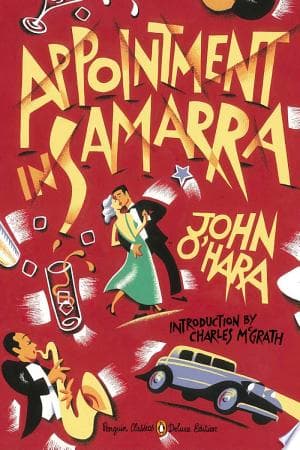
John O'Hara (2013)
Genre
Literary Fiction / Historical Fiction
Reading Time
240 min
Key Themes
See below
Sign in to track this book
In the glittering, booze-soaked high society of 1930s Gibbsville, a single impulsive act by Julian English ignites a rapid, self-destructive plunge from privilege, exposing the brittle facade of the American dream.
The novel opens on a seemingly ordinary December evening in Gibbsville, Pennsylvania, in 1930. Julian English, a successful Cadillac dealer and pillar of the town's upper-class society, is at the Lantenengo Country Club with his wife, Caroline. During a casual conversation with Harry Reilly, a wealthy Irish Catholic whom Julian secretly resents for his social climbing and financial success, Julian impulsively throws a highball in Reilly's face. This shocking act, seemingly minor but deeply offensive within Gibbsville's rigid social hierarchy, immediately alienates Julian from many of his peers and sets in motion a chain of events that will unravel his life over the next two days. The incident shows Julian's underlying frustrations and volatile nature, which he usually keeps hidden beneath a veneer of charm and good breeding.
Following the country club incident, Caroline English is deeply mortified and disappointed by Julian's public outburst. She loves Julian but is also aware of the social repercussions of his actions, which threaten their standing in Gibbsville. Julian, initially defiant, soon feels remorse and a sense of impending doom. He tries to apologize to Harry Reilly, but Reilly, nursing a grudge, refuses to accept it, further isolating Julian. Caroline's reaction shows the importance of social decorum and reputation in their community, and Julian's inability to fully grasp the gravity of his transgression, or perhaps his unwillingness to genuinely atone, foreshadows his continued self-destructive path. Their strained interactions reveal the cracks in their marriage.
After leaving the country club, Julian, now heavily intoxicated and feeling increasingly alienated, drives erratically through Gibbsville. He eventually stops at the home of Helene Holman, a woman with whom he had a past affair and who is now married to his friend, Frank. Julian, driven by a mixture of nostalgia, self-pity, and a desperate need for validation, tries to flirt with Helene and reignite their old passion. Helene, however, rebuffs his advances, recognizing his drunken state and the inappropriateness of the situation. This rejection further fuels Julian's despair and isolation, reinforcing his perception that he is losing control of his life and his relationships, and that his past actions are catching up to him.
Later that night, Julian, still adrift and seeking escape, encounters Mary Terwilliger, a young, attractive woman from a lower social standing who is known for her promiscuity and ambition to climb the social ladder. They go to a secluded spot and have sex. This affair is not driven by love or even genuine affection, but rather by Julian's desperate need for distraction and fleeting pleasure, and Mary's opportunistic desire to associate with a prominent figure like Julian, even if his reputation is currently tarnished. The encounter is sordid and leaves Julian feeling even more empty and detached, showing his moral decay and his increasing disregard for the consequences of his actions.
Caroline, increasingly worried and suspicious about Julian's whereabouts and behavior, is confronted with rumors and direct evidence of his infidelity. She feels a deep sense of betrayal and humiliation, realizing that Julian's actions are not just social blunders but deep personal wounds that threaten the very foundation of their marriage. She considers leaving him, torn between her love for him and her desire to protect her own dignity and social standing. Her internal struggle reveals the suffocating constraints placed upon women in Gibbsville society, where a husband's transgressions could easily ruin a wife's reputation, and her growing despair mirrors Julian's own downward spiral, albeit from a different perspective.
The next day, Julian's self-destructive path continues as he encounters Froggy Ogden, a local bootlegger and tough guy, at a speakeasy. Julian, still heavily under the influence and increasingly aggressive, provokes Froggy, leading to a violent fistfight. Julian is badly beaten, further physically and emotionally scarred. This public brawl, witnessed by others, solidifies Julian's reputation as a man out of control and further alienates him from the respectable society he once belonged to. The fight is a brutal manifestation of Julian's internal turmoil and his growing inability to navigate social situations without resorting to aggression, showing his complete breakdown of self-control and societal norms.
As the consequences of Julian's actions accumulate, his professional life begins to suffer. His business, the Cadillac dealership, faces scrutiny, and his reputation among his clients and business associates is severely damaged. Socially, he becomes an outcast, with many former friends and acquaintances actively avoiding him or speaking of him with disdain. The weight of these pressures—social ostracism, financial insecurity, and the disintegration of his marriage—bears down on Julian, pushing him further into a state of hopelessness. He feels trapped, with no clear path to redemption or escape from the web of his own making, and his sense of self-worth plummets.
In a desperate attempt to salvage her own life and perhaps to shock Julian into sobriety, Caroline writes him a letter, informing him of her decision to leave him. The letter is filled with a mixture of love, frustration, and resignation, expressing her inability to continue living with his self-destructive behavior. This letter is a final, crushing blow to Julian, symbolizing the complete collapse of his marriage and his most significant personal relationship. It shows the profound impact of his actions on those he loves and removes any remaining anchor he might have had to a stable, respectable life, pushing him closer to the brink of despair and isolation.
After reading Caroline's letter, Julian, now completely unmoored, gets into his car and drives aimlessly through the snowy streets of Gibbsville. He reflects on his life, his past choices, and the irreversible mistakes he has made. In a moment of drunken introspection, he stops at a deserted spot and confesses his sins and regrets aloud to the empty night, acknowledging the mess he has made of his life. This confessional moment, though unheard by anyone else, represents a fleeting recognition of his culpability, but it comes too late and is overshadowed by his profound sense of hopelessness and self-pity, leading him to a desperate decision.
Overwhelmed by his accumulated failures, the loss of his wife, his social standing, and his professional prospects, Julian English drives to a secluded garage. He starts his car, allowing the carbon monoxide fumes to fill the enclosed space. His suicide is a culmination of his rapid descent, a final, irreversible act stemming from his inability to cope with the consequences of his impulsive and self-destructive behavior. The title of the novel, referencing the ancient Mesopotamian fable about a man trying to escape death but meeting it in Samarra, subtly alludes to Julian's predetermined fate, suggesting that his downfall was perhaps inevitable, a consequence of his character and the rigid social environment he inhabited.
The Protagonist
Julian begins as a respected member of society but rapidly descends into social ostracism, marital collapse, and ultimately suicide, as his impulsive nature and hidden resentments consume him.
The Supporting
Caroline begins as a loyal and supportive wife, but as Julian's behavior escalates, she transforms into a woman disillusioned and ultimately determined to separate from him to preserve her own dignity.
The Supporting
Reilly remains largely static, serving as a catalyst for Julian's actions and a symbol of the social hierarchy Julian struggles within.
The Supporting
Helene's arc is minor, serving mainly to reflect Julian's past and his present state of desperation.
The Supporting
Mary's arc is minor; she serves as a symbol of Julian's moral decline and opportunistic behavior.
The Supporting
Al remains a consistent, loyal observer, his arc reflecting the impact of Julian's downfall on his business and employees.
The Supporting
Froggy's role is primarily catalytic, his interaction with Julian exacerbating Julian's downfall.
The Mentioned
Frank's arc is minimal, serving mainly to illustrate the social ripple effects of Julian's actions.
The novel traces Julian English's rapid downfall, which is almost entirely caused by a series of impulsive, often alcohol-fueled, actions. From throwing a drink in Harry Reilly's face at the Lantenengo Country Club to his drunken attempts to rekindle an affair with Helene Holman, his tryst with Mary Terwilliger, and his violent brawl with Froggy Ogden, each decision is a spur-of-the-moment choice with devastating, cumulative consequences. O'Hara shows how a single, seemingly minor transgression can unravel a life when coupled with a lack of self-control and an inability to course-correct, ultimately leading to Julian's suicide. The theme highlights the fragility of social standing and personal well-being when urges are unchecked.
““He had done it. He had done it without thinking. It was done, and it could not be undone.””
Gibbsville, Pennsylvania, in 1930 is a town with a strict, almost suffocating, social hierarchy, particularly within its WASP (White Anglo-Saxon Protestant) elite. Julian English, despite his wealth and charm, constantly feels the pressures and constraints of this system. His resentment of Harry Reilly, an Irish Catholic who has achieved wealth but struggles for full social acceptance, shows the subtle yet powerful class distinctions. Julian's actions are not just personal failures but violations of unwritten social codes, leading to swift and unforgiving ostracization. The novel suggests that once an individual steps outside these rigid boundaries, redemption or reintegration is nearly impossible, illustrating the unforgiving nature of small-town society.
““They were all looking at him, and not with curiosity, but with a kind of cold, dreadful knowledge.””
Julian English embodies a superficial version of the American Dream: he is financially successful, married to a beautiful woman, and a member of the social elite. However, beneath this success is deep dissatisfaction, resentment, and emptiness. O'Hara critiques the idea that material wealth and social status guarantee happiness or fulfillment. Julian's rapid decline reveals the dark side of this dream, suggesting that outward prosperity can mask internal turmoil and that the pursuit of status can be soul-destroying. His self-destruction shows the hollowness of a life built on appearances and unexamined privilege, and how easily it can crumble.
““He had everything a man could want, and he was losing it all, for nothing.””
The novel's title, 'Appointment in Samarra,' directly references a fable about a man who tries to escape death but finds it waiting for him. This theme raises questions about whether Julian's tragic end is a result of his own choices and character flaws, or if he is somehow predestined for his fate. While Julian's impulsivity and self-destructive tendencies are clearly the immediate catalysts for his downfall, the title suggests a deeper, almost fatalistic inevitability. The rigid social structure of Gibbsville and Julian's inherent personality traits might be seen as forces that, once set in motion, make his tragic end unavoidable, blurring the lines between personal agency and an unyielding destiny.
““The appointment in Samarra, he thought. It was coming for him.””
As Julian's behavior escalates, he becomes increasingly isolated from his community, his wife, and ultimately himself. The initial act of throwing a drink alienates him from his social circle, which is swiftly followed by rejections from Helene Holman and the final departure of Caroline. His drunken escapades and violent encounters further push him to the fringes, leaving him with no genuine connections. This growing alienation contributes significantly to his despair and his ultimate decision to take his own life. The novel portrays how self-destructive actions can sever all ties, leading to profound loneliness even amidst a seemingly bustling social environment.
““He was alone, completely alone, in a town full of people who had once been his friends.””
A direct allusion to a fable that foreshadows Julian's inevitable doom.
The novel's title refers to an ancient Mesopotamian fable where a man tries to flee Death in Baghdad, only to find Death waiting for him in Samarra. This serves as a powerful instance of foreshadowing, suggesting from the outset that Julian English's fate is sealed. Despite his efforts, conscious or unconscious, to escape the consequences of his actions or his own destructive nature, his tragic end is presented as inevitable. It imbues the entire narrative with a sense of fatalism, making Julian's downfall feel like a predetermined appointment rather than a series of entirely unpredictable events, reinforcing the theme of fate versus free will.
The narrative largely follows Julian's perspective, but occasionally shifts to other characters.
O'Hara primarily uses a limited omniscient point of view, focusing on Julian English's thoughts, feelings, and experiences, allowing readers deep insight into his motivations and despair. However, the narrative occasionally shifts to the perspectives of other characters, most notably Caroline English, providing crucial external views of Julian's actions and their impact. This allows the reader to understand not only Julian's internal turmoil but also the profound effect he has on those around him, offering a more complete and nuanced picture of his self-destruction and the social context in which it occurs, enhancing the tragedy.
Alcohol serves as a catalyst for Julian's impulsivity and a symbol of his self-destruction.
Alcohol plays a pervasive and crucial role throughout the novel, acting as both a catalyst for Julian's impulsive actions and a potent symbol of his self-destruction. Most of Julian's major transgressions—throwing the drink, his attempts with Helene, his encounter with Mary, and the fight with Froggy—occur while he is heavily intoxicated. It lowers his inhibitions, fuels his resentments, and blurs his judgment, directly contributing to his rapid decline. Beyond its functional role, alcohol symbolizes Julian's inability to cope with his life, his escape from reality, and ultimately, his chosen path toward oblivion, culminating in his final act.
The small town serves as a contained, rigid environment that amplifies Julian's downfall.
Gibbsville, Pennsylvania, functions as a meticulously drawn social microcosm, a contained world with its own rigid codes of conduct, class distinctions, and gossip networks. This setting is not merely a backdrop but an active force that amplifies Julian's self-destruction. In such a small, interconnected community, every transgression is immediately known and judged, making escape from social consequences impossible. The suffocating nature of Gibbsville's society highlights the unforgiving nature of its judgments and contributes to Julian's feeling of entrapment, making his downfall all the more inevitable within its confines. It becomes a character in itself, shaping destinies.
“The Lantenengo County Club was the social center of Gibbsville, just as the Gibbsville Club was the social center for the men.”
— Describing the social hierarchy and institutions of Gibbsville.
“Julian English was a gentleman. He had a lot of money and a lot of friends, and he had gone to Princeton.”
— Introducing the protagonist, Julian English, and his background.
“She was a nice girl, but she wasn't a lady. She was a good sport, but she wasn't a lady.”
— Reflecting on Caroline's social standing and perception.
“He knew that he was destroying himself, and he watched himself do it.”
— Julian's self-awareness of his destructive behavior.
“The past was always there, ready to trip you up.”
— A general observation about the lingering influence of past events.
“They were all trapped, in one way or another, by Gibbsville.”
— Highlighting the restrictive nature of the small town on its inhabitants.
“He had a way of making enemies without trying, and a way of losing friends without knowing why.”
— Describing Julian's social ineptitude and impact on his relationships.
“It was just one of those things that happened, and nobody could do anything about it.”
— A fatalistic view of events unfolding, particularly the inevitability of tragedy.
“The trouble with Gibbsville was that everybody knew everybody else's business, and everybody else's business was usually bad.”
— Critiquing the gossipy and judgmental nature of the small town.
“He felt as though he were standing on a trapdoor, and the trapdoor was about to open.”
— Julian's growing sense of impending doom.
“Nobody ever quite got over anything in Gibbsville. It just went on and on.”
— Emphasizing the long memory and unforgiving nature of the community.
“He had money and he had position, and he had thrown it all away.”
— Reflecting on Julian's squandering of his advantages.
“The world was full of people who were waiting for you to make a mistake.”
— A cynical view of human nature and social scrutiny.
“It began on the first day of December, 1930, and it ended on the afternoon of December 31, 1930.”
— The precise framing of the novel's timeline, emphasizing its compressed, fated duration.
Ready to see how well you understood this book? Take our interactive quiz with 10 questions.
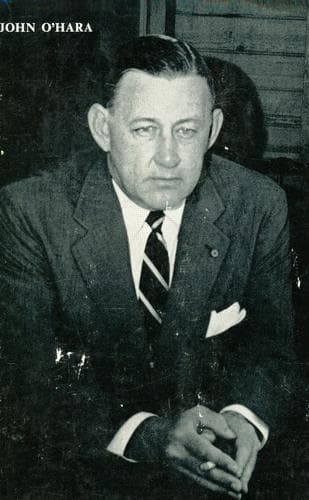
John Henry O'Hara was one of America's most prolific writers of short stories, credited with helping to invent The New Yorker magazine short story style. He became a best-selling novelist before the age of 30 with Appointment in Samarra and BUtterfield 8. While O'Hara's legacy as a writer is debated, his champions rank him highly among the under-appreciated and unjustly neglected major American writers of the 20th century. Few college students educated after O'Hara's death in 1970 have discovered him, chiefly because he refused to allow his work to be reprinted in anthologies used to teach literature at the college level.







