“I am fourteen and I have no bosoms.”
— Georgia's opening line, lamenting her physical development.

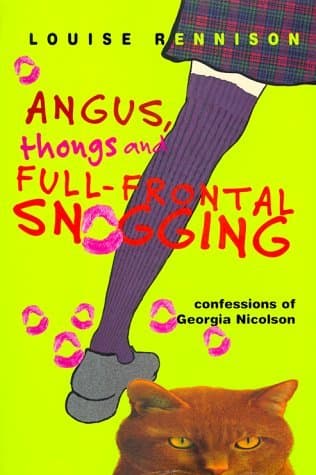
Louise Rennison (2000)
Genre
Children's / Young Adult / Romance
Reading Time
240 min
Key Themes
See below
Sign in to track this book
Join Georgia Nicolson in her hilariously cringeworthy journal as she navigates the epic highs and lows of teenage life, from disastrous parties to under-the-skin spots, all while searching for love and dodging her annoying little sister.
Georgia Nicolson, who calls herself 'ugly' at 14, starts her diary by writing about her ordinary life and her annoyance with her unusual parents and younger sister, Libby. Her life changes when Robbie, 'the Sex God,' and his friend, Tom, arrive. Robbie is older, works at a chip shop, and has a girlfriend named Lindsay. Even so, Georgia immediately develops a strong crush on him. Her best friends, Jas, Rosie, and Ellen, find this amusing and sometimes frustrating. She starts many plans to get Robbie's attention, like wearing silly outfits and trying to seem sophisticated.
Georgia, with her 'Ace Gang,' tries many poorly thought-out plans to get Robbie to like her. This includes going to a party dressed as a stuffed olive (a bad attempt to stand out), trying to get her mother to host a party so Robbie might come, and even trying to learn the bagpipes to impress him. Her efforts often fail because she is clumsy, her parents act unpredictably, and being a teenager is generally awkward. She also has to deal with Lindsay, her rival, who seems effortlessly cool.
The school plans a trip to the local leisure center, which Georgia sees as another chance to get closer to Robbie. Despite her usual clumsiness and her friends being there, she and Robbie have a moment alone. To her surprise, Robbie kisses her. This event makes Georgia very excited. She thinks this kiss means a serious relationship is starting. She carefully looks at every detail of the kiss and Robbie's actions afterward, sharing everything with her diary and the Ace Gang.
For her birthday, Georgia's parents let her have a party. She plans it carefully, hoping it will help her relationship with Robbie. However, her hopes are dashed when Lindsay, Robbie's girlfriend, also comes, invited by another friend. Robbie spends much of the party with Lindsay, making Georgia feel sad and jealous. The party is chaotic, with her parents' strange behavior and her own attempts to seem calm despite her inner sadness. This makes her rivalry with Lindsay stronger.
To seem special and interesting to Robbie, Georgia decides to learn the bagpipes. Her father's brief interest in the instrument inspires her. The results are bad, with terrible noise and her parents getting more frustrated. During this time, her parents decide to move the family to New Zealand. Georgia strongly opposes this plan, fearing it will ruin her chances with Robbie and separate her from her friends. The bagpipe story ends with her father's own questionable musical display, embarrassing Georgia more.
After the kiss and the party, Georgia tries to make her connection with Robbie stronger, but he acts inconsistently. When she finally talks to him, or tries to understand their situation, Robbie says he is confused and unsure what he wants. He mentions still having feelings for Lindsay, which breaks Georgia's heart. She becomes very sad, convinced her life is over and she will never find love. She complains about being 'ugly' and how unfair her situation is. Her friends try to comfort her, but Georgia cannot be cheered up.
While sad about Robbie, Georgia starts to notice Dave the Laugh (David), a friend of Robbie's from school. Dave has always been a cheerful, slightly silly person who often teases Georgia. However, as Robbie becomes more distant, Georgia starts to see Dave differently. He is always kind and funny, and genuinely seems to like being with her. While still hurting from her heartbreak, a new, quiet attraction begins, showing a change in her romantic focus.
The possibility of moving to New Zealand stresses Georgia greatly and makes her feel more alone. She keeps complaining about her parents' 'bonkers' ideas. Adding to the household chaos, her cat, Angus, is pregnant, which surprises Georgia. This event gives the family something new to focus on as they prepare for kittens. It also distracts Georgia from her romantic problems, providing some unexpected warmth and responsibility.
After the initial heartbreak from Robbie, Georgia spends more time with Dave the Laugh. They go to the cinema, hang out with friends, and tell jokes. Georgia finds that Dave is not only funny but also sensitive and understanding. She starts to genuinely like being with him, finding herself laughing more and feeling less self-conscious. This growing closeness with Dave is a welcome change from the emotional ups and downs she had with Robbie. It offers stability and genuine affection.
Dave the Laugh hosts a party, which Georgia attends with her friends. At the party, Georgia and Dave share a passionate kiss. This kiss is different from the one with Robbie; it feels more real and less full of worry. Georgia realizes she truly likes Dave and that he genuinely likes her back. The book ends with Georgia feeling happy and hopeful. She has moved on from her obsession with Robbie and found a new, more promising romantic interest in Dave the Laugh. This shows her growth in understanding love and her own worth.
The Protagonist
Georgia learns to move past a superficial crush and begins to appreciate genuine connection, gaining a nascent sense of self-acceptance.
The Supporting
Jas remains a steadfast friend, her character arc is largely tied to supporting Georgia's journey.
The Supporting
Robbie remains a somewhat static character, representing an initial romantic ideal that Georgia eventually outgrows.
The Supporting
Dave transitions from a background character to a significant romantic interest, showing Georgia a different, more authentic kind of connection.
The Supporting
Her character remains consistently eccentric, serving as a foil to Georgia's teenage angst.
The Supporting
His character remains consistently eccentric, providing comic relief and parental obstacles for Georgia.
The Supporting
Libby remains a consistent source of childish chaos, her role is to annoy Georgia.
The Supporting
Angus's arc involves becoming pregnant, highlighting the natural cycles of life amidst Georgia's human dramas.
The Supporting
Lindsay remains a static character, serving as the obstacle to Georgia's initial romantic pursuit.
Georgia often struggles with how she sees herself. She thinks she is 'ugly' because of her 'nose-pimples' and 'fat thighs.' Her diary entries are full of self-critical comments and desperate attempts to change herself to attract boys. Her journey through the book, from being obsessed with Robbie to finding a real connection with Dave the Laugh, shows her slowly starting to accept herself more. She realizes that true connection is not about perfect looks but about understanding and humor. Her thoughts show the common teenage struggle with self-worth.
“''I am very ugly and need to go into an ugly home.'”
The main part of the story is Georgia's strong first crush on Robbie, 'the Sex God.' The book carefully details the great highs of a shared look or a kiss, and the deep lows of unreturned feelings and jealousy. Georgia's dramatic reactions to Robbie's inconsistent behavior, her careful analysis of every interaction, and her deep sadness after his rejection show the intense nature of teenage first love and heartbreak. Her eventual shift of affection to Dave the Laugh shows a more mature understanding of love.
“'He kissed me! He kissed me! Oh joy! Oh rapture! I am going to have his children.'”
The 'Ace Gang' – Jas, Rosie, and Ellen – are a big part of Georgia's life. They are her trusted friends, partners in plans to attract boys, and her emotional support system through all her romantic problems. Their loyalty and shared experiences give Georgia a sense of belonging. The girls' talks about boys, school, and their own worries show how important peer relationships are during adolescence. They offer both humor and real emotional support for Georgia.
“'My mates are the best in the whole wide world. They really understand me.'”
Georgia's parents, Connie and Bob, often embarrass and frustrate her with their unusual behavior, 'bonkers' ideas (like moving to New Zealand), and not understanding teenage life. Her younger sister, Libby, makes the house even more chaotic. The book humorously shows the age gap and the often difficult but loving relationships within the Nicolson family. Their strange ways provide much of the humor and serve as a background for Georgia's personal dramas.
“'My mum and dad are completely bonkers. They are going to move us to New Zealand.'”
The whole book clearly shows the awkwardness, self-consciousness, and emotional confusion that comes with being a teenager. From bad party outfits (like the stuffed olive) and social mistakes to the intense worry about fitting in and being liked, Georgia's experiences are widely relatable. Her thoughts about her appearance, her clumsy attempts to flirt, and her dramatic reactions to small events perfectly sum up the often embarrassing yet charming journey through puberty and social growth.
“'I went to a party dressed as a stuffed olive. It was not a good look.'”
The entire story is told through Georgia's personal diary entries.
The novel is presented as Georgia Nicolson's personal diary, allowing readers direct access to her unvarnished thoughts, feelings, and often exaggerated perceptions. This device creates an intimate and humorous tone, as Georgia uses her own idiosyncratic language, neologisms ('v.g.o.'), and dramatic flair. It emphasizes her subjectivity, making her a highly unreliable but endearing narrator, and perfectly captures the internal world of a self-obsessed, yet relatable, teenager. The diary format also allows for immediate, unfiltered reactions to events, enhancing the comedic effect.
Georgia frequently overstates her emotions and experiences for comedic effect.
Georgia's narration is characterized by extreme exaggeration. Her crushes are 'sex gods,' her parents are 'bonkers,' and her minor inconveniences are 'the end of the world.' This hyperbole is a key source of the book's humor, allowing the reader to connect with the intense, often disproportionate, emotional landscape of adolescence. It highlights Georgia's dramatic personality and her tendency to view her own life as a grand, tragic, or utterly fabulous saga, making her struggles both funny and deeply relatable.
The diary entries are a direct reflection of Georgia's unfiltered thoughts.
As a diary, the book is essentially Georgia's continuous internal monologue. Her thoughts jump from her spot on her nose to Robbie, to her cat Angus, to her parents' latest embarrassing antics, reflecting the chaotic and associative nature of teenage thinking. This stream-of-consciousness style provides insight into her insecurities, desires, and developing personality, allowing the reader to experience the world directly through her eyes, complete with her unique vocabulary and emotional fluctuations.
Georgia assigns unique, often descriptive, nicknames to people and uses her own slang.
Georgia's world is populated by characters like 'Robbie the Sex God,' 'Dave the Laugh,' and her 'Ace Gang.' She also invents her own slang, such as 'v.g.o.' (very good omen) or 'fabby-fab.' This use of specific, often humorous, nicknames and a personalized lexicon serves to build Georgia's distinct voice and worldview. It reinforces the subjective nature of the diary, making the narrative feel authentic to a particular teenage girl and contributing significantly to the book's comedic charm and relatability.
“I am fourteen and I have no bosoms.”
— Georgia's opening line, lamenting her physical development.
“I am the only person in the universe who has a mad cat and a mad father.”
— Georgia reflecting on her chaotic family life.
“I have decided to become a lesbian. It's the only way to avoid boys.”
— Georgia's dramatic declaration after boy troubles.
“I am a woman of the world. I have snogged a Sex God.”
— Georgia boasting about kissing Robbie, her crush.
“My nose is so big it should have its own postcode.”
— Georgia's self-deprecating humor about her appearance.
“I am in a state of advanced lust.”
— Georgia describing her feelings for Robbie.
“I have decided to become a nun. It's the only way to avoid boys.”
— Another of Georgia's exaggerated plans to escape boy drama.
“I am a woman of mystery and sophistication. Or I will be when I get some.”
— Georgia aspiring to be more grown-up.
“I have a cat who thinks he's a dog and a father who thinks he's a comedian.”
— Georgia describing her quirky household.
“I am in a state of advanced snog deprivation.”
— Georgia complaining about lack of romantic action.
“I have decided to become a hermit. It's the only way to avoid boys.”
— Yet another humorous escape plan from Georgia.
“I am a woman of the world. I have been to Paris. Well, I've seen pictures of it.”
— Georgia's ironic take on her worldly experience.
“I have a nose like a Concorde and a cat like a lunatic.”
— Georgia's witty self-description.
“I am in a state of advanced boy confusion.”
— Georgia summarizing her romantic dilemmas.
Ready to see how well you understood this book? Take our interactive quiz with 10 questions.

Biography coming soon.
Dan Gemeinhart
4.5

Kate O'Hearn
4.4

Jeanne Birdsall
4.4

Jen Wang
4.4
Wendelin Van Draanen
4.3

John Marsden
4.3

Chris Van Allsburg
4.3
Jennifer A. Nielsen
4.2