“In the penguin house at the Central Park Zoo, there are two penguins named Roy and Silo.”
— Opening line introducing the main characters.

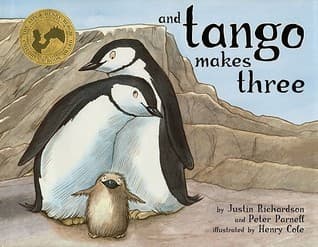
Justin Richardson (2005)
Genre
Children's
Reading Time
5 min
Key Themes
See below
Sign in to track this book
This true story from the Central Park Zoo shows how two male penguins, Roy and Silo, become a family by raising a chick named Tango.
In the Central Park Zoo, among many animal families, live two male chinstrap penguins named Roy and Silo. Unlike the other penguins who pair up as male and female, Roy and Silo are a male couple. They do everything together: they bow, sing, and swim with each other. When breeding season arrives, all the other penguin pairs begin to build nests and lay eggs. Roy and Silo, watching their neighbors, also decide to build a nest. They gather stones and arrange them carefully, just like the other penguin couples, showing they want a family.
After building their nest, Roy and Silo wait for an egg, just as they've seen other penguin pairs do. Day after day, they take turns sitting on their empty nest, keeping it warm and safe, even though no egg is inside. They are very good at their job, carefully tending to the nest with the same care as the other penguins. But no egg ever appears. Their wish for a chick is clear in their ongoing but unsuccessful efforts to incubate their empty nest.
Zookeeper Mr. Gramzay watches Roy and Silo with their empty nest. He sees how faithfully they sit on it, day after day, and knows they deeply want to be parents. At the same time, another penguin couple in the zoo has laid two eggs, which is one more than they can easily care for. Mr. Gramzay has an idea: he takes the extra egg from the other penguin parents and places it carefully in Roy and Silo's nest. He hopes the dedicated male pair can successfully hatch and raise the chick.
Roy and Silo are happy when they find the egg in their nest. They immediately begin to take turns sitting on it, keeping it warm and safe, just as they had practiced with their empty nest. They are very careful and patient, showing their strong commitment. After some time, a tiny crack appears in the egg, and soon a small, fuzzy chick emerges. Roy and Silo are thrilled and proud; they are fathers! They name their baby Tango, because 'it takes two to make a tango,' and she is the first penguin in the zoo to have two daddies.
Roy and Silo are good fathers to Tango. They feed her, protect her, and teach her what a young penguin needs to know. Tango grows bigger and stronger every day, surrounded by the love and care of her two dads. She learns to swim, to find her own food, and to be with the other penguins. She is a happy and healthy part of the Central Park Zoo's penguin group, showing the loving parenting of Roy and Silo, who proved that a family can be made in many ways.
The Protagonist
From a lonely male penguin, Roy becomes a devoted partner and a successful, loving father.
The Protagonist
From a lonely male penguin, Silo becomes a devoted partner and a successful, loving father.
The Supporting
Born into a unique family, Tango grows up healthy and well-adjusted due to her fathers' love.
The Supporting
As an observant zookeeper, he acts as a compassionate facilitator for Roy and Silo's dream of parenthood.
The book shows that families come in many forms. Roy and Silo, two male penguins, form a loving pair and successfully raise a chick. This challenges the common idea of a 'mother and father' family. The story shows that the most important parts of a family are love, care, and dedication, not specific gender roles. Tango's happy childhood comes from her two fathers' commitment, showing that different family structures are just as good and loving.
“Roy and Silo were both boys. It didn't matter. They bowed to each other. They sang to each other. And they built a nest together.”
A main theme is the power of love and caring instincts. Roy and Silo show deep love for each other and a natural wish to care for others. Their constant efforts to keep an empty nest warm, and their careful care for Tango, show that parental love goes beyond usual ideas. The zookeeper sees their dedication, which leads him to help. This means their ability to love and care makes them good parents, no matter their gender.
“They sat on the nest just like the other penguins. But Roy and Silo's nest was empty.”
The book gently promotes acceptance by showing Roy and Silo's family as just another, though special, family in the zoo. No one judges their relationship; instead, their bond is simply seen and, finally, supported by Mr. Gramzay. The story makes their non-traditional family normal, showing Tango growing up happily among other penguin families. This sends a message that all loving families should be recognized and respected.
“And Tango was the very first penguin in the zoo to have two daddies.”
Giving human characteristics and emotions to animals.
The book uses anthropomorphism by attributing human-like emotions and behaviors to the penguins, Roy and Silo. They 'fall in love,' 'bow to each other,' 'sing to each other,' and 'want a family.' This device makes the complex themes of same-sex parenting and family diversity accessible and relatable to young children, allowing them to empathize with the penguins' desire for a chick and understand their loving bond without explicit human-to-human examples.
Represents longing and the desire for family.
The empty nest that Roy and Silo diligently sit on symbolizes their profound longing for a chick and their readiness for parenthood. It represents their hope, dedication, and the void they feel without a child. The zookeeper's observation of their consistent care for this empty nest is what convinces him of their parental capabilities, highlighting that their desire and capacity for nurturing are genuine, even in the absence of a biological offspring.
A plot device for enabling the non-traditional family.
The extra egg from another penguin couple serves as a crucial plot device that allows Roy and Silo to become parents. It's a practical solution to their inability to lay an egg themselves, facilitated by the observant zookeeper. This device highlights how resourceful solutions can enable diverse family formations and underscores the idea that not all families are formed biologically, but through care, opportunity, and a desire to nurture.
“In the penguin house at the Central Park Zoo, there are two penguins named Roy and Silo.”
— Opening line introducing the main characters.
“Roy and Silo were a little bit different. They were both boys.”
— Describes the unique nature of their relationship.
“They did everything together. They bowed to each other. And they walked together.”
— Shows the bond and daily routines of Roy and Silo.
“They made a nest of stones, just like the other penguin couples.”
— Illustrates their desire to build a family like others.
“But no matter how they tried, they could not lay an egg.”
— Highlights the challenge they face in starting a family.
“Mr. Gramzay, the zookeeper, saw that Roy and Silo were trying to hatch a rock.”
— The zookeeper notices their efforts and decides to help.
“He found an egg that needed to be cared for, and he gave it to Roy and Silo.”
— The zookeeper provides them with an opportunity to become parents.
“Roy and Silo took turns sitting on the egg to keep it warm.”
— Shows their dedication and shared responsibility in parenting.
“And then one day, the egg began to crack.”
— The moment their efforts lead to the hatching of the egg.
“Out came a baby penguin! They named her Tango.”
— The introduction of Tango, completing their family.
“Tango made three.”
— A simple, poignant statement about their family unit.
“Roy and Silo taught Tango how to swim and how to catch fish.”
— Depicts their roles as nurturing and teaching parents.
“And the three of them lived happily together.”
— Closing line emphasizing the happiness of their family.
“They were a family.”
— A direct affirmation of their family status.
Ready to see how well you understood this book? Take our interactive quiz with 10 questions.

Biography coming soon.
Dan Gemeinhart
4.5
Kate O'Hearn
4.4

Jeanne Birdsall
4.4

Jen Wang
4.4
Wendelin Van Draanen
4.3

John Marsden
4.3

Chris Van Allsburg
4.3
Jennifer A. Nielsen
4.2