“Truth is a slippery thing, and the more you try to grasp it, the more it eludes you.”
— Reflection on the nature of truth in the novel's complex narrative.

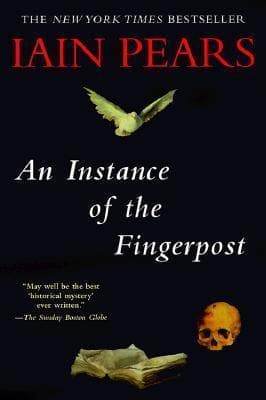
Iain Pears (1997)
Genre
Thriller / Historical Fiction / Mystery
Reading Time
1380 min
Key Themes
See below
Sign in to track this book
In 1660s Oxford, a suspicious death unravels through the conflicting accounts of four witnesses—a physician, a lord's son, a cryptographer, and an antiquarian—each weaving a tangled web of truth and deception around a young woman accused of murder.
The story begins with Marco da Cola, an Italian physician, arriving in Oxford in 1663. He plans to study English scientific advancements and find a patron. He quickly becomes friends with Dr. Richard Lower, a physician known for anatomical experiments. Marco is present when Robert Grove, a fellow of New College, is found dead in his rooms, poisoned. Grove's death happens shortly after a heated argument with his student, Sarah Blundy, a young woman known for her independent spirit and alleged radical views. The authorities, especially Justice John Thurloe, quickly suspect Sarah. This is mainly because of circumstantial evidence and her association with politically undesirable figures. Marco wants to understand the case and perhaps find a patron, so he begins his own investigation, observing Oxford's intellectual and political scene.
John Wallis, a cryptographer and mathematician, gives his account. He reveals a more complex political situation around Grove's death. Wallis, who has worked for both Cromwell's Commonwealth and now King Charles II, explains he was asked to decipher coded messages about potential Catholic and Royalist plots. He says Robert Grove was not just an academic but also involved in these secret activities, possibly as an informant or double agent. Wallis's perspective implicates several powerful figures, including Dr. Richard Lower and Anthony Wood. He suggests Grove's death was not a simple murder but a planned killing linked to the political climate of the Restoration. He also points out Sarah Blundy's unwitting role in these schemes.
Jack Prescot, the son of a Royalist executed during the Commonwealth, offers his version of events. He wants revenge and to clear his family's name. Jack believes his father was betrayed by informers, and he wants to expose them. His story focuses on Sir Harry Vane and John Thurloe, whom he suspects of planning his father's downfall. Jack becomes involved with Sarah Blundy, initially thinking she has information important to his search. He describes his interactions with various Oxford figures, including Grove. He uncovers evidence suggesting Grove was involved in the political maneuvering that led to his father's death. Jack's account shows Sarah as a victim of circumstances, manipulated by powerful men, rather than a killer.
Anthony Wood, an Oxford antiquarian, presents his detailed, often gossipy, account of the events. Wood's narrative describes Oxford life, full of details about the university's people, rivalries, and scandals. He first portrays Sarah Blundy as a dangerous radical and a witch-like figure, reflecting common prejudices of the time. However, as his account continues, Wood's careful record-keeping, combined with his personal animosities and insights, gradually reveals the hidden motives and true characters of those involved. He exposes the intellectual arrogance of figures like Richard Lower and the political opportunism of others. He suggests Grove's death was a mix of academic rivalry, political schemes, and personal vendettas, with Sarah Blundy as an easy target.
Despite the different and often contradictory accounts from Marco, Wallis, Prescot, and Wood, the legal proceedings against Sarah Blundy continue. The evidence presented, which is mostly circumstantial and influenced by the political climate and societal prejudices against independent women, is enough to convict her. Sarah is found guilty of Robert Grove's murder. Her execution is a public event. Her death leaves many questions unanswered, especially for those who believed she was innocent or suspected deeper plots.
By comparing and analyzing the four narratives, the true killer of Robert Grove is revealed to be Robert Boyle, the scientist. Boyle wanted to protect his reputation and prevent Grove from exposing his involvement in certain politically sensitive experiments and potentially heretical scientific theories. Grove had discovered Boyle's secrets and planned to reveal them, which would have greatly harmed Boyle's standing in the Royal Society and with the King. Boyle cleverly manipulated circumstances and people, including Dr. Richard Lower, to frame Sarah Blundy for the crime, diverting suspicion from himself.
Grove's murder was a result of several motives. Robert Boyle wanted to silence Grove to protect his scientific reputation and the secrecy of his controversial experiments, especially those involving blood transfusion and the nature of life, which could be seen as heretical. Grove himself was involved in political espionage, acting as an informant for different groups, which made him a liability. The political climate of the Restoration, with its constant fear of Catholic plots and republican uprisings, made it easy to hide such a crime behind larger concerns. The desire for personal advancement and protecting one's social standing also played roles in the decisions and actions of many characters.
Even though the reader eventually understands the truth, the official record remains the same: Sarah Blundy was convicted and executed for Robert Grove's murder. The powerful figures involved, especially Robert Boyle, avoid justice, and their reputations stay intact. Marco da Cola, disappointed by the corruption, eventually leaves England. Jack Prescot continues his search for familial honor, forever changed by the events. John Wallis continues his cryptography work, always aware of the hidden truths. Anthony Wood continues his detailed chronicling, his insights often overlooked. The novel ends with a sense of how fragile truth and justice are in a world ruled by power, prejudice, and self-interest.
The Protagonist/Narrator
Starts as an eager, somewhat naive observer and becomes disillusioned by the corruption and injustice he uncovers, eventually leaving England.
The Accused/Supporting
From a seemingly independent woman to a condemned scapegoat, her story highlights the vulnerability of the powerless.
The Victim/Central Figure
His death is the catalyst, and his past actions are slowly unveiled through the multiple narratives.
The Narrator/Supporting
His narrative provides the most objective, albeit politically biased, view of the machinations at play.
The Narrator/Supporting
Driven by revenge, he navigates a dangerous world, eventually understanding the complexities of justice beyond simple retribution.
The Narrator/Supporting
Initially biased against Sarah and modern science, his comprehensive chronicling inadvertently exposes the true complexities of the case.
The Supporting
His ambition and scientific pursuits inadvertently make him a pawn in the larger murder plot.
The Antagonist/Mentioned
His hidden role as the mastermind behind Grove's murder is gradually exposed, revealing his ruthless nature.
The Supporting
Maintains his authoritative and politically motivated stance throughout, ensuring Sarah's conviction.
The main theme of the novel is how hard it is to find objective truth, especially when seen through many subjective perspectives. Each narrator—Marco, Wallis, Prescot, and Wood—tells their version of events, shaped by their biases, experiences, and goals. What one narrator leaves out, another includes; what one misunderstands, another clarifies. This makes the reader actively put together the 'true' story, showing how personal motivations, political loyalties, and social prejudices can greatly change reality. The book asks the reader to question every account, similar to how difficult it is to reconstruct past events.
“For the truth is that the past is a story we tell ourselves, and we are forever remaking it.”
The novel shows the difference between legal justice and true justice. Sarah Blundy's wrongful conviction and execution for Robert Grove's murder is an example of injustice. It is driven by political convenience and societal prejudice rather than facts. The powerful (Robert Boyle, John Thurloe) are not held accountable, while the vulnerable are sacrificed. The legal system is shown to be easily manipulated and blind to deeper truths. This highlights how power dynamics and social status decide who is punished and who is protected. The reveal of the true killer, who remains unpunished, highlights this theme.
“Justice, I have learned, is a matter of who tells the best story, and who has the power to make it believed.”
Set during a time of intense intellectual change, the novel examines the tension between new scientific rationalism and old religious beliefs and superstitions. Robert Boyle's controversial experiments, especially those involving blood and the nature of life, push the limits of what religious authorities find acceptable, giving a reason for Grove's murder (to prevent exposure). Sarah Blundy is easily labeled a 'witch' or radical because of her independent thinking and association with certain ideas. The fear of the unknown and the struggle to combine new scientific discoveries with established beliefs are constant influences on how characters see events and each other.
“There are those who would see all new knowledge as a challenge to God, and others who would see it as a path to understanding His works.”
The Restoration era is shown as a time of shifting political loyalties, espionage, and constant fear of conspiracy. Robert Grove's murder is deeply connected to this political climate, involving spies, informants, and plots against the Crown. Characters like John Wallis and John Thurloe are important for understanding the widespread political maneuvering. The novel shows how personal lives are linked to larger political struggles, and how powerful figures manipulate events and individuals to keep their authority and prevent their secrets from being revealed. The fear of Catholic plots and republican uprisings provides a convenient cover for the real motives behind the murder.
“In these times, every man is a spy, and every word a potential betrayal.”
Each narrator's account is presented as a 'history' or 'memory' of the events. This shows how subjective and reconstructive both history and memory are. Anthony Wood's careful chronicles, despite their biases, try to preserve history. The differences between the narratives show how memory is flawed and shaped by individual experience. The novel suggests that 'history' is not one objective story but a collection of often contradictory personal stories, influenced by those who record it. The reader must sort through these memories to build a consistent, though still interpretive, understanding of the past.
“Memory is a treacherous thing, and the past is always being rewritten.”
Four distinct perspectives offering conflicting accounts of the same events.
The novel employs four first-person narrators—Marco da Cola, John Wallis, Jack Prescot, and Anthony Wood—each recounting the events surrounding Robert Grove's murder from their unique vantage point. This device creates ambiguity, forcing the reader to constantly question the reliability of each account and piece together the 'truth' from conflicting information. Each narrator has their own biases, motivations, and access to information, contributing to the central theme of the elusiveness of truth. The differing styles and concerns of each narrator also provide a rich tapestry of the historical period.
Each narrator's account is colored by their biases, agenda, and limited knowledge.
Beyond simply having multiple narrators, each character recounting the story is, to varying degrees, unreliable. Marco is naive, Wallis is politically constrained, Prescot is driven by revenge, and Wood is prejudiced and gossipy. Their unreliability is not always malicious but stems from their subjective experiences, incomplete information, or personal agendas. This device actively engages the reader in detective work, requiring critical evaluation of each statement and a constant re-evaluation of previously accepted 'facts' as new perspectives emerge. The ultimate truth is only revealed through the synthesis of these flawed accounts.
The political and scientific ferment of Restoration England shapes the plot and motives.
The intricate historical context of Restoration England, including the aftermath of the Civil War, the fear of Catholic plots, the rise of the Royal Society, and the intellectual debates of Oxford, is not merely a backdrop but an active plot device. It provides plausible motives for characters (e.g., political espionage, scientific rivalry, religious heresy) and explains the societal prejudices (e.g., against Sarah Blundy). The political instability and the secrecy surrounding new scientific discoveries create a fertile ground for murder and cover-ups, making the specific historical moment integral to the mystery's complexity.
A symbolic representation of diverging paths and the search for direction/truth.
The title 'An Instance of the Fingerpost' alludes to the old term for a signpost, symbolizing the diverging paths of interpretation and truth presented by the four narratives. Each account points in a different direction, guiding the reader along a distinct investigative path. The 'instance' implies a single, specific case where these divergent paths must be navigated to find a singular, correct destination (the truth of the murder). It serves as a constant reminder of the novel's central structural and thematic challenge: making sense of conflicting directions to reach a definitive conclusion.
The narratives are presented as written accounts, mimicking historical documents.
While not strictly an epistolary novel in the sense of letters, the four narratives are presented as distinct, written accounts or memoirs, each with its own prefatory remarks and concluding thoughts. This structure mimics the collection of historical documents or testimonies, lending an air of authenticity and academic rigor to the mystery. It reinforces the idea that the reader is sifting through primary sources, much like a historian, to construct a coherent understanding of the past. The 'found manuscript' feel enhances the historical immersion and the puzzle-solving aspect of the novel.
“Truth is a slippery thing, and the more you try to grasp it, the more it eludes you.”
— Reflection on the nature of truth in the novel's complex narrative.
“In Oxford, a man's reputation is his most precious possession, and it can be destroyed by the merest whisper.”
— Commentary on the academic and social environment of 17th-century Oxford.
“The past is not a fixed country; it shifts and changes with each telling.”
— Observation on how history is interpreted and reinterpreted.
“A man may see what he wishes to see, and believe what he wishes to believe, and call it truth.”
— Critique of subjective perception and confirmation bias.
“In matters of science, as in matters of faith, certainty is the enemy of understanding.”
— Discussion on the scientific and religious debates of the era.
“The dead do not speak, but they leave behind clues that the living must decipher.”
— Reflection on the mystery at the heart of the novel.
“Power is not in the throne, but in the minds of those who believe in it.”
— Comment on political and social power structures.
“A secret shared is no longer a secret, but a weapon.”
— Observation on the dangers of confidences in a treacherous world.
“The greatest crimes are often committed in the name of the highest ideals.”
— Moral reflection on the actions of characters.
“In the end, we are all prisoners of our own perspectives.”
— Conclusion drawn from the multiple narrators' conflicting accounts.
“Justice is a blind goddess, but she is not deaf to the clamor of the powerful.”
— Critique of the judicial system and its biases.
“The fingerpost points the way, but it does not guarantee the destination.”
— Metaphorical reference to the book's title and themes of guidance and uncertainty.
“Love and hatred are two sides of the same coin, and both can drive a man to madness.”
— Exploration of extreme emotions in character motivations.
“A scholar's pride is his downfall, for it blinds him to the truth that lies outside his books.”
— Warning against intellectual arrogance in the academic setting.
Ready to see how well you understood this book? Take our interactive quiz with 10 questions.

Biography coming soon.







