“It was a strange thing to be a girl in the world, to have so many doors closed against you, even before you were old enough to know what was on the other side.”
— Reflecting on societal limitations for women in the 1860s.

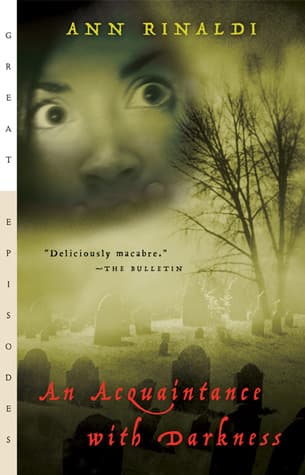
Ann Rinaldi (1997)
Genre
Children's / Historical Fiction / Mystery / Young Adult
Reading Time
512 min
Key Themes
See below
Sign in to track this book
After Lincoln's assassination, fourteen-year-old Emily navigates a world where her uncle may be a grave robber and her best friend's family is accused of treason, making her question trust and darkness.
Fourteen-year-old Emily Pigbush lives a sheltered life in Baltimore until she finds a mysterious package in her attic containing surgical instruments and a human arm. This unsettling find happens as she learns her Uncle Julian is her stepfather, and her mother, Martha, died under mysterious circumstances, possibly in childbirth. Emily is then sent to live with her mother's estranged family, the Thorntons, in Washington D.C. She immediately notices the somber atmosphere of their home and the cold reception from her Aunt Lucy and Uncle Daniel, especially their focus on the Civil War and their loyalty to the Union, which conflicts with Emily's Southern sympathies.
In Washington D.C., Emily struggles to adapt to her Aunt Lucy and Uncle Daniel's strict rules and political fervor. She finds comfort in a new friendship with Augusta and Anna, daughters of Mary Surratt, who run a boarding house. The Surratts, despite appearances, are known to have Confederate sympathies, which both interests and worries Emily, given her adoptive family's strong Unionism. Emily also meets John Wilkes Booth, a charismatic actor with strong Southern opinions, who often visits the Surratt boarding house. Her time with the Surratt family and Booth exposes her to a world of divided loyalties and tensions she had not known in Baltimore.
Emily's suspicions about her Uncle Julian, a respected doctor, grow as she remembers the surgical instruments and human arm found in the attic. She connects these items to rumors of 'resurrectionists' or body snatchers who supply medical schools with bodies, a practice considered wrong and illegal. She overhears quiet conversations and notices Julian's secretive behavior, increasing her unease. Emily struggles with the idea that someone she once trusted could be involved in such a gruesome trade, especially with her growing understanding of wartime medical needs and the ethics of anatomical study.
Driven by her growing suspicions, Emily finds a way to visit the morgue, where unidentified bodies are kept. The experience is horrifying and confirms her worst fears. She sees evidence of the illegal trade, further solidifying her belief that Julian is involved in body snatching. This visit also shows her the grim realities of death and loss during the Civil War, with many soldiers' bodies passing through the morgue. The emotional impact of this discovery is immense, leaving Emily feeling isolated and betrayed, unsure whom she can tell about her uncle's secret, especially with her new family's strict moral code.
As the Civil War intensifies and tensions rise in Washington D.C., the Surratt family, especially Mary Surratt, faces increasing scrutiny from Union authorities. Their boarding house is known as a meeting place for those with Southern sympathies, and rumors of disloyal activities begin to spread. Emily, caught between her loyalty to her new friends and her adoptive family's strong Unionist stance, sees the growing paranoia and suspicion aimed at the Surratts. She observes secret meetings and quiet conversations, further involving her in the complex web of wartime espionage and political intrigue, making her question her friends' true allegiances.
Emily often sees John Wilkes Booth at the Surratt boarding house and notices his increasingly radical views against President Lincoln and the Union. Booth, a charismatic but unstable actor, openly expresses his hatred for Lincoln and his wish for the Confederacy to win. Emily, initially drawn to his charm, becomes increasingly disturbed by his intense words and fervent passion for the Southern cause. She sees him gathering with other Confederate sympathizers, discussing things that suggest more than just political debate, hinting at the tragic events to come and deepening her unease about her friends' company.
Washington D.C. is thrown into chaos and grief with the news of President Abraham Lincoln's assassination at Ford's Theatre. Emily, like everyone else, is deeply affected by the tragedy. The event shocks her adoptive family, who are strong Unionists, and the entire nation. The immediate aftermath is marked by panic, confusion, and a desperate search for the perpetrators. This moment changes the city's atmosphere and starts a chain of events that will directly impact Emily and her friends, forcing her to confront the brutal realities of war and political extremism.
After Lincoln's assassination, a frantic investigation leads to Mary Surratt's arrest. She is accused of being a conspirator in the plot, specifically for helping John Wilkes Booth and his accomplices. Emily is devastated by her friend's mother's arrest and what it means for Augusta and Anna. The Surratt boarding house, once a safe place, becomes a focus of suspicion and fear. Emily struggles to reconcile the kind woman she knew with the image of a co-conspirator, showing the moral complexities and devastating consequences of wartime loyalties and suspicions.
As the conspirators' trial unfolds, Emily finds herself in a terrible situation when called to testify. She holds important information about the activities at the Surratt boarding house and the people who visited it, including John Wilkes Booth. This puts her in a difficult moral dilemma: should she tell the complete truth, possibly condemning her friends' mother, or try to protect Mary Surratt, even if it means holding back information? Her testimony tests her integrity and her understanding of justice, forcing her to navigate loyalty, truth, and the severe consequences of wartime actions.
Despite the arguments, Mary Surratt is convicted of involvement in the assassination plot and sentenced to hang. This verdict is a deep shock and tragedy for Emily, Augusta, and Anna. Emily witnesses her friends' raw grief and despair, further showing the devastating impact of the war and its aftermath on individual lives. Mary Surratt's execution, a woman Emily had come to know and care for, leaves a lasting mark on her, forcing her to confront the harsh realities of justice during a time of national crisis and the irreversible consequences of political extremism.
After the emotional turmoil of the assassination trial, Emily finally gathers the courage to confront her Uncle Julian about his body snatching. She presents the evidence she has collected, from the surgical instruments to her morgue visit. Julian, initially defensive, confesses to his activities, explaining the desperate need for bodies for medical research and training, especially during wartime when many soldiers needed advanced surgical care. While Emily is horrified by the practice, she begins to understand the complex ethical reasons behind his actions, blurring her lines between right and wrong.
After Julian's confession, Emily grapples with her feelings of betrayal and her growing understanding of his reasons. She learns that his actions, though questionable, were driven by a desire to advance medical science and save lives, especially in a time of war when such knowledge was greatly needed. This revelation forces Emily to mature and see the world in shades of gray. She begins to forgive Julian, recognizing the difficult choices people make under extreme circumstances, and starts to repair their fractured relationship, finding a new, complex understanding of family and morality.
The Protagonist
Emily transforms from an innocent, sheltered girl into a mature young woman who understands the complexities of morality and the harsh realities of the world.
The Supporting Character
Julian is revealed as a complex figure whose actions, though illegal and disturbing, are driven by a desire to contribute to medical science.
The Supporting Character
Mary Surratt's journey from a seemingly ordinary boarding house owner to a convicted conspirator highlights the devastating impact of war and political extremism.
The Supporting Character
Augusta endures immense personal tragedy and loss as her mother is accused and convicted, forcing her to confront the harsh realities of war and injustice.
The Antagonist/Mentioned
Booth's character arc is one of escalating radicalization, culminating in his infamous act of assassination.
The Supporting Character
Aunt Lucy remains steadfast in her Unionist beliefs, providing a strong counterpoint to Emily's evolving understanding of morality and loyalty.
The Supporting Character
Uncle Daniel's character remains consistent in his Unionist stance, representing the prevailing sentiment of the time.
The Mentioned Character
Martha's story is revealed posthumously, unraveling a past that shapes Emily's present.
The novel explores the elusive nature of truth, both personal and political. Emily's journey begins with deception about her parentage and mother's death, making her question what she believes. This extends to her Uncle Julian's body snatching, where his questionable actions are driven by a desire for medical advancement. On a larger scale, Washington D.C.'s political climate is full of hidden loyalties and secret plots, making it hard for Emily to know whom to trust. Mary Surratt's trial shows how truth can be manipulated or obscured by political agendas and wartime hysteria, demonstrating that 'truth' is often subjective and influenced by perspective.
“"Truth, I was learning, was a tricky thing. It could hide in plain sight, or it could whisper from the shadows, and sometimes, it was a thing you didn't want to hear at all."”
An Acquaintance with Darkness examines the complexities of moral choices, especially during times like the Civil War. Emily's Uncle Julian's body snatching, though illegal and disturbing, is presented with the context of advancing medical knowledge and saving lives, making Emily and the reader consider if the ends justify the means. Similarly, the Confederate sympathies of the Surratt family, while leading to tragedy, are shown as deeply held beliefs rather than pure malice. The novel challenges simple ideas of 'good' and 'evil,' portraying characters who make difficult decisions with both noble and ignoble motivations, showing that morality is often a spectrum, especially when survival and strong convictions are at stake.
“"There were no easy answers, I realized, not in war, and not in the secrets that families kept. Only choices, and the consequences that followed."”
The Civil War is a constant backdrop, directly influencing every part of Emily's life and the lives of those around her. It shatters her innocence, forces her relocation, and creates the political climate that leads to Lincoln's assassination and the Surratt trial. The war's impact is seen in the need for bodies for medical research, the divided loyalties within families and communities, and the widespread paranoia and suspicion in Washington D.C. The novel illustrates how national conflict can tear apart social fabric, destroy personal lives, and force individuals to confront brutal realities they would otherwise never encounter, leaving lasting emotional and psychological scars on an entire generation.
“"The war, like a great, dark hand, reached into every corner of our lives, touching everything and everyone, leaving its mark like a bruise."”
Emily's journey is a coming-of-age story. She starts as a sheltered, naive girl and is quickly thrown into a world of adult secrets, political intrigue, and national tragedy. The discovery of her family's deceptions, the horrors of body snatching, and the shocking events of Lincoln's assassination and the Surratt trial force her to grow up quickly. She loses her childhood innocence as she deals with moral ambiguities, witnesses death and injustice, and learns to navigate a complex and often cruel world. Her experiences make her develop a more nuanced understanding of humanity, loyalty, and the difficult choices people make under pressure, ultimately shaping her into a more discerning and resilient young woman.
“"My childhood, I knew then, was over. It had ended not with a whimper, but with the clang of a morgue door and the echo of a hangman's noose."”
The story is told from Emily Pigbush's perspective.
This device immerses the reader directly into Emily's thoughts, feelings, and limited understanding of the complex events unfolding around her. It allows for a gradual revelation of secrets and a personal, emotional connection to her coming-of-age journey. The reader experiences her confusion, fear, and growing maturity alongside her, making the discoveries about her family and the political turmoil more impactful. It also highlights her subjective interpretation of events, reflecting the difficulty of discerning truth in a time of widespread deception and conflicting loyalties.
The plot is driven by unanswered questions and hidden truths.
The novel employs mystery and suspense through several key elements: the initial discovery of the human arm and surgical instruments, the ambiguous circumstances of Emily's mother's death, and the slow unraveling of Uncle Julian's involvement in body snatching. Later, the political intrigue surrounding the Surratt boarding house and the impending assassination plot create a sense of foreboding. These elements keep the reader engaged, mirroring Emily's own quest for answers and her growing unease, building tension as she navigates a world full of dangerous secrets and uncertain allegiances.
Washington D.C. during the Civil War is integral to the narrative.
The historical setting of Washington D.C. during the latter stages of the Civil War is not merely a backdrop but an active force shaping the plot and characters. The political tensions, divided loyalties, widespread paranoia, and the constant threat of espionage directly influence the events, such as the Surratt family's situation and Lincoln's assassination. The war dictates the moral dilemmas, the societal norms, and the very atmosphere of fear and uncertainty that Emily experiences, making the historical context essential to understanding the characters' motivations and the story's tragic outcomes.
Hints and clues about future events or revelations are subtly embedded in the narrative.
Foreshadowing is used effectively, particularly in the early chapters, to build suspense and hint at the darker truths Emily will uncover. The mysterious package with surgical instruments and the human arm in the attic foreshadow Uncle Julian's body snatching activities. Similarly, the frequent presence and increasingly radicalized rhetoric of John Wilkes Booth at the Surratt boarding house subtly foreshadow the assassination plot. These subtle clues create a sense of impending doom and allow the reader to anticipate, alongside Emily, the unraveling of secrets and the tragic events that will occur.
“It was a strange thing to be a girl in the world, to have so many doors closed against you, even before you were old enough to know what was on the other side.”
— Reflecting on societal limitations for women in the 1860s.
“The dead don't care about your secrets. They keep them better than the living.”
— Talking about the deceased and the nature of secrets.
“Sometimes the truth is not what you want to hear, but it is always what you need to know.”
— A realization about confronting difficult realities.
“Fear can make you do terrible things, but it can also make you brave, if you let it.”
— Contemplating the dual nature of fear.
“A house holds memories like a jar holds preserves. Some sweet, some sour, but all of them sealed inside.”
— Describing the emotional weight of a familiar home.
“There are some things you can only learn by losing them.”
— Reflecting on lessons learned through loss and hardship.
“The past is never truly gone. It just waits for you to stumble upon it again.”
— Considering how past events continue to influence the present.
“Even in the darkest times, there is always a flicker of light, if you know where to look.”
— Finding hope amidst despair.
“It’s a strange thing, isn’t it, how the world keeps turning even when your own world feels like it’s stopped?”
— Observing the indifferent continuity of life during personal crisis.
“Sometimes, the greatest mysteries are not in what's hidden, but in what's in plain sight.”
— A detective-like observation about solving puzzles.
“We all carry our own darkness, some of us just learn to live with it better than others.”
— Acknowledging the internal struggles everyone faces.
“The silence of a graveyard is a different kind of quiet. It's a silence that speaks volumes.”
— Describing the profound atmosphere of a cemetery.
“To be truly free, you must first understand what holds you captive.”
— A philosophical thought on the nature of freedom.
“A secret shared is a burden halved, but sometimes, a secret kept is a shield.”
— Weighing the pros and cons of revealing secrets.
Ready to see how well you understood this book? Take our interactive quiz with 10 questions.

Dan Gemeinhart
4.5

Kate O'Hearn
4.4

Jeanne Birdsall
4.4

Jen Wang
4.4

Wendelin Van Draanen
4.3

John Marsden
4.3

Chris Van Allsburg
4.3
Jennifer A. Nielsen
4.2