“He was a shadow boy himself, a third child, a no-longer-secret.”
— Granting Luke's internal realization about his shared plight with Jen.

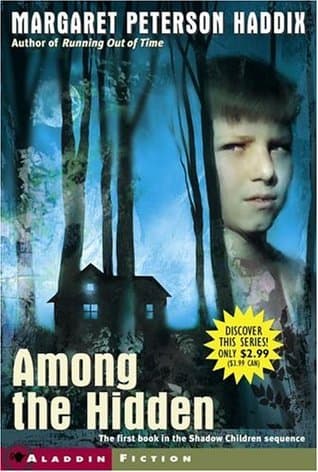
Margaret Peterson Haddix (1998)
Genre
Fantasy / Children's / Science Fiction / Young Adult
Reading Time
150 min
Key Themes
See below
Sign in to track this book
Confined to his home as an illegal third child, Luke discovers a defiant kindred spirit who challenges him to join a dangerous rebellion against a totalitarian regime that forbids his very existence.
Luke Garner is a twelve-year-old boy living in a society where families are only allowed to have two children because of severe food shortages. As a third child, Luke has spent his entire life in hiding on his family's farm, never allowed to go outside when anyone might see him. His world is confined to his house and the small, hidden areas of their property. His only company is his parents and two older brothers, Matthew and Mark, who often resent the sacrifices made for Luke's safety. The constant threat of the Population Police hangs over their lives, enforcing the strict two-child policy and making Luke's existence a secret burden for his family.
Luke's already limited world shrinks when the government sells the woods behind their farm for a new housing development. These new homes have large windows, eliminating any safe outdoor space for Luke. He must stay indoors at all times, even forbidden from looking out the windows for fear of being seen. This extreme isolation affects Luke deeply, as he feels like a prisoner in his own home, watching the new families move in and live openly, a sharp contrast to his hidden existence. He wants freedom and connection, feeling more alone than ever.
One day, while peeking through a vent, Luke observes the new neighborhood. He notices that the houses are all occupied by families with two children, as expected. However, in one house, the Sports Family's home, he sees a brief glimpse of a girl's face in the window, even though he knows they already have two registered children. This sight sparks hope within Luke. Could there be another shadow child like him living so close? The possibility is both exciting and frightening, as it presents a potential connection but also a great risk if he were to investigate.
Driven by a need for companionship and answers, Luke begins to sneak out of his house when his family is gone. He carefully makes his way through the yards, using the cover of darkness and natural obstacles, to reach the Sports Family's house. His heart pounds with a mix of fear and anticipation. He knows that if he is caught, the consequences for him and his family would be severe, possibly leading to his capture and even execution by the Population Police. Despite the danger, the lure of finding another shadow child proves too strong to resist.
Luke breaks into the Sports Family's house and discovers Jen Talbot, a confident shadow child. Unlike Luke, Jen knows a lot about the government and the Population Police, having access to hidden television and the internet. She reveals that her father works for the Population Police, which gives her insider knowledge and some protection. Jen is more rebellious than Luke, openly defying her parents' strict rules and even having a secret party with other shadow children. She is happy to meet Luke, finally having another shadow child to share her plans with.
Jen reveals her plan to Luke: she is organizing a secret rally in the capital, inviting hundreds of other shadow children from across the country to publicly protest their existence. She believes that if enough shadow children appear, the government will have to acknowledge them and change the laws. Jen is passionate and determined, convinced that this is the only way to achieve freedom. She tries to convince Luke to join her, emphasizing the importance of standing up for their rights. Luke is conflicted, torn between his fear of discovery and his growing desire for freedom and justice.
Luke grapples with Jen's plan. His entire life has been defined by fear and hiding, and the idea of public defiance is terrifying. He tries to understand Jen's conviction, but his caution makes him hesitate. Jen pushes him to be brave, arguing that a life in hiding is no life at all. She shows him online chat rooms where other shadow children discuss the rally, showing the widespread discontent. Despite Jen's arguments and the appeal of a future free from fear, Luke decides he cannot bring himself to attend the rally, paralyzed by the risk.
Jen leaves for the rally, full of hope and determination. Luke waits anxiously, hoping for news of her success. Days later, Jen's father returns, looking distraught. He reveals the truth: the rally was a massacre. The Population Police were waiting, and all the shadow children who attended, including Jen, were killed. Jen's father, despite his role, is saddened by his daughter's death and expresses guilt. This news shatters Luke's world, confirming his worst fears and leaving him with grief and a renewed sense of the brutal reality of their society.
In a surprising turn, Jen's father offers Luke a chance at a new life. He explains that he knows of a wealthy family, the Barons, who paid for a third child to be registered as a second child, but that child recently died. Jen's father, using his connections within the Population Police, can arrange for Luke to assume the identity of this deceased child, Lee Grant. This would allow Luke to attend boarding school, live openly, and potentially work to change the system from within. It's a dangerous proposition, requiring Luke to completely abandon his past and embrace a new, false identity.
After much deliberation, and with his parents' tearful consent, Luke decides to accept Jen's father's offer. He says a final, emotional goodbye to his family, knowing he may never see them again. He adopts the persona of Lee Grant, a spoiled, wealthy boy, and prepares to leave for the boarding school. The transformation is significant; Luke must suppress his true self and learn to act like someone he's not, constantly aware of the deception. He carries Jen's memory and her fight for freedom with him, determined to honor her sacrifice by becoming an agent of change in this new, dangerous world.
The Protagonist
Luke transforms from a fearful, isolated boy into a brave individual willing to risk his identity to fight for others like him, honoring Jen's legacy.
The Supporting/Catalyst
Jen inspires Luke to action through her unwavering commitment to freedom, even though her own life ends tragically.
The Supporting/Mentor
He transitions from a seemingly complicit agent to a grieving father who uses his power to help another shadow child find a future.
The Supporting
He remains largely static, representing the fear and caution of the older generation, ultimately supporting Luke's decision for a new life.
The Supporting
She remains a steadfast source of love and comfort for Luke, even as she must make the difficult choice to let him go for his own future.
The Supporting
He remains largely static, highlighting the everyday impact of the Population Law on registered children.
The Supporting
He remains largely static, serving to emphasize Luke's isolation within his own family.
The Antagonists
The Population Police remain a constant, unyielding threat throughout the narrative, symbolizing the oppressive government.
The central theme is the struggle for personal freedom and the right to exist. Luke's entire life is defined by his lack of freedom and his hidden identity. He wants to live openly, to be recognized as a person, not a secret. Jen embodies this fight, organizing a rebellion to claim freedom for all shadow children. Her rally, though tragic, is a powerful statement of asserting identity against an oppressive government. Luke's decision to become 'Lee Grant' is a complex act of both giving up his old identity and embracing a new one with the goal of achieving freedom for others.
“"I can't go through life hiding. No one should have to. It's not living. It's just existing."”
The novel shows the effects of a government that controls personal lives, even family size. The Population Police symbolize this oppressive force, creating fear and dictating every aspect of citizens' existence. The food shortages, while a stated reason for the law, show how such crises can be used to justify extreme control. The constant threat to Luke and Jen's lives demonstrates how such a government dehumanizes people, disregarding individual rights in favor of state control. The tragic outcome of Jen's rally highlights the brutal power of the state.
“"He was a shadow child. He was not supposed to exist."”
Courage is a recurring theme, seen in both Luke and Jen. Luke's initial courage is small, simply daring to look out a window or sneak out of his house. His courage grows as he confronts Jen, processes her ideas, and ultimately decides to take on a new identity. Jen, on the other hand, shows great courage from the start, openly defying her parents and organizing a public protest. Her bravery, though it leads to her death, inspires Luke to find his own strength. The novel suggests that courage is not the absence of fear, but the willingness to act despite it.
“"Sometimes you have to take risks. Sometimes you have to make a choice. And sometimes, you just have to be brave."”
Luke's loneliness drives the story. His isolation as a shadow child makes him want any form of connection. The discovery of Jen is transformative, as it gives him a kindred spirit and validates his existence. Their friendship, though brief, highlights the human need for companionship and understanding. Conversely, the novel also explores the dangers of isolation, as Luke's initial timidity is a direct result of his solitary life. The connection with Jen gives him the strength to consider a future beyond his hidden existence, even after her death.
“"He wasn't alone anymore. He wasn't the only one."”
The core of the conflict, forcing characters to live secret lives.
The central plot device is the hidden identity of 'shadow children' like Luke and Jen. This device creates immediate tension and conflict, as every action they take is fraught with the danger of discovery by the Population Police. It limits their world, shapes their personalities, and drives the narrative forward. The eventual adoption of a new hidden identity by Luke (as Lee Grant) further complicates this device, showing how a false identity can be both a prison and a potential tool for change, allowing him to navigate the oppressive world more openly, albeit deceptively.
Symbolizes Luke's confinement and his yearning for the outside world.
The barricaded window, and later the vent, through which Luke observes the outside world, serves as a powerful symbol of his confinement and his intense desire for freedom. It's his only access to the world beyond his home, representing both his literal prison and his metaphorical longing. The act of looking out is a small rebellion, a way for him to connect with a world he's denied. It's through this device that he first spots Jen, making it a crucial catalyst for the plot and his journey towards breaking free.
The ever-present external antagonist representing state control.
The Population Police function as the primary external antagonist, embodying the oppressive, totalitarian regime. Their constant threat drives much of the tension and fear in the novel. They are not individuals but an anonymous, pervasive force, making them all the more terrifying. Their existence justifies the extreme measures taken by families to hide shadow children and fuels Jen's revolutionary spirit. They represent the insurmountable power of the state, against which individual characters must struggle for survival and freedom.
A turning point and a symbol of collective resistance and its tragic consequences.
Jen's planned rally acts as a pivotal plot device, serving multiple functions. It's the climax of Jen's character arc, showcasing her unwavering commitment to defiance. For Luke, it presents a crucial moral dilemma and a test of his courage. Its tragic outcome serves as a harsh reality check on the dangers of direct confrontation with an oppressive regime, but also as a powerful catalyst for Luke's subsequent actions. The rally, though failed, galvanizes Luke and pushes the narrative towards his eventual decision to work for change from within the system, honoring Jen's sacrifice.
“He was a shadow boy himself, a third child, a no-longer-secret.”
— Granting Luke's internal realization about his shared plight with Jen.
“The government says only two children per family. That's the law. And we're not supposed to break the law.”
— Luke's parents explaining the harsh reality of their situation.
“But you're a person, too. You have a right to exist.”
— Jen trying to inspire Luke to fight for his rights.
“You can't just hide forever. You have to live.”
— Jen's argument to Luke about the necessity of action.
“There are others. Hundreds of others. Thousands. And we're going to come out. All of us.”
— Jen revealing the extent of the hidden children network.
“It was just a question of whether he was going to spend his life hiding, or doing something.”
— Luke's internal conflict after Jen's death.
“He had a name now. And a purpose. And a future.”
— Luke embracing his new identity as Lee Grant.
“Maybe if he hadn't known about Jen, he would have been content to stay hidden forever.”
— Luke reflecting on Jen's impact on his life.
“The world outside was a different place. A dangerous place. But it was also a place where he could finally be.”
— Luke contemplating his journey into the outside world.
“He didn't want to be a shadow anymore. He wanted to be real.”
— Luke's desire for an authentic existence.
“Sometimes you have to break the rules to do what's right.”
— Jen's philosophy on challenging unjust laws.
“It wasn't fair. None of it was fair.”
— Luke's recurring thought about the injustice of his situation.
“He was still afraid, but it was a different kind of fear now. A fear that pushed him forward, instead of holding him back.”
— Luke's evolving courage as he prepares for his new life.
Ready to see how well you understood this book? Take our interactive quiz with 10 questions.

Biography coming soon.







