“It's easy to become anything you wish... so long as you're willing to forfeit your soul.”
— The Monkey King's transformation into a human form, shedding his divine identity.

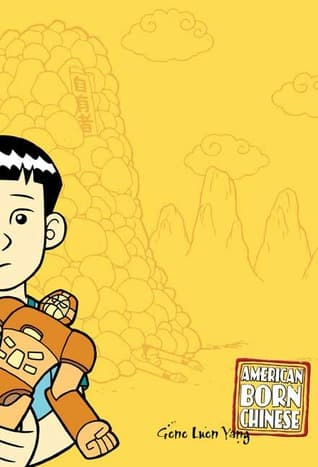
Gene Luen Yang (2006)
Genre
Fantasy / Young Adult
Reading Time
90 min
Key Themes
See below
Sign in to track this book
A graphic novel about an Asian-American teen, a mythical Monkey King, and a stereotypical cousin, exploring identity, self-acceptance, and the roles we play.
The story begins with the Monkey King, ruler of Flower-Fruit Mountain, arriving at a dinner party for the celestial deities. Despite his great power and martial arts skills, the gatekeeper denies him entry, mocking him for being a monkey. Angered and shamed, the Monkey King declares he will no longer be called a monkey. He returns to his mountain, where he makes his subjects wear shoes and trains constantly to prove his superiority. He masters heavenly disciplines and transforms into a giant, god-like figure. He then defeats various deities who try to stop him, proclaiming himself 'The Great Sage, Equal of Heaven.'
Jin Wang, a young Chinese American boy, moves with his family to a new town and starts at Mayflower Elementary. He feels like an outsider, being the only Asian student. His teacher, Mrs. Dabney, incorrectly introduces him as 'Jin Wang, from China,' though he was born in America, which makes him feel even more alone. Other children tease him, especially Peter Garbinsky. Jin finds some comfort in befriending Wei-Chen Sun, a new Taiwanese transfer student, but also feels a sense of rivalry and even dislike towards him, especially when Wei-Chen tries to imitate Jin's American ways. Jin wants to fit in and be seen as 'normal.'
Still wanting to be recognized as a god, the Monkey King confronts Tze-Yo-Tzuh, the universe's creator. Tze-Yo-Tzuh calmly explains that the Monkey King is simply a monkey and cannot change his true nature. The Monkey King boasts he can travel to the ends of the universe in one somersault. Tze-Yo-Tzuh challenges him to prove it, marking his hand with a 'T' and telling him to travel beyond the five pillars at the edge of the universe. The Monkey King quickly flies to the pillars, marks one with his name and urinates on it, believing he has won. However, upon his return, Tze-Yo-Tzuh reveals that the pillars were his own fingers, and the Monkey King was never outside his grasp. As punishment for his arrogance, Tze-Yo-Tzuh traps the Monkey King under a pile of rocks for 500 years.
Danny, a popular American high school student, dreads the annual visit from his cousin, Chin-Kee, from China. Chin-Kee embodies every negative Chinese stereotype: he speaks broken English with an exaggerated accent, has buck teeth, wears traditional Chinese clothing, and loudly acts in embarrassing ways. His presence always shames Danny, leading to social exclusion and Danny having to change schools every year to escape the humiliation. This year, Chin-Kee's actions are particularly disruptive, drawing unwanted attention and making Danny a laughingstock among his new classmates at Ol' Cactus High, especially in front of Melanie, a girl Danny likes. Danny's frustration and desire to escape Chin-Kee reach a breaking point.
As Jin enters junior high, he focuses on fitting in and attracting Amelia Harris, a white girl. He starts to dislike Wei-Chen, who is more comfortable with his Asian identity. Inspired by a perm he sees on a white boy, Jin gets his own hair permed, hoping it will make him more appealing. This act further separates him from Wei-Chen. Jin eventually gathers the courage to ask Amelia out, with help from his friend Timmy. Their date is awkward, and Timmy later tells Jin that Amelia is not interested. However, Jin persists and eventually shares a kiss with Amelia, only for Timmy to tell him that Amelia cannot date him because he is Chinese, which devastates Jin.
After 500 years, the Monkey King is still trapped under the mountain. A monk named Wong Lai-Tsao begins a journey to deliver three packages to the West, and Tze-Yo-Tzuh tells him he must find three disciples to go with him. After a long search, Wong Lai-Tsao reaches the mountain where the Monkey King is imprisoned. He tries to free him, but the Monkey King initially refuses, still full of pride and his desire to be a god. Wong Lai-Tsao explains that the Monkey King must accept his true nature and serve others to find redemption. Through Wong Lai-Tsao's compassion and patience, the Monkey King finally agrees to give up his pride and join the monk on his pilgrimage, changing back into his original monkey form.
After Amelia's rejection, Jin is heartbroken and angry. He sees Wei-Chen confessing his love to Suzy Nakamura, a girl Jin had briefly dated, which sparks a jealous rage. Jin lashes out at Wei-Chen, calling him a 'chink' and mocking his accent, ending their friendship. That night, Jin has a vivid dream where he transforms into a white boy. He wakes up the next morning to find the dream is real: he has completely changed his appearance, becoming the white boy he believed would make him desirable and free from his perceived ethnic limitations. This transformation marks a complete rejection of his Chinese identity.
Danny, unable to stand Chin-Kee's embarrassing presence any longer, finally snaps. He confronts Chin-Kee in the school library, demanding he leave. A fight breaks out, during which Danny punches Chin-Kee repeatedly. As Chin-Kee is beaten, his stereotypical features peel away, revealing his true form: the Monkey King. The Monkey King explains he was sent by Tze-Yo-Tzuh to be Danny's conscience and guide him back to his true self. He reveals that Danny is actually Jin Wang, and his transformation into Danny was an attempt to escape his Chinese heritage and the pain that came with it. The Monkey King explains he took on the guise of Chin-Kee to force Danny/Jin to confront his self-hatred.
After showing his true identity, the Monkey King, still appearing as Chin-Kee in Danny's memory, explains to Jin (who is still embodying Danny) that he was sent as a 'signpost' from Tze-Yo-Tzuh. He tells his own story of pride, punishment, and eventual redemption through serving Wong Lai-Tsao. The Monkey King tells Jin that he too must accept his true identity, the one he was born with, rather than trying to be someone he is not. He explains that Jin's transformation into Danny was a manifestation of his desire to escape his heritage and its struggles. The Monkey King gives Jin a calling card with his true name and address, urging him to find his 'original self.'
Following the Monkey King's guidance, Jin, now back in his original form, searches for Wei-Chen. He finds Wei-Chen working at a boba tea shop. Jin approaches him, full of regret for how he treated his friend. He apologizes for his past actions, especially for calling Wei-Chen a 'chink' and for his general resentment. Wei-Chen, initially cold, eventually accepts Jin's apology. He reveals that he had been sent by the Monkey King to test humanity, but became disillusioned after Jin's betrayal. Their conversation is a turning point for Jin, as he begins to confront his self-hatred and accept his Chinese American identity, understanding the importance of friendship and self-acceptance.
The Protagonist
Jin transforms from a self-loathing boy who rejects his heritage into a young man who accepts and embraces his Chinese American identity, reconciling with his past and friends.
The Protagonist/Mentor/Antagonist (as Chin-Kee)
The Monkey King evolves from an arrogant, power-hungry immortal to a humble, wise mentor who accepts his true nature and dedicates himself to helping others.
The Supporting/Protagonist
Wei-Chen transforms from an innocent, mission-driven celestial being to a disillusioned, cynical rebel, eventually reconciling with Jin and possibly his original purpose.
The Antagonist/Plot Device
Chin-Kee is revealed to be a disguised form of the Monkey King, shedding his stereotypical facade to guide Jin/Danny towards self-acceptance.
The Alter-ego/Protagonist
Danny is revealed to be Jin Wang, and his narrative arc culminates in the confrontation with Chin-Kee, leading to Jin's realization and return to his true identity.
The Supporting
Wong Lai-Tsao remains consistent in his compassionate and humble nature, serving as a beacon of spiritual guidance for the Monkey King.
The Mentioned/God-figure
Tze-Yo-Tzuh remains a constant, all-knowing force, orchestrating events to teach lessons of humility and truth.
The Supporting
Amelia serves as a catalyst for Jin's self-rejection, her role in the story is primarily to advance Jin's character arc.
The main theme of the book is the struggle to accept one's true identity, especially for immigrants and their children. Jin Wang's journey to shed his Chinese heritage to fit in, ending with his transformation into Danny, shows the pain of self-rejection. The Monkey King's initial refusal to be a monkey and his imprisonment reflect Jin's inner conflict. Both characters find peace and strength only when they accept who they are, rather than trying to become something else. This is clear when the Monkey King finally gives up his pride and when Jin returns to his original form to make up with Wei-Chen.
“''It's easy to become anything you wish... so long as you're willing to forfeit your soul.''”
The novel directly addresses the harm of racial stereotypes, especially those faced by Asian Americans. Chin-Kee is a greatly exaggerated and offensive symbol of negative Chinese stereotypes, meant to make the reader uncomfortable and highlight how absurd and damaging such caricatures are. Jin Wang's experiences with microaggressions, racist jokes, and the assumption that he is 'from China' (even though he was born in America) show the everyday racism that shapes his self-perception. The book argues that internalizing these stereotypes can lead to self-hatred and a rejection of one's own culture, as seen in Jin's desperate attempts to be 'white.'
“''You know, Jin, it's easy to become a 'model minority'... so long as you're willing to forfeit your soul.''”
The tension between fitting into a dominant culture and keeping one's cultural heritage is a key theme. Jin Wang's entire story is driven by his desire to assimilate, to shed his 'foreignness' and become 'all-American.' This leads him to reject his best friend Wei-Chen, who is more comfortable with his Taiwanese identity, and to magically transform into Danny. The Monkey King's initial rejection of his monkey form mirrors this struggle. The story suggests that true belonging comes not from abandoning one's heritage but from integrating it, finding a balance between one's cultural roots and the new environment. Jin's eventual reconciliation with Wei-Chen shows his acceptance of his bicultural identity.
“''You know, Jin, I would have saved myself from five hundred years' imprisonment beneath a mountain of rock had I only realized how good it is to be a monkey.''”
The friendship between Jin Wang and Wei-Chen Sun is an important emotional anchor and reflects Jin's inner state. Their friendship is strong at first, giving Jin a sense of belonging. However, as Jin's self-hatred and desire for assimilation grow, he betrays Wei-Chen, verbally abusing him with racist slurs. This betrayal is not just of a friend, but of a part of Jin's own identity. Wei-Chen's subsequent disillusionment and transformation into a cynical rebel highlight the deep impact of Jin's actions. Their eventual reconciliation is vital for Jin's healing and the book's ultimate message, emphasizing the importance of loyalty, forgiveness, and accepting others as they are.
“''A friend is a friend, Jin. It doesn't matter what he looks like.''”
Three seemingly disparate storylines converge to reveal a unified message.
The novel employs three distinct narrative threads: the fable of the Monkey King, Jin Wang's coming-of-age story, and the sitcom-like tale of Danny and Chin-Kee. These stories are presented independently for much of the book, building suspense and allowing the reader to experience each character's struggles in isolation. The eventual reveal that Danny is Jin Wang and Chin-Kee is the Monkey King, and that Wei-Chen is the Monkey King's son, creates a powerful 'aha!' moment. This device effectively highlights the universality of the themes of identity and self-acceptance, demonstrating how different experiences can be connected by shared human struggles.
Supernatural transformations symbolize internal psychological struggles and desires.
Magical realism is a key element, most notably through the physical transformations experienced by the characters. The Monkey King's ability to transform and his eventual return to his original form symbolize his journey of self-acceptance. Jin Wang's magical transformation into Danny, a white boy, is a direct manifestation of his deep-seated desire to escape his Chinese identity and assimilate. This device allows the author to externalize complex internal conflicts, making the psychological impact of racism and self-hatred tangible and visually compelling. The transformations are not just fantastical events but potent metaphors for identity shifts and personal growth.
An exaggerated, offensive stereotype is personified to critique racism.
The character of Chin-Kee is a deliberate and shocking use of a stereotype as a plot device. By creating such an over-the-top, offensive caricature of a Chinese person, the author forces the reader to confront the ugliness and absurdity of racial stereotypes. Chin-Kee's role is to act as a catalyst for Danny's (Jin's) internal conflict, making him so profoundly uncomfortable that he is forced to acknowledge and eventually confront his self-hatred. The reveal that Chin-Kee is the Monkey King in disguise transforms this offensive stereotype into a powerful tool for self-discovery and a critique of internalized racism, demonstrating how such stereotypes can be a painful but necessary mirror.
A recurring symbol representing one's true, unchangeable nature.
The 'T' mark, initially placed on the Monkey King's hand by Tze-Yo-Tzuh, serves as a powerful symbolic plot device. It represents an indelible truth, a fundamental aspect of one's being that cannot be erased or escaped, no matter how much one tries to transform or deny it. For the Monkey King, it signifies his inherent monkey nature. For Jin Wang, it metaphorically represents his Chinese heritage and his true identity. The mark underscores the theme that true self-acceptance comes from embracing one's fundamental nature, rather than attempting to hide or change it, reinforcing the idea that one cannot outrun who they truly are.
“It's easy to become anything you wish... so long as you're willing to forfeit your soul.”
— The Monkey King's transformation into a human form, shedding his divine identity.
“A monkey may be a king, but he's still a monkey.”
— The gods' dismissal of the Monkey King despite his power and title.
“You can't change who you are. You can only change what you do.”
— Wei-Chen's father's advice to his son.
“For a while, I was pretty happy. I was the only Chinese kid in my class, so I was kind of a celebrity.”
— Jin Wang reflecting on his early experiences in elementary school.
“It's... it's just that I don't want to be known as 'the Chinese kid' anymore.”
— Jin Wang expressing his desire to fit in and shed his ethnic label.
“I'm not like other girls, Jin. I'm a good girl.”
— Suzy Nakamura's response to Jin Wang's advances.
“He's a walking stereotype! He's an embarrassment!”
— Danny describing Chin-Kee to his friends, expressing his shame.
“I will be your conscience. I will be your guide.”
— The Monkey King's role as a guide for Jin Wang.
“You have to choose. You have to choose to be yourself.”
— Wei-Chen's father's final advice to his son.
“It was the first time I realized that I wasn't going to be popular. Not in this lifetime, anyway.”
— Jin Wang's realization about his social standing in middle school.
“Chin-Kee is a symbol. He's a symbol of all that is wrong with the way we view Chinese people.”
— The deeper meaning behind the Chin-Kee character.
“You deserve to be happy, Jin Wang. Just be yourself.”
— The Monkey King offering comfort and advice to Jin Wang.
“I didn't want to be the punchline of every joke anymore.”
— Jin Wang's motivation for wanting to change and assimilate.
“It was then that I realized that I had spent my entire life trying to be something I wasn't.”
— Jin Wang's epiphany about his attempts to change his identity.
Ready to see how well you understood this book? Take our interactive quiz with 10 questions.

Biography coming soon.







