“I know who you are. You're me.”
— The narrator's realization about the bartender's true identity.

Robert A. Heinlein (1959)
Genre
Fantasy / Mystery / Science Fiction
Reading Time
15 min
Key Themes
See below
Sign in to track this book
A lonely, time-traveling barkeep recounts the mind-bending tale of how he became his own mother, father, and child, all while ensuring his own paradoxical existence.
The story begins in a cosmic bar in New York City, where a bartender, secretly a Temporal Bureau agent, meets a new patron. This patron is a young man, though ambiguously gendered, who calls himself 'The Unmarried Mother.' He is very unhappy, always complaining about his bad luck and claiming to be the unluckiest person alive. The bartender, seeing a chance to recruit him, offers to buy him a drink and listen to his story, promising his own life has been stranger. He encourages 'The Unmarried Mother' to tell how he became so miserable, suggesting he might offer a solution or a new path.
The patron, now identified as Jane, starts her story. She was an orphan, left at a Cleveland orphanage in 1945. She describes a lonely childhood, always feeling different and not fitting in. Despite her isolation, Jane was smart and dreamed of a career in space, specifically with the 'Space Corps.' She studied hard for this goal, believing it was her destiny to leave Earth and explore the stars. However, a big problem would soon appear that would end her dreams and send her on a different, unexpected path.
Jane recounts a key moment in her life: meeting a mysterious, charming drifter. She fell deeply in love with him, and their passionate affair led to an unplanned pregnancy. This was particularly upsetting for Jane, as it meant the end of her dreams of joining the Space Corps, which had strict rules against pregnant women. The stranger, after getting her pregnant, disappeared without a trace, leaving Jane alone and heartbroken. This abandonment added to her feeling of misfortune and isolation, marking a significant change in her already difficult life.
Jane continues her difficult story, detailing complications during childbirth. Due to an unforeseen medical emergency, doctors found that Jane had both male and female reproductive organs, a condition called hermaphroditism, though she had lived as a woman. To save her life during the difficult delivery, doctors had to perform an emergency operation, changing her into a man. This shocking and involuntary sex change left Jane confused, adding more trauma to her already tragic situation. She was now a man, but had just given birth as a woman.
The tragedy for Jane worsens right after her transformation. While she was recovering from the surgery and accepting her new identity, her newborn baby was taken from the hospital nursery. This final blow completely shattered her, leaving her with no child, no lover, and a body she no longer recognized. The loss of her child confirmed her belief that she was the unluckiest person in the world, a feeling she had told the bartender. She was now a man, with a past as a woman who had given birth to a stolen child.
As Jane finishes her story, the bartender reveals he is a Temporal Agent from the 'Temporal Bureau,' an organization that uses time travel to prevent paradoxes and guide history. He offers Jane a chance to travel back in time to get revenge on the man who abandoned her and perhaps find her stolen child. This offer, however, comes with a condition: Jane would have to join the Temporal Bureau and dedicate her life to its missions. The bartender emphasizes the unique opportunities and strange experiences that await her as a time traveler, appealing to her deep desire for purpose and justice.
Jane accepts the bartender's offer and is taken into the Temporal Bureau's care. Through more surgery and training, she fully becomes a man, becoming 'John.' The bartender, now John's mentor, takes him back in time to 1945, to the orphanage where Jane was left as a baby. Their mission is not immediately clear to John, but he is told to observe. This journey begins John's new life as a Temporal Agent, but it also puts him on a path with his own past, setting the stage for the unfolding paradoxes.
Under the bartender's guidance, John is sent to a specific point in Jane's past. He meets the younger, female version of himself (Jane) and, drawn by an unknown connection, falls deeply in love with her. Unaware of the true identity of the woman he is seducing, John becomes the mysterious stranger who impregnates Jane and then, following the bartender's instructions, abandons her. This act of abandonment, which John believes is a mission, repeats the very event that caused Jane's deep misery, unknowingly completing a crucial loop in his own history.
Right after Jane gives birth and undergoes her sex change, the bartender steps in. He travels to the hospital nursery, takes the newborn baby, and then transports it back in time to 1945. There, he leaves the infant on the doorstep of the Cleveland orphanage, completing the cycle of Jane's origin. The baby is, in fact, Jane herself, ensuring that Jane's life begins as an orphan, just as she recounted. This act closes the loop on Jane's birth and establishes the main paradox of her existence, arranged by the bartender for reasons yet to be fully revealed.
The bartender returns to the present with John. He then reveals the final truth: he is John himself, but from an even further point in the future. He explains that John (the former Jane) is his own father, mother, and child. The bartender explains that the entire sequence of events – Jane's birth, her pregnancy, her sex change, her child's abduction, and John's journey through time – was a carefully planned loop to ensure his own existence and his role within the Temporal Bureau. John, now understanding the full, complex paradox of his life, is destined to become the bartender and continue the cycle, ensuring the stability of this unique timeline.
The Protagonist/Mentor/Future Self
Remains constant, as he is the end-point of the time loop, orchestrating his past self's journey to become him.
The Protagonist
Transforms from a despondent, unlucky woman to a man, John, who travels through time, unknowingly becoming his own parents and child, eventually becoming the Bartender.
The story explores how identity is formed, not just through personal experience but also through time and paradox. Jane's journey from a female orphan to a male time-traveler, who is also her own mother, father, and child, blurs typical ideas of self. Her initial unhappiness comes from a perceived lack of identity and belonging, while her transformation into John and later realization of the time loop forces a major rethinking of who she is. The story makes the reader consider if identity is fixed or fluid, and how much of it is shaped by outside forces and repeating events. The constant changing of pronouns and roles highlights this fluidity.
“I know who I am, but I don't know what I am.”
'All You Zombies' is a great example of time paradoxes, showing a closed causal loop where every event causes and is caused by another. The story shows a predestination paradox, where attempts to change the past simply fulfill it. Jane's entire life, from her birth to her transformation and actions, is revealed to be a self-sustaining cycle. The Bartender's role as the person who creates this loop, who is also its product, shows how complex and unavoidable this time structure is. It suggests that some timelines are inherently self-referential and unchangeable, challenging linear views of time and cause and effect.
“There's a trick to it, you see. You have to be your own grandpa.”
From Jane's lonely childhood in the orphanage to her abandonment by her lover and the theft of her child, a strong sense of loneliness drives much of her initial sadness. Her desire for connection is clear in her falling in love with the mysterious stranger. The final irony is that her deepest connection is with herself, across time, as she becomes her own family. The Bartender's initial offer to listen and his later revelation are a form of connection, though one based on manipulation and a set destiny. Despite the profound self-sufficiency of the time loop, the underlying human need for belonging and understanding remains a strong motivation.
“I was an orphan. That's the first thing you have to understand. Always alone.”
The story leans strongly towards destiny, or a predetermined causal loop, rather than free will. Jane's choices and actions, from falling in love to joining the Temporal Bureau, are all shown to be part of an unavoidable cycle created by her future self. The Bartender's manipulation ensures that events happen exactly as they must to create his own existence. While characters make decisions, these decisions ultimately serve to fulfill the established timeline, suggesting that their 'free will' is an illusion within the paradox. This theme raises philosophical questions about control and how much one can truly change their fate.
“You'll live a life so strange it will make your head spin. And you'll love every minute of it.”
A sequence of events where the future causes the past, which in turn causes the future, forming an inescapable circle.
This is the central plot device of 'All You Zombies.' Every significant event in Jane/John's life, from her birth as an orphan to her becoming her own father and mother, is part of a self-sustaining loop. The Bartender (future John) goes back in time to impregnate Jane (past John), whose baby is then taken back in time to become Jane. This ensures that the events always happen, without an external origin point, creating a stable yet paradoxical timeline where cause and effect are intertwined in a circle.
A narrator whose credibility is compromised, often due to their limited perspective or personal biases.
Initially, Jane (The Unmarried Mother) serves as an unreliable narrator because she is unaware of the full truth of her own story. She recounts her life with a biased perspective of extreme misfortune, not realizing that many of the 'unlucky' events were orchestrated by her future self. The Bartender also withholds crucial information, guiding the narrative in a way that slowly reveals the paradox. This device keeps the reader in suspense, gradually unfolding the truth alongside the protagonist, making the final revelation more impactful.
Hints or clues about future events in a story.
The story employs subtle foreshadowing, particularly through the Bartender's dialogue. His initial offer to listen to Jane's 'strange' life, and his assertion that his own life is 'stranger,' hints at the extraordinary revelations to come. His knowing glances and calculated questions, along with the ambiguous nature of Jane's initial descriptions of herself, all build anticipation and suggest a deeper, more complex reality than what is initially presented. This device prepares the reader, albeit subconsciously, for the mind-bending twists.
A moment in a plot or story in which a character makes a critical discovery.
The climactic moment of anagnorisis occurs when the Bartender reveals to John that he is his own father, mother, and child, and that John is destined to become the Bartender. This sudden and profound realization completely recontextualizes every event in the story, transforming John's understanding of his identity, past, and future. It's the moment where all the disparate pieces of the puzzle click into place, leading to a profound shift in the protagonist's (and the reader's) comprehension of the narrative.
“I know who you are. You're me.”
— The narrator's realization about the bartender's true identity.
“It was a vicious circle, sure enough, but it was a happy circle. I was the only one who could have done it.”
— Reflecting on the paradoxical nature of his existence and lineage.
“There ain't no time like the present, 'cause the present is all there is.”
— The bartender's philosophical musing about the nature of time.
“And there I was. All of me.”
— The culmination of the time travel paradox, realizing his singular existence.
“You are your own father, mother, and child.”
— A concise summary of the central time travel paradox.
“I learned a long time ago that you never can tell what a man will do, until you tell him what he can do.”
— The bartender's observation on human potential and influence.
“Who is the loneliest man in the world? The one who is everyone.”
— A poignant reflection on the isolation inherent in the protagonist's unique situation.
“The greatest joy in life is to be able to do what you want to do.”
— A general statement about freedom and happiness, relevant to the protagonist's choices.
“I'm a self-made man. And I mean that literally.”
— A direct, humorous, and profound statement about his paradoxical origin.
“It hurts, but it's worth it. It's the only way.”
— Referring to the necessary and painful steps in his time-traveling journey.
“You can always tell a man by the company he keeps. And I keep my own company.”
— A clever twist on a common saying, highlighting his solitary and self-contained existence.
“There was only one of him. Him. Me.”
— Reinforcing the ultimate revelation of the story's time loop.
“The past, the present, and the future are not really distinct. They are all one, and you are living in all of them right now.”
— A more explicit philosophical explanation of the story's core concept.
Ready to see how well you understood this book? Take our interactive quiz with 10 questions.
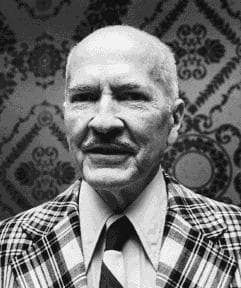
Robert Anson Heinlein was an American science fiction author, aeronautical engineer, and naval officer. Sometimes called the "dean of science fiction writers", he was among the first to emphasize scientific accuracy in his fiction, and was thus a pioneer of the subgenre of hard science fiction. His published works, both fiction and non-fiction, express admiration for competence and emphasize the value of critical thinking. His plots often posed provocative situations which challenged conventional social mores. His work continues to have an influence on the science-fiction genre, and on modern culture more generally.







