“Every night she falls asleep to the sound of it, and every morning she wakes to it. It is the most beautiful sound she has ever heard.”
— Marie-Laure listening to her great-uncle's radio.


Anthony Doerr (2014)
Genre
Historical Fiction
Reading Time
10-12 hours
Key Themes
See below
Sign in to track this book
During World War II, a blind French girl guarding a rare diamond and a German orphan skilled in radio technology find their lives connected as they search for humanity amidst the war's destruction.
Marie-Laure LeBlanc lives in Paris with her father, Daniel LeBlanc, a locksmith for the Museum National d'Histoire Naturelle. At age six, she loses her sight. To help her move around their neighborhood and the museum, Daniel carefully builds a wooden model of their area, teaching her to learn the layout by touch. Marie-Laure develops a remarkable ability to understand the world through her other senses, especially touch and sound. She spends her days exploring the museum and listening to her father's stories, preparing for a life where her blindness will not limit her curiosity.
In the mining town of Zollverein, Germany, Werner Pfennig and his younger sister, Jutta, grow up in an orphanage. Their lives involve poverty and the constant presence of the mines. One day, Werner finds a broken shortwave radio. With a natural skill for mechanics, he fixes it, and the siblings begin listening to broadcasts from faraway places, including science talks and music. A specific French broadcast, with a kind voice explaining difficult subjects, fascinates Werner, sparking his talent for radio technology and a desire for knowledge beyond his difficult life.
As the Nazi invasion of France approaches in 1940, Daniel LeBlanc gets an important job from the museum. He must protect one of its most valuable items, the Sea of Flames diamond. This diamond is said to give immortality to its owner but bring bad luck to them and their loved ones. Unknown to him, three identical fake diamonds have also been made to confuse thieves. Daniel, with Marie-Laure, leaves Paris for Saint-Malo, where his great-uncle Etienne LeBlanc and his housekeeper Madame Manec live. Marie-Laure carries a small, heavy stone, not knowing what it is.
The German military notices Werner's skill with radios. Despite being young, he is recruited into Schulpforta, a strict Nazi academy for promising boys. There, he excels in radio technology and math, but he is disturbed by the Nazi teachings and the cruelty shown to weaker students, especially his friend Frederick. Werner's sense of right and wrong is tested as he is forced to be part of the harsh system, seeing beatings and the loss of humanity in his classmates, all while dealing with his own involvement and wish to survive.
Marie-Laure and Daniel arrive in Saint-Malo, finding safety with Etienne LeBlanc. Etienne is a veteran of World War I, shell-shocked and has lived as a recluse for decades, troubled by his brother's death and unable to leave his house. Madame Manec, Etienne's brave housekeeper, becomes an important connection to the outside world. Daniel continues to build a small model of Saint-Malo for Marie-Laure, letting her explore the city with her fingers. He also hides the real Sea of Flames diamond inside this model, a secret he keeps even from Marie-Laure, believing it to be safe there.
After the Germans arrest Daniel, Marie-Laure is left with Etienne and Madame Manec. Madame Manec, strongly against the Nazis, convinces Etienne to use his old radio equipment to broadcast coded messages for the French Resistance. Marie-Laure helps by remembering and writing down number codes as musical notes. After Madame Manec dies, Marie-Laure takes over her role in the resistance, leaving loaves of bread with hidden messages in a grotto. Etienne, overcoming his fear of open spaces, eventually begins broadcasting his deceased brother's science lectures, mixed with coded information, which many hear, including Werner.
The Wehrmacht uses Werner's skills. He is assigned to a special unit that finds illegal resistance radio broadcasts, often used to plan partisan activities. He and his team travel across Europe, using their advanced equipment to pinpoint the locations of hidden transmitters. Werner becomes better at his job, but his work makes him face the moral consequences of his actions, as he knows finding these radios leads to the capture, torture, and death of those using them. He struggles with his conscience, remembering his sister Jutta's warnings.
As the Allies move into France, Saint-Malo becomes a main target because of its important port. The city is bombed heavily, turning it into ruins. Marie-Laure is trapped in Etienne's house, using her model of the city to find her way through the destruction. Meanwhile, Werner's unit is sent to Saint-Malo to find the resistance broadcasters. Their bunker is destroyed during an Allied attack, trapping Werner and his team under the rubble. Werner, hurt and without food or water, manages to fix a small radio, picking up the familiar French broadcast from his childhood.
Sergeant Major Reinhold von Rumpel, a gemologist obsessed with finding the Sea of Flames diamond, tracks Marie-Laure to Etienne's house in Saint-Malo. He believes she has the real diamond and corners her, threatening her life. Werner, having escaped his collapsed bunker and found the source of the French broadcast at Etienne's house, arrives. Overcoming his fear, Werner shoots and kills von Rumpel, saving Marie-Laure. He then helps her escape the ruined house, finally meeting the girl whose voice he had heard on the radio.
Marie-Laure and Werner share a brief moment of connection. She shows him the hidden Sea of Flames diamond, and he understands its meaning. Before they part, Marie-Laure, following an instruction from her father, leaves the diamond in the grotto, a place she thinks is safe. American soldiers capture Werner and take him to a POW camp. Suffering from typhus and confused, he walks into a minefield and dies. The diamond stays hidden in the grotto for decades, a reminder of the lives it touched and the war it survived.
Years after the war, Jutta Pfennig, still affected by her brother's death, struggles with her past. She eventually dedicates her life to helping others and understanding the truth of the war. Marie-Laure, returning to Paris after the war, becomes a marine biologist, continuing her grandfather's work on shells. Decades later, Werner's old comrade, Volkheimer, finds Jutta and gives her Werner's belongings, including the miniature house from Saint-Malo that contains the diamond. Jutta finds Marie-Laure, and they connect over their shared memories of Werner.
In 2014, Marie-Laure, now an old woman, returns to Saint-Malo with her grandson, Michel. They visit the grotto where she left the Sea of Flames diamond. Michel finds the small, miniature house, and inside it, the diamond. Marie-Laure decides to return the Sea of Flames to the Museum National d'Histoire Naturelle in Paris, where it belongs. The diamond, having moved through many hands and seen much history, finally goes back to its original home, a symbol of survival, memory, and the lasting power of human connection.
The Protagonist
From a dependent child, Marie-Laure grows into an independent and courageous young woman who actively contributes to the resistance and finds her own path after the war.
The Protagonist
Werner is forced from an innocent, curious boy into a tool of the Nazi regime, but ultimately reclaims his humanity through an act of courage and self-sacrifice.
The Supporting
Daniel's journey is one of protection and sacrifice, ultimately separated from his daughter but leaving her with the tools and strength to survive.
The Supporting
From a questioning child, Jutta grows into a woman dedicated to truth and reconciliation, carrying the memory of her brother.
The Supporting
Etienne moves from a life of reclusive fear to one of quiet heroism, overcoming his trauma to aid the resistance and care for Marie-Laure.
The Supporting
Madame Manec is a steadfast figure of resistance and care, whose death leaves a void but inspires Marie-Laure to continue her work.
The Antagonist
Von Rumpel's character arc is a descent into increasing desperation and ruthlessness, culminating in his violent death.
The Supporting
Frederick's arc is one of tragic innocence, broken by the violence of the academy, serving as a stark warning to Werner.
The novel explores different forms of 'light' and 'sight,' both literally and symbolically. Marie-Laure, though blind, has a deep inner sight, seeing the world through touch, sound, and imagination, often 'seeing' more deeply than those with physical vision. Werner's ability to hear distant radio waves brings him 'light' in the form of knowledge and connection, helping him 'see' beyond his difficult reality. The title, 'All the Light We Cannot See,' refers to the electromagnetic spectrum of radio waves, but also to the unseen acts of kindness, courage, and human connection that continue even in the darkest times of war. This theme shows in Marie-Laure's ability to navigate Saint-Malo using her father's models, and Werner's interest in the French broadcasts.
““Open your eyes and see what you can with them before they close forever.””
The novel shows how war affects individuals and society, highlighting both the capacity for great cruelty and the lasting human spirit. Characters like Werner are forced to take part in cruel acts, tracking and eliminating perceived enemies, while trying to keep their own moral sense. The harsh training at Schulpforta removes individuality and empathy from the boys. In contrast, the acts of courage, kindness, and resistance by characters like Madame Manec, Etienne, and even Werner's final act of defiance, show the strength of the human spirit when faced with great difficulty. The kindness between Marie-Laure and Werner in their short meeting is an example of this theme.
““Is it right,” Jutta says, “to do something only because everyone else is doing it?””
Communication, especially through radio, is a main way to connect people across distances and differences. Werner and Jutta first connect to the outside world through illegal radio broadcasts. Later, Etienne and Marie-Laure use their radio to send resistance messages, creating a network of defiance. This technology, which can be used for both propaganda and freedom, physically brings Werner and Marie-Laure together. The shared experience of listening to the same French broadcast forms an unseen bond between them long before they meet, showing that even in isolation, people can be linked by shared experiences and common humanity.
““The air itself is a library, a radar, a map of what happened, what exists. Every sound, every whisper, every scream, it's all still in the air.””
The novel deals with fate and free will. The Sea of Flames diamond, with its legend of giving immortality but bringing bad luck, represents a strong outside force affecting lives. Characters often feel carried along by the war, their choices limited by circumstances. However, moments of individual action, such as Werner's choice to save Marie-Laure, or Marie-Laure's choice to return the diamond to the grotto, show that even in the worst situations, individuals can make choices that go against their expected paths. The paths of Marie-Laure and Werner, though seemingly meant to cross, are shaped by their personal decisions.
““All your life you wait for the right moment to do something, and then you realize you’ve been doing it all along.””
The novel stresses the importance of memory, both personal and shared, in understanding history and forming identity. Characters like Etienne are haunted by memories of past wars, while Marie-Laure uses her father's models to keep the memory of places. The story itself has alternating timelines, constantly moving between the war's immediate events and the distant past and future. This highlights how history is lived, remembered, and passed down. Objects, like the diamond and the miniature house, become vessels for memory, carrying the echoes of lives lived and choices made. Jutta and Marie-Laure's post-war thoughts show the lasting impact of historical events.
““Every day, the world is created. Every day, the world is destroyed. This is the rhythm of things.””
The story shifts between Marie-Laure and Werner's POVs and different years.
The novel is structured with short, alternating chapters that switch between Marie-Laure's and Werner's perspectives, and also jump between the besieged Saint-Malo in 1944 and earlier periods of their lives (1934, 1940, etc.). This device builds suspense by gradually revealing how their lives converge, while also providing rich backstory and context for their choices. It allows the reader to experience the war from both sides, fostering empathy for characters caught in the conflict and highlighting the parallel experiences of innocence lost.
A legendary, cursed diamond that drives much of the plot's external conflict.
The Sea of Flames is a large, fabled diamond believed to grant immortality to its owner but bring misfortune to anyone else connected to it. It serves as a powerful MacGuffin, driving the actions of characters like Daniel LeBlanc (who must protect it) and Reinhold von Rumpel (who obsessively hunts for it). Symbolically, it represents the corrupting influence of greed and superstition, but also the preciousness of life and the burdens of fate. Its hiding place within Marie-Laure's miniature house links it directly to her personal journey.
Daniel's wooden models of cities, used by Marie-Laure for navigation and hiding.
Daniel LeBlanc meticulously crafts detailed wooden models of Paris and Saint-Malo for his blind daughter, Marie-Laure. These models serve as crucial tools for her to 'see' and navigate her environment, empowering her independence. More profoundly, they become a symbol of her father's love and ingenuity. The Saint-Malo model also serves as a hiding place for the Sea of Flames diamond and, later, for the key to the grotto, making it a pivotal plot device that connects the personal with the historical and the tangible with the metaphorical.
Shortwave radio transmissions that connect characters and serve as plot catalysts.
Radio broadcasts are a central plot device, initially connecting Werner and Jutta to a wider world beyond their orphanage through scientific lectures and music. Later, Etienne uses his powerful transmitter for French Resistance broadcasts, which Werner's unit is tasked with finding. The familiar voice of the French professor, heard by both Werner and Marie-Laure, creates an invisible bond between them. Radio acts as a lifeline, a weapon, and a symbol of communication, hope, and the light of knowledge in the darkness of war, ultimately leading Werner to Marie-Laure.
“Every night she falls asleep to the sound of it, and every morning she wakes to it. It is the most beautiful sound she has ever heard.”
— Marie-Laure listening to her great-uncle's radio.
“Open your eyes and see what you can with them before they close forever.”
— Daniel LeBlanc, Marie-Laure's father, advising her.
“The sea is a living thing. And what a thing it is. It holds you. It embraces you. It drowns you.”
— Marie-Laure reflecting on the ocean.
“To shut your eyes is to guess nothing of the darkness. You must open your eyes and see what you can with them.”
— Marie-Laure's father teaching her to navigate without sight.
“Is it right to hold on to something that's only going to bring you pain?”
— Werner pondering his choices and the consequences.
“The brain is a forest, and the soul is a forest. We lose ourselves in them.”
— Dr. Hauptmann speaking to Werner about the complexity of the mind.
“Don't you want to be alive before you die?”
— Jutta asking Werner about his aspirations beyond the mining town.
“The world is full of things that can kill you.”
— A common understanding during wartime.
“All your life you wait for the right moment to do something great. But the right moment never comes.”
— Reflecting on the nature of opportunity and inaction.
“What the war did to dreamers. It made them realists.”
— A general observation about the impact of war on individuals.
“Sometimes the best way to survive is to be useful.”
— Werner understanding his role in the German military.
“Light. It is the most beautiful sound she has ever heard.”
— Marie-Laure, blind, connecting the concept of light to her auditory world.
“The smallest things, they are the ones that save us.”
— Reflecting on the significance of small acts of kindness or beauty in difficult times.
“Our lives are but a blink in the great history of the world.”
— A broader philosophical reflection on human existence.
Ready to see how well you understood this book? Take our interactive quiz with 10 questions.
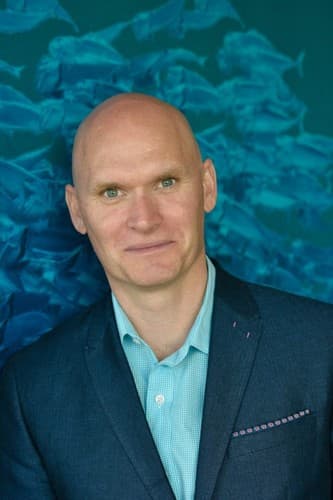
Anthony Doerr is a Pulitzer Prize-winning author celebrated for his evocative prose and compelling storytelling. His novel "All the Light We Cannot See" earned him widespread acclaim, including the Pulitzer Prize for Fiction. Doerr's other notable works include "The Shell Collector" and "Memory Wall," showcasing his mastery of historical fiction and intricate character development.







