“Love isn't something you can just turn off. It's like breathing.”
— Carrie reflects on her feelings for Mark, despite their complicated situation.

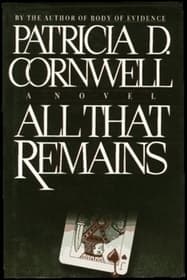
Patricia Cornwell (1992)
Genre
Young Adult / Romance
Reading Time
750 min
Key Themes
See below
Sign in to track this book
Young lovers disappear and reappear as mutilated bodies in Richmond. Forensic pathologist Kay Scarpetta races to connect present horrors to a past killer before the President's daughter becomes the next victim.
Dr. Kay Scarpetta, Chief Medical Examiner of Virginia, is called to a scene where the remains of two young lovers, Deborah and Fred, have been found after being missing for months. This is the fourth such double murder in Richmond in two years. The bodies are badly decomposed and dismembered. Shortly after, the daughter of the President's new drug czar, Jill Harrington, and her boyfriend, Alexander Manchester, disappear from a secluded spot near the James River. This high-profile disappearance brings in the FBI, in the form of Special Agent Benton Wesley, which initially annoys Kay due to their different methods.
Kay and her assistant, Dr. Pete Marino, carefully examine Deborah and Fred's remains. Kay notes the precise, surgical dismemberment and the lack of trace evidence, pointing to an organized killer. She also finds evidence of sexual assault on the female victims. Benton Wesley, however, believes a satanic cult or thrill-killers are responsible, due to the ritualistic disposal of the bodies. Kay finds this assumption premature and focuses on forensic evidence, believing the meticulousness points to a single, intelligent perpetrator.
Jill Harrington and Alexander Manchester's disappearance becomes a national priority. Governor Harvey, Jill's father, arrives in Richmond with his wife, adding political pressure to the investigation. Kay feels the strain as the FBI's presence grows, and the media focuses on the story. She continues her forensic work, hoping to find a link between the previous victims and the missing Jill and Alexander, but the lack of evidence at the disappearance site is frustrating.
Kay uses forensic entomology, studying insects on the decomposed remains, to determine the approximate time of death and how long the bodies were exposed before being moved or buried. This advanced technique provides important information that contradicts some of the FBI's earlier timeline assumptions. She also finds subtle tool marks on the bones, suggesting the killer uses specialized instruments. This discovery confirms her belief in a single, skilled perpetrator who takes extreme measures to hide their tracks.
As the investigation continues, Benton Wesley finds a very similar, unsolved double murder from years earlier in Florida, a case Kay had worked on. The details—young lovers, dismemberment, lack of evidence—are consistent. This discovery disturbs Kay, as it suggests the killer has a long history and has been operating undetected for years, possibly following her career. Re-examining this cold case opens new investigation paths and creates a personal connection for Kay.
Through careful analysis of tool marks on the bones and a review of surgical instruments, Kay and Marino begin to suspect a medical professional. The Florida connection leads them to Dr. Steven Donatella, a brilliant but troubled former intern of Kay's from her time in Florida. Donatella had a fascination with anatomy and a history of erratic behavior. Kay remembers his ability to disarticulate bones precisely. The possibility that someone she once mentored could be responsible for these crimes is chilling for Kay.
Kay concludes that the killer targets young, attractive couples in secluded areas, abducts them, holds them captive, tortures them, sexually assaults the women, then dismembers their bodies. The killer's precision and complete lack of forensic evidence suggest a highly intelligent, organized individual with medical knowledge and access to specialized tools. Kay believes the killer enjoys not just the act, but the challenge of avoiding capture, almost playing a game with law enforcement. The psychological profile points to a psychopath with deep issues.
Kay, along with Benton Wesley and Pete Marino, tracks Dr. Steven Donatella to a remote cabin in the woods, where they believe he is holding Jill Harrington and Alexander Manchester. A tense confrontation occurs. Donatella, showing his psychopathic tendencies and a twisted admiration for Kay, taunts them with knowledge of his crimes. He has booby-trapped the cabin, creating a dangerous environment. Kay, using her forensic instincts and quick thinking, tries to outmaneuver him and save the victims, who are still alive but badly injured.
Jill Harrington and Alexander Manchester are rescued, though severely traumatized and injured. Dr. Steven Donatella is killed in the struggle, ending his crimes. However, the experience leaves a deep mark on Kay. The realization that she had once worked with such a monster, and that he had followed her career, shakes her sense of security and professional detachment. The case shows the dark side of human nature and the psychological burden of being a medical examiner, even as it strengthens her dedication to justice.
Afterward, Kay reflects on the personal cost of her work. The case, with its high-profile victims and the personal connection to the killer, pushes her to her limits. She struggles with the psychological impact of witnessing such depravity and the constant pressure of her job. Her relationship with Benton Wesley, though initially difficult, develops into mutual respect. She reaffirms her commitment to forensic science, understanding that it is the only way to give a voice to victims and bring their killers to justice.
The Protagonist
Kay initially resists FBI interference but learns to collaborate, ultimately confronting a past professional connection who becomes a serial killer, forcing her to reconcile her past and present.
The Supporting
Benton learns to appreciate Kay's forensic methods while providing the broader investigative context, forming a strong partnership.
The Supporting
Marino remains a steadfast and reliable presence for Kay, his loyalty and practical skills proving invaluable.
The Antagonist
Donatella is revealed as the killer, his past connection to Kay surfacing as he continues his spree, leading to his eventual confrontation and death.
The Mentioned
Jill is a victim whose disappearance is the primary catalyst for the heightened stakes of the investigation.
The Mentioned
Governor Harvey's role is to amplify the political pressure on the investigation.
The Mentioned
Lucy is primarily a background presence, a reminder of Kay's family and a potential future asset.
The novel explores the nature of psychopathy through Dr. Steven Donatella. His careful planning, lack of empathy, and ability to fit into society show how dangerous such individuals are. The theme emphasizes that evil can appear intelligent and normal, making it hard to detect until it is too late. Kay's struggle to understand Donatella, a former mentee, highlights the unsettling fact that even those trained to heal can harbor deep darkness, as seen in his precise dismemberment.
“Evil, Kay thought, was not an abstract concept but a tangible, suffocating presence that could corrupt the most brilliant minds.”
This theme shows the psychological and emotional toll on forensic professionals like Kay Scarpetta. Despite her dedication, Kay deals with the horrors she sees and the pressure to bring justice to victims. The detailed descriptions of autopsies and decomposition highlight the gruesome reality of her job. The pursuit of justice is not just a professional duty but a personal mission for Kay, often leading to isolation and internal conflict, especially when the killer has a personal connection, forcing her to confront humanity's dark side daily.
“The dead speak to me, Kay often said, but sometimes their voices were a cacophony of pain she could barely endure.”
The novel shows how scientific methods and intuition work together to solve complex crimes. Kay Scarpetta represents a commitment to forensic science—facts, microscopic evidence, biological truths. Benton Wesley, the FBI profiler, uses a psychological approach, looking for patterns in behavior and motive. The story demonstrates that while science provides proof, intuition and profiling can guide investigators to apply science, requiring both for true breakthroughs, as seen in Kay and Benton's collaboration.
“Facts are stubborn things, Kay believed, but sometimes the most stubborn facts were those that resided in the dark corners of the human mind.”
This theme is central to the plot, as the current Richmond murders are linked to an unsolved case from Kay's past in Florida. The reappearance of a killer she once knew, whose methods she had studied years ago, blurs the lines between her past professional life and her current investigation. This connection adds a personal dimension to Kay's pursuit of justice, forcing her to confront her own history and the possibility that she might have missed clues long ago. The killer's long history shows that unresolved darkness can resurface with devastating consequences.
“Sometimes the shadows of the past were not just memories, but tangible presences, waiting to strike again.”
Misleading clues or suspects to divert attention.
Early in the investigation, the FBI, particularly Benton Wesley, initially pushes the theory of a satanic cult or a group of thrill-killers due to the ritualistic nature of the body disposals. This theory serves as a red herring, diverting attention from the meticulous, individualistic nature of the killer's work. Kay Scarpetta's skepticism and reliance on forensic evidence eventually steer the investigation away from this initial, plausible but incorrect, hypothesis.
Meticulous scientific procedures drive the plot and reveal the killer.
The novel heavily relies on Kay Scarpetta's detailed forensic analysis to advance the plot. Rather than traditional detective work, it's the examination of insect evidence, tool marks on bones, and decomposition rates that provide crucial breakthroughs. These scientific revelations not only offer clues about the killer's identity and methods but also build suspense and showcase Kay's brilliance, making the seemingly dry science a compelling narrative force.
The killer is a former acquaintance, heightening the stakes.
The revelation that Dr. Steven Donatella, the serial killer, was once Kay Scarpetta's medical intern in Florida serves as a powerful plot device. This personal connection significantly elevates the emotional and psychological stakes for Kay. It not only makes the killer's pursuit more urgent but also forces Kay to confront her own past and the unsettling reality that she once mentored a psychopath, adding a layer of guilt and personal responsibility to her professional duty.
The disappearance of a politically connected individual increases pressure.
The abduction of Jill Harrington, the daughter of the President's new drug czar, serves as a critical plot device. Her high-profile status immediately escalates the case to national importance, bringing in the FBI and intensifying political and media pressure on Kay and the investigative team. This device compresses the timeline, forces faster action, and highlights the immense scrutiny under which forensic work and law enforcement operate, adding urgency and external conflict to the narrative.
“Love isn't something you can just turn off. It's like breathing.”
— Carrie reflects on her feelings for Mark, despite their complicated situation.
“Sometimes the hardest battles are the ones we fight inside ourselves.”
— Mark struggles with his past and his fear of commitment.
“A secret shared is no longer a secret, but a burden halved.”
— Carrie confides in her best friend about a difficult situation.
“The future isn't written in stone; it's written in the choices we make today.”
— A character contemplates the impact of their current decisions.
“You can't outrun your past, but you can learn to live with it.”
— Mark grapples with the lingering effects of past trauma.
“Hope is a fragile thing, but it's often all we have left.”
— Carrie tries to remain optimistic during a challenging period.
“Sometimes, the strongest people are the ones who aren't afraid to ask for help.”
— A character overcomes pride to seek support from others.
“True love isn't about perfection; it's about accepting imperfections.”
— Carrie and Mark learn to appreciate each other's flaws.
“The greatest adventures often begin with a single, brave step.”
— A character decides to take a risk and pursue a dream.
“Forgiveness isn't just for the other person; it's for yourself too.”
— A character learns to let go of resentment and find peace.
“Sometimes goodbye isn't forever, it's just a promise to meet again.”
— Carrie and Mark face a temporary separation.
“You don't truly know someone until you've seen them at their worst.”
— A character witnesses another's vulnerability during a crisis.
“The most beautiful melodies are often born from the deepest silences.”
— A character finds inspiration and clarity in moments of solitude.
“Hearts can mend, but the scars will always tell a story.”
— Carrie reflects on past emotional wounds and their lasting impact.
Ready to see how well you understood this book? Take our interactive quiz with 10 questions.

Biography coming soon.