“I will change the past. I will save you.”
— Marina's internal monologue, driven by her mission to alter the past to save someone she loves.

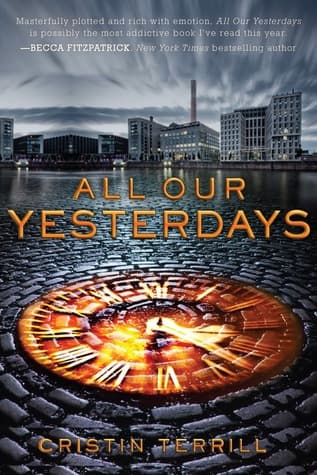
Cristin Terrill (2013)
Genre
Thriller / Fantasy / Science Fiction / Young Adult / Romance
Reading Time
360 min
Key Themes
See below
Sign in to track this book
Imprisoned and tortured for a future crime, a girl must travel back in time to murder the boy she loves to prevent a world-ending tragedy, guided only by cryptic notes from her future self.
Em wakes up in a stark, cold cell, disoriented and alone. She can hear Finn, a boy she knows, in an adjacent cell, his pain a constant reminder of their shared predicament. They are being interrogated by 'The Doctor,' who seeks information about events that, to Em, haven't happened yet. The present is a relentless cycle of questioning and deprivation. Em's memory is fragmented, but she knows she loves Finn. One day, she discovers a small, folded note hidden in her cell. It's from her future self and contains cryptic, urgent instructions: 'You have to go back. You have to kill him.' This note shatters her understanding of their situation and hints at a far more complex, time-bending reality.
Following the note's instructions, Em experiences a disorienting temporal shift, finding herself in a past version of her body. She is in an asylum, a place she vaguely remembers. Here, she meets a younger, unscarred Finn and a girl named Charlie, who is also a 'traveler' from the future. Charlie helps Em understand her new reality: they are part of 'Project Tempest,' a covert operation using time travel to prevent a catastrophic future. Em learns that her current mission is to locate and kill the younger version of James, a brilliant but dangerously unstable scientist, before he can initiate the events that lead to their dystopian present. Em struggles with the concept of killing James, whom she once considered a friend.
Charlie becomes Em's reluctant mentor, teaching her the intricacies and dangers of time travel, including the 'ripple effect' and the importance of not altering history unnecessarily. Em learns that she can 'jump' into her past selves, reliving moments and making different choices. Their primary target is James, the young genius, who is currently attending a prestigious university. Em and Charlie formulate a plan to get close to him. Em is plagued by guilt and internal conflict, as the James she remembers from her past was not inherently evil, but rather a brilliant, albeit troubled, boy. She questions the morality of their mission and whether killing him is truly the only way to save the future, or if there's another path.
Em and Charlie successfully enroll at the university James attends, posing as new students. Em’s mission is to observe James, understand his motivations, and ultimately, eliminate him. However, as she gets closer to the younger James, she finds herself drawn to his intelligence and his earnest, albeit socially awkward, personality. She sees glimpses of the kind boy she knew before the 'Doctor' persona consumed him. This rekindled connection makes her mission increasingly difficult, as the lines between her past affections and her future directive blur. Charlie remains pragmatic, constantly reminding Em of the stakes and the horrific future they are trying to prevent, but Em struggles to reconcile the two versions of James.
Em's presence and interactions in the past begin to subtly alter the timeline, creating minor paradoxes and inconsistencies. Her emotional turmoil over James is exacerbated by the unexpected arrival of a younger Finn in the past. This Finn is not the tortured prisoner she knows but a carefree, charming boy who quickly becomes integral to their small group. His appearance creates a dangerous love triangle and further complicates Em's loyalties and mission. She struggles to maintain her focus, torn between her duty to the future, her growing feelings for the present Finn, and her lingering affection for James. Charlie becomes increasingly frustrated with Em's wavering resolve.
As Em and Finn grow closer, James begins to display unsettling traits that hint at his future transformation into 'The Doctor.' He becomes possessive of Em, showing flashes of his manipulative genius and a desire for control. During this time, a member of Project Tempest, who Em and Charlie thought they could trust, betrays them, providing crucial information to James. This betrayal jeopardizes their mission and forces Em to confront the harsh reality that James is indeed on a path to becoming the monster they need to stop. The stakes escalate, and Em realizes the window for action is closing rapidly, forcing her to consider more drastic measures.
Em, realizing she can no longer delay, confronts James. The confrontation is emotionally charged, as Em tries to reason with him, hoping to steer him away from his destructive path. However, James's paranoia and nascent megalomania are too strong. The encounter turns violent, forcing Em, Finn, and Charlie to flee. This event solidifies James's transformation into 'The Doctor' in Em's eyes, hardening her resolve. They are now fugitives, hunted by James and his burgeoning organization, making their mission to stop him even more perilous. The escape is fraught with danger, and they barely make it out alive, cementing their desperate situation.
As they continue their mission, Em's love for Finn deepens, creating an unbearable paradox. The note from her future self had instructed her to kill 'him,' which she initially assumed was James. However, new information and her growing understanding of the timeline suggest a horrifying possibility: the 'him' she must kill might actually be Finn. This realization is devastating, forcing Em to choose between the boy she loves and the salvation of humanity. She grapples with the ultimate sacrifice, questioning whether she has the strength to commit such an act, even if it means preventing the dystopian future she's fighting against. Her internal conflict is at its peak.
Em, Finn, and Charlie track James to his new base of operations, where he is close to perfecting his time-travel technology, the very device that will lead to the dystopian future. A climactic battle ensues, filled with temporal distortions and high stakes. Em confronts James one last time, recognizing the monstrous 'Doctor' fully formed. In the chaos, Em is forced to make the ultimate sacrifice. She realizes that to truly sever the thread that leads to the future, she must kill Finn, not James, as Finn's death is the catalyst for James's descent into villainy. With a broken heart, she fulfills her mission, ensuring a different timeline, and then experiences a final, painful jump.
Em wakes up in a new, altered future, one where Project Tempest never existed, and the dystopian world has been averted. The world is peaceful, and the 'Doctor' is merely a historical footnote, a brilliant scientist who died young. She meets a version of Finn who is alive and well, but who has no memory of their shared past or the love they once shared. Em carries the full weight of her memories and her sacrifice alone. She lives in a world she saved, but at the cost of her love and her own innocence. She is a hero, but a solitary one, forever haunted by the choices she made and the life she had to take to create this better, yet bittersweet, present.
The Protagonist
Em transforms from a confused prisoner to a determined, albeit heartbroken, savior, accepting the tragic necessity of her mission.
The Love Interest / Tragic Figure
Finn remains a constant source of love and support for Em, ultimately becoming the tragic victim necessary to save the future.
The Antagonist
James transforms from an awkward genius into a manipulative, power-hungry villain, 'The Doctor,' whose actions necessitate Em's intervention.
The Supporting
Charlie remains steadfast in her mission, providing guidance and support to Em, even as Em's emotional attachments threaten their goals.
The Supporting/Catalyst
Future Em acts as the unseen architect of the past, guiding her younger self towards a necessary, painful outcome.
The novel explores the ethical dilemmas of sacrificing one life for the greater good. Em grapples with killing a younger, seemingly innocent James, and later, the devastating realization that she must kill Finn, the boy she loves, to prevent a dystopian future. This theme is central to her internal conflict, as she questions whether the ends justify such brutal means, and what it costs a person to make such a choice. The story forces both Em and the reader to confront the weight of these decisions.
“You have to go back. You have to kill him.”
Em is torn between her deep love for Finn and her duty to save humanity from The Doctor's tyranny. Her emotional attachments conflict with the cold, hard logic of her mission. This struggle is highlighted by her initial reluctance to kill James, and later, the agonizing choice she faces when she realizes Finn might be the true target. The novel suggests that while love can be a powerful motivator, it can also be a dangerous distraction, forcing Em to make an impossible choice that shatters her heart but ultimately saves the world.
“How could she kill the boy she loved, even if it meant saving everything else?”
Time travel in the novel creates a complex interplay with identity and memory. Em 'jumps' into her past selves, reliving moments and making new choices, which subtly alters her own history and memories. She struggles with fragmented recollections and the weight of knowing multiple timelines. The question of who she truly is, given her altered pasts and future knowledge, becomes a significant internal challenge. The novel explores how much of one's identity is tied to their experiences and how difficult it is to reconcile different versions of oneself.
“Every jump changed her, erased a piece of the Em she used to be.”
The novel illustrates the 'ripple effect' in time travel. Even minor alterations in the past can have unforeseen and significant consequences for the future. Em's interactions, particularly her relationship with Finn, inadvertently change the timeline, sometimes for the worse, highlighting the delicate balance of causality. This theme shows the immense responsibility of the time travelers and the dangers of meddling with history, showing how even noble intentions can lead to unexpected and tragic outcomes.
“One wrong move, one misplaced word, and the future could unravel in a thousand different ways.”
The primary method of altering the past, allowing characters to inhabit their past selves.
Characters like Em and Charlie possess the ability to 'jump' into their past bodies at specific moments. This isn't a physical journey but a mental one, where their consciousness inhabits a younger version of themselves, allowing them to relive and potentially alter events. This device is crucial for the plot, enabling Em's mission to prevent the dystopian future. It also introduces complexities regarding memory, identity, and the ripple effect, as characters must navigate their own pasts with future knowledge.
A cryptic message from the future that initiates Em's mission.
The note found by Em in her cell, written by her future self, serves as the initial inciting incident. Its vague but urgent instructions ('You have to go back. You have to kill him.') create immediate suspense and mystery, driving Em's actions and the reader's curiosity. The ambiguity of 'him' is a central mystery that evolves throughout the story, leading to the ultimate heartbreaking twist. This device effectively sets the high stakes and the personal cost of the mission from the very beginning.
The consequence of altering the past, where small changes lead to unpredictable future outcomes.
This device highlights the inherent dangers and complexities of time travel. Every action Em takes in the past, no matter how small, has consequences that subtly (or dramatically) alter the future. This creates a sense of constant tension and uncertainty, as characters must weigh their choices carefully. It also introduces paradoxes, such as Em's own existence being tied to the future she's trying to prevent, making the narrative a compelling exploration of causality and destiny.
The framing device of Em and Finn's imprisonment, revealing information in fragments.
The story begins and periodically returns to Em and Finn's imprisonment and interrogation by 'The Doctor' in the dystopian future. This serves as a powerful framing device, creating a sense of urgency and mystery. The Doctor's questions about events that haven't happened yet to Em provide tantalizing hints about the future and the stakes involved. This narrative structure keeps the reader disoriented, mirroring Em's confusion, and gradually reveals the full horror of the future they are fighting against.
“I will change the past. I will save you.”
— Marina's internal monologue, driven by her mission to alter the past to save someone she loves.
“The future isn't fixed. It's a million possibilities, and we choose which one to step into.”
— A reflection on the nature of time and destiny, central to the time-travel narrative.
“Sometimes, the only way to save someone is to let them go.”
— A poignant realization about the complexities of love and sacrifice in dire circumstances.
“Every choice we make ripples through time, affecting everything that comes after.”
— Emphasizing the butterfly effect and the consequences of altering the past.
“Memory is a funny thing. It can be a weapon, or a shield, or a prison.”
— Reflecting on the unreliable and powerful nature of memory, especially for someone experiencing fragmented recollections.
“You can't outrun your past, but you can choose how you face it.”
— A theme of confronting one's history and taking responsibility for actions.
“Love isn't about finding the perfect person, it's about seeing an imperfect person perfectly.”
— A romantic sentiment expressed amidst the chaos and danger of their situation.
“The greatest prison is the one we build for ourselves inside our own minds.”
— Exploring themes of mental confinement and the struggle for freedom.
“Even a broken clock is right twice a day. Even a lost cause can have its moments of triumph.”
— A hopeful and resilient outlook, even in the face of overwhelming odds.
“Sometimes, the hardest thing to do is forgive yourself.”
— A character grappling with guilt and the need for self-forgiveness.
“The past is a stubborn thing. It doesn't want to be changed.”
— Highlighting the inherent difficulties and dangers of altering historical events.
“We're all just trying to make sense of the chaos, to find our place in the storm.”
— A philosophical reflection on the human condition amidst turbulent circumstances.
“What if saving one person means dooming another? How do you choose?”
— A moral dilemma faced by the protagonist regarding the ethical implications of time travel.
“There's a difference between living and just existing.”
— A realization about the importance of truly experiencing life, not just enduring it.
Ready to see how well you understood this book? Take our interactive quiz with 10 questions.







