
Biography coming soon.
Archivist's Choice
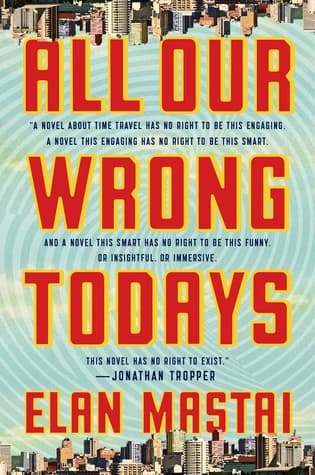
All Our Wrong Todays
Elan Mastai (2017)
Genre
Fantasy / Science Fiction
Reading Time
12 Minutes
Key Themes
See below
Track Your Reading
Sign in to track this book
A man from a utopian future accidentally travels to our present, forcing him to choose between restoring his perfect world or embracing the messy beauty of our reality.
Synopsis
Tom Barren lives in a utopian 2016, a future imagined by 1950s optimists, complete with flying cars and moon bases. Despite this perfect world, Tom feels out of place. After a catastrophic accident involving his father's time machine, Tom inadvertently travels to our 2016 – a reality he perceives as a dystopian wasteland. Stranded and struggling to adapt, he discovers a different, yet unexpectedly fulfilling, life with alternate versions of his family, career, and even a potential soulmate. Tom is faced with an impossible choice: use his knowledge to restore his original utopian timeline, or embrace this new, imperfect reality that, paradoxically, offers him a chance at true belonging and self-discovery. His journey becomes a quest across timelines to define his own identity and ideal future.
Difficulty
Medium
Pacing
Moderate
Mood
Witty, reflective, hopeful, charming, slightly melancholic
Plot Summary
The Perfect World
Tom Barren lives in a utopian 2016, a retro-futuristic world. The Go-Forward machine, invented by Lionel Barren in 1965, ended scarcity and disease. Humanity has flying cars, moon colonies, and a positive outlook, free from war. Tom, however, feels like a failure, always overshadowed by his brilliant father, Lionel. He struggles with his job as a 'temporal tour guide' at the Chronosync agency. He is awkward and unconfident, wanting a connection, especially with Penelope, a co-worker who barely notices him. His father's latest project is a perfected time machine. Tom, despite his usual clumsiness, is chosen to be the first person to make a short temporal jump.
The Temporal Anomaly
During the first time-travel experiment, Tom is supposed to observe the past for a few minutes. However, a series of mishaps occurs. Penelope, his crush, unexpectedly appears in the time machine, revealing she is assigned to monitor him. Distracted by her and his own awkwardness, Tom accidentally activates the machine's emergency return sequence too soon. This error, along with a sudden power surge, causes a major malfunction. Instead of a simple jump and return, reality tears apart. Tom finds himself not back in his utopian 2016, but in a drastically different, seemingly worse version of the same year. Penelope is gone, and his future has vanished.
A World Without Utopia
Tom wakes up confused in a hospital in what he quickly realizes is our 2016. To him, this world is a bleak, backward place: no flying cars, no moving sidewalks, no moon bases, just traffic, pollution, and social unrest. He learns that the Go-Forward machine was never invented, and his father, Lionel, died in a car accident in 1965, never making his scientific breakthroughs. Tom is now a different person in this reality, an unremarkable, middle-aged architect with no memory of his past life. He struggles to accept this harsh new reality, feeling a deep sense of loss.
The Journal and the Truth
While living his new life, Tom discovers a hidden journal in his apartment. This journal, written by his 'original' self from the utopian timeline, details the events leading up to the time-travel experiment and the subsequent change in history. It reveals that Tom's accidental action prevented his father, Lionel, from inventing the Go-Forward machine. The journal also contains his father's detailed plans and calculations for the machine, giving Tom a small hope that he might be able to fix his mistake and restore his original timeline. He becomes focused on 'fixing' history.
Meeting Penelope (Again)
In this new 2016, Tom meets a woman named Penelope. She is not the same Penelope from his utopian world but a cynical, intelligent, and practical woman who works at a local library. Despite their different personalities and backgrounds, Tom is instantly drawn to her. He struggles with seeing a familiar face in a changed world, balancing his wish to restore his past with his growing feelings for this new Penelope. Their interactions are marked by Tom's awkwardness and Penelope's sharp humor, slowly building a connection that challenges Tom's sole focus on returning home.
The Quest for the Go-Forward
Following the journal's instructions and wanting to return to his original timeline, Tom begins a secret mission to recreate his father's Go-Forward machine. He uses his architectural skills to find a hidden workshop and starts assembling the complex parts. This effort pushes him to learn and grow, past his previous self-perceived limits. He faces many setbacks, showing his initial inexperience but also his growing resolve. His efforts are made more difficult by the need to keep his true identity and mission a secret from everyone, especially Penelope.
Building a Life in the 'Wrong' World
Despite his main goal of correcting the timeline, Tom unintentionally starts building a life in this 'wrong' 2016. He makes real friends, finds purpose in his architectural work, and deepens his relationship with Penelope. He discovers a version of his family – his mother and brother – who are different but loving. He begins to appreciate the complexities and flaws of this reality, finding beauty and meaning in its struggles and human connections. This growing attachment creates an internal conflict, as he questions whether restoring his old world is truly what he wants anymore, or if he has found a different kind of home.
The Reveal and the Dilemma
As Tom gets closer to finishing the Go-Forward machine, Penelope discovers his secret. She finds his journal and the partially built device, confronting him with the truth about his origins and his plan to erase their shared reality. This discovery causes a deep crisis in their relationship. Penelope is hurt and feels betrayed, struggling to understand how the man she loves could consider undoing their entire existence. Tom is forced to face the moral and emotional consequences of his actions, torn between his original mission and his love for Penelope and the life he has built with her.
The Choice and the Consequence
Faced with the completed Go-Forward machine and Penelope's heartbroken plea, Tom must make an impossible choice: activate the machine and return to his utopian past, erasing this current timeline and his relationship with Penelope, or destroy the machine and commit to this imperfect but meaningful present. He struggles with the weight of both decisions, knowing that either path means a deep loss. The choice is not just about which world to live in, but about which version of himself he wants to be, and what truly makes a 'perfect' life. He realizes the utopia was perfect, but he wasn't.
A New Beginning, A New Ending
Tom ultimately chooses to stay in our 2016, destroying the Go-Forward machine. This decision shows his acceptance of imperfection, his love for Penelope, and his new appreciation for the messy, unpredictable beauty of this reality. He embraces his life as an architect, his relationships, and the challenges that come with them. The novel ends with Tom reflecting on happiness and the idea that true fulfillment comes not from a perfect world, but from embracing the present and the people in it. He understands that while he lost a utopia, he gained a more authentic and personal future.
Principal Figures
Tom Barren
The Protagonist
Tom transforms from an insecure, dependent individual seeking to undo his past into a self-aware man who embraces imperfection and finds genuine happiness in a 'flawed' reality.
Penelope (our 2016)
The Supporting
She initially views Tom as an odd but charming individual, evolving to a loving partner who must grapple with the revelation of his true origins and the potential erasure of her own existence.
Lionel Barren (utopian)
The Supporting
His character arc is primarily pre-established before the story, as his invention shapes the utopian world and his absence defines our 2016. He serves as a catalyst for Tom's journey.
Penelope (utopian)
The Supporting
Her brief appearance triggers the inciting incident, and her absence drives Tom's initial desire to restore his original timeline.
Barry Barren (our 2016)
The Supporting
He serves as a consistent, if sometimes challenging, familial anchor for Tom in the 'wrong' timeline, helping Tom connect with his new identity.
Mrs. Barren (our 2016)
The Supporting
She provides emotional support and a sense of belonging for Tom in the new timeline, helping him to heal and find a new family.
The Narrator
The Narrator
The narrator's voice evolves from a nostalgic longing for a lost utopia to a profound acceptance and celebration of the present, reflecting Tom's personal growth.
Themes & Insights
The Nature of Utopia vs. Reality
The novel explores what makes a 'perfect' world. Tom's original 2016 is a technological utopia, free from suffering, yet he feels unfulfilled. Our 2016, first seen as a bad place, offers challenges, flaws, and pain, but also deep love, personal growth, and real connection. The theme asks if true happiness is in an idealized, problem-free life or in embracing the messy, unpredictable richness of real life, with all its struggles and successes. It suggests that a perfect world might not be perfect for everyone, especially if it stops individual growth.
“Maybe the problem wasn't the world, maybe the problem was me. Maybe I was the wrong today for the right yesterday.”
Choice and Consequence
A central theme is how individual choices, both accidental and planned, affect personal lives and reality itself. Tom's initial accidental time-travel error changes history, causing many unforeseen effects. Later, his conscious decision to either restore the original timeline or accept the new one highlights the importance of moral and emotional choices. The theme shows that every decision, no matter how small, has consequences, and that taking responsibility for those consequences is key for personal maturity and shaping one's own future.
“Every choice, every moment, every tiny decision branches off into infinite possibilities. It's exhilarating and terrifying.”
Identity and Self-Acceptance
Tom's journey is one of self-discovery. In his utopian world, he struggles with feeling insufficient and lacking identity, always feeling like a 'screw-up'. Being thrown into a new reality where he is a different person forces him to confront who he is, apart from his father's legacy or what society expects. He learns to value his own strengths, accept his flaws, and ultimately define his own happiness and purpose. The theme suggests that true identity is not fixed but is shaped by experience, challenges, and the choices we make.
“I was learning that the past wasn't a place you could go back to, not really. It was a story you told yourself.”
Love Across Timelines
The novel explores the lasting power of love, especially through Tom's relationships with the two versions of Penelope. His initial unrequited crush in the utopian world contrasts with the deep, evolving love he develops for Penelope in our 2016. This theme asks if love is an innate connection between people or a result of shared experiences and circumstances. It suggests that while the specific individuals might differ across realities, the ability for deep connection and affection can go beyond changed histories, becoming a powerful force that grounds Tom to his chosen reality.
“Maybe love wasn't about finding the perfect person, but about seeing the imperfect person perfectly.”
Plot Devices & Literary Techniques
The Go-Forward Machine
The pivotal time-travel device
This is the central scientific invention, created by Lionel Barren in the utopian timeline. It is a complex time-travel device capable of shifting entire realities or sending individuals to the past. Its accidental misuse by Tom is the inciting incident that alters history, and its potential reconstruction becomes the primary goal for Tom to restore his original timeline. The machine serves as a physical manifestation of the choice Tom faces: to revert to a 'perfect' past or commit to an 'imperfect' present. It is both a symbol of utopian possibility and the catalyst for profound disruption.
Tom's Journal
A record of the original timeline and the plan to fix it
Discovered by Tom in our 2016, this journal was meticulously kept by his 'original' self from the utopian timeline before the temporal shift. It details the events leading up to the accident, his father's plans for the Go-Forward machine, and the steps needed to recreate it. The journal serves multiple purposes: it explains the timeline alteration, provides a blueprint for Tom's mission, and acts as a direct link to his past self. It is a constant reminder of what he lost and what he believes he needs to fix, driving much of the plot's early momentum and internal conflict.
Parallel Timelines/Multiverse
The existence of multiple realities
The novel operates on the premise of parallel timelines or a multiverse, where different choices and events lead to divergent realities. Tom's accidental action doesn't just change his past; it creates an entirely new, distinct timeline that continues to exist alongside his original. This device allows for the exploration of 'what if' scenarios and highlights the profound impact of a single point of divergence. It underpins the central conflict of the story, forcing Tom to choose between two equally real, yet vastly different, versions of existence, and questions the notion of a single 'correct' future.
Critical analysis
Notable Quotes
Quiz
Test Your Knowledge
Ready to see how well you understood this book? Take our interactive quiz with 10 questions.
10
Questions
~5
Minutes
?
Best Score
Key Questions (FAQ)
The book follows Tom Barren, who lives in a utopian 2016 imagined by 1950s futurists. He accidentally travels back to our 2016, which he perceives as a dystopia, and must decide whether to restore his timeline or embrace our reality.







