“If you are a tree, all your friends are dead.”
— The opening premise of the book, setting the tone for the various predicaments.

Avery Monsen (2010)
Genre
Children's
Reading Time
15 min
Key Themes
See below
Sign in to track this book
Explore the darkly humorous existential struggles of everything from dinosaurs to houseplants as they face the universal truth that all their friends eventually die.
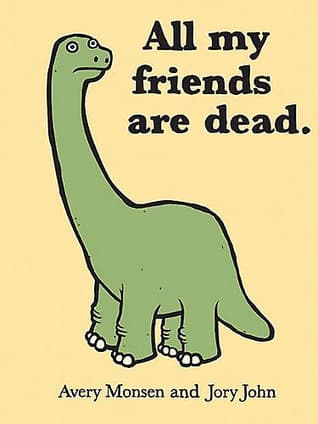
The book begins with a large, green dinosaur, looking sad. It states simply, "If you're a dinosaur, all of your friends are dead." This sets the sad yet funny tone for the book, immediately establishing the main idea: the loneliness or unavoidable death of one's companions, depending on the character. The dinosaur's situation is a direct, historical fact, making its statement a touching, if darkly funny, thought on death and time. The illustration shows the single dinosaur against a plain background, highlighting its solitude in a post-extinction world.
After the dinosaur, a rough-looking pirate with an eye patch and a peg leg appears, sharing his own problem: "If you're a pirate, all of your friends have scurvy." This scenario shifts from outright death to a chronic, disabling condition, offering a slightly different kind of bad luck. The humor here comes from the common yet historically accurate suffering of pirate life, contrasting the romanticized image with a dose of grim reality. The pirate's complaint shows the shared suffering within a specific group, where even if friends are not dead, they are certainly not well, adding a layer of collective misery.
A sturdy tree, with a few leaves, expresses its sorrow: "If you're a tree, all of your friends are end tables." This entry introduces the idea of friends turning into inanimate objects, a form of 'death' from the tree's view. The humor comes from the common, everyday items that were once living beings, making the reader think about the life cycle of natural resources from an unusual perspective. The tree's quiet acceptance of this fate emphasizes the theme of unavoidable change and loss, even if the 'friends' continue to exist in a different form, no longer able to offer companionship.
A green-skinned zombie, with empty eyes, offers its perspective: "If you're a zombie, all of your friends are brains." This entry plays on the zombie idea, where the act of 'making friends' (or rather, eating them) leads to their death. The humor comes from the contradiction of a creature that wants companionship but whose nature requires destroying potential friends. It is a darkly funny take on the challenges of forming relationships when your existence depends on consuming others, showing a unique form of existential loneliness.
A small potted houseplant, looking somewhat worried, shares its concern: "If you're a houseplant, all of your friends are being slowly killed by irresponsible plant owners (like you)." This breaks the fourth wall, directly accusing the reader and adding a meta-humorous layer. The houseplant's weakness and its friends' gradual death due to human neglect provide a relatable, if guilt-inducing, scenario. It shows the power dynamics in relationships and the helplessness of some beings in the face of others' actions, even if unintended, making a subtle jab at human responsibility.
A lone, striped sock, looking sad, states: "If you're a sock, all of your friends are missing." This entry touches on a universal, common frustration — the mystery of disappearing socks. The personification of the sock and its complaint turns a minor household annoyance into a touching tale of loss and separation. The humor comes from raising a trivial object's problem to an existential crisis, making the reader feel for the simple, everyday object and its unexplainable solitude, a common experience for many.
A clown, despite its cheerful clothes and painted smile, shows a deeper sadness: "If you're a clown, all of your friends are sad." This entry goes against the expectation of joy with clowns, showing the irony of their job. The clown's friends are not dead, but they are always unhappy, creating a shared emotional burden. This highlights the theme of empathy and the weight of others' sorrows, suggesting that even in jobs meant to bring happiness, one can be surrounded by a different kind of sadness, making true companionship hard.
A retro cassette tape, looking a bit dusty, declares: "If you're a cassette tape, all of your friends are obsolete." This entry touches on the theme of technological outdatedness and the feeling of being left behind. The cassette tape's friends are not physically gone but have become irrelevant in a fast-changing world. The humor is bittersweet, appealing to those who remember older technologies and the unavoidable march of progress, where usefulness defines value, and loss is a result of innovation. It is a comment on the short-lived nature of trends and the loneliness of the outdated.
A simple, boxy robot, with one eye, states: "If you're a robot, all of your friends are recharging." This entry presents a unique form of temporary separation and weakness. The robot's friends are not dead or outdated, but simply unavailable due to a basic need. The humor comes from the common yet essential need for robots, showing how even in a technologically advanced world, basic needs can dictate social interaction, leading to periods of unwanted solitude. It is a reminder that even in a digital age, connection can be interrupted by practical matters.
The book ends with a final, overall statement, often given by a generic, simple character or the narrator, that generalizes the previous examples into a universal truth. While not explicitly stated on a single page, the combined effect of the various characters' complaints leads to the implied conclusion that, in some way, everyone faces loss, change, or separation from their 'friends.' The humor remains dark but moves into a more profound, yet simple, thought on the human (or object) condition, leaving the reader with a thoughtful, slightly sad, and ultimately accepting view on life's unavoidable challenges.
The Protagonist
The dinosaur's arc is static, serving as an initial, foundational example of the book's core theme.
The Supporting
The pirate remains consistent in his lament, illustrating a facet of collective suffering.
The Supporting
The tree's character is a static representation of transformation and loss of original form.
The Supporting
The zombie's role is to illustrate an ironic and self-defeating form of loneliness.
The Supporting
The houseplant remains a static example of vulnerability and external threats to companionship.
The Supporting
The sock's character is a static symbol of everyday, unexplainable loss.
The Supporting
The clown serves as a static example of emotional burden and empathetic suffering.
The Supporting
The cassette tape's character is a static representation of obsolescence and the passage of time.
The Supporting
The robot serves as a static example of practical interruptions to companionship.
The main theme is the unavoidable nature of loss in its many forms. Whether it is the extinction of the dinosaur's friends, the transformation of the tree's companions into furniture, or the outdatedness of the cassette tape's peers, the book consistently shows that everything and everyone changes, disappears, or eventually dies. This theme is presented with a dark, yet funny, acceptance, suggesting that acceptance is the only choice. The book does not focus on sadness but points out the universal nature of impermanence, making it a shared, though sad, experience.
“If you're a dinosaur, all of your friends are dead.”
Directly from loss, the theme of loneliness is central. Each character, because of their specific problem, finds themselves isolated. The single sock looking for its missing partner, the zombie whose nature prevents lasting bonds, or the houseplant whose friends are systematically destroyed – all show different sides of being alone. The book highlights how various circumstances, from historical events to biological needs to human neglect, can lead to deep solitude. It suggests that, in some form, loneliness is a natural part of existence, often unavoidable.
“If you're a sock, all of your friends are missing.”
The book uses humor well to highlight the absurdity of life's problems. By giving human qualities to inanimate objects (like a sock or a cassette tape) and giving voice to the existential worries of creatures (like a zombie or a houseplant), it turns common or tragic realities into darkly funny observations. The humor often comes from the contrast of a character's simple, wide-eyed expression with the deep, often grim, nature of their 'friend's' fate. This theme encourages readers to find humor in life's unavoidable challenges, accepting that some situations are simply beyond control and best met with a wry smile.
“If you're a houseplant, all of your friends are being slowly killed by irresponsible plant owners (like you).”
Each page offers a unique view on suffering and loss, inviting the reader to feel for a diverse range of characters and their specific complaints. From the large scale of extinction (dinosaur) to the common annoyance of lost items (sock), the book expands the idea of 'friends being dead' to include various forms of separation, illness, transformation, and outdatedness. This encourages readers to consider different viewpoints and understand that 'loss' is not a single experience, fostering a broader sense of empathy for the diverse challenges faced by all beings, real or imagined.
“If you're a pirate, all of your friends have scurvy.”
Giving human qualities to non-human entities.
Personification is the central plot device, as every character in the book, whether an animal, object, or mythical creature, is given the ability to speak and express complex emotions, particularly sorrow and resignation. This device allows the authors to explore universal themes of loss and loneliness through a highly diverse and often absurd cast. By making a sock or a cassette tape lament its friends, the book makes abstract concepts relatable and humorous, creating empathy for unexpected 'characters' and highlighting the universality of their predicaments.
Using morbid or depressing themes for comedic effect.
Dark humor is fundamental to the book's tone. The core premise—that 'all my friends are dead' or similarly afflicted—is inherently grim, but the simple, matter-of-fact delivery and the often absurd scenarios (a tree mourning its friends as end tables) transform tragedy into comedy. This device allows the book to tackle heavy themes like death, obsolescence, and loneliness without becoming overly depressing. It encourages readers to laugh at the inevitable, providing a coping mechanism and a sense of shared, albeit morbid, understanding of life's difficulties.
Placing contrasting elements side-by-side for effect.
The book frequently uses juxtaposition to create its unique blend of humor and poignancy. This is evident in the contrast between the simple, childlike illustrations and the profound, often melancholic statements made by the characters. For instance, a cute, wide-eyed houseplant laments its friends being killed by its owner. The innocent visual style alongside the grim reality creates a comedic tension. Furthermore, the diverse types of 'loss' juxtaposed against each other (extinction vs. scurvy vs. being an end table) highlight the varied nature of suffering while unifying them under a single theme.
Directly addressing the audience.
While not constant, the book occasionally breaks the fourth wall, most notably with the houseplant character. When the houseplant states, "If you're a houseplant, all of your friends are being slowly killed by irresponsible plant owners (like you)," it directly addresses and implicates the reader. This device adds a layer of meta-humor and personal engagement, making the reader momentarily part of the narrative's world and its predicaments. It serves to draw the audience in more closely, making the abstract themes more immediate and relatable, and often generating a chuckle of recognition or guilt.
“If you are a tree, all your friends are dead.”
— The opening premise of the book, setting the tone for the various predicaments.
“If you are a pirate, all your friends are dead.”
— One of many examples illustrating the titular concept.
“If you are a zombie, all your friends are dead. (And they want to eat your brains.)”
— A humorous twist on the theme, adding an extra layer of difficulty.
“If you are a cowboy, all your friends are dead. (Probably from a shootout.)”
— Another example, providing a common cause of death for the friend group.
“If you are a unicorn, all your friends are dead. (Because you're magical and they're not.)”
— A more whimsical and slightly sad reason for isolation.
“If you are a robot, all your friends are dead. (Or they're just turned off.)”
— A technological take on the theme, with a hint of ambiguity.
“If you are a dinosaur, all your friends are dead. (Because of a meteor.)”
— A classic extinction event used to explain the lack of friends.
“If you are a cupcake, all your friends are dead. (Because someone ate them.)”
— An inanimate object's perspective on its friends' demise.
“If you are a vampire, all your friends are dead. (Or they're just sleeping... forever.)”
— A supernatural example, playing with the concept of 'death' for the undead.
“If you are a toy, all your friends are dead. (Or they're just in the toy box.)”
— A child-friendly interpretation of disappearance, with a hopeful undertone.
“If you are a ghost, all your friends are dead. (And you're all just hanging out.)”
— A lighthearted take on the afterlife, suggesting companionship in death.
“If you are a monster, all your friends are dead. (Because you probably ate them.)”
— A darkly humorous reason for isolation from the monster's point of view.
“If you are a cloud, all your friends are dead. (They just evaporated.)”
— A natural phenomenon used to explain the absence of companions.
“If you are a sock, all your friends are dead. (They're lost in the laundry.)”
— A relatable and mundane reason for loss, often experienced in daily life.
“If you are a book, all your friends are dead. (They've been read and put away.)”
— A meta-commentary on the lifecycle of books and their stories.
Ready to see how well you understood this book? Take our interactive quiz with 10 questions.
Dan Gemeinhart
4.5
Kate O'Hearn
4.4

Jeanne Birdsall
4.4

Jen Wang
4.4
Wendelin Van Draanen
4.3

John Marsden
4.3

Chris Van Allsburg
4.3
Jennifer A. Nielsen
4.2