“Why, sometimes I've believed as many as six impossible things before breakfast.”
— The White Queen to Alice in Through the Looking-Glass, encouraging imagination.

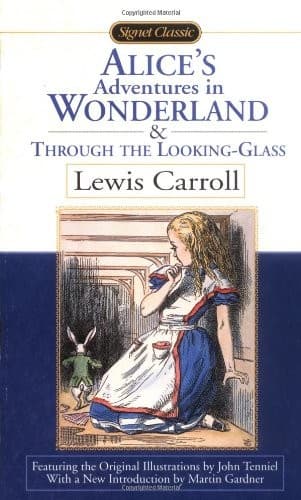
Lewis Carroll (1971)
Genre
Fantasy / Children's / Young Adult
Reading Time
240 min
Key Themes
See below
Sign in to track this book
Alice falls into a whimsical, nonsensical world where logic bends and identity shifts, as she navigates mad tea parties, croquet with flamingos, and a chess game that mirrors her fantastical journey.
While bored on a riverbank with her sister, Alice sees a White Rabbit in a waistcoat looking at a pocket-watch and exclaiming he's late. Curious, she follows him into a large rabbit-hole, falling for a very long time past shelves and cupboards. She lands in a long hall with locked doors. Finding a tiny key on a glass table, she sees it opens a small door to a garden, but she is too large to fit. She finds a bottle labeled 'DRINK ME' which shrinks her, but she forgets the key on the table. Later, she eats a cake labeled 'EAT ME' and grows to an enormous size, filling the hall and crying a pool of tears.
Alice, now tiny again after fanning herself with the White Rabbit's fan, swims in the pool of tears she cried when she was giant. She meets a Mouse, and together they swim to shore with a Dodo, a Lory, an Eaglet, and other creatures. To get dry, the Dodo suggests a 'Caucus-Race' where everyone runs in circles with no clear winner or rules, and everyone receives a prize (thimbles from Alice). Alice then talks about her cat Dinah's hunting skills, frightening all the small animals, who scatter away.
The White Rabbit mistakes Alice for his maid, Mary Ann, and sends her to get his gloves and fan from his house. Inside, Alice drinks from an unlabeled bottle and grows so large that her arm and leg burst out of the windows. The Rabbit and his friends try to remove her, throwing pebbles that turn into cakes, which Alice eats to shrink. Fleeing the house, she meets a large, hookah-smoking Caterpillar sitting on a mushroom. The Caterpillar gives confusing advice about identity and tells her that one side of the mushroom will make her grow, the other shrink. Alice tries the mushroom, eventually returning to a manageable size.
Alice enters a house where a Duchess is nursing a baby, a Cook is throwing dishes, and the air is thick with pepper. The Duchess is rude and the baby turns into a pig in Alice's arms. Alice then meets the Cheshire Cat, who can disappear and reappear, leaving only its grin. The Cat directs her towards the March Hare's house, saying that everyone there is mad, including himself. He talks about madness and identity before vanishing completely.
Alice arrives at the March Hare's house and finds him, the Mad Hatter, and a sleeping Dormouse at a perpetual tea party. They explain it's always six o'clock (tea-time) because the Hatter offended Time. They pose unanswerable riddles, offer Alice no tea, and make rude remarks. The Dormouse, when awake, tells a story about three sisters living in a treacle well. Frustrated by their illogic and rudeness, Alice eventually leaves the party, feeling it was the silliest tea party she had ever attended.
Alice enters a garden and finds three gardeners (playing cards) painting white roses red, fearing the Queen of Hearts. The Queen of Hearts arrives with a procession of other playing cards, including the King, and immediately orders executions for small offenses. Alice is invited to play croquet, but the game is chaotic: flamingos are mallets, hedgehogs are balls, and card-soldiers are hoops, constantly moving. The Queen often shouts 'Off with his head!' for various reasons. Alice again meets the Cheshire Cat, whose head appears in mid-air, starting an argument about its existence.
The Queen of Hearts sends Alice to the Gryphon, who takes her to meet the Mock Turtle. The Mock Turtle tells his sad life story and sings songs, including 'Turtle Soup,' while explaining his education in subjects like 'Reeling and Writhing.' Their conversation stops when they are called to the trial of the Knave of Hearts, who is accused of stealing the Queen's tarts. The King of Hearts presides, the White Rabbit is herald, and various Wonderland creatures are the jury. The trial is completely nonsensical, with illogical evidence and proceedings.
Alice is called as a witness in the Knave's trial, but she has grown to her normal size and accidentally knocks over the jury box. The King tries to dismiss her because of her height, but Alice refuses to leave. When the White Rabbit reads a nonsensical poem as 'evidence,' Alice calls the entire trial absurd, declaring they are 'nothing but a pack of cards!' The cards fly up and swarm around her. Alice then wakes up on the riverbank, her head in her sister's lap, realizing it was all a vivid dream. She tells her sister about her adventures, who then dreams of them herself.
One snowy evening, Alice is playing with her kittens, Kitty and Snowdrop, and a black Queen chess piece. She wonders what the world on the other side of the looking-glass might be like and, to her surprise, finds herself able to step through the mirror into a reversed version of her own house. Everything is backward: the clock shows the wrong time, the fire doesn't burn, and books are written in a mirror-image language. She finds a poem, 'Jabberwocky,' which she can only read when holding it up to the mirror.
Alice steps out into a garden where the flowers can talk, but they are rather rude. She meets the Red Queen, who explains that the entire area is laid out like a giant chessboard. The Red Queen tells Alice that in Looking-Glass World, one must run as fast as possible just to stay in the same place. She offers Alice the chance to become a Queen by moving across the chessboard-like land, starting as a pawn. Alice accepts, beginning her journey across the squares.
Alice meets the fat, identical twins Tweedledum and Tweedledee, who constantly quote poetry and argue. They show her the sleeping Red King, explaining that if he wakes, she will disappear, as she is 'only a sort of thing in his dream.' They then recite the long poem 'The Walrus and the Carpenter,' a dark tale about two characters who trick and eat a group of oysters. The twins soon get into a fight, which they prepare for with ceremony, but are interrupted by a crow, causing them to flee.
Alice meets Humpty Dumpty, a giant egg-like figure sitting on a wall. He explains the meaning of the 'Jabberwocky' poem, especially the portmanteau words, and boasts about his ability to make words mean whatever he chooses. He is very condescending. After leaving Humpty Dumpty, Alice enters a wood where things lose their names, and then meets the White Knight, who often falls off his horse and invents useless contraptions. The White Knight sings her a sad song and escorts her to the final square.
Alice successfully crosses the final square and becomes a Queen. She is abruptly seated next to the Red Queen and White Queen. The Queens immediately fall asleep on her shoulders. Alice attends her own coronation feast, but the banquet quickly becomes chaotic. The food comes alive, the guests (including the White Rabbit and the Hatter from Wonderland) behave wildly, and the entire scene becomes a riotous free-for-all. Alice, overwhelmed by the pandemonium, decides she can no longer tolerate the madness.
Frustrated and angry by the unruly banquet and the general illogic of Looking-Glass World, Alice grabs the Red Queen, whom she blames for much of the chaos, and begins to shake her. The Red Queen shrinks and transforms into one of Alice's kittens, Kitty. Alice then wakes up back in her armchair in her own house, holding Kitty, realizing that her entire journey through the looking-glass was another elaborate dream. She wonders whether it was her or the Red King who dreamt the adventure.
The Protagonist
Alice begins as a passive observer but gradually asserts herself, culminating in her defiance of the Queen of Hearts and the Red Queen, reclaiming her agency.
The Supporting
Maintains his anxious, hurried nature throughout, serving as a recurring, albeit minor, plot driver.
The Supporting
Serves as a static, guiding figure, offering wisdom without undergoing personal change.
The Antagonist
Remains consistently tyrannical, serving as the primary antagonist until Alice's defiance.
The Supporting
A static character who embodies the absurdity of Wonderland.
The Supporting
Remains a static, symbolic figure of the Looking-Glass World's rules until transformed back into a kitten.
The Supporting
A static character who serves to explain the linguistic peculiarities of Looking-Glass World.
The Supporting
A static, endearing character who aids Alice in her final steps.
The Supporting
A static character who embodies the absurdity of Wonderland.
The Supporting
A static character, primarily used for comedic and absurd effect at the tea party.
Alice constantly questions her identity throughout both books, especially in Wonderland. Her frequent changes in size lead her to wonder 'who I am' and whether she has transformed into someone else. The Caterpillar's question, 'Who are YOU?', directly challenges her sense of self. In Looking-Glass World, characters like Humpty Dumpty impose their own definitions, and the idea that Alice might be 'only a sort of thing in his dream' further destabilizes her existence. These experiences force Alice to confront the changing nature of self and the importance of defining oneself amidst external chaos.
“'I can't explain myself, I'm afraid, Sir,' said Alice, 'because I'm not myself, you see.'”
The main conflict in both books comes from Alice's attempts to apply logical reasoning and conventional manners to worlds ruled by complete nonsense. Wonderland and Looking-Glass World have inverted logic, arbitrary rules, and conversations that defy rationality, from the Mad Tea-Party's unanswerable riddles to the Red Queen's 'faster to stay in place' rule. Alice's frustration shows the clash between the ordered world she knows and the chaotic, illogical realms she enters, suggesting the limits of rigid logic in understanding the absurd.
“'Why, sometimes I've believed as many as six impossible things before breakfast.'”
Physical growth and shrinking are literal and symbolic signs of change in Wonderland. Alice's changing size forces her to adapt and constantly re-evaluate her surroundings and capabilities. This physical change mirrors her mental and emotional journey, as she develops from a curious, slightly bewildered child into a more assertive individual who ultimately challenges the absurd authority around her. In Looking-Glass World, her progression across the chessboard from pawn to queen shows a similar journey of advancement and change, though with its own illogical rules.
“'Curiouser and curiouser!' cried Alice (she was so much surprised, that for the moment she quite forgot how to speak good English).”
Both adventures are framed as dreams, making the reader and Alice herself think about the boundary between imagination and reality. The ending of each book, with Alice waking up, explicitly calls the events dreams. However, the vividness and complexity of her experiences, especially her sister's later dreaming of Wonderland, blur these lines. The question of who dreamt whom (Alice dreaming the Red King, or the Red King dreaming Alice) further explores ideas about subjective reality and the power of the subconscious mind to create entire worlds.
“'It was a dream, of course,' thought Alice: 'but oh, how real it felt!'”
Language itself is a central theme, often manipulated or made meaningless by the inhabitants of Wonderland and Looking-Glass World. Puns, riddles, and wordplay are common, but often used to obscure rather than clarify. Characters like Humpty Dumpty explicitly state their power over words, making them mean 'just what I choose it to mean.' This challenges Alice's reliance on fixed meanings and shows the arbitrary nature of linguistic conventions, reflecting the broader theme of order versus chaos.
“'When I use a word,' Humpty Dumpty said, in rather a scornful tone, 'it means just what I choose it to mean—neither more nor less.'”
A pervasive inversion of conventional logic and reason
Carroll employs nonsense logic throughout both books, where conventional rules of cause and effect, time, and social interaction are constantly subverted. This device creates a world that is bewildering yet internally consistent within its own absurd framework. Examples include the Mad Tea-Party where it's 'always tea-time,' the Red Queen's dictum to 'run as fast as you can to stay in the same place,' and the trial where evidence is presented after the verdict. This device highlights Alice's struggle to impose order on chaos and emphasizes the subjective nature of reality.
Framing the entire narrative as a vivid, elaborate dream
Both 'Alice's Adventures in Wonderland' and 'Through the Looking-Glass' are explicitly presented as dreams. This device allows for the suspension of disbelief, justifying the fantastical and illogical events without requiring realistic explanations. It also provides a neat narrative conclusion, with Alice waking up. The dream framework invites philosophical contemplation about the nature of imagination, subconscious desires, and the blurred lines between waking life and the dream world, particularly when Alice's sister also dreams of Wonderland.
Characters and objects changing form or meaning to reflect inner states or narrative progression
Beyond Alice's physical changes in size, many elements undergo symbolic transformations. The baby turning into a pig, the Duchess's kitchen filled with pepper, or the Red Queen becoming Alice's kitten are examples. These transformations often reflect a character's true nature or Alice's perception of them. In Looking-Glass World, the entire landscape is a chessboard, and Alice's journey from pawn to queen is a symbolic progression of her agency and maturity, mirroring her internal growth as she navigates the challenges of the dream world.
Giving human qualities and speech to animals, plants, and inanimate objects
Carroll extensively uses anthropomorphism to populate his fantastical worlds. Animals like the White Rabbit, the Mouse, the Gryphon, and the Mock Turtle speak, wear clothes, and engage in human-like activities. Flowers talk, playing cards serve as soldiers and royalty, and even chess pieces have personalities. This device creates a vibrant, whimsical, and often unsettling world where the familiar becomes strange, challenging Alice's (and the reader's) expectations of reality and adding to the pervasive sense of wonder and absurdity.
Extensive use of linguistic jokes, riddles, and double meanings
Language itself is a playground in Carroll's books, filled with puns, riddles, and nonsensical poetry like 'Jabberwocky' and 'The Walrus and the Carpenter.' Characters like Humpty Dumpty engage in discussions about the arbitrary nature of words. This device highlights the malleability of language and its potential for both communication and confusion. It underscores the theme of logic versus nonsense, as Alice often struggles to understand the literal and figurative meanings used by the Wonderland inhabitants, adding layers of humor and intellectual engagement.
“Why, sometimes I've believed as many as six impossible things before breakfast.”
— The White Queen to Alice in Through the Looking-Glass, encouraging imagination.
“Curiouser and curiouser!”
— Alice's exclamation after shrinking in Wonderland.
“We're all mad here. I'm mad. You're mad.”
— The Cheshire Cat to Alice in Wonderland.
“It's no use going back to yesterday, because I was a different person then.”
— Alice reflecting on her changing size and experiences.
“Off with their heads!”
— The Queen of Hearts' frequent command in Wonderland.
“If you don't know where you are going, any road will get you there.”
— The Cheshire Cat's advice to Alice about direction.
“I can't go back to yesterday because I was a different person then.”
— Alice's realization about personal growth.
“Begin at the beginning and go on till you come to the end: then stop.”
— The King of Hearts' advice on telling a story.
“I'm not strange, weird, off, nor crazy, my reality is just different from yours.”
— A paraphrase often attributed to the Cheshire Cat's philosophy.
“Twinkle, twinkle, little bat! How I wonder what you're at!”
— The Mad Hatter's nonsense song at the tea party.
“Everything's got a moral, if only you can find it.”
— The Duchess to Alice in Wonderland.
“I can't explain myself, I'm afraid, sir, because I'm not myself, you see.”
— Alice's confused response to the Caterpillar.
“The time has come, the Walrus said, to talk of many things: Of shoes—and ships—and sealing-wax—Of cabbages—and kings—”
— From the poem recited by Tweedledee and Tweedledum in Through the Looking-Glass.
“It takes all the running you can do, to keep in the same place. If you want to get somewhere else, you must run at least twice as fast as that!”
— The Red Queen's explanation of the looking-glass world's physics.
Ready to see how well you understood this book? Take our interactive quiz with 10 questions.
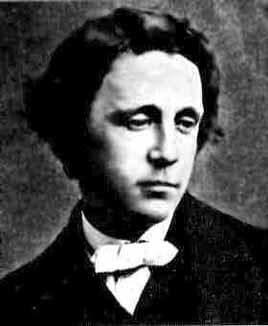
Charles Lutwidge Dodgson, better known by his pen name Lewis Carroll, was an English author, poet and mathematician. His most notable works are Alice's Adventures in Wonderland (1865) and its sequel Through the Looking-Glass (1871). He was noted for his facility with word play, logic, and fantasy. His poems Jabberwocky (1871) and The Hunting of the Snark (1876) are classified in the genre of literary nonsense.







