““I have a name. It’s Alice. Not little girl. Not child. Alice.””
— Alice asserting her identity to the Rabbit after escaping from the asylum.

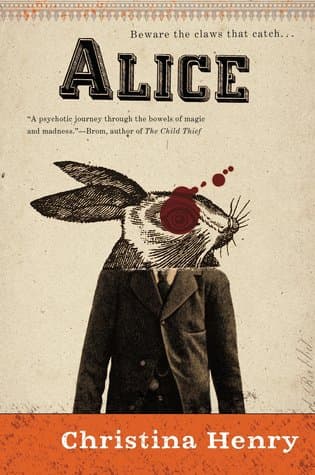
Christina Henry (2015)
Genre
Fantasy / Young Adult
Reading Time
360 min
Key Themes
See below
Sign in to track this book
In a grim reimagining of Wonderland, a traumatized Alice escapes a nightmarish asylum only to hunt the monstrous remnants of her past through a decaying city, seeking fragmented memories and the truth behind her bloody tea party.
Alice, a young woman with broken memories, has been in the 'Old City' asylum for ten years. She only remembers a tea party, a White Rabbit, and a bloody event. She suffers daily torment from the nurses and the 'Doctor,' who uses her for experiments, leaving her scarred and broken. One night, a large fire engulfs the asylum. In the chaos, Alice sees the Doctor's true, monstrous form — a creature with a rabbit-like face and long ears. She escapes through a wall, but not before seeing the Doctor, as the Rabbit, kill a nurse. This encounter confirms her belief that the 'Rabbit' from her memories is real and dangerous.
After escaping the burning asylum, Alice stumbles through the Old City's ruined streets. Exhausted and hurt, she collapses. Hatcher, a strong man with a hook for a hand and a violent past, finds her. Hatcher, at first wary, sees a shared trauma in Alice and the marks on her body. He says he was also a victim of the Doctor, whom he calls the 'Mad Hatter,' and that the Doctor destroyed his family. Despite being gruff, Hatcher offers Alice protection and a place to heal. They form an alliance based on their shared enemy and desire for revenge against the Doctor/Hatter.
Hatcher takes Alice to his hidden home in the Old City, a place with other outcasts and survivors. They learn about the city's power: the Jabberwocky, a crime lord who controls much of the city's trade and violence, and his rival, Chessur, a mysterious, cat-like figure who deals in information and dark magic. As Alice's memories slowly return in painful flashes, she realizes the Doctor's experiments gave her a strange, almost magical ability to influence others, especially through touch. Hatcher, skilled in the city's brutal ways, teaches Alice to defend herself, readying her for the coming fight with the Doctor and his allies.
Wanting information about the Doctor and her past, Alice convinces Hatcher to take her to Chessur, a shrewd and manipulative information broker. Chessur, a man with unsettling wide smiles and a love for riddles, is reluctant to help but is curious about Alice's unique aura. He reveals that the Doctor is a powerful creature, a 'Rabbit' who feeds on fear and pain, and that the asylum was where he conducted his experiments. Chessur also tells Alice about 'Drink Me,' a potent hallucinogenic drug the Doctor uses to control victims and increase their suffering, linking it to Alice's fragmented tea party memories.
Alice and Hatcher follow a lead into a part of the Old City controlled by the Jabberwocky. There, they find a gruesome scene: a young woman, barely alive, known as the Dormouse. She is severely thin and traumatized, clearly a victim of the Doctor's long torture and experiments, much like Alice. The Dormouse is barely coherent, whispering about 'tea parties' and the 'Rabbit' before she dies. This affects Alice deeply, strengthening her resolve to stop the Doctor and prevent others from suffering. It also shows how widespread the Doctor's cruelty is in the city.
To get closer to the Doctor, Alice and Hatcher realize they must deal with the Jabberwocky, who seems to be an unwitting or unwilling helper. They confront the large, imposing crime lord in his lair. The Jabberwocky, a man of brutal strength and cunning, at first dismisses them. But Alice, using her growing ability to subtly influence people, plants doubts and fears in his mind about the Doctor's true plans and the threat he poses to the Jabberwocky's power. Hatcher's threats also help, making the Jabberwocky reveal information about the Doctor's current location and his network.
Following the Jabberwocky's reluctant directions, Alice and Hatcher find the Doctor's new lair, a hidden complex under the Old City. The place mirrors a warped wonderland, filled with distorted statues and strange machines. They meet the Doctor's 'children' — people so broken and controlled by him that they act as his loyal, deranged servants. These 'children' are grotesque, physically altered, showing more of the Doctor's experiments. Alice's memories become clearer. She recognizes parts of her childhood, realizing the Doctor has hunted her for a long time, and that the 'tea party' was a traumatic event he planned.
Deep in the lair, Alice faces her past. Through traumatic flashbacks, triggered by the surroundings and the Doctor's presence, she finally remembers everything. The 'tea party' was not a party, but a horrific event where the Doctor, her own father, experimented on her and her mother. He was always the 'Rabbit,' a monstrous being who sought to control and corrupt. Her mother tried to protect her but was killed by him. Alice herself was subjected to his first experiments, which gave her unique powers and broken memories, explaining her ten years in the asylum.
Alice and Hatcher confront the Doctor, who fully becomes his monstrous 'Rabbit' form, a creature of great physical and psychological power. The Rabbit mocks Alice, enjoying her pain and trying to break her spirit. He reveals his goal: to turn Alice into a similar creature, a 'Queen' to his 'Rabbit,' and unleash her power on the world. A brutal fight follows. Hatcher uses his strength and cunning to distract the Rabbit, while Alice, using her growing powers and new clarity, fights back with rage from ten years of suppressed trauma. She uses her ability to influence and manipulate, turning the Rabbit's dark magic against him.
In a final struggle, Alice defeats the Rabbit. She does not kill him in a normal way, but shatters his mental and magical hold, leaving him a broken, powerless man. The victory is mixed; the immediate threat is gone, but Alice is left with the full weight of her traumatic past and her own dark potential. Hatcher, though wounded, stays by her side. The Old City remains dangerous. While the Rabbit's direct influence is gone, the forces he started and other creatures of this twisted world still exist. Alice has won a battle, but the war for her soul, and the future of the Old City, is far from over.
The Protagonist
Alice transforms from a traumatized, amnesiac victim into a powerful, self-aware individual who embraces her dark potential to confront her abuser.
The Supporting
Hatcher moves from a solitary, vengeance-driven figure to a loyal protector, finding a new purpose in helping Alice.
The Antagonist
The Doctor is revealed to be the Rabbit, and his monstrous identity is unmasked, leading to his eventual defeat and the shattering of his power.
The Supporting
Chessur remains largely a static character, serving as a knowledgeable, if morally ambiguous, guide for Alice.
The Supporting
The Jabberwocky shifts from an obstacle to a reluctant, temporary ally, manipulated by Alice into revealing information.
The Mentioned
The Dormouse's brief appearance highlights the Doctor's cruelty and the impact of his experiments on others.
The novel explores the psychological effects of trauma and how memory breaks apart. Alice's journey is about her need to put her past back together, a past the Doctor deliberately suppressed and twisted. Her memories return in painful flashes, often triggered by people or places, like the 'tea party' or seeing the Rabbit. The scars on her body remind her of the horrors she suffered, showing how trauma affects both inside and out. The story emphasizes how hard it is to face and accept painful memories to heal and understand oneself, even if the truth is terrifying.
“My memories are a broken mirror, reflecting only fragments of a past I can't quite grasp.”
Christina Henry redefines monstrosity, moving past simple villains to show how evil appears psychologically and physically. The Doctor's change into the 'Rabbit' is not just physical; it shows his complete fall into sadism and inhumanity. The 'children' he creates are physical proof of his twisted experiments, showing the monstrous effects of his abuse. The novel asks if monstrosity is natural or made by circumstances, suggesting the Doctor's actions come from a deep, predatory nature. It also hints at a monstrous potential within Alice, forcing her to face the darkness she inherited.
“He wasn't just a man. He was a hunger, a void that consumed everything beautiful.”
Despite years of torture and manipulation, Alice and Hatcher show great strength. Alice's escape from the asylum and her determination to find the truth, even with frightening revelations, shows her inner power. Hatcher, having survived the Doctor's brutality and made a life in the Old City's harsh environment, shows practical strength and resourcefulness. The characters learn to adapt, fight back, and find strength in their shared experiences. These bonds help them face difficult odds. Their journey shows the human spirit's ability to endure and fight for freedom and justice.
“We are survivors, Alice. We bleed, but we don't break.”
The theme of lost innocence is key to the novel, especially through Alice's story. Her childhood was not happy, but full of brutal experiments by her own father, the Doctor. The 'tea party' image, usually linked to childhood fun, is twisted into a scene of horror and abuse. The Doctor wants to corrupt Alice's power, to turn her into a 'Queen' he designed, thus completing his perversion of her innocence. This theme shows how trauma can steal childhood and leave lasting scars, forcing characters to reclaim their lives and define themselves outside their abusers' twisted stories.
“He took my childhood, my name, my very self. But he wouldn't take my fight.”
Alice's unreliable and incomplete recollection of her past.
Alice's fragmented memories serve as the primary driving force of the plot. Her inability to recall her past, beyond terrifying snippets, creates suspense and mystery. This device allows the author to slowly reveal the horrific truth of her past, mirroring Alice's own journey of discovery. The unreliable nature of her memory also initially casts doubt on the reality of her experiences, making her quest for truth more urgent and perilous. It emphasizes the psychological damage inflicted by her trauma.
A powerful hallucinogenic drug used by the Doctor to control and torment his victims.
The 'Drink Me' potion is a powerful hallucinogen that the Doctor uses to manipulate and amplify the suffering of his victims, creating a distorted reality. It directly links to the Lewis Carroll source material but is reimagined as a tool of psychological torture. This device explains the surreal, nightmarish elements of Alice's fragmented memories and the distorted perceptions of other victims. It highlights the Doctor's control over not just bodies, but minds, blurring the lines between reality and delusion.
A gothic, decaying urban landscape reflecting the characters' brokenness.
The Old City functions as more than just a setting; it is a character in itself, a decaying, labyrinthine urban landscape that mirrors the psychological state of its inhabitants. Its crumbling buildings, desperate people, and hidden dangers reflect the characters' brokenness and the pervasive trauma that defines their lives. The city's factions and hidden passages contribute to the sense of a world gone wrong, a twisted reflection of a forgotten past, and a constant source of danger and opportunity for those who navigate its streets.
Characters named after figures from 'Alice in Wonderland' with twisted roles.
The use of symbolic character names (Alice, Rabbit, Hatcher for Hatter, Chessur for Cheshire, Jabberwocky, Dormouse) is a key plot device. These names evoke the familiar 'Alice in Wonderland' narrative but subvert expectations by assigning dark, twisted roles to the characters. This immediately signals to the reader that this is not a whimsical tale, but a dark reimagining, creating a sense of dread and anticipation as the true, horrific nature of these 'wonderland' figures is revealed. It also allows for thematic parallels while forging a distinct, grim narrative.
““I have a name. It’s Alice. Not little girl. Not child. Alice.””
— Alice asserting her identity to the Rabbit after escaping from the asylum.
““The asylum had taken her memories, but it hadn’t taken her will.””
— Narrator reflecting on Alice's inner strength despite her amnesia.
““Sometimes the monsters are the people you trust the most.””
— Alice realizing the true nature of some characters she had encountered.
““She was a broken doll, but she still had sharp edges.””
— Description of Alice's appearance and underlying danger after her escape.
““Revenge is a dish best served with a side of madness.””
— Hatter's philosophy on seeking retribution.
““The world was a dark place, but that didn’t mean she had to be.””
— Alice's resolve to maintain her own morality in a corrupt world.
““Memories are like pieces of a broken mirror. You can try to put them back together, but they’ll never be whole again.””
— Alice's struggle with her fragmented memories.
““Just because you’re mad, doesn’t mean you’re wrong.””
— A character's justification for their unconventional actions.
““Fear was a powerful weapon, but so was desperation.””
— Alice's motivation during a perilous situation.
““Some scars never fade, no matter how much time passes.””
— Alice reflecting on the lasting impact of her past trauma.
““The line between sanity and madness was a thin, blurry one, easily crossed.””
— Observation about the mental state of characters in the story.
““She had survived the asylum, and she would survive this too.””
— Alice's internal monologue during a moment of extreme danger.
““Sometimes, the only way to find your way out of the darkness is to become a part of it.””
— A character's grim advice to Alice.
““There was no going back to the girl she had been before. That girl was dead.””
— Alice's acceptance of her transformation and loss of innocence.
Ready to see how well you understood this book? Take our interactive quiz with 10 questions.

Christina Henry is a fiction author known for her imaginative retellings of classic tales. Her most notable work, "Alice," offers a dark and compelling reimagining of Lewis Carroll's beloved character. Henry's writing often explores themes of folklore, mythology, and the darker aspects of fantasy, drawing readers into richly detailed and atmospheric worlds.







