“I went to sleep with gum in my mouth and now there's gum in my hair.”
— The very first problem Alexander encounters upon waking.

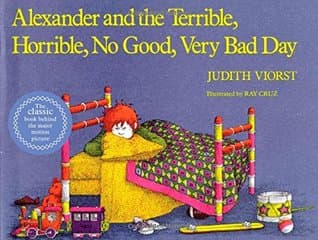
Judith Viorst (1972)
Genre
Children's
Reading Time
5 min
Key Themes
See below
Sign in to track this book
Alexander's day goes from bad to worse, starting with gum in his hair and ending with lima beans for dinner, making him wish he could just move to Australia.
Alexander's day starts badly when he wakes up with gum in his hair. This first problem sets the mood for the whole day. As he gets out of bed, he trips on his skateboard, further confirming his belief that this will be a 'terrible, horrible, no good, very bad day.' His brothers, Anthony and Nicholas, seem to have perfect mornings, finding prizes in their cereal boxes, while Alexander finds only cereal. This early difference shows Alexander's growing frustration and feeling of unfairness, as he sees everyone else's day starting much better than his.
At breakfast, Alexander's toast is missing, and he gets squished in the car on the way to school. His teacher, Mrs. Dickens, dislikes his drawing of an invisible castle, and his best friend, Paul, leaves him for a new friend, Philip Parker. During playtime, he is left out of a basketball game and then accidentally trips over a fire hydrant, falling into a puddle. These events at school make Alexander feel like an outsider and add to his growing misery and sense of injustice throughout the day.
Lunch brings more disappointment for Alexander; there's no dessert in his lunch bag, only a sandwich. He then argues with his friend, Anthony, over a chair and is scolded by Mrs. Dickens. Later, when his father takes him to the shoe store, Alexander has to try on uncomfortable plain white shoes, which he dislikes, instead of the cool blue sneakers he wanted. This further adds to his growing frustration, as even simple choices seem to go against his wishes.
After the shoe store, Alexander has a dentist appointment where Dr. Fields finds a cavity, needing a filling. The experience is painful and unpleasant, making his negative feelings about the day worse. On the way home, his mother picks him up in a carpool with other children, and Alexander has to sit in the middle seat, feeling squashed and uncomfortable, with no window to look out of. The day keeps giving him one uncomfortable situation after another, with no break.
When he gets home, Alexander's situation doesn't get better. He finds that his brother, Nicholas, has a cool new toy, a walkie-talkie, which Alexander can't play with. This exclusion makes him feel even more left out and jealous. He then gets into another argument with his brothers over who gets to use the bathroom first, further increasing the tension and showing that even at home, he can't escape the day's frustrations and conflicts with his siblings.
Dinner is another source of misery for Alexander as his mother serves lima beans, which he hates. To make things worse, dessert is tapioca, another food he dislikes. While trying to escape the unpleasant meal by watching TV, he is disgusted to see his parents kissing, an act he finds embarrassing and unappealing. This series of events at dinner confirms his feeling that the world is against him, offering only things he dislikes and sights he finds uncomfortable.
During bathtime, Alexander accidentally drops his favorite toy submarine down the drain. This small but important loss adds to his already full cup of sadness and frustration. As he gets ready for bed, his brothers won't let him use their night-light, forcing him to sleep in the dark. These final events of the day, even in the quiet moments before sleep, keep adding to his misery, making him feel alone and unlucky.
Throughout the day, as each new problem happens, Alexander repeatedly says he wants to move to Australia. This becomes his main way of coping with the overwhelming negative feelings of his day. He imagines that in Australia, things would be different, better, and that he wouldn't have such terrible, horrible, no good, very bad days. This fantasy shows his wish to escape and start fresh, far from his current problems.
As Alexander finally gets into bed, still complaining about his terrible day, his mother comes in to comfort him. She understands his feelings and listens to his list of complaints. Instead of dismissing his emotions, she offers a simple, deep truth: that everyone, even people in Australia, has terrible, horrible, no good, very bad days sometimes. This moment of understanding gives Alexander a sense of validation and a small bit of hope, suggesting that his experience is not unique but a part of life.
Despite his mother's comforting words, Alexander still feels the weight of his terrible day. However, her saying that bad days happen to everyone gives him a small amount of relief. He eventually falls asleep, likely hoping that tomorrow will be a better day, or at least one where he doesn't have gum in his hair or lima beans for dinner. The day ends with Alexander still wanting a different reality, but with the quiet acceptance that bad days are part of being human.
The Protagonist
Alexander begins the day feeling personally targeted by misfortune and ends it with a slight understanding that bad days are a universal experience, even if he still wishes for a better one.
The Supporting
She remains a consistent source of comfort and wisdom throughout the story, providing a steady counterpoint to Alexander's escalating frustrations.
The Supporting
His character remains consistent, fulfilling practical parental duties without significant emotional development.
The Supporting
Anthony remains a consistent source of sibling rivalry for Alexander.
The Supporting
Nicholas, like Anthony, remains a consistent source of sibling rivalry for Alexander.
The Mentioned
Paul's character serves as a catalyst for Alexander's feeling of social rejection.
This theme explores the idea that everyone, no matter their age or location, has days filled with problems and frustration. Alexander's mother's last words, 'Some days are like that. Even in Australia,' sum up this message. All through the story, Alexander feels uniquely targeted by bad luck, from gum in his hair to lima beans for dinner. The many small, relatable problems help readers feel understood in their own 'terrible, horrible, no good, very bad days,' offering comfort in the shared human experience of occasional difficulty.
“Some days are like that. Even in Australia.”
The story looks at a child's emotional reaction to many disappointments and how they try to cope. Alexander's main coping method is his repeated wish to move to Australia, which shows a desire to escape and start over from his problems. He also shows his frustration through complaints and a feeling of unfairness. The story shows a child dealing with situations he can't control, from not getting his preferred shoes to having a cavity, and his struggle to process these negative experiences without fully understanding they are temporary.
“I think I'll move to Australia.”
This theme shows how many small, everyday annoyances can build up to create a strong feeling of negativity. Individually, gum in the hair, no prize in cereal, or lima beans for dinner are small issues. But when they happen one after another throughout a single day, they contribute to Alexander's strong feeling that his day is 'terrible, horrible, no good, very bad.' This shows how the combined effect of small problems can affect one's mood just as much as a single big disaster, especially from a child's point of view.
“I could tell it was going to be a terrible, horrible, no good, very bad day.”
The story is deeply based on Alexander's personal experience of fairness, or lack of it. He sees his brothers having better luck (prizes in cereal), his friends leaving him, and adults making choices he dislikes (uncomfortable shoes, lima beans). From his view, the world is unfairly against him. This theme captures how a child understands justice, where personal trouble or disappointment is often seen as a general unfairness, rather than just one event.
“Anthony and Nicholas had prizes in their cereal boxes. There was no prize in my cereal box.”
The phrase 'terrible, horrible, no good, very bad day' is repeated throughout the story.
The repeated phrase 'terrible, horrible, no good, very bad day' serves to emphasize Alexander's escalating frustration and provides a clear emotional barometer for the reader. Each time it's uttered, it reinforces the cumulative effect of the day's misfortunes and helps to ground the narrative in Alexander's subjective experience. This repetition also makes the phrase memorable and iconic, making the story relatable for children who have experienced similar days, allowing them to instantly identify with Alexander's plight.
Alexander's exaggerated reactions to minor misfortunes.
Alexander's reactions to his day's events are often exaggerated, which is a key element of the story's humor and relatability. Things like gum in his hair or having lima beans for dinner are treated with the gravity of major disasters. This hyperbole effectively captures the intense emotional world of a child, where small setbacks can feel catastrophic. It allows young readers to see their own magnified feelings reflected, while older readers can appreciate the comedic and nostalgic aspects of a child's dramatic response to everyday annoyances.
Alexander's repeated desire to move to Australia.
Alexander's constant declaration, 'I think I'll move to Australia,' functions as a running gag and a catchphrase throughout the book. It serves as his ultimate escape fantasy, a place where he imagines life would be free of his current woes. This device lightens the mood of an otherwise perpetually unlucky day and humorously illustrates a child's desire to literally run away from their problems when things get tough. It also provides a satisfying resolution when his mother addresses this fantasy directly.
“I went to sleep with gum in my mouth and now there's gum in my hair.”
— The very first problem Alexander encounters upon waking.
“I think I'll move to Australia.”
— Alexander's recurring lament when things go wrong, expressing a desire to escape his bad day.
“My best friend, Anthony, told me I wasn't his best friend anymore.”
— A social setback Alexander experiences at school.
“There were two cupcakes in my lunch, and I only got to eat one of them because Anthony snatched the other one away.”
— Another instance of Anthony causing Alexander grief during lunch.
“And there was a song in my head, and I sang it. I sang it very loud. I sang it all the way to school. I sang it all the way to the bus. I sang it all the way to the bus stop. I sang it all the way to the bus stop, and the bus came. And I sang it all the way to the bus.”
— Alexander's attempt to enjoy himself is met with disapproval.
“And Mrs. Dickens said, 'No singing in school, Alexander.'”
— Alexander's teacher scolds him for singing.
“I could tell it was going to be a terrible, horrible, no good, very bad day.”
— Alexander's realization early in the day that things are not going well.
“At school, Mrs. Dickens said that because I was talking when I shouldn't, I got a star for good work, but she didn't mean it.”
— Alexander receives sarcastic praise from his teacher.
“I went to the bathroom, and the big boys were there, and they took my quarter.”
— Alexander's money is stolen by older kids.
“My mom said that some days are like that. Even in Australia.”
— Alexander's mother offers comfort and perspective at the end of the day.
“I think I'll move to Australia.”
— Alexander's final thought before bed, still clinging to his escape fantasy.
“I hope you have a terrible, horrible, no good, very bad day.”
— Alexander's internal thought directed at his brother, Nick, after Nick trips him.
“There were lima beans for dinner. And I hate lima beans.”
— Alexander's disappointment with the evening meal.
“And my bath was too hot, and I got soap in my eyes.”
— Even the simple act of bathing goes wrong for Alexander.
Ready to see how well you understood this book? Take our interactive quiz with 10 questions.

Biography coming soon.

Dan Gemeinhart
4.5

Kate O'Hearn
4.4

Jeanne Birdsall
4.4

Jen Wang
4.4
Wendelin Van Draanen
4.3

John Marsden
4.3

Chris Van Allsburg
4.3
Jennifer A. Nielsen
4.2