“The past is a ghost, the future a dream, and all we ever have is now.”
— A reflection on time and living in the present moment.

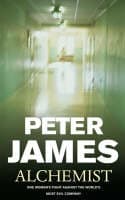
Peter James (1999)
Genre
Thriller / Mystery
Reading Time
1127 min
Key Themes
See below
Sign in to track this book
When bizarre deaths plague an English town, a detective races to uncover a modern alchemist's dark secrets before more victims are sacrificed for immortality.
Dr. Richard Anderson, a talented but disgraced archaeologist, leads a team excavating an ancient monastery in the Carpathian Mountains. His funding is low, and his career is in jeopardy. They find a hidden chamber with a well-preserved, centuries-old manuscript. The text is in an old code, hinting at alchemical secrets and a dark past. Anderson is drawn to deciphering its contents, believing it will save his academic reputation.
Richard starts translating 'The Book of Azazel.' As he reads its passages about alchemical processes, spiritual rituals, and strange prophecies, he experiences disturbing psychological events. He has vivid, terrifying nightmares and sees fleeting shadows. He first dismisses these as stress, unaware of the ancient text's influence on his mind and surroundings.
The excavation site becomes tense as a series of horrifying accidents affect Richard's team. A worker falls to his death, a research assistant dies in a rockslide, and another gets a severe, unexplained illness. Authorities are baffled, but Richard sees a link between these events and the manuscript. He notices a pattern: those near the book, or skeptical of its power, seem most at risk.
Concerned by the deaths, Richard's university sends Dr. Sarah Miller, an expert in ancient languages, to assist and investigate. Sarah is practical and rational, initially dismissing Richard's paranoia as delusion. She finds the manuscript rare but views it only as an academic artifact. Her arrival creates tension with Richard, who struggles between scientific skepticism and the terrifying reality unfolding.
Despite her initial doubts, Sarah begins to experience unsettling events. She hears whispers, sees objects move, and feels a heavy, malevolent presence near the manuscript. One night, she has a terrifying hallucination of grotesque figures from the book's illustrations. These experiences force her to consider that something beyond science is happening. Her rational view crumbles, and she realizes Richard's warnings were true.
Working together, Richard and Sarah decipher more of 'The Book of Azazel.' They learn it is not just an alchemical text, but a grimoire for summoning and binding Azazel, a powerful ancient entity. The original alchemist, a mad zealot, tried to use Azazel's power for immortality but failed, leaving an incomplete ritual in the manuscript. They realize the entity is not dormant but has been gaining strength, feeding on fear and death, preparing to fully manifest.
Through more research and local stories, Richard and Sarah discover the monastery's dark past. It was built on an ancient pagan site, known for its powerful ley lines and as a place of sacrifice. The monks, trying to purify the land, accidentally attracted and trapped the entity the alchemist later sought to control. The monastery's location and structure were meant to contain, but also empower, the malevolent presence that had been dormant for centuries, now awakened by the manuscript.
As Richard and Sarah work to stop the entity, Azazel's influence grows stronger. Attacks become more direct and personal. They experience violent poltergeist activity and terrifying apparitions. Azazel tries to possess people, including their remaining team members, turning them against Richard and Sarah. The entity tries to manipulate their fears and doubts, hoping to divide them and weaken their resolve, knowing their combined intellect is its biggest threat.
Realizing normal methods will not work, Richard and Sarah look for a counter-ritual in the manuscript or related texts. They find fragmented passages hinting at a way to banish Azazel, but the information is cryptic and dangerous. The ritual requires specific items, done at a precise time and place in the monastery, with significant personal risk. They must decipher the remaining clues while fighting Azazel's increasingly powerful attempts to stop them from completing the counter-ritual and sealing it away.
The climax occurs in the heart of the ancient monastery, where the manuscript was found, during a powerful storm. Richard and Sarah, with their knowledge and desperate resolve, begin the counter-ritual. Azazel fully manifests, a terrifying, formless entity of pure evil, unleashing its power to stop them. The monastery seems to come alive, walls crumbling, ancient symbols glowing with dark energy. Richard and Sarah must perform the ritual perfectly, battling Azazel's physical and psychological attacks. One mistake means their death and the unleashing of evil on the world.
With their intellect, courage, and a last-minute sacrifice by a loyal team member, Richard and Sarah complete the counter-ritual. With a blinding flash and a roar, Azazel is banished, receding into the shadows, sealed again within the monastery. The damaged building falls silent. Richard and Sarah survive, but they are changed, bearing deep psychological scars. The manuscript is re-sealed and hidden, its secrets guarded, ensuring it can never again unleash such terror.
The Protagonist
Transforms from a cynical, career-driven academic into a courageous defender against ancient evil, forced to accept the existence of the supernatural.
The Supporting
Begins as a staunch skeptic, but is forced to confront and accept the reality of supernatural forces, becoming a vital partner in combating them.
The Antagonist
Gradually awakens and increases its power throughout the narrative, culminating in a full manifestation before being re-imprisoned.
The Supporting
Remains largely skeptical throughout, representing the inability of conventional science to fully grasp the supernatural events.
The Supporting
Initially a voice of dismissed superstition, he becomes a tragic figure, his warnings validated as he falls victim to the entity's power.
The Mentioned
His past actions and ambition are slowly revealed, providing context for the present danger.
The main theme is the danger of pursuing knowledge humanity is not meant to have. Dr. Anderson's ambition to decipher 'The Book of Azazel' for academic fame accidentally releases an ancient evil. The manuscript itself represents this forbidden knowledge, a text promising power but bringing destruction. The story shows that some secrets are best left buried, as the translation of the text directly leads to more supernatural events and deaths.
“There are some doors that, once opened, can never be truly closed.”
The novel explores the conflict between rational, scientific understanding and inexplicable supernatural forces. Richard and Sarah, both educated academics, initially dismiss strange events as coincidences or stress. But as the entity's manifestations become undeniable, their scientific views are shattered. The story shows the limits of purely rational thought when faced with forces beyond human understanding. Mihai, the superstitious local foreman, serves as a contrast; his early warnings, based on folklore, prove more accurate than the academics' initial skepticism.
“We seek to categorize and explain, but some things simply defy our neat little boxes.”
Richard Anderson's story is about redemption. Disgraced and trying to save his career, his first reason for finding the manuscript is selfish. However, as he understands the horror he has unleashed, his focus shifts from personal gain to a desperate responsibility to contain the evil. This change shows how extreme adversity can make people confront past mistakes and strive for a greater purpose. His desire for redemption becomes tied to his responsibility to protect humanity from Azazel.
“It wasn't about proving myself anymore. It was about stopping what I'd started.”
Azazel is not a creature of brute force but an entity that uses psychological manipulation, fear, and corruption. Its influence is subtle, slowly eroding the sanity and trust among the characters before physical manifestations occur. The evil it represents is ancient and patient, feeding on the negative emotions and weaknesses of its victims. This slow, creeping dread is more terrifying than overt violence, as it undermines the characters' sense of reality and self, making them question their own minds and each other.
“True darkness doesn't always roar; sometimes, it whispers in the quietest corners of your mind.”
The central artifact that triggers and contains the supernatural threat.
This ancient, coded text is the primary catalyst for all the events in the novel. It functions as a grimoire, containing the rituals to summon and bind Azazel. Its very presence and translation act as a key, slowly unlocking the entity's power. It also serves as a source of both peril and potential salvation, as the counter-ritual is also hidden within its pages or related texts. The manuscript is not merely a book; it is a prison and a conduit for the malevolent force.
An isolated, ancient location that enhances dread and serves as the entity's prison/locus of power.
The dilapidated monastery in the Carpathian Mountains provides an ideal setting for a horror thriller. Its isolation cuts the characters off from outside help, amplifying their sense of vulnerability. Its ancient history, built on a pagan site and later used to contain the entity, makes it a powerful locus for supernatural activity. The labyrinthine ruins, hidden chambers, and sense of forgotten time contribute to the oppressive atmosphere and provide the perfect stage for the entity's manifestations and the final confrontation.
The entity's primary method of attack, eroding the characters' sanity.
Azazel primarily attacks its victims not through physical force, but by preying on their minds. It induces terrifying hallucinations, vivid nightmares, and sows seeds of doubt and paranoia among the characters. This psychological warfare is crucial for building suspense and dread, as it makes the characters question their own sanity and the reality of what they are experiencing. It weakens their resolve and isolates them, making them more susceptible to the entity's ultimate goal of possession and liberation.
Information about the entity and its weaknesses is revealed gradually.
The narrative structure relies heavily on a slow, methodical unveiling of the mystery surrounding Azazel and its origins. Richard and Sarah piece together clues from the manuscript, local folklore, and historical records. This gradual revelation builds suspense, as each new piece of information makes the threat more terrifying and the stakes higher. It also provides a sense of intellectual challenge for the characters, as they race against time to understand their enemy before it fully manifests.
“The past is a ghost, the future a dream, and all we ever have is now.”
— A reflection on time and living in the present moment.
“Every man has a secret he guards, and every secret has a price.”
— A general observation about human nature and the consequences of hidden truths.
“Sometimes the greatest dangers are the ones you invite in yourself.”
— A realization about self-sabotage and internal struggles.
“Justice isn't always about the law, sometimes it's about making things right.”
— A character's perspective on the difference between legal and moral justice.
“Fear is a powerful motivator, but it can also be a blinding one.”
— An observation on the dual nature of fear as a driving force.
“The truth is rarely simple, and often, it's the last thing people want to hear.”
— A cynical view on the complexity of truth and human aversion to it.
“There are some shadows even the brightest light can't dispel.”
— A metaphorical statement about enduring darkness or unresolved issues.
“Revenge is a dish best served cold, but it often leaves a bitter taste.”
— A classic saying applied to the pursuit of vengeance and its aftermath.
“The line between genius and madness is often blurred, especially when obsession takes hold.”
— A reflection on the fine line between intense focus and mental instability.
“Sometimes the only way to escape your past is to face it head-on.”
— A character's realization about confronting their history to move forward.
“Trust is a fragile thing, easily broken and almost impossible to fully mend.”
— An observation on the delicate nature of trust in relationships.
“The greatest lies are often told with the most sincere intentions.”
— A paradoxical statement about deception stemming from good intentions.
“Every lock has a key, and every secret has a way of coming out.”
— A detective's belief in the inevitability of uncovering hidden information.
“The world is full of monsters, and not all of them hide in the dark.”
— A chilling thought about the presence of evil in plain sight.
“Sometimes the most dangerous weapon is the one you never see coming.”
— A strategic observation about unexpected threats and hidden dangers.
Ready to see how well you understood this book? Take our interactive quiz with 10 questions.

Biography coming soon.







