“The gods are not in the heavens; they are within us, and we are within them.”
— Akhenaten's early philosophical musings, challenging traditional polytheism.

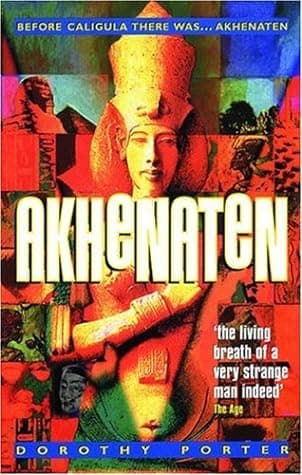
Dorothy Porter (1991)
Genre
Historical Fiction
Reading Time
180 min
Key Themes
See below
Sign in to track this book
In sun-drenched, verse-novel Egypt, Akhenaten, a pharaoh of incestuous desires and androgynous beauty, defies tradition to enthrone himself as the living embodiment of a singular, heretical sun god, only to face the calculated erasure of his megalomaniacal reign.
The story begins with Amenhotep IV's coronation in Thebes, where he is presented as the new Pharaoh. The young pharaoh immediately shows his dislike for the traditional polytheistic religion, especially the Amun cult. He declares his devotion to Aten, the sun disk, as the one true god, a radical change from Egyptian belief. This declaration surprises the court and priesthood, who are set in the old ways. Amenhotep IV starts ordering new temples for Aten, beginning his effort to dismantle the existing religious order and establish monotheistic worship centered on himself as Aten's prophet.
Queen Nefertiti, Amenhotep IV's wife, is a powerful and influential figure, often shown as an equal partner in his religious and political changes. She accepts Aten worship with her husband, strengthening her position at court. As resistance from the Amun priesthood grows in Thebes, Amenhotep IV decides to leave the old capital. He orders a new city, Akhetaten (Horizon of Aten), built in a desert location. This large project is meant to be a pure city dedicated only to Aten, free from the old gods and their priests. The move signals a complete break with tradition and a bold statement of his new religious order.
Amenhotep IV officially changes his name to Akhenaten, meaning 'Effective for Aten,' further showing his commitment to the new religion. He tries harder to suppress other gods, ordering their images defaced and their temples closed. The Amun priests lose their power and wealth, causing resentment among the people and elite. Akhenaten's religious passion nears fanaticism, as he promotes a direct, personal relationship with Aten, bypassing traditional priests. This radical change in belief and practice creates deep divisions in Egyptian society, with many secretly holding onto the old ways.
The novel looks into Akhenaten's complex and often troubling family life. Besides Nefertiti, Akhenaten has an incestuous relationship with his younger sister, Mutnedjmet, who becomes one of his secondary wives. This relationship shows the pharaoh's disregard for traditional rules and his belief in his divine right to act as he wishes. The poem explores the sensuality and power within these relationships, often from Akhenaten's viewpoint, revealing his self-absorption and belief in his unique status. His children, especially his daughters with Nefertiti, are also important in the court, often shown in intimate scenes with their parents.
Akhenaten's reign includes a revolutionary change in Egyptian art, known as the Amarna style. Traditional rigid, idealized depictions of pharaohs and gods are replaced by more naturalistic, even exaggerated, representations. Akhenaten himself is often shown with an elongated skull, narrow waist, and wide hips, features that have led to historical debate about his appearance. The art also shows the royal family in intimate, domestic scenes, a sharp contrast to earlier formal court art. This artistic change directly reflects Akhenaten's desire to break from the past and create a new aesthetic aligned with his monotheistic vision and emphasis on truth and naturalism.
While Akhenaten focuses on his religious changes and building Akhetaten, the Egyptian Empire's foreign policy and internal stability begin to fail. Letters from vassal states in the Near East, asking for military help against invading enemies, are largely ignored. The pharaoh's single-minded devotion to Aten means he neglects a ruler's traditional duties, including maintaining the empire's borders and alliances. This neglect leads to a decline in Egypt's international standing and the loss of territories, increasing discontent among the military and elite who see the empire weakening under his rule.
At some point during Akhenaten's reign, Queen Nefertiti appears less in public. Her images stop appearing with Akhenaten's, and her name is eventually replaced by her daughter, Meritaten, or another queen, Kiya. The novel does not explicitly state why she disappears, mirroring the historical mystery around her fate. This sudden absence creates a gap in the royal court and suggests a possible disagreement with Akhenaten, her death, or perhaps her taking on a different identity or role. Her disappearance adds to the sense of instability and the increasingly isolated nature of Akhenaten's court.
Towards the end of Akhenaten's reign, Smenkhkare appears as a co-regent. Smenkhkare's identity is unclear, with historical theories suggesting he could be Akhenaten's younger brother, a son, or even Nefertiti herself in a male role. The novel explores this ambiguity, showing Smenkhkare as a shadowy figure who briefly shares power with Akhenaten. This co-regency, followed by Smenkhkare's short and mysterious reign, highlights the succession crisis and political maneuvering within the royal family as Akhenaten's power fades and his health worsens. Smenkhkare's introduction signals the coming collapse of Akhenaten's experiment.
As his reign continues, Akhenaten becomes isolated within Akhetaten. His devotion to Aten alienates him from his people, the military, and even some in his court. The stress of maintaining his religious vision, combined with growing external threats and internal disagreement, affects his health. The novel shows him becoming more frail and detached from governing, focused only on his divine connection to Aten. He becomes a figure of intense, almost pathological, self-reflection, convinced of his unique destiny despite the crumbling world around him.
Akhenaten's reign ends with his death, the circumstances not explicitly detailed but implied to be from his declining health and the general instability of his rule. His death marks the quick undoing of his changes. The traditional priesthood, especially the Amun cult, quickly regains power. Akhetaten is abandoned, and efforts begin almost immediately to erase all traces of Akhenaten and his religion from Egyptian history. His death means the ultimate failure of his grand experiment, leading to a period of restoring the old order and the eventual rise of Tutankhamun.
The Protagonist/Antagonist
Akhenaten begins as an idealistic, revolutionary pharaoh but becomes increasingly isolated and consumed by his religious fervor, ultimately leading to the undoing of his legacy.
The Supporting
Nefertiti rises as a powerful co-ruler, fully embracing Akhenaten's vision, but eventually fades from prominence as the reign progresses.
The Supporting
Mutnedjmet serves as a secondary consort, representing Akhenaten's transgressions of traditional familial and moral boundaries.
The Supporting
Ay maintains his position and influence throughout Akhenaten's reign, poised to play a significant role in the post-Amarna restoration.
The Supporting
Horemheb observes the decline of the empire under Akhenaten, eventually rising to power after the Amarna period to restore order.
The Mentioned
His eventual reign marks the undoing of Akhenaten's reforms and the return to traditional Egyptian religion.
The Antagonist
Initially powerful, they are suppressed by Akhenaten but eventually regain their authority after his death.
The Mentioned
Aten's worship rises and falls with Akhenaten's reign, ultimately being suppressed after his death.
The main conflict in the novel is Akhenaten's zealous monotheism (Atenism) against Egypt's traditional polytheistic beliefs, especially the Amun cult. Akhenaten's radical changes, such as defacing old gods and building a new capital, show how destructive and isolating his fanaticism is. The theme explores the tension between revolutionary ideas and established belief systems, showing how forced change often leads to resentment and backlash, as seen in the undoing of Akhenaten's legacy.
“I am the sun, the disk, the living Aten. / There is no god but me, and Akhenaten is my prophet.”
Akhenaten's reign is a study of absolute power and its corrupting effect, appearing as megalomania. He believes himself divine, the sole link between Aten and humanity, leading to a cult of personality centered on him. This theme is clear in his disregard for traditional authority, his incestuous relationships, and his single-minded pursuit of his vision at the empire's expense. The novel explores how unchecked power can lead to isolation and, ultimately, the downfall of the ruler and his kingdom, as Akhenaten's obsession blinds him to his empire's failing state.
“My will is the will of Aten. My word is the law. / Let the old gods crumble, for I am the new dawn.”
The radical shift in Egyptian art during Akhenaten's reign, known as the Amarna style, is a main theme. The novel explores how art becomes a direct tool for expressing ideas, breaking from centuries of rigid tradition to show more natural, often intimate, portrayals of the royal family and the pharaoh. This artistic freedom, however, is still controlled by Akhenaten's vision, reflecting his desire to reshape religion and aesthetic perception. The unique, elongated features of Akhenaten in Amarna art symbolize his unique, almost alien, presence in Egyptian history.
“Let my face be as it is, not as it should be. / For truth is beauty, and beauty is Aten.”
The theme of incest appears through Akhenaten's relationships, especially with his sister, Mutnedjmet. This breaking of a deep-seated rule shows Akhenaten's belief in his divine right to act beyond human morality. It emphasizes his isolation, self-indulgence, and complete break from traditional societal norms. The incestuous relationships further highlight his megalomaniacal tendencies, where he sees himself above human laws, able to control even the most intimate aspects of his family life according to his desires.
“My sister, my wife, my blood. / In our union, the divine is made manifest.”
The novel implicitly explores the theme of legacy and its deliberate erasure. Akhenaten's attempts to create a lasting monotheistic legacy are ultimately stopped, as his successors systematically dismantle his reforms and try to remove his name and memory from history. This theme highlights the fragility of power and the disputed nature of historical memory. The archaeological discovery of Akhenaten's remnants, despite efforts to erase him, underscores the lasting power of his controversial reign and the human desire to understand forgotten histories.
“They will try to unmake me, to bury my name. / But the sun still rises, and Aten remembers.”
The story is primarily told from Akhenaten's obsessive, poetic perspective.
The novel's use of Akhenaten's first-person voice allows readers direct access to his innermost thoughts, desires, and fanatical beliefs. This grants a unique, intimate, and often disturbing insight into his megalomania, his artistic sensibilities, and his unwavering devotion to Aten. By filtering events through his subjective lens, the narrative emphasizes his isolation and self-absorption, while also making him a compelling, if unreliable, narrator. It allows the reader to experience his world as he perceives it, justifying his radical actions from his own point of view.
The entire novel is written in poetic verse.
The use of verse, rather than traditional prose, elevates the language and creates a lyrical, incantatory quality that mirrors the religious and artistic fervor of Akhenaten's reign. The poetic form allows for intense emotional expression, vivid imagery, and a sense of timelessness appropriate for a historical figure. It also lends itself to the obsessive, repetitive nature of Akhenaten's thoughts, making his pronouncements feel like hymns or divine decrees. The rhythm and cadence of the verse enhance the hypnotic and often unsettling atmosphere of the narrative.
The narrative embraces and explores the gaps and uncertainties in Akhenaten's historical record.
Rather than providing definitive answers, the novel leans into the historical ambiguities surrounding Akhenaten's life, such as Nefertiti's disappearance, the identity of Smenkhkare, and the exact circumstances of his death. This device adds to the mystery and allure of the story, allowing for interpretive depth and imaginative reconstruction. It highlights the fragmentary nature of historical knowledge and invites the reader to contemplate the 'silences' in the past, making the characters and events feel both historically grounded and mythic.
The pervasive use of light (Aten) and darkness (old gods/ignorance) as symbolic motifs.
Light, primarily embodied by Aten, symbolizes truth, divine revelation, and Akhenaten's enlightened vision. Darkness, conversely, represents the old gods, ignorance, and the resistance to Akhenaten's reforms. This pervasive symbolism underscores the central religious conflict and Akhenaten's fervent belief in his monotheistic path. The contrast between the blinding light of Aten and the shadow of forgotten deities creates a vivid metaphorical landscape that reflects Akhenaten's internal and external struggles, emphasizing the stark dualism of his world view.
“The gods are not in the heavens; they are within us, and we are within them.”
— Akhenaten's early philosophical musings, challenging traditional polytheism.
“To change a kingdom, one must first change the hearts of its people.”
— Akhenaten contemplating the resistance he faces in implementing his reforms.
“There is no greater beauty than truth, and no greater truth than the Aten.”
— Akhenaten's fervent declaration of his new religion.
“A king's strength is not in his army, but in the devotion of his subjects.”
— Akhenaten reflecting on the political challenges and his focus on spiritual rather than military power.
“The old ways are a comfortable shroud, but they can also suffocate the future.”
— Akhenaten's internal monologue about the need to break from tradition.
“Love is not just a feeling; it is the light by which we see the divine.”
— Akhenaten's personal reflections on his relationship with Nefertiti and his spiritual beliefs.
“To build a new city is to build a new world, brick by sacred brick.”
— Akhenaten's vision and dedication to the construction of Akhetaten.
“Silence can hold more power than any decree, if one knows how to listen to it.”
— Akhenaten observing the subtle shifts in court opinion and public mood.
“The sun gives life to all, and in its pure light, all are equal.”
— A core tenet of Akhenaten's Atenism, promoting a sense of universal equality.
“A dream, however grand, is nothing without the will to make it real.”
— Akhenaten's determination to bring his religious and social reforms to fruition.
“Even the mightiest river can be diverted, if the current is strong enough.”
— Akhenaten's metaphor for the profound changes he seeks to enact upon Egyptian society.
“The past is a heavy chain, but the future is an open sky.”
— Akhenaten's constant struggle to move beyond the entrenched traditions of his ancestors.
“To see the world anew, one must first unlearn all that has been taught.”
— Akhenaten's radical approach to knowledge and his rejection of established dogma.
“There are shadows even in the brightest light, and it is in those shadows that doubt takes root.”
— Akhenaten's moments of introspection and the internal struggles he faces.
Ready to see how well you understood this book? Take our interactive quiz with 10 questions.

Dorothy Porter was an Australian poet and author, primarily known for her groundbreaking novel 'Akhenaten.' Her work often explored themes of history, mythology, and the human psyche with a distinctive lyrical and experimental style. Porter's contributions significantly enriched Australian literature, particularly within the realm of speculative and historical fiction.