“The machine was not a mystery. It was a problem.”
— Casey looking at the damaged plane, emphasizing her practical, engineering mindset.

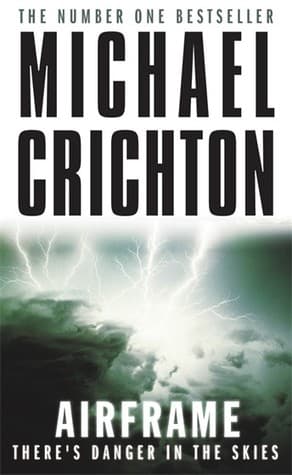
Michael Crichton (1996)
Genre
Thriller / Mystery / Science Fiction
Reading Time
9-10 hours
Key Themes
See below
Sign in to track this book
After a routine flight turns into a bloody mid-air mystery, a corporate investigator races to find out what happened on the crippled jet before public opinion and corporate rivals ruin the airline's reputation.
TransPacific Airlines Flight 545, a new N-22 wide-body jet, flying from Hong Kong to Denver, declares an emergency off the coast of California. The pilot reports severe turbulence and asks for priority landing at Los Angeles International Airport (LAX), requesting forty ambulances. When the plane lands, rescue workers find a terrible scene: ninety-four passengers are hurt, three are dead, and the plane's inside is badly damaged, with seats torn loose and blood everywhere. Everyone assumes extreme turbulence, but the amount of damage and the crew's vague statements raise questions.
Casey Singleton, Vice President of Quality Assurance at Norton Aircraft, the N-22's maker, is called in by her boss, John Marder. TransPacific Airlines threatens to cancel a multi-billion dollar order for more N-22s, which could bankrupt Norton. Casey has only twelve hours to write an initial report explaining what happened on Flight 545, as the media and corporate rivals close in. Her main goal is to find out if the incident was due to a mechanical failure of the N-22, which would be disastrous for Norton.
Casey's team, including technician Doug Doherty, starts a careful examination of the N-22. They find no clear signs of structural failure or mechanical problem that would explain the damage. Meanwhile, interviews with the flight crew, including Captain John Hammond and First Officer Ted Olsen, give inconsistent and evasive answers. The flight attendants are too traumatized to give clear details. A key piece of evidence, the cockpit voice recorder (CVR), is found, but its contents are vital and must be analyzed carefully. The pressure on Casey grows as time runs out.
The media descends on LAX, and sensational reports start appearing, often suggesting a design flaw in the N-22. Marty Reardon, a well-known tabloid journalist, becomes a constant problem, trying to control the story. Casey also suspects that Norton's rival, Donaldson Aircraft, is actively trying to hurt Norton's reputation by leaking false information and encouraging TransPacific to cancel their order. Her investigation is not just about finding the truth, but also about protecting Norton from outside attacks.
Doug Doherty and his team carefully analyze the Flight Data Recorder (FDR), which records things like airspeed, altitude, and control surface movements. The data starts to contradict the crew's claims of severe clear-air turbulence. Instead, the FDR suggests unusual and violent maneuvers, including rapid climbs and descents and sudden turns. These are not consistent with normal flight or even extreme weather. This discovery shifts the focus from a possible aircraft problem to a possible human factor or outside force.
Casey learns that a Chinese delegation, led by Ambassador Chang, was on Flight 545. This delegation was important to a multi-billion dollar deal for Norton to sell N-22s to China. The incident, especially the death of one of the Chinese delegates, threatens to ruin this critical deal. The delegation's presence adds another layer of complexity to the investigation, suggesting possible motives beyond simple mechanical failure or turbulence. The political and economic stakes are very high.
A breakthrough happens when Casey's team finds a passenger's camcorder. The footage, though shaky and broken, gives a terrifying, first-hand account of the events inside the cabin. It clearly shows a violent struggle, not just turbulence. Passengers are seen fighting, and the camera catches glimpses of a young woman, later identified as Charlotte Kinross, acting erratically and aggressively, attacking other passengers. This footage completely changes the direction of the investigation, pointing to a deliberate act of violence.
Casey focuses on Charlotte Kinross, the woman seen attacking passengers in the video. Kinross is a former Norton Aircraft employee who was fired for incompetence. Driven by anger and a desire for revenge, she planned the incident. Her plan was to fake an aircraft malfunction by causing chaos and damage, then claim she was a heroic victim. Her goal was to discredit Norton and profit from the lawsuits and media attention, possibly with help from a rival company or a lawyer specializing in aviation incidents.
Casey, with the video evidence and FDR data, confronts the flight crew. They finally admit they covered up the truth to protect their careers and avoid blame. Kinross, with help from some crew members and possibly outside plotters, deliberately caused the damage by violently attacking passengers and interior fittings. She then claimed the plane had severe, unexplained turbulence. The three deaths were a direct result of her actions, not a mechanical failure. The crew's initial claims were a desperate attempt to avoid responsibility.
At a high-stakes press conference, Casey Singleton presents her findings. She uses the video footage and data to prove that the N-22 was not at fault. She reveals that Charlotte Kinross, acting out of malice, was responsible for the violence on board, and that the flight crew, fearing consequences, tried to cover it up. This revelation clears Norton Aircraft, saving the company from financial ruin and restoring its reputation. Kinross is arrested, and the crew members face charges for their involvement and obstruction.
The Protagonist
Casey evolves from a diligent but somewhat overlooked executive to a confident leader who saves her company through her unwavering pursuit of truth.
The Supporting
Marder initially pushes Casey for a quick, favorable report but eventually trusts her judgment as the true nature of the incident unfolds.
The Supporting
Doug's role remains consistent as a reliable technical expert, crucial to the investigation's success.
The Antagonist
Kinross is revealed as the mastermind behind the incident, her carefully constructed facade crumbling as Casey uncovers the truth.
The Supporting
Reardon remains a persistent antagonist, ultimately exposed as a purveyor of misinformation.
The Supporting
Hammond transitions from evasiveness to reluctant confession as the evidence against him and his crew mounts.
The Supporting
Olsen, like Hammond, is forced to reveal the truth under Casey's persistent investigation.
The Mentioned
His involvement highlights the global implications of the incident.
The novel explores how truth can be hidden, manipulated, and seen differently based on individual biases and outside pressures. Initial reports of 'turbulence' are widely accepted until Casey's careful investigation uncovers the reality of a deliberate attack. The media, corporate rivals, and even the flight crew actively shape perceptions to serve their own goals, making it hard for Casey to find out what really happened. This theme is clear in the different stories presented by Marty Reardon versus Casey's evidence-based findings.
“''Everybody sees what they want to see, or what they're paid to see.''”
The novel looks at the harsh world of corporate competition, especially in the aviation industry. Norton Aircraft faces not only the immediate crisis of Flight 545 but also active sabotage from rival companies like Donaldson Aircraft. Ethical lines blur as competitors leak false information and try to use the disaster for their own financial gain. Casey's fight is as much against outside corporate enemies as it is about finding the truth of the incident itself, showing the moral compromises made to make money.
“''In this business, you don't just compete. You attack.''”
Crichton critically examines the powerful and often harmful role of the media, especially tabloid journalism, in shaping public opinion during a crisis. Marty Reardon shows this by valuing sensationalism and a dramatic story over factual accuracy. His constant pursuit of Casey and his willingness to publish unproven rumors create fear and suspicion, putting huge pressure on Norton and hindering the investigation. The novel shows how media can twist events, cause panic, and even influence corporate decisions, regardless of the truth.
“''The public doesn't want the truth, Casey. They want a story.''”
A main tension in the story is whether the incident was caused by a technological failure of the advanced N-22 aircraft or by human actions. Initially, people assume a mechanical flaw, matching public fears about new technology. However, Casey's investigation, using data from the FDR and raw camcorder footage, systematically disproves this. The final reveal points to human malice and a deliberate act of violence, made worse by human error (the crew's cover-up). This shows that even with advanced technology, the human element remains the most unpredictable and dangerous factor.
“''The machine is perfect. It's the people who are not.''”
The theme of responsibility is explored through many characters. Charlotte Kinross is directly responsible for the violence and deaths, driven by personal revenge. The flight crew, Captain Hammond and First Officer Olsen, are accountable for their initial cover-up and misleading statements, trying to avoid blame for not controlling the situation. Casey, in contrast, shows accountability, relentlessly seeking the truth even when it is uncomfortable or politically inconvenient for her company. The novel argues for the need for individuals to take responsibility for their actions, regardless of the outcomes.
“''The truth is always inconvenient, but it has to be told.''”
A ticking clock that creates intense pressure and urgency for Casey's investigation.
The arbitrary twelve-hour deadline imposed by John Marder on Casey forces her to work with extreme speed and efficiency. This device heightens the tension throughout the narrative, making every discovery and every interview feel critical. It also serves to illustrate the immense corporate pressure Casey is under, as the fate of Norton Aircraft hinges on her ability to produce a credible report within this impossible timeframe. The deadline is a constant reminder of the high stakes involved.
Key technological artifacts that provide objective evidence of the flight's events.
The FDR and CVR act as crucial, unbiased witnesses to the events on Flight 545. The FDR's detailed data, recording airspeed, altitude, and control inputs, objectively contradicts the crew's claims of turbulence. The CVR, though initially difficult to interpret, eventually provides audio clues. These devices represent the triumph of objective data over subjective accounts and cover-ups, allowing Casey to piece together the truth despite human deception and faulty memory.
A found-footage element that provides a visceral, undeniable eyewitness account from inside the cabin.
The discovery of the camcorder footage is the turning point in the investigation. It serves as a visual, unfiltered, and irrefutable piece of evidence that directly contradicts all previous assumptions and lies. The shaky, chaotic footage brings the horror of the event directly to the reader and Casey, shifting the focus from mechanical failure to human violence. It's a powerful device for revealing the 'hidden' truth and exposing the perpetrator.
Misleading clues and initial assumptions designed to divert the investigation.
The initial and widely accepted explanation for the incident—severe clear-air turbulence or a mechanical flaw in the N-22—serves as a major red herring. This narrative is reinforced by the crew's vague statements and the media's sensationalism. These diversions force Casey to painstakingly eliminate false leads and challenge conventional wisdom, making her eventual discovery of human malice all the more impactful. They highlight the difficulty of finding truth amidst misinformation.
“The machine was not a mystery. It was a problem.”
— Casey looking at the damaged plane, emphasizing her practical, engineering mindset.
“There's always a reason. Sometimes it's a good reason, sometimes it's a bad reason, but there's always a reason.”
— A recurring theme, often stated by Casey, about understanding the root cause of events.
“Everyone wants to believe the worst. It's a fundamental human trait.”
— Discussing the media's and public's tendency to jump to negative conclusions.
“The truth is rarely pure and never simple.”
— A general observation about the complexity of real-world situations, especially in investigations.
“Aviation is a series of compromises.”
— Discussing the design and operational realities of aircraft, balancing various factors.
“People don't want to know the truth. They want to be told a story.”
— Casey reflecting on how information is received, particularly by the public and media.
“The difference between an accident and an incident is often a matter of luck, and a few inches.”
— Emphasizing the fine line between a minor event and a catastrophic failure in aviation.
“If you don't know what you're looking for, you won't find it.”
— A principle of investigation, highlighting the importance of having a clear objective.
“The purpose of a press conference is to control the message, not to convey information.”
— Discussing the strategic use of media in corporate crisis management.
“No amount of data will ever replace a good pair of eyes and a clear head.”
— Casey valuing direct observation and critical thinking over purely digital analysis.
“Fear is a powerful motivator. And a powerful distorter.”
— Examining how fear can influence both actions and perceptions during a crisis.
“The world is not a perfect place, and neither are the machines we build.”
— Acknowledging the inherent imperfections in technology and human endeavors.
“The more complex the system, the more ways it has to fail.”
— A principle of engineering and system design, relevant to modern aircraft.
“Sometimes the most obvious explanation is the right one, and sometimes it's the one they want you to believe.”
— Casey's cautious approach to initial findings, always considering ulterior motives.
Ready to see how well you understood this book? Take our interactive quiz with 10 questions.

Biography coming soon.







