“Satyagraha means holding onto truth with all your might. It means following your conscience.”
— Anjali's father explains the meaning of Satyagraha to her.

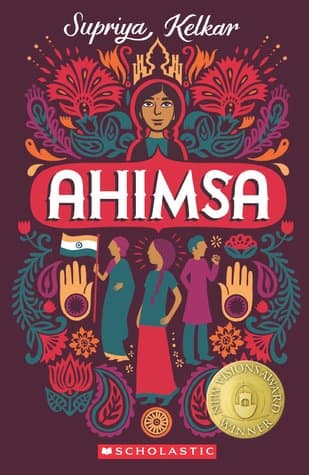
Supriya Kelkar (2018)
Genre
Children's / Historical Fiction / Young Adult
Reading Time
240 min
Key Themes
See below
Sign in to track this book
In 1942 India, ten-year-old Anjali faces personal sacrifice and societal prejudice when her mother joins Gandhi's non-violent freedom movement, forcing Anjali to confront her own biases and eventually lead the charge when her mother is imprisoned.
In 1942, ten-year-old Anjali lives a comfortable life in a British-controlled Indian city, enjoying her fine foreign-made clothes and the privileges of her upper-caste status. Her father works for the British government, providing a stable existence for their family. However, the political situation changes when Mahatma Gandhi calls for Indians to join the freedom movement through 'ahimsa,' non-violent resistance. Anjali fears her father will join, disrupting their lives. To her shock, her mother, a quiet but determined woman, announces she will dedicate herself to the cause, changing Anjali's world and perceptions.
The first major change in Anjali's life is the adoption of swadeshi, the boycott of foreign goods in favor of Indian-made products, especially khadi, homespun cloth. Anjali is sad when she must give up her beautiful, imported dresses, including her favorite blue frock, and wear scratchy khadi instead. Her mother, committed to Gandhi's principles, begins to spin her own yarn on a charkha. This shift is not just about clothing; it means a deeper commitment to the independence movement and a rejection of British economic control. Anjali struggles with these changes, missing her old comforts.
Anjali's mother expands her involvement in the freedom movement by focusing on helping the Dalit community, traditionally called 'untouchables.' This includes visiting the Dalit settlement and advocating for their rights. Anjali, raised with her caste's prejudices, is uncomfortable with this. She is particularly distressed when her mother insists on cleaning their own latrine, a task traditionally done by Dalits, to show equality. Anjali initially resists engaging with Mohan, a Dalit boy her age, but slowly, through her mother's example, her rigid views begin to soften.
Despite her initial reluctance, Anjali interacts more with Mohan. She learns about the harsh realities of his life, including the discrimination he faces daily, the lack of opportunities for his community, and his family's struggles. Mohan is a kind and intelligent boy, and through their conversations and shared experiences, Anjali begins to see him as a person, not an 'untouchable.' This friendship is important in Anjali's personal growth, challenging her upbringing and her ideas about caste and social hierarchy, embodying the equality her mother champions.
Anjali's father, a government clerk, seems loyal to the British. However, Anjali gradually discovers that he secretly helps the independence movement by passing information to her mother. He uses his position to gather intelligence and provide support, a dangerous act that could cost him his job, freedom, or life. This revelation adds another layer of complexity to Anjali's understanding of her family's commitment and the risks involved in the freedom struggle. She realizes that even those who appear to be on the British side may secretly support nationalist sentiments.
The intensifying freedom movement leads to widespread arrests of activists. One day, British officers arrive at Anjali's home and arrest her mother for her participation in protests and her work with the Dalit community. Anjali is devastated and afraid, but her mother, before being taken away, asks Anjali to continue her work, especially her efforts in the settlement. This moment is a turning point, putting Anjali in a leadership role she never expected. She feels the immense responsibility, realizing she must step up and carry on her mother's legacy despite her fears.
Following her mother's arrest, Anjali, though nervous, resolves to fulfill her promise. She begins to visit the Dalit settlement, taking over her mother's role of teaching the children and distributing supplies. She faces initial doubt and challenges, but her determination slowly wins over the community. This work forces Anjali to confront her remaining prejudices and develop her own sense of purpose. She learns practical skills, like organizing and teaching, and gains a deeper understanding of the struggles faced by the Dalit community, solidifying her commitment to their upliftment.
Anjali embraces spinning khadi, recognizing its symbolic and practical importance to the freedom movement. She teaches others in the settlement to spin, empowering them with a means of self-sufficiency and a way to contribute to the economic boycott of British goods. Spinning becomes a unifying activity, connecting Anjali to her mother's legacy and the larger struggle. She learns that even small acts like spinning thread can be powerful forms of resistance and community building, embodying the principles of ahimsa and swadeshi.
Anjali's continued activism does not go unnoticed. She faces threats from British authorities and their supporters, who try to discourage her work. There are moments of fear, but Anjali draws strength from her mother's example and her growing connection to the community. She learns to navigate dangerous situations, becoming more resilient and courageous. These challenges strengthen her resolve, cementing her commitment to the cause and showing her transformation from a sheltered child to a determined activist.
Anjali and the community participate in a non-violent protest against British rule, using Gandhi's methods. British police meet the protest with force, using lathis (batons) to disperse the crowd. Anjali sees the violence firsthand, a terrifying experience that solidifies her understanding of the sacrifices made for freedom. Despite the danger, she stands her ground, demonstrating her newfound courage and commitment to ahimsa, even when confronted with aggression. This event shows the brutality of colonial rule and the bravery needed to resist it.
Following the lathi charge and continued oppression, Anjali rallies the community in an act of non-violent resistance. She organizes a demonstration where they refuse to cooperate with British demands, embodying Gandhi's principle of civil disobedience. This act of unity, despite the risks, shows the strength of their collective will and their commitment to freedom. Anjali's leadership in this moment solidifies her role as a respected figure within the movement, showing her ability to inspire others towards a common goal.
After a period of imprisonment, Anjali's mother is released. The reunion is emotional, but what strikes her mother most is Anjali's transformation. The shy, prejudiced girl has become a confident, compassionate young activist, committed to social justice and the freedom movement. Anjali has not only continued her mother's work but has also grown into her own, embodying the principles of ahimsa and equality. Her mother expresses pride in Anjali's courage and dedication, acknowledging her daughter's contributions to the cause and her personal growth.
As the story concludes, while India's independence is still some years away, Anjali looks to the future with hope. She continues her work, now alongside her mother, with a deeper understanding of social justice and the power of non-violent resistance. Her experiences have shaped her into a young woman who not only dreams of a free India but actively works towards one where all people are treated with dignity and respect.
The Protagonist
Anjali transforms from a sheltered, prejudiced child into a brave, empathetic activist who takes on her mother's work and challenges social injustices.
The Supporting
She embodies the principles of the freedom movement, inspiring her daughter and community through her selfless dedication and courage.
The Supporting
He maintains a facade of loyalty while secretly contributing to the freedom movement, demonstrating a different kind of bravery.
The Supporting
He serves as a guide for Anjali, helping her confront and overcome her prejudices and understand the broader struggle for social equality.
The Mentioned
His philosophy provides the foundational principles for the characters' actions and the overarching narrative.
The Antagonist
They serve as the embodiment of the oppressive colonial power that the protagonists are working to overthrow.
The central theme of the book, 'ahimsa,' or non-violent resistance, is directly inspired by Mahatma Gandhi's philosophy. It appears through the family's adoption of swadeshi (wearing homespun khadi, as seen when Anjali gives up her foreign clothes), the peaceful protests, and the willingness to endure hardship and imprisonment without retaliation. Anjali's mother shows this, and Anjali learns to practice it when she continues her mother's work, facing threats with courage but without violence. It is shown as a powerful force capable of challenging oppression.
“''Ahimsa is not just about not hurting others. It's about loving everyone, even those who hurt you.''”
The book explores caste discrimination, particularly the situation of the Dalit community. Anjali's journey from holding prejudices to forming a friendship with Mohan and working in the settlement highlights the importance of social equality as part of true independence. Her mother's dedication to cleaning her own latrine and advocating for Dalits directly confronts the 'untouchability' practice. The narrative suggests that political freedom is incomplete without social justice, emphasizing that all people deserve dignity and respect, regardless of their birth.
“''How can we be free if we don't treat everyone as equal?''”
Anjali's personal growth is a main theme. She transforms from a sheltered, somewhat self-centered child into a brave, empathetic, and responsible activist. This transformation is driven by her mother's example, her friendship with Mohan, and the need to take over her mother's duties after the arrest. She overcomes her fears and prejudices, finding her own voice and strength to lead and contribute to the movement. Her journey shows that even ordinary individuals, especially children, can find courage and make significant contributions to a larger cause.
“''Being brave doesn't mean you're not scared. It means you do what's right, even when you are.''”
The theme of sacrifice is present throughout the narrative. Anjali's family gives up their comforts and foreign goods for swadeshi. Her mother sacrifices her freedom by going to jail, and her father risks his job and safety by secretly aiding the movement. Anjali, too, sacrifices her childhood innocence and comfort to continue her mother's work. These personal sacrifices are portrayed as acts of patriotism, demonstrating individuals' deep commitment to an independent India. The book shows that freedom comes at a cost, requiring great personal dedication.
“''Sometimes, to gain something truly great, you have to give up things you hold dear.''”
The story emphasizes how collective action and unity are essential for the freedom movement's success. Anjali's work in the settlement, teaching the children and organizing spinning, builds a sense of community among the marginalized. The protests and acts of civil disobedience are powerful because many people act together. The unity between different castes, as shown by Anjali and Mohan's friendship, strengthens the movement against the common oppressor. The book illustrates that a unified front, even through non-violent means, can challenge power.
“''When we stand together, even the smallest voices can make a mighty roar.''”
Represents self-reliance, resistance, and unity.
Khadi, the homespun cotton cloth, is a powerful symbol throughout the book. It represents swadeshi, the economic boycott of British goods, and promotes self-reliance and Indian industry. For Anjali, giving up her fine foreign clothes for scratchy khadi is a personal sacrifice and a step towards embracing the movement. The act of spinning khadi becomes a meditative and unifying activity, connecting individuals to the larger cause and embodying the simplicity and purity of Gandhi's ideals. It's a tangible manifestation of resistance and national pride, worn by all as a badge of defiance.
Anjali's journey from childhood innocence to mature activism.
The narrative is structured as a coming-of-age story for Anjali. She begins as a sheltered, somewhat prejudiced child and, through the challenges and responsibilities thrust upon her, grows into a courageous, empathetic, and politically aware young woman. Her journey involves overcoming personal fears, confronting societal biases, and taking on adult responsibilities. This arc allows young readers to connect with Anjali's personal struggles and triumphs, making the historical context more accessible and relatable as they witness her transformation and self-discovery within the larger independence movement.
Allows intimate access to Anjali's evolving thoughts and feelings.
The story is told from Anjali's first-person perspective, providing an intimate and immediate window into her experiences, fears, prejudices, and eventual growth. This viewpoint allows readers to deeply empathize with her struggles as she navigates the complexities of the freedom movement and challenges her ingrained beliefs. It effectively conveys the emotional impact of the historical events on a young individual, making the grand historical narrative personal and relatable. Her evolving understanding of ahimsa, caste, and patriotism is central to the narrative's emotional resonance.
Creates suspense and highlights the varied forms of resistance.
Anjali's father's secret involvement as an informant for the freedom movement serves as a plot device that introduces an element of suspense and moral complexity. It challenges Anjali's initial perception of him as simply a British loyalist and reveals the hidden dangers faced by those who resisted colonial rule. This device also illustrates that resistance took many forms, not just overt protest, and that patriotism could exist even within the ranks of those seemingly aligned with the oppressor. His clandestine actions underscore the pervasive nature of the independence struggle.
“Satyagraha means holding onto truth with all your might. It means following your conscience.”
— Anjali's father explains the meaning of Satyagraha to her.
“Bapu says we must not hate the British, only their actions. It is hard to remember that sometimes.”
— Anjali reflects on Gandhi's teachings about non-violence and hate.
“The spinning wheel isn't just for making cloth. It's for making us free.”
— Anjali understands the deeper symbolism of the charkha.
“Sometimes, the biggest battles are not fought with fists, but with silence and stubbornness.”
— Anjali learns about different forms of resistance.
“How can you fight for freedom when you don't even have the freedom to choose your own clothes?”
— Anjali questions the hypocrisy of British rule and the importance of Swadeshi.
“Ahimsa isn't just about not hurting others. It's about actively loving them.”
— Anjali's mother explains the full meaning of ahimsa.
“Even a small act of kindness can be a revolution.”
— Anjali observes the impact of seemingly minor gestures.
“Fear is a powerful weapon, but hope is even stronger.”
— Anjali confronts her own fears and finds courage.
“It's easy to follow rules when they make sense. It's harder when they don't, but you still have to.”
— Anjali grapples with unjust laws and her duty.
“The greatest strength is not in never falling, but in rising every time you fall.”
— Anjali learns about resilience through her experiences.
“Sometimes, the truth is not what you want to hear, but what you need to understand.”
— Anjali faces difficult realities about her world.
“Change starts with one person, one thought, one small act.”
— Anjali realizes her own potential to make a difference.
“Learning to forgive is harder than fighting, but it's the only way to truly be free.”
— Anjali processes her feelings towards those who have wronged her.
Ready to see how well you understood this book? Take our interactive quiz with 10 questions.

Dan Gemeinhart
4.5

Kate O'Hearn
4.4

Jeanne Birdsall
4.4

Jen Wang
4.4

Wendelin Van Draanen
4.3

John Marsden
4.3

Chris Van Allsburg
4.3

Jennifer A. Nielsen
4.2