BookBrief
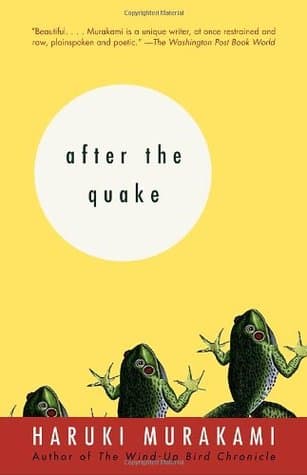
After the Quake cover
Archivist's Choice

After the Quake

Haruki Murakami

Genre

Fantasy

Reading Time

180 min

Key Themes

See below

Track Your Reading

Sign in to track this book

After the Kobe earthquake, ordinary people face strange challenges: an electronics salesman delivers a mysterious package, a 'son of God' searches for his human father, and a giant talking frog asks for help to save Tokyo. These events reveal the odd, often unsettling, parts of human life.

Synopsis

In "After the Quake," Haruki Murakami explores how the 1995 Kobe earthquake affects people's minds and feelings in six connected short stories. The earthquake itself is rarely the main event, but its impact pushes characters to deal with life's fragility and the strange things that lie beneath everyday life. Characters struggle with being left alone, feeling lost, and trying to find meaning when their world suddenly seems unstable. In 'UFO in Kushiro,' a man's wife leaves him after the quake. He then takes on an unusual delivery that helps him understand himself. 'Frog Saves Tokyo' features a quiet man recruited by a giant talking frog and a worm to stop a second, worse earthquake by fighting an even bigger worm. Across the collection, normal people face unusual situations, often blurring the line between real life and dreams, as they handle personal problems that reflect the wider societal changes caused by the disaster.
Reading time
180 min
Difficulty
Medium
Pacing
Moderate
Mood
Dreamlike, Reflective, Slightly Melancholy, Surreal
✓ Read this if...
You enjoy surrealism, introspective character studies, and stories where external events trigger deep internal shifts.
✗ Skip this if...
You prefer straightforward narratives without ambiguity or strong elements of magical realism.

Plot Summary

UFO in Kushiro

Komura, an electronics salesman in Tokyo, is suddenly left by his wife, Kyoko. She says the Kobe earthquake made her realize she could not live with someone who cared about nothing. Upset, Komura takes a week off work. His colleague, Sasaki, asks him to deliver a mysterious package to a woman named Keiko in Hokkaido. The package, a small, empty box, has unclear meaning. Komura travels to Kushiro, meets Keiko and her friend Shimao, and delivers the box. Keiko is curious but not surprised by its emptiness, hinting at its symbolic nature. Later, Shimao invites Komura to her hotel room. There, she shares a dream about a UFO and a bear, suggesting a link to his wife's departure and his own emptiness. Komura spends the night with Shimao, starting to feel emotions again.

Landscape with Flatiron

Junko, a young woman in a small seaside town, works at a convenience store. She struggles with insomnia and a feeling of dread after the Kobe earthquake. She often visits the beach late at night, where she meets an older man named Keisuke. Keisuke spends his nights building small bonfires from driftwood, then puts them out with water, saying he is 'killing' them. He tells Junko about a man who lost his family in the earthquake and is now deeply sad. Junko feels a strange connection to Keisuke's rituals and stories, which echo her own feelings of helplessness and loss, even though the quake did not directly affect her. She continues to watch him, finding a strange comfort in his repeated, seemingly pointless actions.

All God's Children Can Dance

Yoshiya, a religious and somewhat naive young man, was raised by his mother to believe he is the son of God. His mother still strongly believes this. He works in an office and lives a quiet life, but his mother's strong faith, even after the Kobe earthquake, affects him greatly. One day, he sees a man at a train station who looks much like a photo of his mother's old lover, a man who might be his biological father. Yoshiya feels he must follow this stranger. He trails the man through the city, watching him from a distance, thinking about what this possible meeting means. The chase leads him to a deserted baseball field late at night. There, he has a deep, almost spiritual, moment of understanding himself and connecting to the world, questioning his mother's story and his own identity.

Thailand

Dr. Satsuki, a successful gynecologist, goes to Thailand for a solo vacation. She seeks a break from her busy life and the worries from the Kobe earthquake, which affected her deeply. While at a resort, she gets daily massages from a quiet, elderly Thai woman. One day, the old woman performs a special ritual for Satsuki, with chanting and a strange, symbolic stone. The woman then tells Satsuki about a 'box' inside her, filled with 'bad things' — hatred, anger, and betrayal — from a man in her past. The old woman warns Satsuki these feelings will soon burst out and destroy her. Satsuki is deeply troubled by this prediction, facing old emotional baggage she had tried to hide, especially about a past lover.

Frog Saves Tokyo

Katagiri, a quiet loan collection agent, comes home to find a giant, six-foot-tall talking frog waiting for him. The Frog explains that a huge worm, named Worm, is moving under Tokyo because of the Kobe earthquake. If it fully awakens, it will cause an even worse earthquake that will destroy the city. Frog tells a confused Katagiri that he needs his help to defeat Worm, as Katagiri has a special spiritual energy that can boost Frog's strength. Katagiri, despite his initial disbelief and fear, is reluctantly drawn into this absurd mission. He finds himself getting ready for a fantastical battle against an unseen, underground threat, all while dealing with his normal job and personal life.

Honey Pie

Junpei, a writer, has secretly loved his best friend, Sayoko, for years. Sayoko is now married to Takatsuki and has a young daughter named Sala. After the Kobe earthquake, Sala starts having bad dreams about a giant bear called 'Earthquake Bear' who comes to eat her. To help Sala, Sayoko asks Junpei to make up a story about a brave 'Honey Pie' who fights the bear. Junpei tells a comforting story, but the nightmares continue. He feels a deep bond with Sala and Sayoko, and the story becomes a way to talk about the hidden dangers and emotional weaknesses they all face. The story shows Junpei's unreturned love and his wish to protect Sayoko and Sala, even as he sees Sayoko's marriage growing distant.

Frog's Sacrifice

In 'Frog Saves Tokyo,' the giant Frog, with Katagiri's spiritual help, gets ready for his fight against Worm deep under Tokyo. Katagiri is supposed to stay in a hotel room, giving moral support through a phone. However, he falls into a coma-like state, dreaming of the battle. In his dream, he sees Frog's heroic fight against the huge Worm, a clear and violent clash. Frog, despite his great power, is badly hurt. Katagiri wakes up in a hospital, learning that Frog has vanished, leaving only a pool of blood. The city is safe, but the experience changes Katagiri deeply, making him question if his encounter was real and what his part in saving Tokyo was. He is left to think about heroism and sacrifice.

Sayoko's Dilemma

In 'Honey Pie,' Sayoko's husband, Takatsuki, becomes more distant and unfaithful after the Kobe earthquake, spending more time away from home. Sayoko tells Junpei about her marriage problems and her growing unhappiness. Junpei, who has secretly loved Sayoko for years, finds himself in a hard spot, torn between his loyalty to his friend and his own desires. He continues to tell Sala stories to comfort her, deepening his bond with the child. As Sayoko's marriage worsens, Junpei has to face his feelings and think about whether he should finally tell her he loves her, or if his role is just to be a supportive friend during her crisis. The story explores unreturned love, loyalty, and how outside events affect personal relationships.

Komura's Reflection

In 'UFO in Kushiro,' after meeting Shimao, Komura thinks about his wife Kyoko's sudden departure. He starts to understand her accusation that he 'doesn't care about anything.' The empty box he delivered, and Shimao's dream about the UFO and the bear, show the emptiness inside him that Kyoko could no longer stand. Komura begins to admit his own emotional distance and the passive way he had lived. The trip to Hokkaido and the brief, close connection with Shimao help him look inward. He realizes that for Kyoko, the earthquake was a breaking point that revealed the emptiness in their relationship, forcing him to face his lack of emotional involvement and start a path toward self-discovery.

Satsuki's Confrontation

In 'Thailand,' Dr. Satsuki is deeply bothered by the old woman's prediction about the 'box' of bad things inside her. The prediction forces her to confront the lasting bitterness and anger she holds from a past relationship, especially with a former lover who betrayed her. She realizes that despite her career success and calm appearance, these unresolved emotions have been growing inside her, just as the old woman described. For Satsuki, the earthquake metaphorically shook loose these hidden feelings. The story ends with Satsuki thinking about what to do next, realizing she must acknowledge and deal with these emotions instead of continuing to hide them, suggesting a possible journey of emotional healing and self-assessment.

Yoshiya's Revelation

In 'All God's Children Can Dance,' Yoshiya's night-time search for the man he believes is his father ends in a deep experience on a deserted baseball field. Under the moonlight, he dances alone, feeling a strong connection to the earth and the universe. This experience goes beyond his mother's strict religious teachings and his belief in being the son of God. He feels a sense of belonging not to a divine line, but to humanity and the natural world. This moment allows him to accept the uncertainty of his origins and embrace his human identity, free from his mother's expectations. He returns home feeling free and with a deeper understanding of himself and his place in the world, separate from his mother's story.

Junko's Acceptance

In 'Landscape with Flatiron,' Junko continues to watch Keisuke's nightly ritual of building and putting out bonfires on the beach. While she does not fully understand why he does it, she finds a strange comfort in his repeated actions and his quiet presence. His stories of loss and the strangeness of life connect with her own worries from the earthquake. Junko starts to accept that life is fragile and suffering is sometimes unexplainable. Her visits to the beach become a way to meditate, helping her process her own feelings of helplessness and find a quiet strength amid the unsettling post-quake mood. She finds a subtle form of connection and understanding, not through answers, but through shared observation of the human condition.

Principal Figures

Komura

The Protagonist

Komura moves from a state of emotional numbness and bewilderment to a nascent understanding of his own detachment and a tentative step towards self-awareness.

Kyoko

The Supporting

Her arc is largely off-screen, but she initiates a profound change in Komura by seeking her own emotional truth.

Junko

The Protagonist

Junko moves from a state of anxious insomnia to a subtle acceptance of life's ambiguities and a quiet resilience.

Yoshiya

The Protagonist

Yoshiya transitions from a religiously defined identity to embracing his human origins and finding his own spiritual connection to the world.

Dr. Satsuki

The Protagonist

Satsuki moves from a state of emotional suppression to a painful but necessary confrontation with her past and unresolved feelings.

Katagiri

The Protagonist

Katagiri transforms from an ordinary, fearful man into a reluctant hero who, through his spiritual presence, contributes to saving Tokyo.

Frog

The Supporting

Frog sacrifices himself in battle against Worm to save Tokyo, fulfilling his heroic destiny.

Junpei

The Protagonist

Junpei grapples with his unrequited love and the moral dilemma of expressing his feelings as Sayoko's marriage crumbles.

Sayoko

The Supporting

Sayoko faces the breakdown of her marriage and seeks comfort and support, implicitly opening up to a new future.

Sala

The Supporting

Sala's arc is largely static, serving as a catalyst for Junpei and Sayoko's interactions, but her nightmares reflect the lingering anxieties of the quake.

Themes & Insights

The Lingering Impact of Trauma

The Kobe earthquake is a constant background, not always causing physical harm, but sparking psychological and emotional change. Characters like Komura, Kyoko, Junko, and Satsuki experience deep shifts in their lives, prompted by the quake's symbolic breaking of daily stability. Kyoko leaves Komura because the quake made her see his emotional emptiness ('UFO in Kushiro'). Junko struggles with insomnia and a sense of dread ('Landscape with Flatiron'). Satsuki's hidden past comes up in Thailand, triggered by the general feeling of fragility ('Thailand'). The earthquake reveals existing problems in relationships and individual minds, forcing characters to face their inner selves.

What the earthquake had done was to uproot the deepest part of her life and send it to the surface.

Narrator, 'UFO in Kushiro' (referring to Kyoko's feelings)

The Search for Identity and Meaning

Many characters are searching to understand who they are and what their lives mean. Yoshiya, raised to believe he is the son of God, looks for his biological father to connect his inherited identity with his human origins ('All God's Children Can Dance'). Komura, left by his wife, must face his own emotional void and redefine himself outside his marriage ('UFO in Kushiro'). Junko finds a strange, unsettling meaning in Keisuke's ritualistic bonfires, showing her own search for sense in a chaotic world ('Landscape with Flatiron'). These journeys often involve questioning old ideas and accepting uncertainty.

I may be the Son of God, but I'm also just a guy.

Yoshiya, 'All God's Children Can Dance'

The Power of the Unseen and the Absurd

Murakami mixes realism with fantasy, suggesting that reality is more complex and mysterious than it seems. The giant talking Frog and the underground Worm in 'Frog Saves Tokyo' represent unseen good and evil forces that affect the physical world. Shimao's dream about a UFO and a bear gives a symbolic look at Komura's emotional state ('UFO in Kushiro'). Sala's 'Earthquake Bear' stands for the hidden fears children have after trauma ('Honey Pie'). These absurd or magical elements often act as metaphors for psychological states or the deep, unexplainable changes happening in the characters' lives, showing the limits of logical understanding.

The greater the earthquake, the greater the number of people who are lost in the cracks. And it's not just physical cracks, but cracks in the mind.

Frog, 'Frog Saves Tokyo'

Love, Loss, and Connection

Relationships, both starting and ending, are key to the stories. Komura deals with losing his wife and the lack of emotional connection ('UFO in Kushiro'). Junpei handles his unreturned love for Sayoko and his role as a supportive friend and storyteller for her daughter, Sala ('Honey Pie'). Sayoko experiences losing her husband's affection and the possible breakdown of her family. These stories explore the complexities of human bonds, the pain of separation, and the many forms love can take, from romantic longing to selfless care. The earthquake often either breaks existing ties or highlights the strong need for new, more real connections.

It was as if some vital part of her had dried up and blown away, leaving a hollow space inside.

Narrator, 'Honey Pie' (referring to Sayoko's feelings about her marriage)

Plot Devices & Literary Techniques

The Kobe Earthquake as a Catalyst

A real-world event that triggers psychological and emotional shifts.

The catastrophic 1995 Kobe earthquake serves not merely as a setting, but as a symbolic and psychological catalyst for the characters' internal upheavals. It rarely inflicts direct physical harm on the protagonists but acts as a breaking point or an awakening. For Kyoko, it's the realization of Komura's emotional void; for Junko, it exacerbates her existential dread; for the city of Tokyo, it's a precursor to a potentially greater disaster. The earthquake represents the fragility of existence and the sudden, unpredictable forces that can shatter the illusion of stability, forcing characters to confront deeper truths about themselves and their relationships.

Magical Realism

The blending of mundane reality with fantastical or absurd elements.

Murakami seamlessly integrates elements of the fantastical into otherwise realistic narratives. A giant talking frog ('Frog Saves Tokyo'), a mysterious empty box ('UFO in Kushiro'), and a child's nightmares manifesting as a 'Earthquake Bear' ('Honey Pie') are presented without extensive explanation, treated as part of the characters' reality. This device allows Murakami to explore complex psychological states, subconscious fears, and existential questions in a metaphorical and often humorous way, pushing the boundaries of what is considered 'real' and inviting readers to find deeper symbolic meaning in the absurd.

Symbolism of Dreams and Objects

Recurring motifs and objects that carry deeper, often ambiguous, meaning.

Dreams and specific objects frequently serve as symbols, reflecting characters' inner lives or foreshadowing events. The empty box Komura delivers symbolizes his own emotional emptiness ('UFO in Kushiro'). Shimao's dream of a UFO and a bear hints at the inexplicable forces at play in Komura's life. Sala's 'Earthquake Bear' personifies the abstract fear of disaster ('Honey Pie'). The old woman's prophecy about the 'box' of bad emotions within Satsuki ('Thailand') externalizes her internal struggles. These symbols often remain open to interpretation, adding layers of psychological depth and mystery to the narratives.

The Unseen Threat

A hidden or abstract danger that drives character action and thematic exploration.

Many stories feature a threat that is either invisible, metaphorical, or not fully understood. The 'Worm' beneath Tokyo is an unseen entity threatening destruction ('Frog Saves Tokyo'). The 'box' of bad things inside Satsuki is an internal, emotional threat ('Thailand'). Sala's 'Earthquake Bear' is a manifestation of an abstract fear ('Honey Pie'). These unseen threats allow Murakami to explore themes of anxiety, the subconscious, and the profound impact of internal struggles, often mirroring the invisible psychological fallout of a real-world disaster like the earthquake. They force characters to confront forces beyond their immediate control or understanding.

Critical analysis

Notable Quotes

We're all alone in the world. We're all all alone in the world. We're all alone in the world. We're all alone in the world. We're all alone in the world.

Yoshioka's internal monologue about loneliness, reflecting the isolation many characters feel.

That's how it is in this world. You're born, you suffer, and then you die. And in between, you have some good times, but mostly you just suffer.

Takatsuki reflecting on the harsh realities of life, a common Murakami theme.

Sometimes fate is like a small sandstorm that keeps changing directions. You turn one way and the storm chases you. You turn the other way and the storm still chases you.

Komura pondering the inescapable nature of certain events, particularly after the earthquake.

The world is full of things that can't be explained.

A general observation that underpins the surreal elements in many of the stories.

Maybe the earthquake was a kind of trigger. A trigger that set off something inside people that was already there, waiting to be released.

A character speculating on the psychological impact of the Kobe earthquake.

He felt as if he were standing on the edge of a vast, dark ocean, gazing at the distant lights of a ship that was slowly sailing away.

A metaphor for the feeling of loss and detachment experienced by some characters.

What we remember is not what happened, but what we remember remembering.

A philosophical reflection on the subjective nature of memory.

There are some things you can't undo, no matter how hard you try.

A character facing the irreversible consequences of past actions or events.

The most important thing is to make sure you don't lose yourself. That you don't forget who you are.

A piece of advice given to a character struggling with their identity or purpose.

Sometimes you have to be able to accept things that don't make sense.

A common Murakami sentiment about dealing with the absurdities of life.

He felt a strange mix of relief and emptiness, like after a long, intense dream.

Describing the emotional aftermath of a significant or unsettling experience.

It was as if the world had suddenly tilted, and everything that had once been firmly in place was now sliding precariously.

A description of the destabilizing effect of the earthquake, both literal and metaphorical.

The darkness that lived inside him was a darkness that had always been there, waiting for its chance to emerge.

Exploring the idea of inherent darkness within individuals, often triggered by external events.

We carry our own private earthquakes inside us.

A powerful metaphor suggesting that personal crises and internal turmoil are as impactful as external disasters.

Quiz

Test Your Knowledge

Ready to see how well you understood this book? Take our interactive quiz with 10 questions.

10
Questions
~5
Minutes
?
Best Score

Key Questions (FAQ)

The stories are connected by the psychological and existential aftershocks of the 1995 Kobe earthquake, even if the characters are not directly in Kobe. The earthquake serves as a catalyst, making characters confront the fragility of life, the unknown depths of their own psyches, and the surreal elements lurking beneath ordinary existence.

About the author

Haruki Murakami

Haruki Murakami is a Japanese writer. His novels, essays, and short stories have been bestsellers in Japan and internationally, with his work translated into 50 languages and having sold millions of copies outside Japan. He has received numerous awards for his work, including the Gunzo Prize for New Writers, the World Fantasy Award, the Frank O'Connor International Short Story Award, the Franz Kafka Prize, and the Jerusalem Prize.






